

Microsoft disclosed CVE-2026-42969 on June 9, 2026, as a medium-severity Windows Push Notifications information disclosure vulnerability affecting supported Windows 10, Windows 11, and Windows Server releases, with the flaw described as a local issue requiring an authorized attacker rather than a remote, unauthenticated exploit. The dry language matters because this is not the kind of bug that will dominate Patch Tuesday headlines. It is, however, exactly the kind of platform-level weakness that reminds administrators how much sensitive state modern Windows now routes through background services users barely see. The real story is not that push notifications are suddenly dangerous; it is that even modest Windows information disclosures deserve more respect when they sit inside plumbing shared by consumer apps, enterprise enrollment, browsers, messaging clients, and the shell itself.
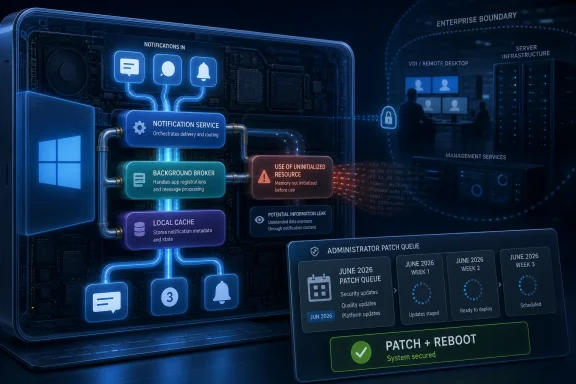
CVE-2026-42969 lands in Windows Push Notifications, the machinery that allows Windows and apps to receive toast alerts, badges, raw notification events, and other asynchronous updates without each application maintaining its own always-on connection. Microsoft’s public classification puts the vulnerability in the information disclosure bucket, not remote code execution, privilege escalation, or security feature bypass. That distinction is important: this is not a wormable server bug, and there is no public evidence that it is being used as an initial access weapon.
But “medium” is not the same as “irrelevant.” Information disclosure vulnerabilities often look harmless in isolation because they do not hand an attacker code execution by themselves. Their value appears in chains: a leaked pointer that weakens memory protections, a token-like artifact that helps map a user session, stale heap data that reveals system state, or application-specific context that helps make a later exploit more reliable.
The reported technical root is a use of an uninitialized resource. In plain English, that means software may be reading from or exposing something before it has been properly set to a safe value. Depending on where that happens, the result can range from a crash to unintended data exposure. In Windows internals, the uncomfortable part is not always the bug class itself; it is what happened to be sitting in memory, state, or a service boundary when the bug was triggered.
The vulnerability also requires a local, authorized attacker. That narrows the threat model significantly. It means defenders should not treat CVE-2026-42969 like an internet-facing emergency, but they also should not ignore it on multi-user systems, shared workstations, VDI pools, jump boxes, developer machines, kiosks, or compromised endpoints where a foothold already exists.
The Windows Notification Service model is straightforward at a high level. An app asks Windows for a notification channel, Windows obtains a channel URI, the app sends that URI to its own cloud service, and that service later posts notification payloads through Microsoft’s infrastructure for delivery to the device. The user sees a badge, toast, or background-triggered behavior, but underneath is a chain involving the app, Windows, Microsoft’s cloud service, identity, transport security, local databases, and per-user services.
That layered design is useful precisely because it centralizes what would otherwise be a mess of bespoke polling loops. It is also why vulnerabilities in this area deserve attention. A flaw in notification handling is not automatically catastrophic, but it sits near activity that can reflect user presence, application state, messaging activity, account context, and device-management behavior.
Administrators already know this indirectly. When WNS connectivity breaks, Outlook notifications fail, Teams alerts go missing, browser push becomes unreliable, and management workflows can become strangely delayed. The annoyance users report as “notifications are broken” is often the surface symptom of a deeper dependency on services such as WpnService and per-user notification components.
CVE-2026-42969 should be understood against that background. This is not a vulnerability in a novelty feature. It is a bug in one of the quiet subsystems that makes modern Windows feel connected, responsive, and cloud-aware.
The vulnerability is credible because Microsoft assigned and published the CVE, tied it to Windows Push Notifications, and shipped fixes through the normal security update channel. That vendor acknowledgement gives defenders enough confidence to act. At the same time, the public detail level remains limited, which means outside analysts should avoid pretending they know exactly what data can be disclosed in every scenario.
That is the uncomfortable middle ground of Patch Tuesday work. Security teams are asked to prioritize before exploit write-ups, proof-of-concept code, and telemetry-rich attack reports exist. Waiting for those things can produce better analysis, but it can also mean waiting until attackers have had the same time to reverse patches, diff binaries, and work backward from Microsoft’s fix.
For CVE-2026-42969, the known shape suggests a lower-urgency item than a critical RCE or an actively exploited zero-day. It requires local access, it is an information disclosure issue, and its CVSS score is in the medium range. But it is still a Windows platform vulnerability with broad product coverage, which means it belongs in the monthly cumulative update process rather than in a “maybe someday” backlog.
The right operational posture is sober: patch it as part of June’s Windows security cycle, watch for regressions in notification-heavy environments, and do not sell it internally as a crisis unless new exploitation evidence appears.
Information disclosure is especially useful in that messy middle stage. An attacker who lands as a low-privilege user may be looking for memory layout clues, account identifiers, service behavior, notification database artifacts, or application context that helps with lateral movement or privilege escalation. A single medium-severity disclosure may not be decisive, but it can remove uncertainty from the next step.
That is why mature patch programs do not only chase remote code execution. They also close off the less dramatic vulnerabilities that make exploitation more reliable. The history of Windows attack chains is full of bugs that looked unglamorous alone but mattered greatly when paired with a sandbox escape, kernel bug, browser flaw, or credential theft technique.
The local requirement also has a different meaning in enterprise settings than it does on a single home PC. In VDI farms, lab machines, call-center desktops, school devices, and shared administrative workstations, “local” can describe a crowded risk surface. Multiple users, reused images, endpoint agents, background sync clients, and privileged tools all raise the stakes for data that crosses boundaries poorly.
For home users, the calculus is simpler. Install the cumulative update when offered, especially if the machine runs messaging apps, work accounts, or browsers that rely heavily on notification infrastructure. The bug is not a reason to disable Windows notifications wholesale, and doing so may break more than it protects.
The version spread also reflects the realities of cumulative servicing. A single component defect may need to be fixed across long-supported client and server branches, each with its own build line. Windows 10 22H2, Windows 11 23H2 and 24H2, newer Windows 11 releases, and server releases all carry different build numbers, but administrators ultimately care about whether the June 2026 cumulative security update for their branch is installed.
Server exposure deserves a nuanced reading. Many Windows Server deployments do not use consumer-style notifications in the way laptops and desktops do, and Server Core installations reduce a great deal of graphical shell surface. But affected server listings still matter because the underlying components can exist in supported images, management stacks, or feature configurations even when the user-facing experience is minimal.
For administrators, the practical inventory question is not “do my users click toast notifications?” It is “which supported Windows builds in my fleet have received the June security baseline?” The answer should come from patch compliance tooling, not from assumptions about whether a device appears to use WNS.
The same applies to golden images and offline media. If an organization maintains Windows images for deployment, repair, kiosk reset, lab provisioning, or VDI refresh, those images should be updated or rebuilt after the June patch cycle. Otherwise, the vulnerability returns each time a supposedly clean machine is reimaged from stale media.
For defenders, that sparseness creates real friction. It is hard to write a detection analytic for “use of uninitialized resource in Windows Push Notifications” without knowing the trigger path, exposed data type, process boundary, or expected artifacts. It is hard to brief executives when the honest explanation is that the bug is probably not urgent in isolation but still should be remediated promptly because it touches a broad Windows subsystem.
For attackers, the same sparseness is merely a speed bump. Patch diffing remains a fact of life. When a cumulative update modifies relevant binaries, skilled researchers and adversaries can compare old and new versions, inspect changed code paths, and infer what Microsoft fixed. That is one reason medium-severity Windows bugs can become more interesting after Patch Tuesday than they were before it.
This is where exploit maturity metrics can mislead non-specialists. “No known exploit” does not mean “no one can build one.” It means public or vendor-known exploitation has not reached the threshold being reported. The gap between those statements is where reverse engineers, vulnerability brokers, offensive teams, and defensive researchers all operate.
Still, Microsoft’s restraint is defensible. Publishing a step-by-step technical breakdown on release day would help some defenders, but it would also compress the attacker learning curve. The burden shifts to enterprises to patch on cadence rather than wait for perfect specificity.
That does not mean CVE-2026-42969 exposes those exact details. The public record does not support that level of precision. But it does explain why information disclosure in a notification component is inherently more interesting than the severity label alone suggests.
Modern privacy failures frequently come from metadata rather than content. Knowing that a user received a notification from a particular app at a particular time can be sensitive in legal, medical, journalistic, political, or corporate contexts. Knowing which apps have active channels, which services are registered, or what state the notification platform is tracking could matter even if the actual message body remains protected.
Windows also stores notification-related state locally. Administrators and forensic analysts have long known that Windows notification databases and related artifacts can reveal useful timelines about application behavior. Again, CVE-2026-42969 should not be overclaimed as a forensic leak without more detail, but the general context matters: notification systems accumulate traces of user and app activity because that is what they are designed to coordinate.
This is why privacy-minded users sometimes underestimate the security value of boring cumulative updates. The exploit that steals a password is obvious. The bug that leaks just enough environmental detail to make a later attack cleaner is easier to dismiss, and that is precisely why disciplined patching matters.
But the patch queue is where risk compounds. Organizations rarely fail because they skipped one medium CVE on one laptop. They fail because fleets drift, exceptions become permanent, reboot debt grows, pilot rings stall, and “non-urgent” vulnerabilities accumulate into a landscape where attackers have options.
The operational advice is therefore conventional but not trivial. Push the June cumulative updates through rings, validate business-critical applications, check for notification regressions, and close the deployment loop. Do not create a separate emergency change window solely for CVE-2026-42969 unless your environment has a specific exposure pattern that makes local information disclosure unusually sensitive.
There are such environments. Shared clinical workstations, legal offices, trading floors, managed service provider jump systems, developer workstations with secrets-heavy tooling, and high-security VDI deployments all have reasons to treat local disclosure more seriously. In those contexts, a vulnerability in a component that may touch user activity and app state deserves faster movement.
There is also a monitoring angle, though it should be modest. Security teams can watch for unusual crashes or behavior around Windows notification services, but without detailed exploit indicators, detection will be blunt. Patch verification is the stronger control.
Push notification design is full of security tradeoffs. Developers choose what payloads to send, what metadata to encode, how long channel identifiers are retained, how backend services authenticate, and whether sensitive content appears in previews. The platform can provide transport and delivery guarantees, but it cannot make every application’s notification strategy private by default.
The safest design treats notifications as potentially exposed metadata. Send the minimum useful information. Avoid secrets in payloads. Be careful with message previews. Rotate or expire server-side channel state when appropriate. Assume local databases, logs, crash dumps, and background-service interactions may someday become part of an investigation or vulnerability chain.
That principle matters even when the specific CVE is patched. Platform bugs come and go, but notification ecosystems remain attractive because they connect identity, presence, cloud services, and user attention. A developer who sends too much detail in a push payload is betting not only on their own code but on every layer between the backend and the user’s screen.
Windows developers using modern app notification APIs should also test failure modes. What happens when WNS is blocked by a firewall? What happens when the notification service restarts? What happens when the user disables notifications, the device is offline, or the local notification database is corrupted? Reliability testing and privacy testing are closer cousins than many teams admit.
Users do not need to disable notifications because of this advisory. That is the wrong lesson. Turning off WNS-related services can break application behavior, cause settings oddities, interfere with badges and alerts, and create troubleshooting problems that are worse than the marginal risk reduction for most people.
A better consumer habit is to treat Patch Tuesday as maintenance, not drama. Let the first wave shake out catastrophic update regressions if you are risk-averse, but do not sit unpatched for weeks because the vulnerability name sounds obscure. Obscure components are still components attackers can study.
There is also no need to chase registry hacks or service-deletion advice from old forum threads. Windows notification services are entangled with the shell and app platform. Removing or disabling them at a low level may create unpredictable behavior and may not meaningfully mitigate a vulnerability that is already addressed by Microsoft’s supported update mechanism.
The most useful home-user posture is simple: stay on a supported Windows release, apply cumulative updates, keep browsers and messaging apps current, and avoid running untrusted local software. CVE-2026-42969 requires an authorized local attacker, so the old advice about not executing unknown downloads still matters.
That makes risk communication harder. A medium information disclosure in Windows Push Notifications will never be as easy to explain as a critical RDP bug or a browser zero-day. Yet defenders have to build programs that handle both the obvious fires and the slow erosion caused by unpatched platform flaws.
The most disciplined organizations will not overreact to this CVE, but they will not forget it either. They will use it as another reason to keep cumulative update rings healthy, to monitor patch exceptions aggressively, and to avoid pretending that local vulnerabilities are irrelevant after endpoint compromise. They will also recognize that privacy and security are converging in the notification layer, because the data that helps apps feel immediate is often the same data attackers would like to observe.
 A Medium-Severity Bug in a High-Traffic Part of Windows
CVE-2026-42969 lands in Windows Push Notifications, the machinery that allows Windows and apps to receive toast alerts, badges, raw notification events, and other asynchronous updates without each application maintaining its own always-on connection. Microsoft’s public classification puts the vulnerability in the information disclosure bucket, not remote code execution, privilege escalation, or security feature bypass. That distinction is important: this is not a wormable server bug, and there is no public evidence that it is being used as an initial access weapon.But “medium” is not the same as “irrelevant.” Information disclosure vulnerabilities often look harmless in isolation because they do not hand an attacker code execution by themselves. Their value appears in chains: a leaked pointer that weakens memory protections, a token-like artifact that helps map a user session, stale heap data that reveals system state, or application-specific context that helps make a later exploit more reliable.
The reported technical root is a use of an uninitialized resource. In plain English, that means software may be reading from or exposing something before it has been properly set to a safe value. Depending on where that happens, the result can range from a crash to unintended data exposure. In Windows internals, the uncomfortable part is not always the bug class itself; it is what happened to be sitting in memory, state, or a service boundary when the bug was triggered.
The vulnerability also requires a local, authorized attacker. That narrows the threat model significantly. It means defenders should not treat CVE-2026-42969 like an internet-facing emergency, but they also should not ignore it on multi-user systems, shared workstations, VDI pools, jump boxes, developer machines, kiosks, or compromised endpoints where a foothold already exists.
Push Notifications Became Operating-System Infrastructure
It is tempting to think of Windows Push Notifications as little more than toast pop-ups in the corner of the screen. That was never quite true, and it is less true with every Windows release. Notifications are now part user experience, part application activation model, part cloud rendezvous mechanism, and part enterprise dependency that admins often discover only when it breaks.The Windows Notification Service model is straightforward at a high level. An app asks Windows for a notification channel, Windows obtains a channel URI, the app sends that URI to its own cloud service, and that service later posts notification payloads through Microsoft’s infrastructure for delivery to the device. The user sees a badge, toast, or background-triggered behavior, but underneath is a chain involving the app, Windows, Microsoft’s cloud service, identity, transport security, local databases, and per-user services.
That layered design is useful precisely because it centralizes what would otherwise be a mess of bespoke polling loops. It is also why vulnerabilities in this area deserve attention. A flaw in notification handling is not automatically catastrophic, but it sits near activity that can reflect user presence, application state, messaging activity, account context, and device-management behavior.
Administrators already know this indirectly. When WNS connectivity breaks, Outlook notifications fail, Teams alerts go missing, browser push becomes unreliable, and management workflows can become strangely delayed. The annoyance users report as “notifications are broken” is often the surface symptom of a deeper dependency on services such as WpnService and per-user notification components.
CVE-2026-42969 should be understood against that background. This is not a vulnerability in a novelty feature. It is a bug in one of the quiet subsystems that makes modern Windows feel connected, responsive, and cloud-aware.
The Exploitability Signal Is Deliberately Boring
The user-facing confusion around this CVE comes from the security scoring language. Microsoft’s vulnerability pages include metrics that try to describe confidence, exploit maturity, and exploitability expectations, and those categories often get flattened into a single emotional verdict: panic or ignore. CVE-2026-42969 belongs in neither bucket.The vulnerability is credible because Microsoft assigned and published the CVE, tied it to Windows Push Notifications, and shipped fixes through the normal security update channel. That vendor acknowledgement gives defenders enough confidence to act. At the same time, the public detail level remains limited, which means outside analysts should avoid pretending they know exactly what data can be disclosed in every scenario.
That is the uncomfortable middle ground of Patch Tuesday work. Security teams are asked to prioritize before exploit write-ups, proof-of-concept code, and telemetry-rich attack reports exist. Waiting for those things can produce better analysis, but it can also mean waiting until attackers have had the same time to reverse patches, diff binaries, and work backward from Microsoft’s fix.
For CVE-2026-42969, the known shape suggests a lower-urgency item than a critical RCE or an actively exploited zero-day. It requires local access, it is an information disclosure issue, and its CVSS score is in the medium range. But it is still a Windows platform vulnerability with broad product coverage, which means it belongs in the monthly cumulative update process rather than in a “maybe someday” backlog.
The right operational posture is sober: patch it as part of June’s Windows security cycle, watch for regressions in notification-heavy environments, and do not sell it internally as a crisis unless new exploitation evidence appears.
Local Bugs Still Matter After the First Compromise
The phrase “authorized attacker” has a way of lulling organizations into complacency. If an attacker already has an account, the thinking goes, surely the important failure has already happened. That is a dangerous assumption in Windows environments, where the distance between “some access” and “useful access” is often negotiated through local bugs, leaked state, cached credentials, weak boundaries, and chained vulnerabilities.Information disclosure is especially useful in that messy middle stage. An attacker who lands as a low-privilege user may be looking for memory layout clues, account identifiers, service behavior, notification database artifacts, or application context that helps with lateral movement or privilege escalation. A single medium-severity disclosure may not be decisive, but it can remove uncertainty from the next step.
That is why mature patch programs do not only chase remote code execution. They also close off the less dramatic vulnerabilities that make exploitation more reliable. The history of Windows attack chains is full of bugs that looked unglamorous alone but mattered greatly when paired with a sandbox escape, kernel bug, browser flaw, or credential theft technique.
The local requirement also has a different meaning in enterprise settings than it does on a single home PC. In VDI farms, lab machines, call-center desktops, school devices, and shared administrative workstations, “local” can describe a crowded risk surface. Multiple users, reused images, endpoint agents, background sync clients, and privileged tools all raise the stakes for data that crosses boundaries poorly.
For home users, the calculus is simpler. Install the cumulative update when offered, especially if the machine runs messaging apps, work accounts, or browsers that rely heavily on notification infrastructure. The bug is not a reason to disable Windows notifications wholesale, and doing so may break more than it protects.
The Affected Footprint Is Broad Because the Component Is Shared
The affected product list is wide: Windows 10, Windows 11, Windows Server 2016, Windows Server 2019, Windows Server 2022, and Windows Server 2025 all appear in public vulnerability trackers for CVE-2026-42969. That breadth is not surprising. Notification plumbing is a shared Windows subsystem, not a boutique feature limited to one SKU.The version spread also reflects the realities of cumulative servicing. A single component defect may need to be fixed across long-supported client and server branches, each with its own build line. Windows 10 22H2, Windows 11 23H2 and 24H2, newer Windows 11 releases, and server releases all carry different build numbers, but administrators ultimately care about whether the June 2026 cumulative security update for their branch is installed.
Server exposure deserves a nuanced reading. Many Windows Server deployments do not use consumer-style notifications in the way laptops and desktops do, and Server Core installations reduce a great deal of graphical shell surface. But affected server listings still matter because the underlying components can exist in supported images, management stacks, or feature configurations even when the user-facing experience is minimal.
For administrators, the practical inventory question is not “do my users click toast notifications?” It is “which supported Windows builds in my fleet have received the June security baseline?” The answer should come from patch compliance tooling, not from assumptions about whether a device appears to use WNS.
The same applies to golden images and offline media. If an organization maintains Windows images for deployment, repair, kiosk reset, lab provisioning, or VDI refresh, those images should be updated or rebuilt after the June patch cycle. Otherwise, the vulnerability returns each time a supposedly clean machine is reimaged from stale media.
Microsoft’s Sparse Disclosure Is Both Necessary and Frustrating
Microsoft’s vulnerability disclosures have become a balancing act between giving defenders enough information to prioritize and avoiding a free exploit-development guide. CVE-2026-42969 shows both sides of that tradeoff. The public advisory identifies the product area, impact category, severity, exploitability shape, and affected platforms, but it does not provide a rich narrative of exactly what can be leaked or how.For defenders, that sparseness creates real friction. It is hard to write a detection analytic for “use of uninitialized resource in Windows Push Notifications” without knowing the trigger path, exposed data type, process boundary, or expected artifacts. It is hard to brief executives when the honest explanation is that the bug is probably not urgent in isolation but still should be remediated promptly because it touches a broad Windows subsystem.
For attackers, the same sparseness is merely a speed bump. Patch diffing remains a fact of life. When a cumulative update modifies relevant binaries, skilled researchers and adversaries can compare old and new versions, inspect changed code paths, and infer what Microsoft fixed. That is one reason medium-severity Windows bugs can become more interesting after Patch Tuesday than they were before it.
This is where exploit maturity metrics can mislead non-specialists. “No known exploit” does not mean “no one can build one.” It means public or vendor-known exploitation has not reached the threshold being reported. The gap between those statements is where reverse engineers, vulnerability brokers, offensive teams, and defensive researchers all operate.
Still, Microsoft’s restraint is defensible. Publishing a step-by-step technical breakdown on release day would help some defenders, but it would also compress the attacker learning curve. The burden shifts to enterprises to patch on cadence rather than wait for perfect specificity.
The Notification Stack Is a Privacy Boundary, Not Just a UX Layer
Notifications often carry more meaning than their payload. A toast about a meeting reveals calendar activity. A messaging badge reveals communication timing. A browser push alert can reveal which web applications a user has active. A raw notification may never appear on screen but still wake or steer an application in ways that reflect backend state.That does not mean CVE-2026-42969 exposes those exact details. The public record does not support that level of precision. But it does explain why information disclosure in a notification component is inherently more interesting than the severity label alone suggests.
Modern privacy failures frequently come from metadata rather than content. Knowing that a user received a notification from a particular app at a particular time can be sensitive in legal, medical, journalistic, political, or corporate contexts. Knowing which apps have active channels, which services are registered, or what state the notification platform is tracking could matter even if the actual message body remains protected.
Windows also stores notification-related state locally. Administrators and forensic analysts have long known that Windows notification databases and related artifacts can reveal useful timelines about application behavior. Again, CVE-2026-42969 should not be overclaimed as a forensic leak without more detail, but the general context matters: notification systems accumulate traces of user and app activity because that is what they are designed to coordinate.
This is why privacy-minded users sometimes underestimate the security value of boring cumulative updates. The exploit that steals a password is obvious. The bug that leaks just enough environmental detail to make a later attack cleaner is easier to dismiss, and that is precisely why disciplined patching matters.
Enterprise Risk Lives in the Patch Queue
For IT departments, CVE-2026-42969 is unlikely to be the top June 2026 Patch Tuesday item. Reports around the June release point to a large patch load with critical vulnerabilities and zero-day concerns elsewhere in the Microsoft ecosystem. In that crowd, a medium Windows Push Notifications information disclosure will not win the triage meeting by itself.But the patch queue is where risk compounds. Organizations rarely fail because they skipped one medium CVE on one laptop. They fail because fleets drift, exceptions become permanent, reboot debt grows, pilot rings stall, and “non-urgent” vulnerabilities accumulate into a landscape where attackers have options.
The operational advice is therefore conventional but not trivial. Push the June cumulative updates through rings, validate business-critical applications, check for notification regressions, and close the deployment loop. Do not create a separate emergency change window solely for CVE-2026-42969 unless your environment has a specific exposure pattern that makes local information disclosure unusually sensitive.
There are such environments. Shared clinical workstations, legal offices, trading floors, managed service provider jump systems, developer workstations with secrets-heavy tooling, and high-security VDI deployments all have reasons to treat local disclosure more seriously. In those contexts, a vulnerability in a component that may touch user activity and app state deserves faster movement.
There is also a monitoring angle, though it should be modest. Security teams can watch for unusual crashes or behavior around Windows notification services, but without detailed exploit indicators, detection will be blunt. Patch verification is the stronger control.
Developers Should Hear the Warning Behind the Windows Bug
Application developers may be tempted to view CVE-2026-42969 as Microsoft’s problem. In the strictest sense, it is: the vulnerability is in Windows Push Notifications, and Microsoft owns the platform fix. But the broader lesson lands squarely on app teams that use notification services as if they were neutral pipes.Push notification design is full of security tradeoffs. Developers choose what payloads to send, what metadata to encode, how long channel identifiers are retained, how backend services authenticate, and whether sensitive content appears in previews. The platform can provide transport and delivery guarantees, but it cannot make every application’s notification strategy private by default.
The safest design treats notifications as potentially exposed metadata. Send the minimum useful information. Avoid secrets in payloads. Be careful with message previews. Rotate or expire server-side channel state when appropriate. Assume local databases, logs, crash dumps, and background-service interactions may someday become part of an investigation or vulnerability chain.
That principle matters even when the specific CVE is patched. Platform bugs come and go, but notification ecosystems remain attractive because they connect identity, presence, cloud services, and user attention. A developer who sends too much detail in a push payload is betting not only on their own code but on every layer between the backend and the user’s screen.
Windows developers using modern app notification APIs should also test failure modes. What happens when WNS is blocked by a firewall? What happens when the notification service restarts? What happens when the user disables notifications, the device is offline, or the local notification database is corrupted? Reliability testing and privacy testing are closer cousins than many teams admit.
The Consumer Fix Is Simple, but the Habit Is the Point
For individual Windows users, the practical response is refreshingly boring: install the June 2026 security update for your supported Windows version. If Windows Update is working normally, the fix should arrive through the usual cumulative update path. If you manage your own machine manually, check the update history after installation and make sure the device actually rebooted into the patched build.Users do not need to disable notifications because of this advisory. That is the wrong lesson. Turning off WNS-related services can break application behavior, cause settings oddities, interfere with badges and alerts, and create troubleshooting problems that are worse than the marginal risk reduction for most people.
A better consumer habit is to treat Patch Tuesday as maintenance, not drama. Let the first wave shake out catastrophic update regressions if you are risk-averse, but do not sit unpatched for weeks because the vulnerability name sounds obscure. Obscure components are still components attackers can study.
There is also no need to chase registry hacks or service-deletion advice from old forum threads. Windows notification services are entangled with the shell and app platform. Removing or disabling them at a low level may create unpredictable behavior and may not meaningfully mitigate a vulnerability that is already addressed by Microsoft’s supported update mechanism.
The most useful home-user posture is simple: stay on a supported Windows release, apply cumulative updates, keep browsers and messaging apps current, and avoid running untrusted local software. CVE-2026-42969 requires an authorized local attacker, so the old advice about not executing unknown downloads still matters.
The Patch Is the Message Microsoft Did Not Spell Out
CVE-2026-42969 is a small window into a larger Windows reality: the operating system’s attack surface is increasingly made of brokers, background services, cloud-connected channels, local caches, identity handoffs, and user-experience plumbing. The old mental model of “dangerous network daemon versus harmless desktop feature” no longer works very well. Desktop features are often networked; networked features are often local; local services often mediate cloud state.That makes risk communication harder. A medium information disclosure in Windows Push Notifications will never be as easy to explain as a critical RDP bug or a browser zero-day. Yet defenders have to build programs that handle both the obvious fires and the slow erosion caused by unpatched platform flaws.
The most disciplined organizations will not overreact to this CVE, but they will not forget it either. They will use it as another reason to keep cumulative update rings healthy, to monitor patch exceptions aggressively, and to avoid pretending that local vulnerabilities are irrelevant after endpoint compromise. They will also recognize that privacy and security are converging in the notification layer, because the data that helps apps feel immediate is often the same data attackers would like to observe.
The Practical Read for WindowsForum Readers
The useful read on CVE-2026-42969 is neither alarmist nor dismissive. It is a medium-severity, local information disclosure vulnerability in a shared Windows component that should be patched through the June 2026 security updates and watched mainly for fleet-compliance and regression issues.- CVE-2026-42969 affects Windows Push Notifications and is categorized as an information disclosure vulnerability rather than remote code execution.
- The known attack model requires an authorized local attacker, which lowers internet-scale urgency but still matters on shared, managed, or already-compromised systems.
- The vulnerability is associated with use of an uninitialized resource, a bug class that can expose unintended state depending on the affected code path.
- Supported Windows 10, Windows 11, and Windows Server branches are in scope, so administrators should validate June 2026 cumulative update deployment across client and server fleets.
- Disabling Windows notification services is not a sensible general mitigation, because it can break legitimate shell, app, and enterprise behaviors.
- The strongest response is normal patch discipline: deploy, verify, reboot, update images, and keep exceptions from becoming permanent.
References
- Primary source: MSRC
Published: 2026-06-09T07:00:00-07:00
Security Update Guide - Microsoft Security Response Center
 msrc.microsoft.com
- Related coverage: rapid7.com
Rapid7 Vulnerability Database
Rapid7's VulnDB is curated repository of vetted computer software exploits and exploitable vulnerabilities.www.rapid7.com - Related coverage: sentinelone.com
CVE-2026-26172: Windows Push Notifications Privilege Escalation
CVE-2026-26172 is a privilege escalation vulnerability in Windows Push Notifications. Learn about its impact, affected versions, and mitigation methods.www.sentinelone.com
- Related coverage: securityvulnerability.io
CVE-2025-59209 : Information Disclosure Vulnerability in Windows Push Notification by Microsoft
Discover the information disclosure vulnerability in Microsoft Windows Push Notification affecting multiple versions.securityvulnerability.io - Related coverage: assets.kpmg.com
16 september 2022 microsoft september 2022 patch tuesday fixes 64 flaws.pdf.coredownload.inline
PDF documentassets.kpmg.com
- Related coverage: cert.gov.vu
Advisory 117 CVE 2026 20805 Microsoft Windows Information Disclosure Vulnerability
PDF documentcert.gov.vu
- Official source: learn.microsoft.com
Windows Push Notification Services (WNS) overview - Windows apps | Microsoft Learn
The Windows Push Notification Services (WNS) enables third-party developers to send toast, tile, badge, and raw updates from their own cloud service. This provides a mechanism to deliver new updates to your users in a power-efficient and dependable way.learn.microsoft.com - Related coverage: help.sap.com
SAP Help Portal | SAP Online Help
help.sap.com
- Official source: support.microsoft.com
Firewall and network protection in the Windows Security app | Microsoft Support
Learn how to turn the Windows Firewall on or off using the Windows Security app.support.microsoft.com - Official source: microsoft.com
Download Windows Notification Service (WNS) VIP and IP Ranges from Official Microsoft Download Center
This file contains the VIP's and IP address ranges used by the Windows Notificaton Service.www.microsoft.com
- Official source: blogs.windows.com
Understanding How Microsoft Push Notification Works – Part 2
In the previous post – Understanding Microsoft Push Notifications for Windows Phones, you learned what push notifications (PN) are and why we need them. In this post, we’ll explain a little about how Microsoft Push Notification (MPN) service works behind the scenes and who the...blogs.windows.com - Official source: download.microsoft.com
Connectivity and firewall port requirements for Microsoft Dynamics CRM 2013
PDF documentdownload.microsoft.com
- Related coverage: blog.qualys.com
Microsoft and Adobe Patch Tuesday, June 2026 Security Update Review | Qualys
Every Patch Tuesday presents a race between defenders applying fixes and attackers seeking opportunities. Microsoft’s June 2026 release is no exception…blog.qualys.com - Related coverage: absolute.com
Patch Tuesday June 2026: 211 Fixes, Critical CVEs | Absolute Security Blog
Microsoft Patch Tuesday June 2026 delivers 211 fixes and 37 critical vulnerabilities. Learn key risks, CVEs, and how to prioritize enterprise patching.www.absolute.com - Related coverage: ap7i.com
ap7i.com | Microsoft's June 2026 Patch Tuesday: A Record 200 Flaws, 3 Zero-Days
The largest Patch Tuesday ever shipped: roughly 200 vulnerabilities, 33 Critical, three publicly disclosed zero-days, and a CVSS 9.8 in Nuance PowerScribe that radiology shops should not sit on. The Secure Boot certificate deadline is 17 days out — this is the last Patch Tuesday before it.ap7i.com - Related coverage: bleepingcomputer.com
Microsoft June 2026 Patch Tuesday fixes 6 zero-days, 200 flaws
Today is Microsoft's June 2026 Patch Tuesday, with security updates for 200 flaws, including five publicly disclosed zero-day vulnerabilities and one actively exploited in attacks.www.bleepingcomputer.com - Related coverage: aha.org
- Related coverage: sra.io
