

Microsoft disclosed CVE-2026-42970 on June 9, 2026, as a Windows Push Notification information disclosure vulnerability affecting supported Windows client and server releases, with the flaw described as local, authenticated, medium-severity, and rooted in the use of an uninitialized resource. The bug is not the sort of network-wormable emergency that earns late-night incident calls by itself. But it lands in a part of Windows that sits quietly between cloud services, local apps, user attention, and device state. That makes it a useful reminder that modern Windows security is increasingly about the plumbing nobody sees until it leaks.
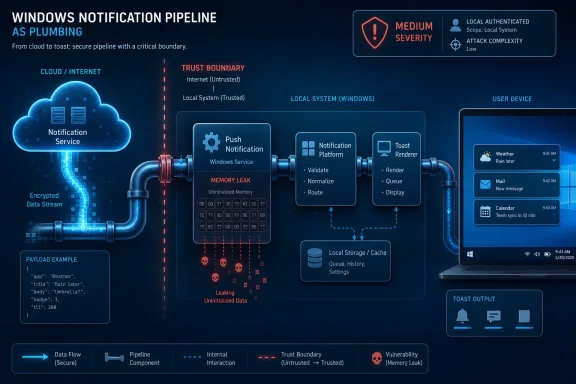
Windows Push Notifications are easy to dismiss as consumer-facing fluff: toast pop-ups, badge counts, calendar pings, chat alerts, and the background signals that keep apps from constantly polling their cloud services. In practice, the Windows notification stack is one of the operating system’s many trust brokers. It accepts cloud-originated events, routes them through platform services, wakes apps, updates user-visible state, and sometimes handles app-defined payloads that are not meant to be displayed at all.
CVE-2026-42970, as published by Microsoft’s Security Update Guide, is an information disclosure vulnerability in that machinery. The public description says an authenticated attacker could disclose information locally because Windows Push Notifications use an uninitialized resource. That is a terse sentence, but it contains the whole risk model: this is not about breaking in from the Internet; it is about what a user or process already on the machine might be able to learn from memory or state it should not see.
That distinction matters. Information disclosure bugs rarely look dramatic when compared with remote code execution or privilege escalation, but they often become more useful when chained with other weaknesses. A leaked token, pointer, memory fragment, URI, credential-adjacent blob, or app-specific payload can turn a limited foothold into a better one. In security operations, “just an info leak” is often the phrase that ages worst.
Microsoft’s rating reflects that middle ground. A medium CVSS score is not a license to ignore the patch; it is a signal that administrators should place it in the normal Windows update pipeline rather than treating it as a standalone fire drill. The useful question is not whether CVE-2026-42970 is terrifying on its own. It is whether the Windows estate has become so dependent on background brokers like notification services that medium flaws now deserve more architectural attention than their score suggests.
“Local” no longer means an attacker is sitting at the keyboard. It can mean code running inside a user session, a malicious document that succeeded in crossing another boundary, a compromised app package, a browser escape, a low-privilege foothold obtained through phishing, or a post-exploitation step after an initial breach. Once malware is executing as a standard user, the difference between “local” and “remote” becomes less relevant than the quality of the data available inside the session.
Windows has spent the last decade moving more activity into brokered services, app containers, background tasks, cloud-connected identity components, and user-mode helpers. That is good engineering when the boundaries are strong. It also means attackers have more incentive to hunt for unintended cross-talk between components that were never designed to leak state to one another.
CVE-2026-42970 appears to sit in this category. Microsoft has not published a full technical root-cause analysis, exploit sample, or detailed data disclosure scenario. The known public detail is enough to identify the class of problem but not enough to tell defenders exactly what might be exposed on a vulnerable machine. That opacity is normal for Patch Tuesday, but it is also why administrators should resist overfitting their response to the short advisory text.
The phrase “use of uninitialized resource” usually points toward a programming error in which software consumes memory, state, or an object before it has been properly set to a known safe value. Depending on context, that can expose leftover data from previous operations or produce behavior that reveals implementation details. In an operating system component that brokers notifications, even small leaks can matter because the component lives near app identity, channel state, and user-session boundaries.
That last category is where the platform becomes more interesting. Raw notifications are not necessarily user-facing. They can wake an app, signal a state change, trigger synchronization, or deliver app-defined data. From a security perspective, they are not just visual interruptions; they are control messages in a distributed system.
Microsoft’s own developer guidance has long warned that notification payloads should not contain confidential, sensitive, or personal data. That warning exists because notification systems are delivery mechanisms, not vaults. They traverse cloud services, platform brokers, client APIs, background execution rules, and app code. A developer who treats a push payload like a private message bus is already building on a shaky assumption.
CVE-2026-42970 does not prove that notification payloads themselves are exposed, and Microsoft’s public note does not say that. But the vulnerability does remind us why the guidance exists. The more sensitive a notification channel becomes, the more valuable any memory disclosure, stale state leak, or improper boundary handling becomes to an attacker who has already landed locally.
For Windows enthusiasts, this is also a useful corrective to the way the notification subsystem is often discussed. The annoyance of a persistent Teams toast or a news badge is the visible surface. Beneath it is a power-management and app-lifecycle mechanism that decides when software wakes, what background work is allowed, and how cloud-originated events reach a user session. Security bugs in that layer deserve more respect than the word “notification” tends to receive.
June 2026 was not a quiet month for Microsoft security updates. Reporting from security vendors and technology publications described an unusually large Patch Tuesday release, with counts varying depending on how individual vendors group Microsoft CVEs, republished advisories, and product families. In that environment, a medium Windows Push Notifications disclosure bug is easy to miss beside critical remote code execution flaws, Exchange issues, kernel bugs, and vulnerabilities with known exploitation.
That triage instinct is defensible. A security team with limited maintenance windows should always prioritize actively exploited flaws, unauthenticated network bugs, domain-wide privilege escalations, and exposed server workloads. But that does not make medium-severity local disclosure vulnerabilities irrelevant. It means they belong in the broader patch-quality and exposure-management conversation.
Attackers do not rank vulnerabilities the way dashboards do. They care about whether a bug helps complete a chain. A local information disclosure can help defeat address-space layout randomization, reveal object layouts, expose handles or tokens, identify installed apps, leak fragments of previous messages, or give malware better environmental awareness. Sometimes the vulnerability that makes the intrusion possible is not the one that gets the headline.
This is why Windows administrators should avoid a purely severity-driven patch culture. CVSS is useful as a first-pass sorting mechanism, not as an oracle. A medium vulnerability in a widely deployed Windows component can be more operationally relevant than a critical bug in a product you do not run.
In this case, the strongest fact is Microsoft’s own acknowledgement. CVE-2026-42970 exists in Microsoft’s Security Update Guide, carries a Microsoft product assignment, and is addressed through the Windows update channel. That gives defenders high confidence that the vulnerability is real, even if the public technical account is thin.
The weaker part is detail. Microsoft has not publicly described the exact attack path, the specific process or service boundary involved, the kind of data that may be disclosed, or whether exploitation requires a particular app state. That absence is not unusual, especially when publishing too much information could accelerate exploit development. But it leaves administrators with a familiar Patch Tuesday problem: act on certainty about existence while living with uncertainty about mechanics.
For would-be attackers, limited detail cuts both ways. A sparse advisory does not hand over a recipe. On the other hand, phrases like “uninitialized resource” and “Windows Push Notifications” narrow the search area for researchers and exploit developers who know how to diff patches, inspect binaries, and exercise local APIs. Once updates ship, the clock starts for anyone comparing old and new Windows components.
This is the uncomfortable bargain of coordinated disclosure at operating-system scale. Defenders need enough information to prioritize. Vendors want to avoid publishing exploit blueprints. Attackers can often extract more from the patch than from the prose. The result is a public advisory that looks bland but still changes the threat landscape.
The server angle is more nuanced. Many Windows Server deployments do not behave like consumer desktops and may have limited use for app notifications. But Windows Server still carries broad platform components, shared code, APIs, and services that can be present even when a feature is not central to the workload. Administrators should not assume that a desktop-sounding component is irrelevant to a server estate without checking actual applicability and installed updates.
For managed Windows clients, the patch path is straightforward in principle: install the June 2026 cumulative updates through Windows Update, Windows Update for Business, WSUS, Configuration Manager, Intune, Autopatch, or whatever patch orchestration system the organization uses. The harder part is sequencing around known update regressions, maintenance windows, VPN users, kiosk devices, and machines that only appear on the corporate network intermittently.
Home users have a simpler but less visible version of the same challenge. If Windows Update is enabled and the machine is supported, the fix should arrive as part of the monthly cumulative update. The risk is not that a typical user must hunt down CVE-2026-42970 manually. The risk is that paused updates, unsupported hardware workarounds, stale Windows 10 deployments, or broken update components leave machines missing a fix that was supposed to be routine.
This is where Microsoft’s cumulative update model helps and hurts. It helps because users do not need to understand every CVE in the month’s release. It hurts because a single problematic cumulative update can cause administrators to defer a large bundle of unrelated security fixes, including quiet medium-severity ones like this.
A chat app wants to display a sender and preview. A line-of-business app wants to wake up and sync a record. A monitoring tool wants to send a useful alert. A consumer service wants the notification to be rich enough to drive engagement. Each of those choices can be reasonable, but every extra field in a payload increases the damage if an endpoint, broker, log, memory buffer, or app boundary exposes more than intended.
The better pattern is to treat push notifications as signals, not containers. The payload should carry the minimum data needed to wake the app or inform the user, while sensitive details are fetched only after the app authenticates and authorizes the current user through the service. This is not as convenient as stuffing state into the push channel, but it is more resilient when the platform underneath has a bad month.
Windows App SDK and UWP developers should also pay attention to channel URI handling. The channel URI is an interface between the app and its cloud service, and Microsoft advises developers to validate that channels use the expected Windows notification domain while treating the URI itself as an opaque string. That guidance is not directly about CVE-2026-42970, but it reflects the same security theme: notification infrastructure is a boundary, and boundaries rot when applications make assumptions about what they contain.
For enterprise developers, there is a governance angle. If internal apps use Windows push notifications for workflow events, approvals, health alerts, or operational messages, teams should revisit what those payloads include. A platform information disclosure bug is easier to absorb when the application layer has already minimized what can be exposed.
CVE-2026-42970 is exactly the kind of vulnerability that gets lost in that flood. It is not known to be exploited in the wild at publication. It is not critical. It does not have an eye-catching remote attack vector. It sits in a familiar Windows component whose name sounds mundane. In a spreadsheet, it is easy to scroll past.
But a mature patch process cannot be built only around spectacle. The dull bugs are the ones that test whether an organization actually has disciplined update hygiene. If a Windows fleet is consistently patched within a predictable window, CVE-2026-42970 becomes just another fixed flaw. If the fleet depends on heroic manual triage every month, medium vulnerabilities accumulate into an attack surface nobody has time to reason about.
This is especially true for hybrid workstations and developer machines. They run chat clients, browsers, IDEs, package managers, VPN tools, cloud CLIs, password managers, and internal apps. They receive notifications from both consumer and enterprise services. They also often have elevated privileges, cached credentials, SSH keys, tokens, and access to production-adjacent environments. A local information disclosure on such a device may be more valuable than its generic CVSS score suggests.
The uncomfortable truth is that Windows patching has become less about deciding whether to patch and more about preserving the ability to patch continuously. Rings, telemetry, rollback plans, update compliance reporting, and user communication are now security controls. Without them, every large Patch Tuesday becomes an argument between operational fear and security debt.
The more useful administrator response is inventory-driven. Identify which Windows client and server versions are in scope, confirm they are still supported, and verify that update compliance tooling can report the relevant June builds. If servers are included in the affected product list, do not wave away the issue solely because the component sounds client-oriented.
Security teams should also watch for post-release intelligence. If proof-of-concept code appears, if Microsoft revises exploitability assessment, or if researchers publish a patch diff that clarifies the disclosed data, the prioritization may change. Patch Tuesday advisories are not static artifacts; they are the first public version of a story that can become more specific over time.
Help desks and endpoint teams should resist the temptation to troubleshoot notification weirdness by broadly loosening permissions, disabling security controls, or encouraging users to run apps elevated. Notification reliability issues are common enough without turning them into privilege problems. A vulnerability in the notification stack is a reminder to keep the platform patched, not a reason to normalize unsafe workarounds.
For organizations using Windows Autopatch, Intune, or Windows Update for Business, this is a good month to audit rings and deadlines. Medium vulnerabilities are where update governance proves itself. If only critical and exploited bugs move quickly, the estate remains permanently behind on the quieter flaws that attackers can later combine.
The practical read is straightforward:
Microsoft’s June 2026 patch cycle will be remembered, if at all, for its volume and its more severe vulnerabilities, not for a medium Windows Push Notification disclosure bug. Still, CVE-2026-42970 captures the shape of Windows security in 2026: sprawling, cloud-tethered, broker-heavy, and full of components whose importance is easy to underestimate until a CVE forces them into view. The organizations best positioned for the next one will be those that treat routine patching, payload minimization, and platform boundaries as the same security conversation rather than three separate chores.
 Microsoft’s Quiet Notification Bug Is Really About Trust Boundaries
Windows Push Notifications are easy to dismiss as consumer-facing fluff: toast pop-ups, badge counts, calendar pings, chat alerts, and the background signals that keep apps from constantly polling their cloud services. In practice, the Windows notification stack is one of the operating system’s many trust brokers. It accepts cloud-originated events, routes them through platform services, wakes apps, updates user-visible state, and sometimes handles app-defined payloads that are not meant to be displayed at all.CVE-2026-42970, as published by Microsoft’s Security Update Guide, is an information disclosure vulnerability in that machinery. The public description says an authenticated attacker could disclose information locally because Windows Push Notifications use an uninitialized resource. That is a terse sentence, but it contains the whole risk model: this is not about breaking in from the Internet; it is about what a user or process already on the machine might be able to learn from memory or state it should not see.
That distinction matters. Information disclosure bugs rarely look dramatic when compared with remote code execution or privilege escalation, but they often become more useful when chained with other weaknesses. A leaked token, pointer, memory fragment, URI, credential-adjacent blob, or app-specific payload can turn a limited foothold into a better one. In security operations, “just an info leak” is often the phrase that ages worst.
Microsoft’s rating reflects that middle ground. A medium CVSS score is not a license to ignore the patch; it is a signal that administrators should place it in the normal Windows update pipeline rather than treating it as a standalone fire drill. The useful question is not whether CVE-2026-42970 is terrifying on its own. It is whether the Windows estate has become so dependent on background brokers like notification services that medium flaws now deserve more architectural attention than their score suggests.
The Word “Local” Does Not Mean Harmless Anymore
Microsoft’s advisory language indicates that exploitation is local and requires authorization. For some readers, that will sound comforting. For administrators who have lived through modern intrusion chains, it should sound more like a scoping note than a dismissal.“Local” no longer means an attacker is sitting at the keyboard. It can mean code running inside a user session, a malicious document that succeeded in crossing another boundary, a compromised app package, a browser escape, a low-privilege foothold obtained through phishing, or a post-exploitation step after an initial breach. Once malware is executing as a standard user, the difference between “local” and “remote” becomes less relevant than the quality of the data available inside the session.
Windows has spent the last decade moving more activity into brokered services, app containers, background tasks, cloud-connected identity components, and user-mode helpers. That is good engineering when the boundaries are strong. It also means attackers have more incentive to hunt for unintended cross-talk between components that were never designed to leak state to one another.
CVE-2026-42970 appears to sit in this category. Microsoft has not published a full technical root-cause analysis, exploit sample, or detailed data disclosure scenario. The known public detail is enough to identify the class of problem but not enough to tell defenders exactly what might be exposed on a vulnerable machine. That opacity is normal for Patch Tuesday, but it is also why administrators should resist overfitting their response to the short advisory text.
The phrase “use of uninitialized resource” usually points toward a programming error in which software consumes memory, state, or an object before it has been properly set to a known safe value. Depending on context, that can expose leftover data from previous operations or produce behavior that reveals implementation details. In an operating system component that brokers notifications, even small leaks can matter because the component lives near app identity, channel state, and user-session boundaries.
Push Notifications Are Not Just Toasts
Windows Push Notification Services let apps receive cloud-originated updates without running constantly in the background. A Windows app requests a notification channel, receives a channel URI, shares that URI with its own cloud service, and that service later sends notification payloads through Microsoft’s infrastructure to reach the device. The same ecosystem supports visible notifications, badges, tiles, and raw notifications consumed by the app itself.That last category is where the platform becomes more interesting. Raw notifications are not necessarily user-facing. They can wake an app, signal a state change, trigger synchronization, or deliver app-defined data. From a security perspective, they are not just visual interruptions; they are control messages in a distributed system.
Microsoft’s own developer guidance has long warned that notification payloads should not contain confidential, sensitive, or personal data. That warning exists because notification systems are delivery mechanisms, not vaults. They traverse cloud services, platform brokers, client APIs, background execution rules, and app code. A developer who treats a push payload like a private message bus is already building on a shaky assumption.
CVE-2026-42970 does not prove that notification payloads themselves are exposed, and Microsoft’s public note does not say that. But the vulnerability does remind us why the guidance exists. The more sensitive a notification channel becomes, the more valuable any memory disclosure, stale state leak, or improper boundary handling becomes to an attacker who has already landed locally.
For Windows enthusiasts, this is also a useful corrective to the way the notification subsystem is often discussed. The annoyance of a persistent Teams toast or a news badge is the visible surface. Beneath it is a power-management and app-lifecycle mechanism that decides when software wakes, what background work is allowed, and how cloud-originated events reach a user session. Security bugs in that layer deserve more respect than the word “notification” tends to receive.
A Medium Score Can Hide a High-Value Chain
The published CVSS 3.1 base score for CVE-2026-42970 is 5.5, placing it in Microsoft’s medium band. That is reasonable if the flaw requires local authenticated access and primarily affects confidentiality. It is also exactly the kind of score that gets buried in a large Patch Tuesday spreadsheet.June 2026 was not a quiet month for Microsoft security updates. Reporting from security vendors and technology publications described an unusually large Patch Tuesday release, with counts varying depending on how individual vendors group Microsoft CVEs, republished advisories, and product families. In that environment, a medium Windows Push Notifications disclosure bug is easy to miss beside critical remote code execution flaws, Exchange issues, kernel bugs, and vulnerabilities with known exploitation.
That triage instinct is defensible. A security team with limited maintenance windows should always prioritize actively exploited flaws, unauthenticated network bugs, domain-wide privilege escalations, and exposed server workloads. But that does not make medium-severity local disclosure vulnerabilities irrelevant. It means they belong in the broader patch-quality and exposure-management conversation.
Attackers do not rank vulnerabilities the way dashboards do. They care about whether a bug helps complete a chain. A local information disclosure can help defeat address-space layout randomization, reveal object layouts, expose handles or tokens, identify installed apps, leak fragments of previous messages, or give malware better environmental awareness. Sometimes the vulnerability that makes the intrusion possible is not the one that gets the headline.
This is why Windows administrators should avoid a purely severity-driven patch culture. CVSS is useful as a first-pass sorting mechanism, not as an oracle. A medium vulnerability in a widely deployed Windows component can be more operationally relevant than a critical bug in a product you do not run.
The “Report Confidence” Metric Says the Bug Is Real, Not Fully Explained
The user-facing text attached to this vulnerability references a metric that measures confidence in the existence of a vulnerability and the credibility of the known technical details. That concept is important because modern vulnerability records often mix confirmed vendor facts, researcher analysis, inferred weakness classes, and third-party enrichment. Not every CVE arrives with the same level of proof or public explanation.In this case, the strongest fact is Microsoft’s own acknowledgement. CVE-2026-42970 exists in Microsoft’s Security Update Guide, carries a Microsoft product assignment, and is addressed through the Windows update channel. That gives defenders high confidence that the vulnerability is real, even if the public technical account is thin.
The weaker part is detail. Microsoft has not publicly described the exact attack path, the specific process or service boundary involved, the kind of data that may be disclosed, or whether exploitation requires a particular app state. That absence is not unusual, especially when publishing too much information could accelerate exploit development. But it leaves administrators with a familiar Patch Tuesday problem: act on certainty about existence while living with uncertainty about mechanics.
For would-be attackers, limited detail cuts both ways. A sparse advisory does not hand over a recipe. On the other hand, phrases like “uninitialized resource” and “Windows Push Notifications” narrow the search area for researchers and exploit developers who know how to diff patches, inspect binaries, and exercise local APIs. Once updates ship, the clock starts for anyone comparing old and new Windows components.
This is the uncomfortable bargain of coordinated disclosure at operating-system scale. Defenders need enough information to prioritize. Vendors want to avoid publishing exploit blueprints. Attackers can often extract more from the patch than from the prose. The result is a public advisory that looks bland but still changes the threat landscape.
The Affected Surface Is Broad Because Windows Is Broad
Third-party CVE trackers list the affected product families as spanning Windows 10, Windows 11, and multiple Windows Server generations, including Server 2016, Server 2019, Server 2022, and Server 2025. That breadth should surprise no one. Push notification infrastructure is part of the modern Windows platform, not a niche add-on used by a handful of Store apps.The server angle is more nuanced. Many Windows Server deployments do not behave like consumer desktops and may have limited use for app notifications. But Windows Server still carries broad platform components, shared code, APIs, and services that can be present even when a feature is not central to the workload. Administrators should not assume that a desktop-sounding component is irrelevant to a server estate without checking actual applicability and installed updates.
For managed Windows clients, the patch path is straightforward in principle: install the June 2026 cumulative updates through Windows Update, Windows Update for Business, WSUS, Configuration Manager, Intune, Autopatch, or whatever patch orchestration system the organization uses. The harder part is sequencing around known update regressions, maintenance windows, VPN users, kiosk devices, and machines that only appear on the corporate network intermittently.
Home users have a simpler but less visible version of the same challenge. If Windows Update is enabled and the machine is supported, the fix should arrive as part of the monthly cumulative update. The risk is not that a typical user must hunt down CVE-2026-42970 manually. The risk is that paused updates, unsupported hardware workarounds, stale Windows 10 deployments, or broken update components leave machines missing a fix that was supposed to be routine.
This is where Microsoft’s cumulative update model helps and hurts. It helps because users do not need to understand every CVE in the month’s release. It hurts because a single problematic cumulative update can cause administrators to defer a large bundle of unrelated security fixes, including quiet medium-severity ones like this.
Developers Should Treat Notification Payloads as Public Enough to Leak
The most practical lesson from CVE-2026-42970 may be for application developers rather than patch managers. Microsoft’s notification guidance is clear that apps should not put confidential, sensitive, or personal data in notification payloads. Yet real-world software often drifts toward convenience, and push messages are tempting places to stash context.A chat app wants to display a sender and preview. A line-of-business app wants to wake up and sync a record. A monitoring tool wants to send a useful alert. A consumer service wants the notification to be rich enough to drive engagement. Each of those choices can be reasonable, but every extra field in a payload increases the damage if an endpoint, broker, log, memory buffer, or app boundary exposes more than intended.
The better pattern is to treat push notifications as signals, not containers. The payload should carry the minimum data needed to wake the app or inform the user, while sensitive details are fetched only after the app authenticates and authorizes the current user through the service. This is not as convenient as stuffing state into the push channel, but it is more resilient when the platform underneath has a bad month.
Windows App SDK and UWP developers should also pay attention to channel URI handling. The channel URI is an interface between the app and its cloud service, and Microsoft advises developers to validate that channels use the expected Windows notification domain while treating the URI itself as an opaque string. That guidance is not directly about CVE-2026-42970, but it reflects the same security theme: notification infrastructure is a boundary, and boundaries rot when applications make assumptions about what they contain.
For enterprise developers, there is a governance angle. If internal apps use Windows push notifications for workflow events, approvals, health alerts, or operational messages, teams should revisit what those payloads include. A platform information disclosure bug is easier to absorb when the application layer has already minimized what can be exposed.
Patch Tuesday’s Scale Is Becoming Its Own Security Problem
The June 2026 Patch Tuesday cycle was notable not just for any one CVE, but for its scale. Security companies and news outlets described one of Microsoft’s largest monthly security releases, with roughly two hundred vulnerabilities addressed depending on counting methodology. That number is both a testament to Microsoft’s vulnerability intake machine and an indictment of how much complexity defenders are expected to digest in a single day.CVE-2026-42970 is exactly the kind of vulnerability that gets lost in that flood. It is not known to be exploited in the wild at publication. It is not critical. It does not have an eye-catching remote attack vector. It sits in a familiar Windows component whose name sounds mundane. In a spreadsheet, it is easy to scroll past.
But a mature patch process cannot be built only around spectacle. The dull bugs are the ones that test whether an organization actually has disciplined update hygiene. If a Windows fleet is consistently patched within a predictable window, CVE-2026-42970 becomes just another fixed flaw. If the fleet depends on heroic manual triage every month, medium vulnerabilities accumulate into an attack surface nobody has time to reason about.
This is especially true for hybrid workstations and developer machines. They run chat clients, browsers, IDEs, package managers, VPN tools, cloud CLIs, password managers, and internal apps. They receive notifications from both consumer and enterprise services. They also often have elevated privileges, cached credentials, SSH keys, tokens, and access to production-adjacent environments. A local information disclosure on such a device may be more valuable than its generic CVSS score suggests.
The uncomfortable truth is that Windows patching has become less about deciding whether to patch and more about preserving the ability to patch continuously. Rings, telemetry, rollback plans, update compliance reporting, and user communication are now security controls. Without them, every large Patch Tuesday becomes an argument between operational fear and security debt.
Where Administrators Should Spend Their Attention
There is no special mitigation publicly documented for CVE-2026-42970 that should replace installing Microsoft’s security updates. Disabling notifications across an enterprise would be a blunt and probably counterproductive response unless a specific environment has an unusually sensitive notification-dependent workflow and cannot patch promptly. The normal answer is to deploy the June 2026 Windows cumulative updates, confirm installation, and keep moving.The more useful administrator response is inventory-driven. Identify which Windows client and server versions are in scope, confirm they are still supported, and verify that update compliance tooling can report the relevant June builds. If servers are included in the affected product list, do not wave away the issue solely because the component sounds client-oriented.
Security teams should also watch for post-release intelligence. If proof-of-concept code appears, if Microsoft revises exploitability assessment, or if researchers publish a patch diff that clarifies the disclosed data, the prioritization may change. Patch Tuesday advisories are not static artifacts; they are the first public version of a story that can become more specific over time.
Help desks and endpoint teams should resist the temptation to troubleshoot notification weirdness by broadly loosening permissions, disabling security controls, or encouraging users to run apps elevated. Notification reliability issues are common enough without turning them into privilege problems. A vulnerability in the notification stack is a reminder to keep the platform patched, not a reason to normalize unsafe workarounds.
For organizations using Windows Autopatch, Intune, or Windows Update for Business, this is a good month to audit rings and deadlines. Medium vulnerabilities are where update governance proves itself. If only critical and exploited bugs move quickly, the estate remains permanently behind on the quieter flaws that attackers can later combine.
The Small Leak That Belongs in the June Patch Story
CVE-2026-42970 should not be inflated into the headline vulnerability of June 2026, but it should not be dismissed as trivia either. Its value is as a case study in how the Windows attack surface has shifted toward service brokers, app platforms, and cloud-connected background features. A medium local information disclosure in that space is still a real defect in a real trust boundary.The practical read is straightforward:
- Organizations should deploy the June 2026 Windows security updates through their normal patch rings and verify completion rather than trying to treat this CVE as a one-off exception.
- Administrators should remember that “local authenticated” vulnerabilities can still matter after phishing, malware execution, browser compromise, or abuse of a low-privilege account.
- Developers should avoid placing sensitive personal, business, credential, or workflow data directly inside Windows push notification payloads.
- Security teams should monitor for advisory revisions, exploitability changes, and credible researcher analysis that clarifies what information can be disclosed.
- Unsupported or update-paused Windows systems carry disproportionate risk because cumulative updates are the delivery vehicle for quiet fixes like this one.
Microsoft’s June 2026 patch cycle will be remembered, if at all, for its volume and its more severe vulnerabilities, not for a medium Windows Push Notification disclosure bug. Still, CVE-2026-42970 captures the shape of Windows security in 2026: sprawling, cloud-tethered, broker-heavy, and full of components whose importance is easy to underestimate until a CVE forces them into view. The organizations best positioned for the next one will be those that treat routine patching, payload minimization, and platform boundaries as the same security conversation rather than three separate chores.
References
- Primary source: MSRC
Published: 2026-06-09T07:00:00-07:00
Security Update Guide - Microsoft Security Response Center
 msrc.microsoft.com
- Official source: microsoft.com
MSRC - Microsoft Security Response Center
The Microsoft Security Response Center is part of the defender community and on the front line of security response evolution. For over twenty years, we have been engaged with security researchers working to protect customers and the broader ecosystem.www.microsoft.com
- Related coverage: datacomm.com
- Related coverage: www2.gov.bc.ca
- Official source: support.microsoft.com
- Related coverage: cyberscoop.com
Microsoft breaks Patch Tuesday record with 206 vulnerabilities | CyberScoop
Fears and warnings about a roaring flood of error-riddled software have materialized. And the disease is spreading.cyberscoop.com

- Related coverage: pcworld.com
Microsoft's May updates patch 120 security flaws in Windows and Office | PCWorld
This month's Patch Tuesday addressed 120 vulnerabilities across Windows, Office, and cloud services, including critical issues in Word.www.pcworld.com - Related coverage: absolute.com
Patch Tuesday June 2026: 211 Fixes, Critical CVEs | Absolute Security Blog
Microsoft Patch Tuesday June 2026 delivers 211 fixes and 37 critical vulnerabilities. Learn key risks, CVEs, and how to prioritize enterprise patching.www.absolute.com - Related coverage: blog.qualys.com
Microsoft and Adobe Patch Tuesday, June 2026 Security Update Review | Qualys
Every Patch Tuesday presents a race between defenders applying fixes and attackers seeking opportunities. Microsoft’s June 2026 release is no exception…blog.qualys.com - Related coverage: thurrott.com
Microsoft Releases June 2026 Patch Tuesday Updates
The June 2026 Patch Tuesday updates for Windows 11 bring support for shared audio over Bluetooth LE, multi-app camera usage, and there's also a speed boost for app launches and core shell experiences.www.thurrott.com - Official source: learn.microsoft.com
- Related coverage: techradar.com
Microsoft confirms two major Defender security issues — so update now or face possible attack | TechRadar
CISA confirms two bugs being actively exploited in the wildwww.techradar.com - Related coverage: sra.io
