

Microsoft’s Quiet Notification Pipe Becomes the Security Story
Windows Push Notifications sounds like consumer-grade background noise: toast alerts, app badges, sync nudges, and the invisible machinery that lets Windows applications wake up and tell users something has changed. But in modern Windows, notification infrastructure is not decorative. It is part of the operating system’s brokered communication model, tying local applications, cloud services, user sessions, and permissions into something that has to be fast, reliable, and difficult to abuse.
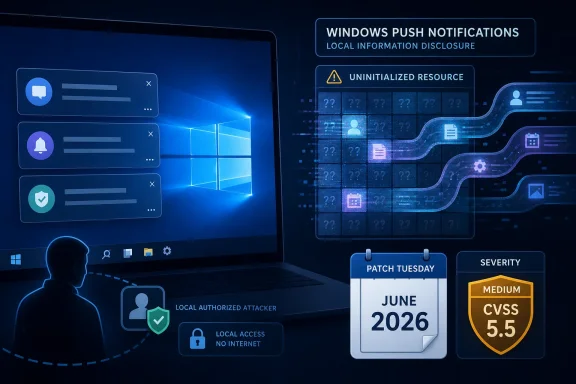
That is why CVE-2026-42971 deserves more attention than its medium rating may invite. Microsoft’s public framing identifies the bug as an information disclosure vulnerability in Windows Push Notifications, with exploitation requiring an authorized attacker and local access. The available description points to the use of an uninitialized resource, a class of issue that often means software exposes data that should have been cleared, reset, or newly allocated before use.
The phrase “authorized attacker” does important work here. This is not a wormable internet-facing flaw where a random packet crosses the perimeter and topples machines. It is closer to the uncomfortable world of post-access exploitation, where a user, process, or attacker who already has some foothold may be able to read something they should not.
That distinction lowers the headline severity but raises a more practical question: what kind of information might be exposed in a component that handles notifications? Microsoft’s advisory, at least in the public summary available at publication time, does not spell that out. The absence of detail is not unusual, but it changes how defenders should read the advisory.
Medium Severity Is a Risk Rating, Not a Reassurance
A 5.5 CVSS score lands CVE-2026-42971 in the “medium” band, which is often where vulnerabilities go to die inside overloaded patch queues. That would be a mistake. CVSS is a useful normalization system, but it is not a substitute for understanding where a vulnerable component lives and how attackers chain small primitives into larger outcomes.
Information disclosure bugs are especially prone to being underrated by non-specialists. They do not, by themselves, promise code execution, administrator privileges, or ransomware deployment. But real intrusions rarely follow the taxonomy in a vulnerability database. Attackers collect tokens, memory fragments, identifiers, usernames, file paths, configuration data, message contents, and environmental clues because each scrap can narrow the gap to the next step.
That is the operational significance of a local information disclosure bug in a Windows subsystem. If exploitation requires prior access, CVE-2026-42971 may be most useful after an attacker has landed on a machine but before they have achieved their broader objective. In that phase, a disclosure primitive can assist reconnaissance, help bypass assumptions about isolation, or expose data that was supposed to remain confined to another process, user context, or application boundary.
The advisory’s apparent lack of public exploit details also cuts both ways. It reduces the immediate copy-and-paste risk for opportunistic attackers, but it also leaves defenders with fewer specifics for compensating controls. When Microsoft says little, enterprises are left to infer risk from the component, the affected platforms, the CVSS vector, and their own exposure patterns.
The Uninitialized Resource Clue Matters
The most technically revealing phrase associated with CVE-2026-42971 is “use of uninitialized resource.” In plain English, this suggests a resource was used before being properly prepared for safe use. Depending on the implementation, that can mean stale memory, residual state, improperly reset handles, or object contents that carry data from an earlier operation into a later one.
This is not a new genre of bug. Uninitialized memory and stale-state issues have haunted operating systems for decades because high-performance system software constantly allocates, reuses, caches, and passes objects across boundaries. Security depends on those transitions being clean. When they are not, the software may accidentally hand one party information that belongs to another.
In a notification subsystem, the concern is not merely whether a popup reveals a message preview. The deeper issue is that notification services often mediate between applications and users. They may hold metadata about app activity, account state, delivery channels, registration identifiers, or queued content. Even if the exposed data is limited, the boundary being crossed is what matters.
Microsoft has not publicly described the exact data exposed by CVE-2026-42971, so it would be irresponsible to claim the bug leaks credentials, message contents, or tokens. But it is equally irresponsible to assume that “information disclosure” means trivial leakage. The safe reading is narrower and more disciplined: the vulnerability allows a local authorized attacker to disclose information through Windows Push Notifications, and the full practical value of that disclosure depends on the environment and the data reachable through the flawed resource path.
Local Bugs Still Matter in a Cloud-Managed Windows Estate
The security industry has trained itself to prioritize remote unauthenticated bugs, and for good reason. Those flaws produce the worst days: mass scanning, emergency firewall rules, out-of-band patches, and weekend incident calls. But local vulnerabilities form the connective tissue of many intrusions, especially in Windows environments where attackers move from phishing or stolen credentials into endpoint execution.
A local information disclosure vulnerability can matter in three common scenarios. First, it can help malware running with limited privileges learn more about the host and its users. Second, it can assist lateral movement by revealing environmental data that would otherwise require additional permissions. Third, it can undermine assumptions made by endpoint controls, application sandboxes, or user-session isolation.
Windows Push Notifications is also a reminder that the endpoint is now a cloud-adjacent device. Notifications are not just local UI flourishes. They connect to account experiences, Store apps, Microsoft services, enterprise apps, and modern application frameworks. That does not make every notification bug a cloud compromise, but it does mean the component lives in a richer trust environment than its name suggests.
For administrators, the relevant question is not “Can this be exploited from the internet?” The better question is “Where would this help an attacker who already has code execution under a user context?” In a mature risk program, those second-stage and third-stage questions are where medium vulnerabilities find their real priority.
Patch Tuesday’s Small Print Is Where Chained Attacks Begin
CVE-2026-42971 arrived as part of the ordinary cadence of Microsoft vulnerability disclosure, not as a splashy emergency. That ordinary context matters. Patch Tuesday is both a security mechanism and a sorting problem: dozens of fixes arrive, each with a severity label, affected product list, exploitability assessment, and often frustratingly terse description.
The flaws that dominate the morning briefings are usually critical remote-code-execution bugs, exploited zero-days, and elevation-of-privilege vulnerabilities in widely attacked components. A medium information disclosure issue in Windows Push Notifications will naturally fall below those in an emergency queue. But queue position is not the same thing as irrelevance.
The best-run Windows shops already know this. They do not patch every machine instantly without testing, but they also do not let medium vulnerabilities drift indefinitely. They track affected builds, deployment rings, reboot requirements, endpoint telemetry, and business-critical exceptions. In that operating model, CVE-2026-42971 is not a crisis; it is a patch-management obligation with a reasonable but real security rationale.
Consumer users have a simpler path. Install the cumulative Windows update when offered, do not defer security updates for weeks, and remember that the cumulative model means this fix is packaged with many others. The practical risk of a single medium CVE may be modest, but the risk of becoming chronically unpatched is not.
Windows Push Notifications Is Bigger Than Toasts
The name invites underestimation. “Push notifications” sounds like the thing that tells you an app wants attention, and for many users that is where the story ends. Under the hood, however, notification delivery requires a service architecture that knows which apps are registered, which users are active, which messages are pending, and how the operating system should broker delivery across sessions and permissions.
That architecture has to balance usability with isolation. A notification should reach the right user, from the right app, at the right time, without exposing data to another user, another process, or a lower-privileged context. If the operating system mishandles a resource during that path, even a small leak can become meaningful.
This is why notification components have become security-sensitive across platforms. Mobile operating systems learned this years ago because lock-screen notifications could reveal private content. Desktop operating systems now face similar pressure because they are no longer just local productivity environments; they are identity-bearing endpoints connected to SaaS, messaging, device management, and collaboration tools.
In Windows, the push notification stack sits in that same modern endpoint reality. It may not be as famous as SMB, RDP, Kerberos, or the kernel, but it participates in the user experience that organizations increasingly depend on. Any flaw that crosses information boundaries in that layer deserves a careful look.
The Credibility Signal Is Stronger Than the Detail Signal
The user-supplied MSRC text points toward a metric concerned with confidence: how certain the vulnerability is, how credible the technical details are, and how much knowledge may be available to would-be attackers. For CVE-2026-42971, the existence of the vulnerability is not a rumor. It is a Microsoft-published CVE in the Security Update Guide, which gives defenders a high-confidence vendor acknowledgement.
But acknowledgement is not the same as full disclosure. Public details remain sparse. We have the affected component, impact category, general exploitation posture, and severity score. We do not have a public exploit, a detailed root-cause write-up, a proof-of-concept, or a precise statement of the data exposed.
That combination creates a common asymmetry in enterprise defense. The vendor knows enough to patch. Attackers may be able to reverse the patch. Defenders, meanwhile, must make a deployment decision without having the whole story. In Windows security, that is not a bug in the disclosure process so much as the default state of affairs.
The practical conclusion is simple: treat the vulnerability as confirmed, but do not overclaim its mechanics. It is fair to say that CVE-2026-42971 is a real Microsoft-recognized Windows Push Notification information disclosure issue. It is not fair, based on public information alone, to assert a specific exploit chain or a specific type of leaked secret.
Reverse Engineering Is the Clock Defenders Rarely See
Once a vendor ships a patch, the vulnerability becomes more discoverable to capable attackers. This is the uncomfortable paradox of coordinated disclosure: the update protects customers who apply it, but it can also show researchers and adversaries where to look. For Windows, patch diffing remains a real part of the attacker and researcher ecosystem.
That does not mean every medium vulnerability becomes weaponized. Many never do. Some require awkward preconditions, expose low-value data, or prove too unreliable to matter at scale. But defenders should not confuse the absence of a public proof-of-concept on day one with permanent obscurity.
CVE-2026-42971’s local nature lowers mass-exploitation risk, yet it does not eliminate targeted interest. Attackers who specialize in Windows post-exploitation care about primitives that help them learn, pivot, and escalate. If a patched notification component reveals anything useful about user sessions, application state, or memory contents, someone will eventually test whether it can be incorporated into a chain.
This is where patch timing becomes less philosophical. The longer machines remain unpatched after the fix is available, the more time attackers have to compare old and new binaries, understand the flaw, and build reliable triggers. Medium severity does not stop that clock; it merely affects how fast most organizations choose to move.
The Affected Footprint Is Broad Because Windows Is Broad
Public vulnerability aggregators list Windows 10, Windows 11, and multiple Windows Server generations among the affected product families, including Server 2016, Server 2019, Server 2022, and Server 2025. That spread is unsurprising for a shared Windows component. It also means the fix is relevant across mixed estates, not just the newest client fleet.
The server angle is easy to overlook. Servers do not look like notification-heavy consumer devices, and many server roles have minimal interactive use. But Windows Server still includes shared operating system components, and vulnerability applicability is not determined by how often a human sees a toast notification. If the vulnerable code is present and reachable under supported conditions, it belongs in the patch plan.
Desktop fleets may carry more obvious exposure because users run modern apps, sign into cloud-connected accounts, and interact with notification-heavy workflows all day. Multi-user systems, shared workstations, virtual desktops, and remote app environments may deserve particular attention because information-boundary bugs become more interesting when multiple users or app contexts coexist.
For home users, the affected-footprint story is more boring and therefore better. Supported Windows devices should receive the fix through normal updating. The main risk comes from disabled updates, long deferrals, unsupported versions, or third-party “debloat” configurations that interfere with Windows servicing.
Enterprise Prioritization Should Follow Exposure, Not Anxiety
The right enterprise response begins with inventory. Security teams should identify which supported Windows versions are in scope, which update channels apply, and whether any machines are intentionally delayed for compatibility reasons. The vulnerability should then be folded into the normal June 2026 Windows cumulative update process.
For most organizations, CVE-2026-42971 should not jump ahead of critical remote-code-execution vulnerabilities or actively exploited zero-days. But it should move ahead of cosmetic fixes, low-confidence advisories, and issues affecting components not present in the environment. The combination of vendor confirmation, broad Windows applicability, and local information disclosure is enough to merit timely remediation.
Testing still matters. Windows cumulative updates can affect authentication, printing, endpoint agents, VPN clients, line-of-business applications, and device management behavior. A disciplined staged rollout is not negligence; it is how enterprises avoid turning a security fix into an availability incident. The key is to make staging measured in days or a small number of weeks, not quarters.
Administrators should also watch for any Microsoft revision to the advisory. Security Update Guide entries can change after publication as affected products are clarified, exploitability assessments are updated, or mitigation language is refined. A medium CVE can become more urgent if exploit code appears or if Microsoft later adds stronger language about exploitation likelihood.
Detection Will Be Indirect Unless Microsoft Says More
One frustrating feature of information disclosure vulnerabilities is that they are often difficult to detect after the fact. Unlike malware execution, privilege escalation, or network exploitation, a successful disclosure may not leave an obvious event. The attacker reads something and moves on. If the vulnerable component does not log the access pattern, defenders may have little to hunt.
That does not mean defenders are blind. Endpoint detection and response tools can still surface suspicious local behavior around process creation, unusual access patterns, privilege boundary probing, memory inspection, or post-exploitation tooling. But those detections are behavioral and circumstantial. They may catch the campaign, not the CVE.
For CVE-2026-42971 specifically, absent public exploit details, defenders should avoid building brittle detections around guesses. It is more productive to verify patch status, monitor for abnormal local activity, and correlate with broader endpoint compromise signals. If Microsoft or credible researchers later publish technical indicators, those can be added to hunt logic.
This is another reason patching is the primary control. When a vulnerability is confirmed but opaque, remediation beats speculation. Security teams can spend hours imagining exploit paths, or they can close the known hole and reserve investigative energy for systems that remain unpatched or already show compromise indicators.
The Real Lesson Is About Trust Boundaries Inside the Endpoint
CVE-2026-42971 is not merely a notification bug. It is a reminder that modern Windows security depends on thousands of small trust boundaries inside the endpoint. Every broker, service, cache, queue, and helper process has to keep data in the right lane.
The old mental model of endpoint security was perimeter-heavy: keep bad things out, harden the firewall, block remote exploits, and patch the obvious internet-facing services. That model is now incomplete. Phishing, token theft, malicious OAuth grants, supply-chain compromises, and drive-by user execution all mean attackers often begin with some form of authorized access.
Once inside, they live off the land. They query local systems, inspect application data, enumerate sessions, and look for weak seams between privilege levels. Information disclosure vulnerabilities fit this world because they do not have to be spectacular to be useful. They just have to reveal something the attacker was not supposed to know.
Microsoft’s Windows security architecture has steadily moved toward stronger isolation, virtualization-based protections, app containers, brokered access, and cloud-backed identity controls. Those defenses help, but they also increase the number of places where implementation mistakes can matter. The more Windows mediates, the more important the mediators become.
The Patch Is Routine; the Habit Is Strategic
The immediate prescription is straightforward: apply the relevant June 2026 Windows security updates through Windows Update, Windows Update for Business, WSUS, Microsoft Intune, Configuration Manager, or whatever deployment channel fits the environment. Validate installation on representative systems, watch for known update issues, and close exceptions quickly.
The strategic lesson is broader. Organizations should not let severity labels become moral judgments about whether a vulnerability matters. Medium does not mean meaningless. Local does not mean unreachable. Information disclosure does not mean harmless.
This is especially true in environments with shared endpoints, developer workstations, privileged admin consoles, virtual desktop infrastructure, help desk jump boxes, and servers where interactive logon occurs. In those places, local boundaries matter because the value of adjacent information is higher. A leak that is uninteresting on a single-user kiosk may be much more consequential on an administrator’s workstation.
For Windows enthusiasts and power users, CVE-2026-42971 is also an argument against update theater. Disabling services, delaying patches indefinitely, or stripping components because they seem annoying can create fragile systems that are harder to secure and harder to support. If notifications bother you, configure them; do not assume the subsystem behind them is security-irrelevant.
The Notification Bug Leaves a Practical Paper Trail
CVE-2026-42971 is one of those vulnerabilities whose importance will be decided less by its CVSS number than by how it behaves in real environments. The known facts support action, not alarm. The unknowns argue for humility, not speculation.
- CVE-2026-42971 is a confirmed Microsoft vulnerability in Windows Push Notifications, published on June 9, 2026.
- The issue is classified as information disclosure and carries a medium CVSS 3.1 score of 5.5.
- Publicly available descriptions indicate exploitation is local and requires an authorized attacker, which lowers mass internet exploitation risk.
- The reported root-cause class involves use of an uninitialized resource, a pattern that can expose data across boundaries if cleanup or initialization fails.
- Supported Windows client and server families are in scope, so enterprises should treat the fix as part of normal Windows cumulative update hygiene.
- There is no public basis, at publication time, to claim a specific leaked secret or exploit chain, but there is enough vendor-confirmed detail to justify timely patching.
The strongest security programs will handle CVE-2026-42971 in exactly that spirit. They will not sound the klaxon reserved for wormable RCEs, but they will not bury the issue beneath a pile of “medium” tickets either. They will patch, verify, monitor for advisory revisions, and remember that Windows security is often won or lost in the unglamorous subsystems users only notice when something goes wrong.