

Microsoft’s Quiet Push Notification Bug Has a Loud Privilege Boundary
The vulnerable component is Windows Push Notifications, the plumbing that helps modern Windows deliver app and system notifications without every application maintaining its own polling loop. It is easy to dismiss that subsystem as user-interface furniture, somewhere between toast pop-ups and background app noise. Microsoft’s advisory makes the opposite point: this is privileged operating-system infrastructure, and a synchronization error inside it can become a security boundary problem.
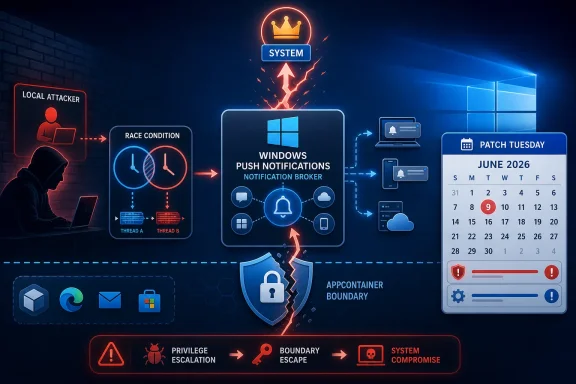
The core description is terse. Microsoft says concurrent execution using a shared resource with improper synchronization allows an authorized attacker to elevate privileges locally. In plainer English, two operations can collide in a way the system does not safely handle, and an attacker who already has ordinary access can try to turn that timing mistake into more powerful execution.
That is why the advisory maps the bug to a race condition and a use-after-free weakness. Race conditions are among the least satisfying vulnerabilities for administrators because they are both serious and slippery. They often require exact timing, but when the stars line up, they can convert mundane local access into a much larger compromise.
Microsoft’s own FAQ narrows the technical picture further: successful exploitation requires winning a race condition, and a successful attacker could gain SYSTEM privileges. Those two facts should be read together. The first lowers exploit reliability; the second raises the stakes if exploitation succeeds.
The CVSS Score Says “Hard,” Not “Harmless”
The vulnerability carries a CVSS 3.1 base score of 7.8, which lands in high-severity territory even though Microsoft’s product severity is Important. That difference is not a contradiction so much as a reminder that Microsoft’s severity labels and CVSS scoring answer different operational questions. CVSS measures the theoretical security impact under defined assumptions; Microsoft’s severity label is part of its own servicing and customer-risk taxonomy.
The vector tells the story. The attack vector is local, privileges required are low, user interaction is not required, and the attack complexity is high. Confidentiality, integrity, and availability impacts are all rated high, and the scope is changed, meaning the vulnerable component can affect something beyond its own security authority.
For defenders, the two most important parts are “low privileges” and “no user interaction.” This is not the sort of bug that lets an unauthenticated attacker reach across the internet and own a machine. But once an attacker has a beachhead — a phished user, a stolen VPN session, a compromised developer box, a malicious insider account, or a foothold through another vulnerability — this kind of flaw can become the second stage.
That second stage matters because Windows privilege escalation is the difference between being a nuisance and becoming the operating system. A standard user context is constrained by design. SYSTEM is not. Attack chains love that gap.
The AppContainer Escape Detail Is the Tell
The most interesting line in the advisory is not the score. It is Microsoft’s explanation of the scope change: the vulnerability could lead to a contained execution environment escape, with a pointer to AppContainer isolation. That does not mean every exploitation scenario begins inside an AppContainer, nor does it provide enough detail to reconstruct the bug. But it does reveal the class of boundary Microsoft believes is implicated.
AppContainer is one of the mechanisms Windows uses to constrain modern apps and processes. It is not a magic sandbox that makes hostile code harmless, but it is part of the layered model that limits what a process can touch. If a vulnerability allows code to escape such a contained environment, the issue becomes more than a local privilege bump in a narrow subsystem. It becomes a failure of a boundary that developers and administrators rely on.
This is where Windows Push Notifications becomes more interesting than its name suggests. Notifications sit at the intersection of apps, user sessions, background activity, identity, and system services. A bug there can have implications beyond whether a toast appears on screen. It can touch the trust relationship between app code and the operating system services that broker its requests.
The advisory does not say the vulnerability is being exploited, and it does not provide proof-of-concept code. That restraint is normal for a newly patched Windows vulnerability. But the AppContainer clue gives defenders enough to understand why Microsoft rated the impacts so broadly.
“Report Confidence: Confirmed” Changes the Reading
The user-supplied excerpt focuses on the CVSS temporal metric for report confidence, and in this case Microsoft marks it Confirmed. That is not decorative metadata. It means the vendor is not merely passing along a rumor, an incomplete external claim, or a vague class of undesirable behavior. Microsoft is acknowledging that the vulnerability exists with enough confidence to publish and patch it.
At the same time, the exploit-code maturity is listed as Unproven. That matters just as much. Microsoft is saying there is no publicly available exploit code known at the time of publication, or that exploitation remains theoretical in public. Publicly disclosed is No. Exploited is No. Microsoft’s exploitability assessment is Exploitation Unlikely.
Those three signals are easy to misread. They do not mean “ignore it.” They mean “do not treat it like an active zero-day emergency unless your environment has special exposure or threat intelligence says otherwise.” The right operational response is disciplined patching, not panic.
Confirmed report confidence also cuts the other way for attackers. Even without a public exploit, the advisory gives skilled vulnerability researchers a compact map: Windows Push Notifications, race condition, possible use-after-free, local low-privilege path, no user interaction, SYSTEM outcome, AppContainer boundary relevance. Microsoft has not published exploit steps, but it has told the world which neighborhood to inspect.
Patch Tuesday Still Rewards Boring Discipline
The fix is available through the June 2026 Windows security updates, with different KB packages and build numbers depending on the Windows release. Affected products include Windows 10 21H2 and 22H2 variants, Windows 11 23H2, 24H2, 25H2, and 26H1 variants, plus Windows Server 2019, 2022, and 2025, including Server Core installations. That spread makes the vulnerability broadly relevant even if the exploitation bar is high.
The Windows 11 servicing rows are especially notable because the same class of issue spans multiple current client branches. Windows 11 23H2 is patched to build 22631.7219, Windows 11 24H2 to 26100.8655, Windows 11 25H2 to 26200.8655, and Windows 11 26H1 to 28000.2269. On the server side, Windows Server 2019 is patched to 17763.8880, Server 2022 to 20348.5256, and Server 2025 to 26100.32995.
For most WindowsForum readers, the practical question is not whether to surgically disable push notifications. The advisory points to official fixes, not a workaround. If you manage fleets, the job is to validate the cumulative update in your rings, watch for known update regressions, and move systems through the normal deployment pipeline before the bug becomes more attractive to exploit developers.
Race-condition local privilege escalations often age badly. On day one, they may be dismissed as unreliable. After enough reverse engineering, crash triage, and exploit engineering, reliability can improve. The elapsed time between “exploitation unlikely” and “working exploit circulating privately” is not something an administrator can schedule around.
Local Privilege Escalation Is the Middle of the Attack, Not the Beginning
One reason local elevation-of-privilege vulnerabilities are chronically underrated is that they do not look like the opening move. They usually require an attacker to already be on the machine with some level of access. That sounds comforting until you remember how most intrusions actually unfold.
Attackers rarely stop at the first foothold. They land in a user context, enumerate the machine, collect tokens, probe endpoint defenses, and look for a route to higher privilege. A local SYSTEM exploit is a force multiplier because it can disable controls, dump credentials, implant persistence, and move laterally with far fewer constraints.
That makes CVE-2026-42978 a post-compromise accelerator. It is not the front door. It is the stairwell behind the lobby. The fact that user interaction is not required means a compromised low-privilege process may not need to wait for a victim to click through a prompt or open a file once the attacker is positioned locally.
The high attack complexity still matters. A race condition must be won, and Microsoft says exploitation is unlikely. But defenders should not confuse unreliable with irrelevant. Attackers are patient when the reward is SYSTEM.
Windows’ Notification Stack Reflects a Bigger Platform Tradeoff
Modern Windows is full of brokers, containers, background services, identity-aware components, and compatibility layers. That architecture is more secure than the old model where applications freely roamed the desktop, but it also creates new seams. Every brokered interaction is a contract. Every contract has state. State creates timing, lifetime, and synchronization problems.
Windows Push Notifications is part of that modern platform fabric. It exists because users expect apps to behave like connected services while preserving battery life, session boundaries, and policy control. That means notifications are not just decorative UI; they are mediated operating-system behavior.
When a race condition appears in such a component, the larger lesson is not that notifications are uniquely dangerous. It is that security boundaries increasingly depend on the correctness of background brokers that most users never think about. The visible Windows experience is only the top layer. The attack surface lives below it.
This is also why AppContainer references deserve attention. Microsoft has spent years pushing more workloads into constrained contexts, from Store-style apps to browser-adjacent processes and system brokers. Each escape bug is a reminder that containment is only as strong as the privileged component that receives the message.
Enterprise IT Should Prioritize by Exposure, Not by Drama
For enterprise administrators, CVE-2026-42978 belongs in the normal Patch Tuesday prioritization queue, but it should not be buried under the assumption that “local” equals “low risk.” Environments with large pools of shared workstations, virtual desktops, developer endpoints, kiosk-like systems, or exposed remote-access hosts should treat local elevation bugs with particular seriousness. Those are the places where low-privilege footholds are common and privilege boundaries do real work.
Server Core being affected is also worth noting. Server Core reduces the GUI surface, but it is not a separate operating system with a magically absent service model. If the vulnerable component is present in a supported server SKU, administrators should apply the relevant cumulative update rather than assuming the lack of a traditional desktop experience removes the issue.
For consumers and enthusiasts, the advice is simpler. Install the June cumulative update when it is offered, or manually check Windows Update if you have deferred updates. If you are running unsupported Windows builds, the advisory is another reminder that security fixes follow support boundaries.
For security teams, detection is harder than patching. A race-condition privilege escalation may not leave neat network indicators. Endpoint telemetry may show suspicious child processes, privilege transitions, service tampering, or exploitation attempts, but the durable control is to remove the vulnerable code path by updating.
The Patch Is the Message Microsoft Wants You to Hear
Microsoft’s advisory is deliberately sparse because publishing exploit mechanics would help attackers. Still, the shape is clear enough. The vulnerability is confirmed, the fix is official, public exploitation was not known at publication, and the company assesses exploitation as unlikely.
That is the useful middle ground between alarmism and complacency. There is no evidence here of a wormable internet-facing crisis. There is also no basis for treating the flaw as harmless. A local authenticated attacker who wins the race could gain SYSTEM privileges, and the affected product matrix is broad.
The timing is also typical: released as part of the June 2026 security update cycle, with revision 1.0 and “information published” on June 9. That matters because administrators can align it with existing monthly change windows. This is not an out-of-band scramble; it is a test of whether the ordinary patch process is healthy.
The uncomfortable truth is that ordinary patching is where many Windows compromises are prevented. Not by a clever dashboard. Not by a heroic weekend. By cumulative updates landing on endpoints before attackers decide a now-documented bug is worth engineering into a chain.
The Notification Bug’s Practical Ledger
CVE-2026-42978 is best understood as a credible privilege-boundary bug with a fix available and no public exploitation reported at release. That profile calls for urgency without theater: validate, deploy, and verify the June updates.
- Microsoft published CVE-2026-42978 on June 9, 2026, as an Important Windows Push Notifications elevation-of-privilege vulnerability.
- The flaw is a local race condition involving improper synchronization, and Microsoft says a successful attacker could gain SYSTEM privileges.
- The CVSS score is 7.8, with low privileges required, no user interaction required, high attack complexity, and high impact across confidentiality, integrity, and availability.
- Microsoft lists the vulnerability as not publicly disclosed and not exploited at original publication, with exploit code maturity marked Unproven and exploitation assessed as unlikely.
- The affected product range spans supported Windows 10, Windows 11, and Windows Server releases, including Server Core installations.
- The practical mitigation is to install the relevant June 2026 cumulative security update and confirm fleet build numbers after deployment.
The lesson from CVE-2026-42978 is not that Windows Push Notifications is suddenly the center of the threat universe; it is that modern Windows security depends on small privileged brokers behaving perfectly under pressure. Microsoft has patched this one before public exploitation was known, which is exactly how the system is supposed to work. The next question is whether endpoints will actually receive the fix before a confirmed but “unlikely” race condition becomes another reliable step in someone else’s intrusion playbook.