

Microsoft Marks the Bug “Important,” but SYSTEM Is the Word That Matters
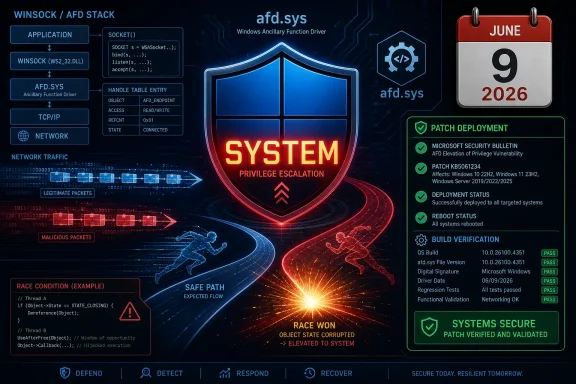
CVE-2026-45601 lands in the familiar gray zone of Windows security: not flashy enough to dominate headlines, but powerful enough to matter deeply once an attacker is already inside the perimeter. Microsoft rates the vulnerability Important, assigns it a CVSS 3.1 base score of 7.0, and describes the underlying issue as a use-after-free in the Windows Ancillary Function Driver for WinSock.
That component, commonly associated with afd.sys, sits in the plumbing between Windows applications and the networking stack. It is not a consumer-facing feature with a tile in Settings or a toggle in Windows Security. It is part of the substrate that makes sockets work, and that is precisely why security people pay attention when it appears in a Patch Tuesday advisory.
The vulnerability requires local access and low privileges. In practical terms, the attacker must already be able to run code or operate under a basic user context on the target system. That makes it less dramatic than a wormable remote code execution bug, but it does not make it benign.
For defenders, the phrase “could gain SYSTEM privileges” is the crux. SYSTEM is not just a slightly better user account; it is the security boundary where a nuisance becomes a platform-level compromise. Malware that begins in a restricted user context often needs exactly this kind of vulnerability to disable protections, dump credentials, tamper with logs, persist across reboots, and move laterally.
The Race Condition Is a Speed Bump, Not a Seat Belt
Microsoft’s advisory says successful exploitation requires an attacker to win a race condition. That explains the high attack complexity rating and helps justify the “exploitation less likely” assessment. It also explains why this vulnerability probably will not be the first thing a criminal crew reaches for when scanning the open Internet.
But race conditions have a way of aging badly. What is unreliable on publication day can become reliable after researchers and exploit developers spend time with a patch diff, a reproducer, and a stack trace. The difference between theoretical and practical exploitation is often not a new discovery; it is engineering.
Use-after-free bugs are especially uncomfortable in kernel-mode contexts because they live in the world of object lifetimes, memory reuse, timing, and control. The vulnerable component may release memory while some path still believes it can use it. If an attacker can shape what gets placed in that memory next, the bug may become a route to controlled corruption.
That is not a claim that public exploit code exists for CVE-2026-45601. Microsoft says the vulnerability was not publicly disclosed and not exploited at the time of release, and its exploit code maturity metric is “Unproven.” The point is narrower and more operational: a hard-to-exploit local privilege escalation is still a local privilege escalation, and defenders should not confuse exploit difficulty with immunity.
AFD Remains One of Windows’ Most Interesting Low-Level Attack Surfaces
The Ancillary Function Driver for WinSock is not new to Microsoft security bulletins. Over the years, AFD-related elevation-of-privilege vulnerabilities have appeared with enough regularity that many administrators recognize the wording before they recognize the specific CVE. This is not surprising: network I/O is complex, heavily used, and deeply integrated into the operating system.
AFD is interesting because it is both ordinary and privileged. Ordinary applications rely on socket operations constantly, but the implementation path crosses into kernel-mode machinery where mistakes can have high consequence. That combination makes it a durable target for vulnerability researchers and adversaries alike.
The existence of repeated AFD advisories does not prove negligence. Mature operating systems accumulate enormous compatibility obligations, and Windows carries decades of application behavior, driver interaction, and legacy support. But the repetition does say something about risk concentration: certain low-level components continue to reward close inspection because they sit at the intersection of reachability, complexity, and privilege.
For WindowsForum readers, the lesson is not that WinSock itself is unsafe or that networking should be disabled in some theatrical hardening exercise. The lesson is that Windows security often turns on components most users never see. The patch that fixes a kernel driver may matter more to real-world resilience than a visible feature update that gets a thousand times more attention.
The Affected List Is Broad Enough to Hit Almost Every Real Fleet
Microsoft lists affected updates across supported Windows client and server lines, including Windows 10, Windows 11, Windows Server 2012 and 2012 R2 under extended servicing arrangements, Windows Server 2016, Windows Server 2019, Windows Server 2022, and Windows Server 2025. The advisory also includes newer Windows 11 branches such as 24H2, 25H2, and 26H1.
That breadth matters because CVE-2026-45601 is not a niche corner case confined to one old SKU. It spans the kind of mixed estate many organizations actually run: Windows 10 machines still waiting for replacement, Windows 11 endpoints in multiple feature-update cohorts, and servers spread across generations because application owners rarely retire workloads on security teams’ preferred timeline.
The update mapping is the practical side of the story. Windows 10 22H2 is fixed at build 10.0.19045.7417, while Windows 11 23H2 moves to 10.0.22631.7219. Windows 11 24H2 moves to 10.0.26100.8655, and Windows 11 25H2 moves to 10.0.26200.8655. Windows Server 2022 is listed at 10.0.20348.5256, and Windows Server 2025 at 10.0.26100.32995.
Those numbers are not trivia for inventory teams. They are how administrators distinguish “the update is approved” from “the vulnerable machine is actually remediated.” In the Windows ecosystem, a KB article in a console is only part of the truth; build verification closes the loop.
The Server 2012 and 2012 R2 entries also deserve attention. Their presence is a reminder that legacy systems do not leave the risk model simply because they leave mainstream comfort. If an organization is still carrying those systems under extended support, it needs to treat these updates as production security work, not archival housekeeping.
The Patch Is Available, Which Changes the Risk Calculation
The temporal score for CVE-2026-45601 is lower than the base score because Microsoft has issued an official fix. That matters. A vulnerability with confirmed technical existence and no patch is one kind of emergency; a vulnerability with a patch available becomes a test of maintenance discipline.
Microsoft’s remediation level is “Official Fix,” and its report confidence is “Confirmed.” The combination is unusually clean for administrators. There is no public exploit reported by Microsoft at release, no active exploitation flag, and no workaround gymnastics in the advisory as the central mitigation. The path is straightforward: deploy the June 9, 2026 security update appropriate to the Windows version, then verify the build.
That does not mean every environment can install instantly. Windows updates still collide with maintenance windows, specialized software, industrial systems, line-of-business dependencies, and the eternal fear that fixing a security bug will break a revenue-generating workflow. But those operational realities do not change the vulnerability’s nature.
For most enterprises, this should fall into the early wave of patching rather than the someday wave. Internet-facing exposure is not the issue here; post-compromise privilege escalation is. If a phishing attachment, stolen credential, remote management misconfiguration, or browser exploit gives an attacker low-privilege code execution, CVE-2026-45601 is the sort of bug that can make the next phase easier.
“Not Exploited” Is a Snapshot, Not a Promise
Microsoft says CVE-2026-45601 was not publicly disclosed and not exploited at the time of original publication. That is good news, and it should be said plainly. Administrators do not need to treat this as a known zero-day fire drill based on the information available at publication.
But “not exploited” is not the same as “not exploitable,” and it is certainly not the same as “irrelevant.” Vendor exploitability assessments describe conditions at a moment in time. Attackers read the same advisories defenders read, and they study the same patch releases defenders deploy.
The most dangerous period for many vulnerabilities begins after a patch is published. Defenders see an update; attackers see a diff. If a bug sits in a broadly deployed component and the patch reveals enough about the fix, the race shifts from Microsoft versus the bug to administrators versus reverse engineering.
That is why the “Report Confidence: Confirmed” metric included in the user-submitted material matters. Microsoft is not saying merely that something undesirable might exist. It is saying the vulnerability is real, the details are credible enough for scoring and remediation, and the vendor has shipped a fix. The uncertainty lies less in the bug’s existence than in how quickly it becomes useful to attackers.
Local Privilege Escalation Is the Middle Act of the Intrusion
Security coverage often favors beginnings and endings: the phishing email that got in, the ransomware note that appeared, the stolen data that showed up for sale. Local privilege escalation is the middle act. It is less visible, but it is where many intrusions become durable.
A low-privilege foothold may be noisy, constrained, and reversible. An attacker who reaches SYSTEM can interfere with endpoint defenses, inspect protected areas of the machine, harvest secrets, install services, manipulate scheduled tasks, and set up persistence mechanisms that survive user logoff. On servers, the consequences can be sharper because the machine often holds higher-value credentials, application secrets, or access paths.
This is why administrators should resist the instinct to rank local privilege escalation below remote vulnerabilities by default. In a modern attack chain, the vulnerability that gets the attacker in and the vulnerability that lets the attacker stay are both business risks. One opens the door; the other hands over the building keys.
CVE-2026-45601 also has no user interaction requirement in Microsoft’s CVSS vector. That detail matters. The attacker does not need to trick another user into clicking something after they already have low privileges. If exploitation conditions are met and the race can be won, the operation is attacker-driven.
The CVSS Vector Tells a More Nuanced Story Than the Headline Score
The CVSS vector for CVE-2026-45601 is local attack vector, high attack complexity, low privileges required, no user interaction, unchanged scope, and high impact to confidentiality, integrity, and availability. That is a mouthful, but it translates into a coherent security picture.
The local attack vector lowers the score because the vulnerability cannot be exploited directly over the network in the way a server-side remote code execution flaw can. High attack complexity lowers it further because exploitation depends on timing conditions outside the attacker’s total control. Those two factors explain why the base score is 7.0 rather than something more severe.
The other side of the vector is more sobering. Low privileges are enough to start, no separate user has to participate, and successful exploitation can produce high impact across the classic CIA triad. Microsoft’s FAQ makes the practical consequence explicit: SYSTEM privileges.
That tension is why this bug deserves calm urgency. It is neither a drop-everything Internet worm nor a minor hardening footnote. It is a high-impact local escalation with an official fix, broad applicability, and enough exploit friction that disciplined patching should beat opportunistic abuse in well-run environments.
The Research Credit Points to a Serious Discovery Pipeline
Microsoft credits Angelboy, also known as @scwuaptx, with DEVCORE for reporting the vulnerability. That acknowledgement will mean something to readers who follow Windows exploitation research. DEVCORE has a long-standing reputation in vulnerability research, and Angelboy is associated with serious low-level exploitation work.
Acknowledgements are not just ceremonial. They tell administrators something about the discovery pipeline. A bug reported through coordinated disclosure by experienced researchers is usually not random noise; it has been examined, reproduced, and presented to the vendor with enough technical substance to drive a patch.
That does not mean defenders get exploit details. Coordinated disclosure often intentionally withholds enough information to protect users while patches roll out. This asymmetry can frustrate administrators who want to understand exact risk before deployment, but it is part of how the ecosystem prevents advisories from becoming instruction manuals on day one.
It also explains the tension in the MSRC page between limited public technical detail and confirmed report confidence. Microsoft can confirm the vulnerability and ship a fix without publishing a step-by-step exploit narrative. That is good for safety, but it leaves defenders to reason from component, impact, CVSS vector, and affected products.
Home Users Should Patch; Admins Should Prove They Patched
For home users, the advice is simple: install the June 2026 Windows security update when it is offered, and do not postpone it indefinitely because the bug is “only” local. Many consumer infections begin with something that runs as the signed-in user. A local privilege escalation can be the difference between cleaning up a bad download and losing control of the system.
For IT administrators, the advice is more demanding. Approval is not deployment, deployment is not installation, and installation is not verification. CVE-2026-45601 should show up in vulnerability management workflows until the endpoint or server reports the relevant fixed build.
This is especially important in mixed Windows 10 and Windows 11 estates. Windows 10 21H2 and 22H2 entries remain in the advisory, but many organizations are already in transition planning because Windows 10’s lifecycle pressure has been building for years. Transitional estates are where patch hygiene often becomes uneven: some devices are managed by modern tooling, some by legacy WSUS paths, and some by “we will replace it soon” optimism.
Servers add another layer. AVD hosts, file servers, RDS farms, application servers, and domain-adjacent systems may all receive patches on different cadences. Local privilege escalation on a server should be taken seriously even when direct user logon is limited, because service accounts, scheduled tasks, remote administration tools, and application execution contexts all complicate the meaning of “local.”
The Most Dangerous Machines Are the Ones Everyone Assumes Are Covered
CVE-2026-45601 is a good example of why asset inventory remains the least glamorous part of security and one of the most consequential. The advisory’s affected list is broad, but the real question is whether an organization can map that list onto its actual machines with confidence.
The obvious candidates are managed Windows endpoints enrolled in Intune, Configuration Manager, or another patch platform. The harder candidates are lab machines, kiosk systems, jump boxes, golden images, offline templates, persistent VDI pools, and servers maintained by application teams outside central IT’s daily view. Local privilege escalation bugs love unmanaged edges because the attacker only needs one stale foothold.
Golden images are particularly easy to forget. If an image remains unpatched, new machines can be born vulnerable after the patch window appears to have closed. The same applies to offline VM templates and disaster recovery images that are only occasionally booted and serviced.
Security teams should also check whether vulnerability scanners are keying off KB presence, build number, file version, or authenticated OS inventory. Each method has tradeoffs. Build number verification is often the cleanest operational signal for cumulative Windows updates, but only if the data is fresh and complete.
Legacy Windows Turns Patch Tuesday Into Risk Accounting
The inclusion of Windows Server 2012 and 2012 R2 in the security update table is a reminder that old Windows does not become harmless when it becomes inconvenient. These platforms survive in production for reasons that are often rational at the local level: application compatibility, vendor certification, budget cycles, or migration complexity. At the enterprise level, however, each exception becomes a risk ledger entry.
CVE-2026-45601 does not single out older Windows as uniquely vulnerable. The affected list reaches modern releases too. But legacy systems are more likely to suffer from delayed maintenance, weaker monitoring, brittle rollback plans, and dependency chains that make administrators hesitant to touch them.
That hesitancy is understandable, but it is also exploitable. Attackers do not need every system to be vulnerable; they need one that gives them leverage. A forgotten 2012 R2 server with a privileged service account can be more valuable than a fully patched Windows 11 laptop.
This is where patch management and modernization converge. If a system is too fragile to receive a security update for a confirmed privilege escalation vulnerability, that fragility is itself a security finding. The answer may not be immediate migration, but it should be documented, owned, and tracked as risk rather than normalized as background noise.
Security Teams Should Treat This as an Attack-Chain Patch
The most practical way to prioritize CVE-2026-45601 is to imagine it as the second vulnerability in an attack chain. The first event might be credential theft, macro abuse, a malicious installer, remote access compromise, or exploitation of a different app. Once the attacker has low privileges, the AFD bug becomes a possible route upward.
That framing changes patch priority. If a vulnerability is local-only but affects many systems and grants SYSTEM on success, it belongs near the top of the normal security update queue even without active exploitation. It may not justify emergency downtime everywhere, but it does justify timely deployment and verification.
Endpoint detection and response tools can reduce risk, but they should not be treated as substitutes for the fix. Kernel-level exploitation may be noisy in development and quieter in mature form. Depending on EDR to catch every local escalation attempt is less reliable than removing the vulnerable code path.
Administrators should also avoid overfitting on the “exploitation less likely” label. Microsoft’s exploitability assessment is useful, but it is not an environmental risk score. A heavily monitored workstation and an under-managed server in a flat network do not face the same practical consequences from the same CVE.
The June Patch Window Has a Clear Assignment
CVE-2026-45601 is not the kind of vulnerability that rewards drama, but it does reward completion. The patch exists, Microsoft has confirmed the issue, and the affected surface covers enough of the Windows installed base that administrators should expect to find it somewhere in their environment.
- Organizations should deploy the June 9, 2026 Windows security updates for affected client and server versions rather than waiting for evidence of exploitation.
- Administrators should verify fixed builds, not merely update approvals, especially on Windows 10 21H2 and 22H2, Windows 11 23H2 through 26H1, and supported Windows Server releases.
- Security teams should prioritize systems where local code execution is plausible, including VDI hosts, RDS servers, developer workstations, jump boxes, and application servers.
- Legacy Windows Server 2012 and 2012 R2 systems should be checked deliberately because extended-support machines are often missed by routine patch assumptions.
- Vulnerability management teams should treat this as a post-compromise escalation risk, not as a network-exposed entry-point bug.
- Golden images, offline templates, and intermittently connected devices should be serviced so the vulnerability is not reintroduced after the main patch wave.
The quiet Windows bugs are often the ones that decide whether an intrusion remains contained or becomes administrative control, and CVE-2026-45601 fits that pattern almost too neatly. Microsoft has given defenders a confirmed vulnerability, an official fix, and enough scoring detail to prioritize without panic. The next move belongs to the people running Windows fleets: patch the visible machines, find the forgotten ones, and assume attackers will eventually learn more than the advisory says today.