

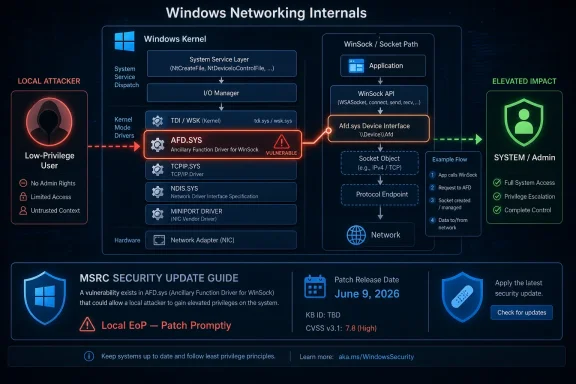
Microsoft’s Quiet Kernel Plumbing Becomes the Story Again
The Ancillary Function Driver for WinSock, usually seen as AFD.sys, is not a glamorous part of Windows. It sits in the networking stack’s machinery, helping user-mode applications talk to the kernel’s socket implementation. That makes it boring in the way load-bearing infrastructure is boring: invisible until it breaks, and privileged enough that a mistake can matter far beyond the application that triggered it.
For WindowsForum readers, this class of vulnerability should feel familiar. Microsoft has shipped a steady drumbeat of AFD-related elevation-of-privilege fixes over recent Patch Tuesday cycles, many of them landing with high CVSS scores because successful exploitation can hand an attacker broad control of the machine. The pattern does not mean every AFD bug is the same bug in disguise. It does mean this is an area where old assumptions, kernel interfaces, and modern exploit chains keep colliding.
That is why CVE-2026-45603 deserves more than a copy-paste advisory treatment. A local privilege escalation in a kernel-adjacent networking component is rarely the first move in an intrusion. It is the second or third move — the one that turns a phished user, a sandbox escape, a malicious document, or a compromised service account into a more durable beachhead.
The public description is narrow, but the operational implication is broad. If an attacker already has low-privileged code execution on a vulnerable Windows system, an AFD elevation bug may offer a route toward higher integrity, credential theft, persistence, defense evasion, or lateral movement preparation. In enterprise terms, that is the difference between “one workstation needs reimaging” and “we need to know what that workstation could touch.”
The Report Confidence Metric Is More Than Advisory Fine Print
The user-facing text around report confidence is often easy to skim past because it sounds like standards-body prose. It explains how much confidence there is in the existence of a vulnerability and in the credibility of known technical details. In plainer English: it is Microsoft telling defenders how far the public record has moved from “someone says this might be real” toward “the vendor has confirmed enough to ship a fix.”
That distinction matters in 2026 because security teams are drowning in vulnerability feeds. A CVE can appear before meaningful details exist, before a patch exists, or before anyone outside a small disclosure loop understands the root cause. Report confidence is one of the few fields that helps separate fog from fact.
For CVE-2026-45603, the essential takeaway is that the vulnerability has moved into Microsoft’s official update pipeline. Even if the public advisory does not hand over exploit-ready internals — and it should not — the presence of the issue in MSRC’s guide is itself an acknowledgment that Windows customers should treat it as real. That is the point of a confirmed confidence rating: defenders do not need to wait for exploit code on GitHub to begin caring.
This is also where the metric quietly flips the usual security psychology. Low public detail can sometimes make a flaw feel less urgent to non-specialists, because there is less to visualize. But from a defender’s point of view, limited detail plus vendor confirmation is not comfort. It is a signal to patch before the details become common knowledge.
Local Does Not Mean Low Risk
The security industry has trained too many people to hear “local attacker” and mentally downgrade the issue. That instinct is understandable and often wrong. Local privilege escalation vulnerabilities are the connective tissue of real intrusions because attackers frequently begin with limited permissions.
Modern Windows compromise is rarely a single magic packet. It is a chain. A browser bug, stolen credentials, a malicious installer, a vulnerable driver, a macro-laced document, or a misconfigured remote management service may get code running as a user. From there, privilege escalation decides whether the attacker remains constrained or starts dismantling the guardrails.
That is why a local EoP in a Windows kernel component can carry a high severity rating even without remote reachability. The attacker does not need to be across the internet hammering port 445. They need a way to run code on the box — and in the age of credential theft, commodity loaders, and living-off-the-land tooling, that prerequisite is not exotic.
For home users, the risk is simpler but still real. Malware that lands under a standard account is more dangerous if it can become administrator or SYSTEM. For businesses, the stakes are higher because privilege escalation can help attackers disable endpoint protection, scrape secrets, tamper with logs, and pivot using credentials that should never have been exposed to a low-privileged process.
AFD.sys Sits Where Old Compatibility Meets Modern Attack Chains
Windows networking has to preserve decades of compatibility while defending against attackers who treat every boundary as provisional. AFD.sys lives in that difficult middle ground. It supports the sockets behavior applications expect, but it does so through kernel interfaces where memory safety, object lifetime, pointer validation, and access checks have very little margin for error.
That is the unglamorous reason this component keeps appearing in security advisories. Kernel drivers that broker user-mode requests must assume hostile inputs, unexpected timing, and weird edge cases from processes that should not be trusted. When those assumptions fail, a local user can sometimes make the kernel do work on their behalf that it should never do.
The result is a familiar Windows security paradox. The vulnerable surface is not necessarily exposed directly to remote attackers, but it is reachable by local code through normal operating system pathways. That makes it attractive as a post-exploitation primitive: reliable enough to be useful, privileged enough to matter, and common enough to justify attacker research.
Microsoft has spent years tightening Windows kernel attack surfaces, from driver blocklists to virtualization-based security features and memory integrity controls. But mitigations do not repeal complexity. They change the economics. Vulnerabilities like CVE-2026-45603 show that the cost of exploitation may rise, while the value of a working local privilege escalation remains stubbornly high.
The Sparse Advisory Is a Defensive Choice, Not an Absence of Meaning
Security advisories often frustrate administrators because they say enough to alarm but not enough to satisfy curiosity. That is especially true for kernel elevation bugs. Defenders want to know the vulnerable code path, exploit reliability, affected call patterns, and whether exploitation leaves forensic traces. Vendors usually provide a title, an impact, a score, and a patch.
That gap is not accidental. Detailed root-cause disclosure before broad patch adoption can help attackers as much as defenders. Microsoft’s Security Update Guide generally favors standardized fields over exploit narratives, and for a vulnerability like this, that restraint is defensible. The public does not need a recipe to understand the risk.
But sparse does not mean empty. The title tells us the impacted component. The impact tells us the attacker’s goal. The confidence language tells us Microsoft accepts the vulnerability’s existence and technical credibility. The update channel tells administrators the mitigation path. For enterprise patching teams, that is enough to begin prioritization.
The mistake is treating unknowns as negatives. If the advisory does not say exploitation is occurring in the wild, that is useful. If it does not provide a proof-of-concept, that is also useful. But neither fact means the window is safe. It means defenders may have a short period where the vendor patch is ahead of mass attacker adoption.
Patch Tuesday Turns Risk Into Scheduling Politics
Every Patch Tuesday is a translation exercise. Microsoft publishes vulnerabilities; administrators turn them into maintenance windows, reboot plans, exception requests, and help-desk forecasts. CVE-2026-45603 lands squarely in the part of that process where security teams and operations teams often talk past each other.
From a security perspective, a confirmed local privilege escalation in Windows should be patched promptly because it can strengthen almost any intrusion chain. From an operations perspective, kernel and networking-adjacent updates can be sensitive because they touch systems that cannot simply reboot whenever convenient. Both views are rational. The job is to keep the second from swallowing the first.
The practical approach is tiering. Internet-facing servers may not be directly exploitable through this local bug, but they are high-value systems if any other weakness grants a foothold. Workstations used by administrators deserve special attention because privilege escalation there can become domain compromise. Shared servers, RDS hosts, developer machines, and build infrastructure should not be treated like ordinary office endpoints.
This is where good asset inventory beats heroic incident response. If you know which Windows builds are deployed, which machines lag behind cumulative updates, and which endpoints run privileged workflows, CVE-2026-45603 becomes a manageable patching task. If you do not, it becomes another line item in a spreadsheet that everyone hopes someone else owns.
The Real Boundary Is Between User and Kernel
Windows security depends on many boundaries, but the user-to-kernel boundary remains one of the most consequential. Most code users run should not be able to rewrite the rules of the operating system. When a local elevation flaw crosses that boundary, it attacks one of the fundamental assumptions behind least privilege.
That is why “requires prior access” is not a dismissal. Prior access as a standard user is supposed to be meaningfully constrained. A successful kernel privilege escalation undermines that constraint, especially if the resulting privileges allow an attacker to tamper with security tools, access protected processes, or impersonate higher-value identities.
Credential protection technologies help, but they are not magic. Virtualization-based security, LSASS protection, attack surface reduction rules, endpoint detection, and application control can all reduce blast radius. Yet many environments run with uneven enforcement, legacy exceptions, or business-critical software that weakens the ideal model.
This makes patching the cleanest fix. Mitigations can make exploitation harder or post-exploitation less profitable, but they generally do not remove the vulnerable code path. A security update does. That distinction matters when an issue is confirmed and the affected component is part of the OS itself.
Home PCs Get the Same Bug With Fewer Safety Nets
Enterprise coverage tends to dominate discussion of Windows privilege escalation, but consumer systems are not immune to the consequences. A home PC running as a standard user can still be hit by malware that wants to become more powerful. A gaming rig, family laptop, or small-business desktop may not have EDR, centralized logging, or a security team watching for suspicious privilege transitions.
The good news is that consumer mitigation is straightforward. Install the relevant cumulative Windows update through Windows Update. Reboot when prompted. Do not defer security updates for weeks because a feature annoyance somewhere on the internet sounds scary. For most users, the risk of remaining unpatched is more concrete than the risk of a properly released security update.
The bad news is that home users often run as administrators by default. That does not make privilege escalation bugs irrelevant; malware still benefits from deeper system privileges and kernel-level access. But it does blur the boundary that Windows security is trying to enforce. A standard account for daily use remains one of the simplest defenses that still feels oddly rare in consumer setups.
Small offices sit in the awkward middle. They often have domain-joined systems, remote access tools, shared credentials, and business-critical data, but without enterprise-grade patch governance. For them, CVE-2026-45603 is a reminder that “we are too small to be targeted” is not a patch strategy. Commodity malware does not care how formal your IT department is.
Administrators Should Watch the Chain, Not Just the CVE
No serious defender should evaluate CVE-2026-45603 in isolation. The better question is what an attacker could pair it with. Local privilege escalation becomes far more dangerous when combined with phishing, exposed remote services, vulnerable VPN clients, weak application control, stolen browser tokens, or overprivileged service accounts.
That is why patch priority should account for business role. A kiosk machine, a developer workstation with signing keys, and a domain admin’s laptop may all run Windows, but they do not carry the same operational risk. The same CVE can be routine on one device and urgent on another.
Telemetry matters too. Security teams should look for unusual process behavior around privilege boundaries, unexpected service creation, suspicious driver activity, tampering with endpoint controls, and post-compromise actions that often follow successful elevation. The public advisory may not describe exploit indicators, but the attacker’s goals after elevation are familiar.
The most mature response is boring by design. Patch. Reboot. Verify build numbers. Confirm coverage in vulnerability management tooling. Hunt broadly for evidence of local privilege abuse if the environment had meaningful exposure before patching. Then fold the lesson into the next cycle instead of treating every Patch Tuesday as a surprise.
Exploit Code Will Decide the Tempo, but Not the Priority
The public risk around a vulnerability often changes when proof-of-concept code appears. Before that moment, exploitation may be limited to the discovering researcher, the vendor, or a small number of advanced actors. After that moment, defenders face copycat testing, opportunistic scanning, and integration into commodity tooling.
CVE-2026-45603 should be patched before that tempo shift, not after. A confirmed Microsoft Windows EoP in a historically interesting component is the kind of bug researchers will examine once patches are available. Patch diffing remains a powerful technique. When Microsoft ships a fix, attackers can compare old and new binaries to infer what changed.
That does not mean panic is useful. It means delay has a cost curve. In the first days after release, defenders may have an advantage because the fix exists and widespread exploit knowledge may not. Weeks later, that advantage can evaporate, especially for organizations that leave workstations and lower-tier servers behind because they are politically easier to neglect.
Security teams should resist the false comfort of “no known exploitation” if that is the current status. Absence of known exploitation is a snapshot, not a guarantee. The strategic question is whether you want to patch while the issue is mostly an advisory, or after it becomes a playbook.
Microsoft’s Patch Machinery Still Relies on Customer Discipline
Microsoft can publish the advisory, assign the CVE, ship the update, and encode confidence in the vulnerability record. It cannot make every organization reboot a domain controller, approve a workstation ring, or fix a broken WSUS workflow. The last mile of Windows security still belongs to customers.
That last mile is where many incidents are born. A patch may be available, but deferred because a maintenance window slipped. A server may be “temporarily” excluded from automatic updating because an old application behaves badly. A laptop may sit outside management for months. A golden image may be stale before it is even deployed.
CVE-2026-45603 is the kind of vulnerability that punishes those gaps indirectly. Attackers do not need every system to be vulnerable. They need one useful system that gives them the privileges or credentials required to continue. In that sense, patch coverage percentage can be a misleading comfort if the unpatched remainder contains the machines that matter most.
The healthier mindset is exposure management, not checkbox compliance. Which systems are vulnerable? Which are most valuable? Which are easiest for an attacker to reach after an initial compromise? Which have compensating controls? Which have no owner? Those questions turn a CVE from a headline into an operational plan.
The WinSock Driver Bug Leaves a Simple Assignment
CVE-2026-45603 is not the flashiest kind of Windows vulnerability, and that is precisely why it deserves attention. It sits in the space where many real intrusions are won or lost: after initial access, before full control. The response should be disciplined rather than dramatic.
- Organizations should treat Microsoft’s confirmation and report-confidence language as sufficient reason to prioritize patching, even if public exploit details remain limited.
- Administrators should focus first on high-value Windows endpoints, administrator workstations, shared servers, remote access hosts, and systems that handle credentials or build artifacts.
- Home users and small offices should install the relevant Windows security update through Windows Update and avoid long deferrals simply because the bug requires local access.
- Security teams should verify patch deployment by build and update status rather than assuming that policy approval equals installation.
- Defenders should watch for post-exploitation behavior associated with privilege escalation, including security-tool tampering, suspicious service creation, credential access attempts, and unusual kernel-adjacent activity.
CVE-2026-45603 is ultimately a reminder that Windows security is not only about blocking the first click, packet, or stolen password; it is about preventing that first mistake from becoming total control. Microsoft has put the vulnerability into the official record, and the confidence signal says defenders should not wait for a more colorful exploit story before acting. The next phase belongs to administrators, who now have the least glamorous but most consequential job in security: get the update deployed before attackers turn a confirmed flaw into another routine step in the intrusion chain.