

A Quiet Kernel Bug Lands in the Loudest Part of Patch Tuesday
CVE-2026-45638 sits in the familiar Patch Tuesday category that enterprise security teams have learned not to ignore: Windows elevation of privilege in a kernel-adjacent component. The name is plain enough to disappear into a spreadsheet, but “Windows Ancillary Function Driver for WinSock” points to a deep networking support layer rather than a desktop app or optional feature.
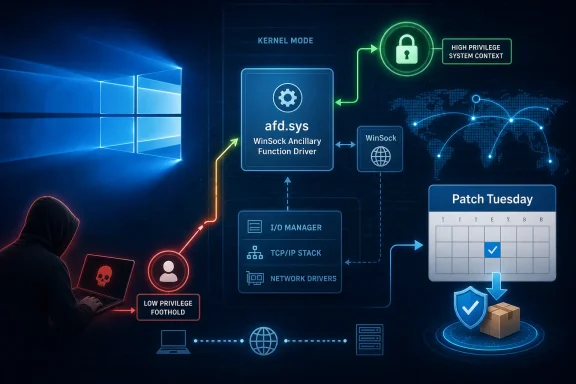
The Ancillary Function Driver, commonly associated with afd.sys, is part of the machinery Windows uses to support the WinSock networking stack. It is not the same thing as an exposed web server listening on the public internet. It is lower, older, and more structural: the sort of component that many applications touch indirectly because networking is everywhere.
That distinction matters because defenders often triage by attack vector first. A local privilege escalation bug may not get the same executive attention as a critical remote exploit, but attackers do not grade vulnerabilities by press coverage. They grade them by usefulness.
A working privilege-escalation bug in a Windows kernel path can be the second act of an intrusion. The first act may be phishing, stolen credentials, a malicious document, a browser exploit, or abuse of a misconfigured service. The second act is where the attacker asks Windows for more power than the compromised account should have.
“Local” Does Not Mean “Harmless”
The comforting interpretation of a local elevation-of-privilege vulnerability is that an attacker must already be on the machine. That is true as far as it goes, and it is also the wrong mental model for modern attacks. In real intrusions, “already on the machine” is often the starting line, not the finish line.
A user-level foothold is noisy, constrained, and fragile. It may not allow credential dumping, security tooling tampering, persistence, lateral movement, or access to sensitive system resources. Elevation of privilege is what changes the economics.
For administrators, the key question is not whether CVE-2026-45638 can be exploited from the internet in one step. The better question is whether it could allow a compromised standard account, low-privileged service, sandbox escape chain, or post-exploitation tool to reach a more powerful security context. That is why Windows local privilege escalation bugs so often appear in mature attack chains.
Microsoft’s title tells us the impact class. It does not, at least in the public-facing summary available at disclosure time, hand defenders a root-cause tour, proof-of-concept path, or exploit recipe. That absence should lower panic, not priority.
The Confidence Metric Is Doing More Work Than It Looks
The text accompanying the disclosure explains a metric that measures confidence in the existence of the vulnerability and the credibility of the known technical details. In plainer English: Microsoft is telling customers how sure the ecosystem should be that the bug exists and how much useful technical knowledge is publicly available.
That is not bureaucratic filler. It is one of the most important parts of vulnerability triage because it separates rumor from confirmed defect. A vulnerability can be suspected, partially understood, reverse-engineered by outside researchers, or acknowledged by the vendor. Each state means something different for defenders and attackers.
When a vendor acknowledges a vulnerability, the defensive conversation changes. Teams no longer need to debate whether the flaw is real; they need to decide how quickly to deploy the update, how to watch for exploitation attempts, and whether compensating controls are realistic. In Windows kernel components, compensating controls are usually less satisfying than patching.
The same metric also hints at the attacker’s knowledge problem. If public details are thin, exploit development may require patch diffing, reverse engineering, or private research. If details are rich, attackers get a head start. CVE-2026-45638 appears to arrive in the former posture: confirmed enough to patch, not publicly explained enough to trivialize.
AFD Is Boring Infrastructure, Which Is Why Attackers Like It
The Windows Ancillary Function Driver for WinSock is not a household name even among many Windows power users. That anonymity is part of its significance. Attackers often prize components that are ubiquitous, privileged, and hard for defenders to disable without breaking normal system behavior.
Networking support code is especially attractive because it sits at the intersection of performance, compatibility, and privilege. Windows must support decades of application expectations while moving packets quickly and safely. The result is a large amount of complex code that ordinary users never see but countless processes rely on.
For IT pros, this is the uncomfortable lesson of recurring AFD-related vulnerabilities: the most important attack surface is not always the most visible one. A server admin may harden IIS, disable SMBv1, lock down RDP, and still depend on kernel networking components beneath every workload. That dependency is unavoidable.
This is why “just disable the vulnerable component” is rarely a serious answer for flaws in core Windows drivers. You cannot treat the networking substrate like an unwanted browser plugin. The fix is almost always to take Microsoft’s update, validate it against the fleet, and move quickly through rings.
The Patch Is the Mitigation, but the Rollout Is the Risk
For home users, the advice is simple: install the Windows security update when it is offered, avoid deferring cumulative updates without a reason, and reboot when required. The operational friction is low, and the downside of staying exposed is not worth the convenience of postponement.
For enterprise IT, the advice is simple only in theory. Cumulative updates touch broad portions of the operating system, and kernel fixes can carry compatibility concerns with endpoint detection tools, VPN clients, legacy line-of-business applications, and specialized networking software. That is why Patch Tuesday is less a download event than a change-management ritual.
Still, local privilege escalation bugs should not be allowed to drift indefinitely through “standard cadence” limbo. If an organization already treats internet-facing RCEs as emergency patches and everything else as background noise, it is missing how attackers actually move. Privilege escalation is the bridge between initial access and meaningful compromise.
The right response is staged urgency. Test quickly, deploy first to representative systems, watch for crash or driver compatibility signals, and expand rapidly if telemetry is clean. The goal is not reckless speed. It is avoiding the slow-motion exposure that comes from treating every non-remote bug as second-tier.
The Absence of Exploit Details Cuts Both Ways
Sparse public detail is good because it denies copy-paste attackers an easy path. It is bad because defenders cannot build precise detections around a known trigger, vulnerable call path, or exploit artifact. That leaves security teams leaning on patch state, behavioral monitoring, and generic post-exploitation signals.
This is a recurring weakness in vulnerability management. The industry asks defenders to prioritize with a handful of fields: severity, exploitability, attack vector, privileges required, user interaction, and whether exploitation has been observed. Those fields are useful, but they compress uncertainty into tidy labels.
CVE-2026-45638 is exactly the sort of vulnerability where that compression can mislead. If no public exploit is known, some dashboards will score it down. If the affected component is core Windows, some administrators will score it up. Both instincts are defensible.
The better approach is to treat confidence and exploit detail as separate dimensions. A confirmed vendor-patched bug with limited public exploitation detail is not “theoretical.” It is a real defect whose exploitation cost is not yet fully visible.
Windows Fleets Are Patchable, but Not Uniform
The Windows ecosystem is simultaneously centralized and fragmented. Microsoft ships cumulative updates through Windows Update, WSUS, Microsoft Configuration Manager, Intune, and other management channels, but the receiving environments vary wildly. A gaming desktop, a domain controller, a point-of-sale terminal, and a hospital workstation may all share the same broad Windows lineage while living under very different constraints.
That diversity shapes the risk from CVE-2026-45638. A single-user home PC may be exposed mainly if malware lands first. A shared workstation may face risk from low-privileged local users. A server may be exposed through a compromised service account or attacker-controlled process after initial access.
Virtual desktops and multi-user systems deserve special attention. Any environment where untrusted or semi-trusted users can run code locally has a sharper privilege-escalation problem. The old boundary between “local user” and “administrator” only matters if the kernel enforces it reliably.
Administrators should also watch for systems that sit outside normal patch rings: lab machines, kiosks, golden images, offline systems, and specialized appliances running Windows under an OEM support model. These are the machines that turn a patched vulnerability into a persistent estate problem.
The Attacker’s Calendar Starts After the Patch Drops
One uncomfortable truth of Patch Tuesday is that disclosure starts a race. Microsoft publishes updates, defenders begin testing, and attackers begin comparing old and new binaries. Even when a CVE lacks public exploit details, a patch can become a map for people with the skill and motivation to reverse-engineer it.
That does not mean every Windows privilege-escalation vulnerability becomes weaponized. Many do not. Some require precise timing, unusual system state, difficult heap manipulation, or conditions that are awkward to reproduce reliably. Others become practical only when paired with another bug.
But defenders should not confuse “no public exploit today” with “no exploit tomorrow.” The value of a Windows local privilege-escalation bug is durable because it can be inserted into many different intrusion workflows. Attackers do not need it to be flashy. They need it to work often enough.
This is why patch latency is so important. The risk curve changes after disclosure, even if the vulnerability was privately reported and responsibly handled. Every day gives defenders more deployment coverage, but it also gives attackers more time to analyze the fix.
Security Teams Should Track the Boring Signals
Because public technical details are limited, detection strategy should focus less on the specific CVE trigger and more on suspicious outcomes. A successful local privilege escalation usually leaves operational consequences: unexpected privileged process creation, token abuse, service installation, driver loading, credential access attempts, or tampering with security tools.
Endpoint detection and response products may eventually add analytics specific to CVE-2026-45638 if exploit techniques become known. Until then, teams should lean on fundamentals. Watch for non-admin users spawning administrative shells, unusual child processes from network-facing services, and abrupt changes in privilege level.
Windows event logs alone may not tell the full story, especially for kernel exploitation. But they can still show the attacker’s next moves. Privilege escalation is valuable because of what follows, and what follows is often more detectable than the exploit itself.
The practical implication is that patch management and detection engineering should not be separate conversations. Patching reduces exposure. Monitoring narrows dwell time if someone gets there first.
The Real Risk Is the Chain, Not the Single CVE
Security coverage often treats vulnerabilities as isolated objects. CVE-2026-45638 is a Windows AFD elevation-of-privilege bug; therefore, it goes in the Windows local EoP bucket. That taxonomy is administratively convenient and analytically incomplete.
Attackers build chains. A phishing email yields code execution as a user. A browser or document exploit breaks into a constrained process. A stolen password gives access to a workstation but not domain dominance. A local privilege-escalation bug supplies the missing rung.
This chain logic is why Windows kernel bugs remain important even when they require local access. They amplify other failures. They turn partial compromise into full compromise.
Defenders should therefore prioritize CVE-2026-45638 based on where privilege boundaries matter most. Developer workstations, admin jump boxes, shared servers, domain-joined endpoints, and systems with sensitive credentials in memory all deserve faster attention than low-value disposable machines.
Microsoft’s Sparse Disclosure Is a Trade-Off, Not a Failure
There is a familiar complaint whenever Microsoft publishes a vulnerability with minimal technical detail: defenders want more. That complaint is fair. Precise information helps security teams assess exposure, write detections, and brief stakeholders without resorting to guesswork.
But full technical disclosure on day one can also help attackers. Microsoft’s security guidance often walks a line between actionable customer information and exploit-enabling specificity. For a kernel privilege-escalation issue, especially one in a broadly deployed Windows component, restraint is understandable.
The problem is that restraint shifts burden onto administrators. Without root-cause detail, they must trust the vendor’s severity assessment, update applicability, and exploitability guidance. In large environments, trust is not a feeling; it is a process backed by testing, telemetry, and rollback plans.
That is the mature reading of CVE-2026-45638. It is not an invitation to panic over an unknown kernel monster. It is a reminder that opaque but confirmed Windows flaws still require disciplined action.
The WindowsForum Readout for CVE-2026-45638
CVE-2026-45638 is not the sort of vulnerability that should send every user racing to unplug the router. It is the sort that should make administrators ask whether their patch process is fast enough for the vulnerabilities attackers actually use after initial access.
- CVE-2026-45638 is a Windows elevation-of-privilege vulnerability in the Ancillary Function Driver for WinSock, a core networking support component.
- The attacker model is local and already authorized, which makes the bug more relevant to post-compromise escalation than to one-step internet exploitation.
- The public description confirms the vulnerability class but does not provide enough technical detail to support highly specific detection guidance.
- The most practical mitigation is to install the relevant Windows security update through normal Microsoft servicing channels as soon as testing allows.
- Shared systems, admin workstations, servers, VDI environments, and machines holding valuable credentials should receive priority in deployment rings.
- Security teams should monitor for suspicious privilege changes and post-exploitation behavior rather than waiting for a perfect CVE-specific detector.
CVE-2026-45638 is a reminder that Windows security is often decided in the unglamorous layers: drivers, tokens, services, update rings, and reboot windows. Microsoft has confirmed enough for defenders to act, but not enough for anyone to pretend the public record tells the whole technical story. The organizations that fare best will be the ones that treat local privilege escalation as a core part of intrusion response, not a secondary patching chore to be handled after the headline bugs have had their turn.