

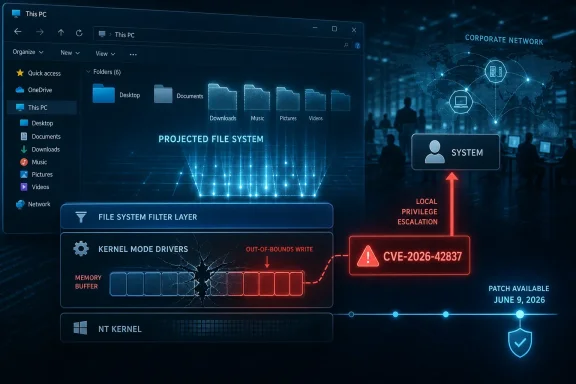
Microsoft’s Quiet File-System Plumbing Gets Another Security Bill
Windows Projected File System, usually shortened to ProjFS, is not a feature most users knowingly enable, tune, or even see. It is infrastructure: a way for applications to present a virtualized file tree to Windows so that files can appear to exist before all their contents are physically present. That makes it useful in developer workflows, source-control scenarios, and tools that need file-system illusion without copying every byte up front.
That invisibility is precisely why CVE-2026-42837 deserves attention. The vulnerability sits in the Windows Projected File System Filter Driver, the kernel-facing machinery that helps make those projections look like normal files and folders to the rest of the operating system. Microsoft’s summary is terse but revealing: a buffer over-read allows an authorized attacker to elevate privileges locally.
A buffer over-read is not, by itself, a full exploit narrative. It says a component reads past the bounds of the memory it should be looking at, which can expose data, destabilize assumptions, or become part of a larger exploit chain. Microsoft maps the weakness to out-of-bounds read, and then scores the impact as high across confidentiality, integrity, and availability, which is the advisory’s way of saying: do not dismiss the phrase “over-read” as harmless.
The attacker model is also clear. This is not a wormable server bug. It is a post-access bug: the adversary already has local code execution or an account with basic rights, and the vulnerability gives that adversary a route toward more powerful privileges. In Microsoft’s own answer to the most important practical question, successful exploitation could grant SYSTEM privileges.
The CVSS Score Says Local, but the Blast Radius Says Enterprise
The CVSS vector for CVE-2026-42837 lands at 7.8, a familiar score for Windows local privilege-escalation issues. The components of that score are worth unpacking because they draw the line between panic and disciplined urgency. Attack vector is local, attack complexity is low, privileges required are low, user interaction is none, and scope is unchanged.
That combination is not as dramatic as a pre-authentication remote-code-execution flaw, but it is far from comforting. “Local” means the bug is not the entry point. “Low privileges” means the entry point does not have to be especially powerful. “No user interaction” means exploitation does not depend on tricking a second user once the attacker is already operating on the target.
In real intrusions, privilege escalation is often the bridge between initial compromise and meaningful control. A phished user, a malicious installer, a stolen help-desk credential, a vulnerable line-of-business app, or a weakly protected remote-management path may provide the first step. A local EoP bug provides the second: the ability to disable defenses, dump credentials, tamper with protected files, install persistence, or move laterally with far fewer constraints.
This is why security teams should read CVE-2026-42837 as an enterprise hygiene problem rather than a boutique developer-feature issue. The affected product list spans mainstream Windows client and server releases, including Windows 10 21H2 and 22H2 variants, Windows 11 23H2, 24H2, 25H2, and 26H1 variants, plus supported Server Core and full installations across Windows Server 2019, 2022, and 2025. Even if ProjFS is not part of every organization’s visible application stack, the vulnerable component is Windows platform code.
Report Confidence Is the Detail That Changes the Patch Conversation
The user-facing MSRC text around report confidence is easy to skip because it reads like scoring-system boilerplate. In this case, it is central to the story. Microsoft marks the report confidence for CVE-2026-42837 as confirmed, meaning the vendor considers the vulnerability real and the technical basis credible.
That does not mean public exploit code exists. Microsoft separately rates exploit code maturity as unproven and says the vulnerability was not publicly disclosed and not exploited at the time of original publication. But report confidence answers a different question: is this merely a vague claim, or has the vulnerability been validated strongly enough that defenders should treat it as an actual bug?
For CVE-2026-42837, Microsoft’s answer is the latter. The advisory also credits multiple security researchers, including Zeze with TXOne, RanchoIce, GwanHyun Lee, and DongJun Kim with Enki WhiteHat. That constellation of acknowledgements suggests coordinated vulnerability disclosure rather than a rumor entering the ecosystem through an exploit dump or a half-described crash report.
The distinction matters because patch prioritization often collapses three different ideas into one: severity, exploitability, and certainty. CVE-2026-42837 is high on impact, moderate-to-high on practical attacker value, and high on certainty. It is lower on immediate public exploitation evidence. Mature patch programs should not confuse “not exploited today” with “safe to ignore this month.”
The ProjFS Pattern Is Bigger Than One CVE
Projected File System keeps showing up in Windows vulnerability advisories because it sits in an awkward and security-sensitive place. It is a broker between user-mode providers, kernel-mode file-system behavior, metadata, paths, placeholders, hydration, enumeration, and the expectations of software that thinks it is dealing with ordinary local files. That is a lot of state, and state is where file-system bugs breed.
Windows has a long history of local privilege-escalation flaws in file-system-adjacent components: filter drivers, cloud file providers, common log infrastructure, kernel storage paths, and virtualization layers. The recurring lesson is not that any one feature is uniquely broken. It is that modern Windows is a layered operating system where “files” are no longer just files. They are policy objects, sync objects, projected objects, cloud-backed objects, developer-workspace objects, and security-boundary-adjacent objects.
ProjFS intensifies that complexity because its job is to make an illusion convincing. If a process asks whether a file exists, the answer may depend on a provider. If a directory is enumerated, results may be synthesized. If metadata is requested, the file may not be fully present in the ordinary sense. Security code then has to preserve access checks, memory safety, object lifetime, and privilege boundaries while honoring the illusion.
That is where the vulnerability class becomes important. A buffer over-read inside a filter driver is not just a bad pointer in an isolated utility. It is a memory-safety failure in a component that participates in privileged file-system operations. If attackers can repeatedly trigger it from a low-privileged context, the “local” label becomes less reassuring.
The Patch Is Available, but Deployment Still Has Edges
Microsoft lists official fixes across affected Windows versions, with June 9, 2026 security updates carrying the remediation. The fixed builds include 10.0.19044.7417 for Windows 10 21H2, 10.0.19045.7417 for Windows 10 22H2, 10.0.17763.8880 for Windows 10 1809 and Windows Server 2019, 10.0.20348.5256 for Windows Server 2022, 10.0.26100.8655 for Windows 11 24H2, 10.0.26200.8655 for Windows 11 25H2, and 10.0.28000.2269 for Windows 11 26H1. Windows Server 2025 is listed with build 10.0.26100.32995.
That breadth is useful for inventory teams because it turns an abstract CVE into a measurable endpoint state. A Windows system is not “probably covered” because updates were approved somewhere in the management stack. It is covered when its installed cumulative update or resulting build corresponds to the fixed release for its branch.
This is especially important for mixed Windows estates. Many organizations still run Windows Server 2019 and 2022 alongside newer Windows 11 clients and early Windows Server 2025 deployments. The security story is not a single KB number across the whole estate; it is a matrix of supported branches, architectures, and installation types.
The operational risk is the usual one: local EoP bugs rarely get emergency-change windows unless they are known exploited. That is rational, but it can produce a backlog of “Important” vulnerabilities that quietly become attacker toolkit material weeks later. If an organization delays this patch, it should do so because testing requires it, not because the advisory lacks a flashy exploit video.
Developers Should Treat Virtualized File Systems as Attack Surface
There is a developer angle here that goes beyond installing the latest cumulative update. ProjFS exists because modern software increasingly wants file systems to behave like APIs. Source trees can be enormous, repositories can be partially materialized, data sets can be fetched on demand, and tools want the responsiveness of local files without the storage cost of local files.
That model is powerful, but it pushes more trust into boundary code. A provider that projects a file hierarchy has to interact cleanly with kernel filtering, antivirus scanning, backup tools, indexing, access control, and application behavior that may be old, weird, or hostile. The safer assumption for developers is that any feature that virtualizes file presence is part of the attack surface, even if it looks like performance plumbing.
For enterprise developers and platform teams, this means test machines and build agents should not be treated as low-risk merely because they do not hold production data. Developer workstations are often loaded with credentials, source code, tokens, package-publishing rights, and administrative exceptions. A local EoP in a file-system component is exactly the kind of bug that can make a compromised developer endpoint far more valuable.
This is also a reason to be careful with privileged developer tooling. If a workflow requires unusual file-system providers, virtualized repositories, filter drivers, or kernel-adjacent components, those machines need prompt patching and strong containment. Least privilege, credential isolation, application control, and endpoint detection are not glamorous controls, but they are the controls that keep a local bug local.
The Absence of Exploitation Is Not the Absence of Risk
Microsoft’s exploitability assessment says exploitation is less likely, and the advisory states that the vulnerability was not publicly disclosed or exploited at the time of publication. That is good news. It also has a shelf life.
Once a patch ships, attackers can begin comparing updated and unupdated binaries. For Windows kernel and driver bugs, that reverse-engineering window is a recurring problem. The patch itself becomes a roadmap, especially when the advisory identifies the component, weakness type, privilege outcome, and affected versions.
This does not mean every local EoP becomes a mass-exploitation event. Many do not. Some are difficult to trigger reliably; some require configurations that are uncommon; some are only useful when chained with other bugs. But Microsoft’s low attack complexity score cuts against the assumption that this one is merely academic.
The more practical framing is that CVE-2026-42837 is a chain amplifier. It is valuable not because it breaks the perimeter, but because it can make a modest compromise more damaging. In ransomware incidents, espionage operations, and hands-on-keyboard intrusions, that is often enough.
Security teams should therefore look for places where low-privileged local execution is already plausible. Shared workstations, developer endpoints, VDI pools, remote desktop hosts, jump boxes, build servers, lab machines, and servers running third-party agents all deserve attention. A local privilege-escalation vulnerability is only “local” until the attacker has a way to run code there, and modern environments offer many such ways.
Windows Admins Need Evidence, Not Assurances
The right response to CVE-2026-42837 is not theatrical. It is inventory, deployment, verification, and telemetry. The advisory contains enough data to make that process concrete: affected platforms, fixed build numbers, exploitability status, severity, and the expected privilege outcome.
Administrators should first identify systems on the affected Windows branches. Then they should confirm that June 2026 security updates have actually installed and that devices report the fixed build numbers for their servicing branch. In environments using rings, pilot groups, or maintenance windows, the question is not whether the update exists in WSUS, Intune, Configuration Manager, or another tool. The question is how many endpoints are still below the fixed build after the deployment window closes.
There is also a logging and detection dimension. Because Microsoft reports no known exploitation at publication, defenders should avoid claiming they can detect a specific public exploit unless they have independent telemetry. But they can still watch for the behaviors that make local EoP useful: suspicious service creation, driver loading attempts, unexpected privilege changes, tampering with security tools, credential access, and anomalous activity from low-privileged accounts.
For servers, the calculus depends on role. A domain controller, build server, management server, remote desktop host, or server with many interactive users deserves faster attention than a tightly locked-down workload with no local logon path. But the patch should still land. “Less likely” is not a compensating control.
Microsoft’s Security Update Guide Is Becoming the Story
CVE-2026-42837 is also a reminder of how much modern vulnerability management depends on terse vendor metadata. Microsoft gives defenders a handful of fields, and those fields now drive patch automation, risk dashboards, executive reporting, and SOC triage. A phrase like “Report Confidence: Confirmed” may be buried in the scoring table, but it can change how a vulnerability should be ranked.
This is both progress and a problem. The progress is that the advisory is structured enough for machines and humans to act on. The problem is that many of the most meaningful details remain necessarily withheld. Microsoft does not publish a root-cause walkthrough, exploit primitive, or proof of concept, because doing so would help attackers as much as defenders.
That leaves IT teams reading between the lines. The affected component says file-system filter driver. The weakness says out-of-bounds read. The impact says SYSTEM. The vector says local, low complexity, low privileges, no user interaction. The exploitability table says not publicly disclosed, not exploited, less likely. The report confidence says confirmed.
Taken together, that is not a reason to panic. It is a reason to patch with intent. Security work often lives in the space between incomplete disclosure and operational certainty, and this advisory is a textbook example.
The June Patch Carries More Weight Than Its Label Suggests
CVE-2026-42837 is an Important-severity bug, not a Critical one, and that label may cause some organizations to treat it as routine. But the “Important” bucket in Microsoft’s taxonomy contains many vulnerabilities that attackers care deeply about. Local privilege escalation has been one of the most durable parts of Windows exploitation because it solves a practical problem attackers encounter after they get in.
The fixed build list makes the remediation path straightforward for supported systems. The harder work is prioritization across endpoints that cannot all be patched at once. Systems with many users, exposed remote access, developer tooling, sensitive credentials, or security-management roles should move earlier in the queue.
There is no public evidence in Microsoft’s advisory that CVE-2026-42837 is already being abused. That should lower the temperature, not the priority. A calm patch is still a patch.
- CVE-2026-42837 is a confirmed Windows Projected File System Filter Driver vulnerability disclosed by Microsoft on June 9, 2026.
- The flaw is a local elevation-of-privilege issue caused by a buffer over-read and can allow a successful attacker to gain SYSTEM privileges.
- Microsoft rates the vulnerability as Important with a CVSS 3.1 base score of 7.8 and a temporal score of 6.8.
- The advisory says exploitation was not known in the wild and exploit code was unproven at original publication.
- Supported Windows 10, Windows 11, Windows Server 2019, Windows Server 2022, and Windows Server 2025 systems have June 2026 security updates available.
- Administrators should verify fixed build numbers rather than relying only on update approval status.
The forward-looking lesson is that Windows’ less visible subsystems now deserve the same security scrutiny as its famous ones. ProjFS is not a household feature, but it lives close enough to the kernel and file system to matter when memory safety fails. CVE-2026-42837 will probably not be remembered as the loudest Windows vulnerability of 2026, but it is exactly the kind of confirmed, local, high-impact flaw that separates mature patch programs from optimistic ones.