

The supplied MSRC language about “confidence” is doing more than filling out a scoring rubric. It tells defenders how much certainty Microsoft believes exists around the flaw and how much useful technical knowledge may already be available to attackers. In plain English, higher confidence means this is not just a theoretical complaint about undesirable behavior; it is a vulnerability Microsoft accepts as real enough to patch and document.
ProjFS Is a Niche Feature Until It Is in Your Threat Model
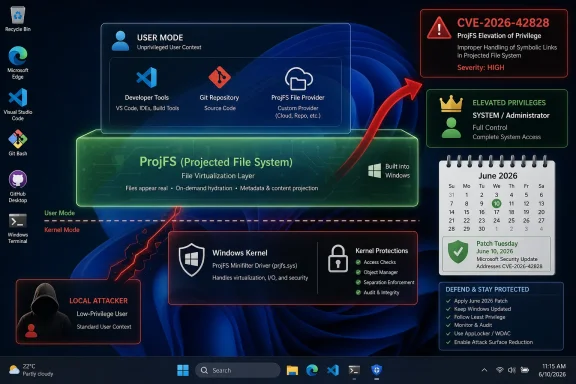
Windows Projected File System, usually shortened to ProjFS, is one of those Windows components that many users have never knowingly touched but that solves a very real problem for large-scale development workflows. It lets a user-mode provider project a hierarchy of files and directories into the file system, making data from some backing store appear local without necessarily materializing everything up front. Microsoft’s own documentation has long used large Git repositories and registry projection as examples of why such a mechanism exists.
That design is elegant because it blurs the line between what is present on disk and what is being synthesized on demand. It is also exactly why security engineers pay attention when the words elevation of privilege and ProjFS appear in the same advisory. The file system is not just a storage abstraction in Windows; it is a dense web of kernel-mode enforcement, user-mode callbacks, object metadata, access checks, and synchronization rules.
ProjFS is not the same thing as OneDrive Files On-Demand or the Cloud Files API, even though all of these technologies live in the broader mental category of “files that may not really be files yet.” ProjFS is aimed at high-speed backing stores and provider-driven virtualization, not slow cloud recall with visible progress semantics. That distinction matters because defenders sometimes underestimate optional or developer-oriented Windows components on the assumption that they are peripheral.
The problem is that optional does not mean harmless. If a component crosses privilege boundaries, accepts input from lower-privileged code, participates in file-system operations, or brokers state between user mode and kernel mode, it belongs in the same risk conversation as drivers, services, and RPC endpoints. CVE-2026-42828 is a reminder that obscure does not mean unimportant.
The Vulnerability Is Local, But Local Is Where Intrusions Mature
Elevation-of-privilege vulnerabilities are sometimes dismissed because they do not usually provide the first step into a network. That is a mistake. In real intrusions, local privilege escalation is the hinge between “a user clicked something” and “the attacker owns the endpoint.”
A phishing payload, stolen VPN credential, malicious developer dependency, abused remote-management tool, or compromised browser session can all land an attacker in a low-privilege context. From there, the adversary’s next question is brutally practical: how do I become administrator, SYSTEM, or otherwise break out of the permissions box I landed in? Bugs like CVE-2026-42828 are built for that phase of the attack chain.
This is why the word “local” should not lull anyone into passivity. Local exploitation may require previous access, but previous access is exactly what modern enterprise attacks are good at obtaining. Endpoint defenses, application control, least privilege, and patching are supposed to make that initial access less useful; an EoP bug works against that containment model.
For WindowsForum readers, the home-user version of the story is simpler but not softer. If malware runs as a standard user, privilege escalation can help it disable defenses, tamper with system files, implant persistence, access other users’ data, or hide more effectively. A Windows box does not need to be a domain-joined enterprise workstation for privilege boundaries to matter.
Microsoft’s Confidence Metric Is a Signal About Attacker Knowledge
The user-supplied MSRC text describes a metric that measures confidence in the existence of a vulnerability and the credibility of public technical details. That metric matters because defenders often read severity scores as if they are the whole story. They are not.
A vulnerability can be severe but poorly understood in public, leaving attackers with little more than a patched binary to reverse engineer. Another can be less dramatic on paper but accompanied by enough detail, proof-of-concept code, or corroborating research to make exploitation more accessible. The confidence metric tries to capture that second dimension: how real the issue is and how much of the path toward exploitation may already be visible.
For CVE-2026-42828, the important editorial point is that Microsoft is acknowledging a Windows Projected File System elevation-of-privilege flaw in its security guidance. That acknowledgement itself moves the issue out of rumor territory. Even if Microsoft withholds root-cause detail, the patch, affected component, impact category, and scoring metadata become a roadmap for both defenders and reverse engineers.
That is the uneasy bargain of coordinated disclosure. Publishing enough information helps administrators prioritize and remediate. Publishing too much too early can accelerate exploit development. Microsoft’s modern advisories often sit deliberately in the middle, offering product, impact, severity, and mitigation guidance while avoiding the sort of exploit narrative that turns a patch note into a recipe.
File-System Virtualization Makes Small Mistakes Expensive
Projected file systems are hard to secure because they must make synthetic state behave like ordinary file-system state. A provider can present directories and files that are backed by something else, and Windows must mediate the illusion while preserving normal expectations around access control, caching, metadata, handles, enumeration, and file operations. Every one of those words hides edge cases.
Attackers love edge cases. Race conditions, stale state, inconsistent validation, mismatched lengths, confused object lifetimes, and improper trust in provider-supplied data are all familiar themes in file-system and kernel-adjacent bugs. That does not mean CVE-2026-42828 necessarily belongs to one of those categories; Microsoft’s public naming does not, by itself, reveal the root cause. But the class of component tells us why the risk is credible.
ProjFS also sits in an awkward place architecturally because it exists to let user-mode code participate in what users experience as file-system behavior. User mode is where flexibility lives. Kernel mode is where enforcement lives. The seam between them is powerful, and therefore dangerous.
This is the old Windows bargain in a modern costume. The platform keeps adding abstractions so applications can do more without rewriting the operating system. Each abstraction reduces friction for developers and administrators, but each one also expands the number of places where the operating system must correctly decide who is allowed to do what.
Patch Tuesday Has Become a Map of Hidden Windows Subsystems
The modern Patch Tuesday experience is less about one blockbuster vulnerability and more about the accumulation of risk across components most users never configure directly. Print Spooler, CLFS, Win32k, AppX deployment, Windows Installer, Cloud Files, Remote Procedure Call, and file-system filters have all had their moments in the spotlight. ProjFS belongs to that same category of plumbing that becomes news only when the trust boundary cracks.
That pattern should change how administrators read vulnerability bulletins. The product name is not merely trivia; it tells you which machines may have relevant code paths, which workflows might exercise them, and which compensating controls have a chance of helping. A domain controller, developer workstation, build server, VDI image, and kiosk are all Windows systems, but their exposure to a ProjFS issue may differ.
Developer workstations deserve particular attention. They often run elevated tools, mount repositories, interact with untrusted source trees, install optional Windows features, and execute scripts from complex dependency chains. If ProjFS is enabled for a development workflow, the machine may be a more interesting target than a generic office endpoint, even when both receive the same monthly cumulative update.
Enterprises also need to remember that component inventory is often weaker than software inventory. Asset tools may confidently report Windows 11 version and installed applications while saying little about optional Windows capabilities, enabled features, driver state, or developer-specific extensions. That gap makes it harder to answer the basic question: where is this actually exposed?
Disabling Features Is Not a Substitute for Patching, But It Is Still a Lever
The clean answer to CVE-2026-42828 is to apply Microsoft’s security updates for the affected Windows versions. That sounds banal because it is the universal answer to almost every Patch Tuesday flaw, but in this case it is still the center of gravity. Elevation-of-privilege bugs are exactly the kind of vulnerabilities that get chained after initial compromise, and delaying the patch keeps that chain intact.
There may also be an argument for disabling Windows Projected File System where it is not needed. ProjFS has historically been exposed as an optional Windows feature under the Client-ProjFS name. On machines that do not use tooling dependent on it, reducing the enabled feature set is a reasonable hardening move.
But administrators should be careful not to turn that into folklore. Disabling a component without understanding dependencies can break workflows, particularly in engineering environments where file virtualization may be part of repository, build, or custom tooling behavior. The better approach is targeted: identify systems with the feature enabled, determine whether there is a business reason, patch regardless, and disable only where the operational impact is known.
For home enthusiasts, the same principle applies at smaller scale. If you enabled ProjFS for a specific experiment or tool and no longer need it, turning it off can reduce unused attack surface. If you do not know whether you need it, the safer immediate move is to install the relevant cumulative update before experimenting with feature removal.
Severity Scores Do Not Capture Operational Timing
One trap in vulnerability management is treating CVSS as a dispatch order. A higher score gets patched first, a lower score waits. That model feels objective, but it often misses the practical rhythm of attacker behavior.
Privilege escalation vulnerabilities can become more urgent when paired with active exploitation of an unrelated initial-access bug. A browser zero-day, VPN appliance compromise, malicious document campaign, or exposed remote service can suddenly make a “local only” Windows EoP much more valuable. Attackers do not experience CVEs one at a time; they assemble them into chains.
The existence of public technical detail also changes timing. Once a patch is available, reverse engineering can reveal what changed. If the advisory names the component and impact, skilled researchers and criminals alike can compare patched and unpatched binaries. That does not guarantee a working exploit, but it starts the clock.
This is why Microsoft’s confidence language matters. A vulnerability believed to exist with certainty, in a known Windows component, with enough metadata to guide analysis, should not sit in the “we will get to it eventually” pile simply because it lacks a flashy remote-code-execution label. For enterprise IT, the right question is not “Is this the worst bug of the month?” but “Does this bug help an attacker who already got in?”
The Defender’s View Starts With Exposure, Not Drama
The first operational task is boring inventory. Administrators should determine which Windows versions are affected by Microsoft’s guidance, which endpoints are missing the June 2026 security update, and which machines have ProjFS enabled or are likely to use it through developer workflows. That information is more useful than speculation about the root cause.
Security teams should also look at where local privilege escalation would be most damaging. Developer machines, help desk workstations, jump boxes, systems used to administer cloud tenants, build agents, and servers with interactive logon patterns deserve more urgency than lightly used desktops. The value of the endpoint shapes the risk of the flaw.
Detection is harder. Without public exploit details, defenders should avoid inventing indicators of compromise that may not exist. It is reasonable to monitor for suspicious privilege changes, abnormal child processes from developer tools, unexpected driver or service activity, tampering with security controls, and exploitation patterns common to local EoP attempts. It is not reasonable to claim that every ProjFS event is evidence of attack.
This is also a moment to revisit least privilege. If routine users already have local administrator rights everywhere, a local privilege-escalation flaw loses some of its practical distinction because the environment has already surrendered the boundary. Patching still matters, but the bug should provoke a broader question about why so many Windows environments continue to normalize elevated daily use.
The Real Risk Is the Chain, Not the Single CVE
CVE-2026-42828 is best understood as an enabling vulnerability. On its own, it likely requires a local foothold. In a chain, it may turn that foothold into control.
That is the pattern behind many Windows compromises. Initial access gets attention because it is easier to explain. Privilege escalation does the quieter work of making the compromise durable. Once an attacker can elevate, disable protections, access credential material, or move laterally with better tokens, the blast radius expands.
The lesson for administrators is to patch EoP flaws before they become the second half of someone else’s exploit story. Waiting for reports of exploitation can be a losing strategy because local privilege escalation is often used after an endpoint is already compromised, buried inside a larger intrusion narrative. By the time defenders see it, the vulnerability may no longer be the headline.
There is also a psychological problem. Remote code execution sounds like a door being kicked in. Elevation of privilege sounds like paperwork. In practice, the second can be what lets the intruder walk from the lobby to the server room.
The June Patch Queue Has a ProjFS-Shaped Warning Label
The practical reading of CVE-2026-42828 is narrow, but the strategic reading is broader. Microsoft is still carrying a large Windows compatibility surface, and many of its most useful enterprise and developer features depend on complicated mediation between user-mode flexibility and kernel-mode authority. That mediation will remain a rich source of vulnerabilities.
For WindowsForum’s audience, the story is not that ProjFS is unsafe and must be feared. The story is that Windows features built for power users and large environments deserve the same maintenance discipline as headline services. If you enable advanced plumbing, you inherit advanced patch obligations.
Near-term response should be crisp rather than theatrical:
- Install Microsoft’s June 2026 security updates on affected Windows systems as the primary remediation for CVE-2026-42828.
- Identify machines where Windows Projected File System is enabled, especially developer workstations, build systems, and specialized engineering endpoints.
- Disable ProjFS only where it is not required and after confirming that no tooling depends on it.
- Treat the vulnerability as most dangerous when chained with initial-access malware, stolen credentials, or another remote exploit.
- Prioritize high-value endpoints where local privilege escalation would give an attacker administrative reach beyond the local machine.
- Avoid relying on public exploit chatter as the trigger for action, because elevation-of-privilege bugs often surface inside broader intrusions rather than as standalone events.
CVE-2026-42828 will probably not become a household name, and that is precisely why it is worth taking seriously. Windows security is increasingly won or lost in the unglamorous layers: optional components, file-system filters, virtualization seams, compatibility code, and developer conveniences that quietly become enterprise dependencies. Microsoft can patch the specific flaw, but administrators have to patch the habit of treating obscure Windows plumbing as someone else’s problem.