

Microsoft’s CVE-2026-26167 advisory points to a Windows Push Notifications elevation-of-privilege issue, but the public-facing information available in the update guide is limited, and that matters. In Microsoft’s own terms, this kind of “confidence” metric is meant to tell defenders how certain they can be that a real vulnerability exists and how much technical detail attackers may have to work with. When the advisory is sparse, the signal is often less about dramatic exploitation and more about the need to treat the bug as a potentially credible local privilege-escalation path until patching guidance says otherwise.
Windows Push Notifications is one of those platform components most users never think about, yet it sits close enough to the operating system’s plumbing that flaws there can matter a great deal. Anything that brokers state, messages, or app interactions inside a privileged Windows service deserves attention because a failure can create an opportunity for local privilege escalation. Historically, Microsoft has repeatedly had to harden Windows subsystems that were never designed with modern attacker persistence in mind.
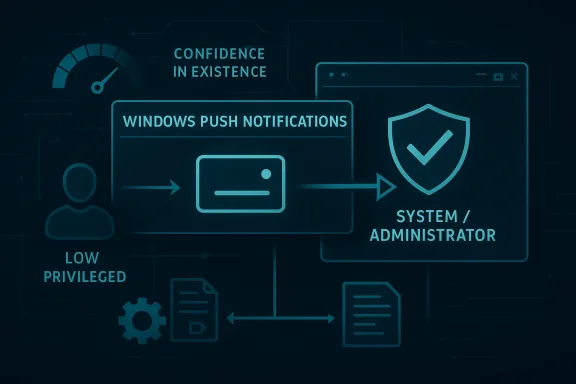
The public description for CVE-2026-26167 identifies it as a Windows Push Notifications Elevation of Privilege Vulnerability. That wording alone tells defenders three important things: it is local rather than remote, it affects a core Windows component, and successful exploitation would likely help an attacker move from a lower-privileged foothold to a more powerful context. The update-guide style disclosure does not, by itself, reveal the root cause, exploitability details, or whether the bug is actively used in the wild.
That uncertainty is not unusual. Microsoft’s security ecosystem often moves through stages: first a terse advisory, then broader patch notes, then third-party analysis, and sometimes later a more complete technical understanding. In other words, the public record starts with confidence in existence rather than complete exploit narrative. For defenders, that distinction is important because it changes how aggressively the issue should be treated in incident response and patch prioritization.
The historical pattern also matters. Windows privilege-escalation flaws regularly cluster around services that handle object types, message routing, brokered permissions, or serialization boundaries. Push notification infrastructure is a plausible candidate for this class of bug precisely because it is designed to coordinate between user sessions, system services, and applications. If a component mishandles input or resource typing, a local attacker may be able to twist the service into executing code or granting access beyond what it should.
Another point worth noting is that Microsoft’s CVE pages have become increasingly structured, but not always immediately informative. A short advisory can still be meaningful, especially when paired with a patch and a severity classification. The absence of technical detail is not the same as absence of risk. In practice, it often means defenders should assume a real but not fully disclosed weakness and wait for more disclosure only after the window for remediation has started to close.
In the case of CVE-2026-26167, the disclosure framing suggests that Microsoft regards the issue as legitimate enough to track as a named CVE rather than dismissing it as a theoretical condition. That alone should move it into the patch queue. Even without a detailed exploit recipe, a Windows EoP flaw can be attractive to attackers because it can turn a simple initial access event into durable control over the machine.
That makes the component strategically interesting to attackers. A privilege escalation bug in a service layer is often more valuable than a noisy remote exploit because it can be used quietly after an initial foothold. The result may be SYSTEM-level control, persistence, tampering with security tools, or lateral movement to more sensitive environments.
Common abuse patterns in this class of bug include:
The broader lesson is that Windows components that seem mundane often prove security-critical once local exploitation enters the picture. Enterprise teams should treat this as part of the long-running pattern of “small service, large consequence.” Consumers should understand it as yet another reminder that keeping Windows current is less about cosmetic changes and more about closing off escalation paths that malware can use after it lands.
That is why CVE-2026-26167 should be viewed alongside the broader trend of Windows EoP disclosures rather than in isolation. Microsoft has spent years closing privilege boundaries across legacy code paths, modern app frameworks, and service infrastructure. Each patch reflects an ongoing reality: Windows is a huge platform, and privilege boundaries are only as strong as their weakest broker or object-handling path.
Microsoft’s decision to track the issue as a named CVE indicates that it has crossed the threshold from internal concern to external response item. In practical terms, that means defenders should be ready for post-patch analysis and possible third-party write-ups, even if the official advisory remains brief.
The impact is amplified when endpoints have local software installation privileges, run legacy agents, or sit in sectors with mixed trust models. A successful attacker does not need a browser zero-day if they can first land via phishing, malicious script execution, or a separate vulnerability, then escalate locally. That is why Windows EoP flaws are frequently the second or third stage of serious incidents.
There is also the issue of layered defense. Credential protection tools, application control, and endpoint monitoring do not replace patching, but they can make privilege escalation harder to convert into full compromise. A strong enterprise posture assumes a local bug will eventually be found and focuses on limiting what the attacker can do next.
Home users often assume they are not attractive targets unless they are high-profile. That is a mistake. Commodity malware frequently includes EoP attempts because they improve success rates across a wide range of victims. A patchable Windows component is an easy target for opportunistic attackers who want to turn one low-privilege foothold into a full system takeover.
In that sense, a patch for a push-notification privilege issue is a reminder that the platform is only as secure as the least disciplined machine in the fleet. One unpatched desktop can become the beachhead for data theft, account abuse, or ransomware staging.
That is why defenders should not downgrade a vulnerability simply because it requires prior access. In modern attacks, that prerequisite is often the easiest part. Once a machine is compromised at all, the question becomes whether the attacker can convert that foothold into durable control. Local EoP bugs are the accelerant.
In Microsoft Windows environments, local escalation is often the difference between a recoverable endpoint incident and a domain-scale problem. The presence of a named CVE in a privileged system component is a strong reason to take the patch seriously, even when the initial advisory is short on detail.
That said, patching alone is only one layer of the response. Security teams should also think about exposure windows, rollback planning, and how to handle endpoints that cannot be updated immediately. Legacy line-of-business apps, controlled environments, and offline systems often complicate a clean rollout.
This is especially important for endpoint fleets with remote workers and long-lived laptops. Devices outside the corporate network can miss internal patch-cadence checks and may remain exposed long after the update is published. Good asset management and compliance reporting matter as much as the patch itself.
There is also a broader strategic lesson. Organizations should not build response plans around the hope that an exploit remains obscure. In today’s ecosystem, obscurity is temporary, and patchable local privilege issues are especially likely to draw attention from researchers and attackers alike. The best defense is to reduce exposure before that attention arrives.
CVE-2026-26167 fits the classic Windows security story: a seemingly narrow bug in a system component can have outsized operational consequences once an attacker gets inside the perimeter. The right response is not panic, but disciplined urgency. Patch early, verify exposure, and assume that even a sparse advisory may represent a very real path to higher privilege.
Source: MSRC Security Update Guide - Microsoft Security Response Center
 Background
Windows Push Notifications is one of those platform components most users never think about, yet it sits close enough to the operating system’s plumbing that flaws there can matter a great deal. Anything that brokers state, messages, or app interactions inside a privileged Windows service deserves attention because a failure can create an opportunity for local privilege escalation. Historically, Microsoft has repeatedly had to harden Windows subsystems that were never designed with modern attacker persistence in mind.The public description for CVE-2026-26167 identifies it as a Windows Push Notifications Elevation of Privilege Vulnerability. That wording alone tells defenders three important things: it is local rather than remote, it affects a core Windows component, and successful exploitation would likely help an attacker move from a lower-privileged foothold to a more powerful context. The update-guide style disclosure does not, by itself, reveal the root cause, exploitability details, or whether the bug is actively used in the wild.
That uncertainty is not unusual. Microsoft’s security ecosystem often moves through stages: first a terse advisory, then broader patch notes, then third-party analysis, and sometimes later a more complete technical understanding. In other words, the public record starts with confidence in existence rather than complete exploit narrative. For defenders, that distinction is important because it changes how aggressively the issue should be treated in incident response and patch prioritization.
The historical pattern also matters. Windows privilege-escalation flaws regularly cluster around services that handle object types, message routing, brokered permissions, or serialization boundaries. Push notification infrastructure is a plausible candidate for this class of bug precisely because it is designed to coordinate between user sessions, system services, and applications. If a component mishandles input or resource typing, a local attacker may be able to twist the service into executing code or granting access beyond what it should.
Another point worth noting is that Microsoft’s CVE pages have become increasingly structured, but not always immediately informative. A short advisory can still be meaningful, especially when paired with a patch and a severity classification. The absence of technical detail is not the same as absence of risk. In practice, it often means defenders should assume a real but not fully disclosed weakness and wait for more disclosure only after the window for remediation has started to close.
What the advisory means
The phrase “This metric measures the degree of confidence in the existence of the vulnerability” is essentially Microsoft telling readers how solid the underlying evidence is. If a vulnerability is confirmed by the vendor, the confidence level is naturally higher than if the issue is inferred from behavior, partial research, or indirect reporting. For practitioners, that matters because a confident advisory usually deserves a more urgent patch response than a speculative one.In the case of CVE-2026-26167, the disclosure framing suggests that Microsoft regards the issue as legitimate enough to track as a named CVE rather than dismissing it as a theoretical condition. That alone should move it into the patch queue. Even without a detailed exploit recipe, a Windows EoP flaw can be attractive to attackers because it can turn a simple initial access event into durable control over the machine.
Why confidence matters operationally
A vulnerability with high confidence but few technical details can still be dangerous. Attackers do not need the full narrative to start reverse-engineering a patch, and defenders do not need the complete root cause to know they are exposed. In practice, the lag between patch release and exploit development is often short enough that waiting for “more detail” is a bad strategy.- Patch priority rises when the vendor confirms the issue.
- Exposure assessment becomes more urgent when the component is local and privileged.
- Detection engineering is harder when the root cause is unpublished.
- Exploit development pressure increases once a CVE number is public.
- Uncertainty is not safety; it is often just a temporary knowledge gap.
Windows Push Notifications as an attack surface
Windows Push Notifications is not a headline component like the kernel or the browser, but it occupies a sensitive role in the Windows software stack. Any subsystem that handles cross-process coordination, app state, and service interactions may expose a broad attack surface. A flaw there can be leveraged by a low-privileged local user, a sandbox escape chain, or malware already running under standard-user permissions.That makes the component strategically interesting to attackers. A privilege escalation bug in a service layer is often more valuable than a noisy remote exploit because it can be used quietly after an initial foothold. The result may be SYSTEM-level control, persistence, tampering with security tools, or lateral movement to more sensitive environments.
Why these bugs are so useful
Push-notification and brokered-service issues tend to sit at the intersection of user context and privileged context. That is exactly where attackers like to probe. If the service trusts a structure, assumes a type, or mishandles lifecycle state, a malicious caller may be able to manipulate memory, impersonate a higher-privileged operation, or trigger access that was never intended.Common abuse patterns in this class of bug include:
- Improper authorization checks
- Incorrect object type handling
- Confused-deputy behavior
- Memory corruption in brokered service code
- Race conditions during message handling
The broader lesson is that Windows components that seem mundane often prove security-critical once local exploitation enters the picture. Enterprise teams should treat this as part of the long-running pattern of “small service, large consequence.” Consumers should understand it as yet another reminder that keeping Windows current is less about cosmetic changes and more about closing off escalation paths that malware can use after it lands.
How this fits Microsoft’s vulnerability pattern
Microsoft’s recent vulnerability handling has become more transparent at the metadata layer, but not necessarily more verbose in every CVE record. The company has been expanding structured advisory data and machine-readable disclosures, while still reserving the right to publish only what is necessary at first. That approach helps customers automate response, but it also means a CVE page can look minimal while still representing a real security concern.That is why CVE-2026-26167 should be viewed alongside the broader trend of Windows EoP disclosures rather than in isolation. Microsoft has spent years closing privilege boundaries across legacy code paths, modern app frameworks, and service infrastructure. Each patch reflects an ongoing reality: Windows is a huge platform, and privilege boundaries are only as strong as their weakest broker or object-handling path.
The business of “quiet” disclosures
Not every serious flaw arrives with a dramatic blog post. Sometimes the most consequential bugs are the ones that surface in a compact advisory and then disappear into patch management workflows. The lack of fanfare does not reduce the operational importance. In many cases, it increases it because admins may underestimate a CVE that appears understated in the update guide.- Quiet advisories often mask important internal validation.
- Local elevation bugs are frequently chained with other attacks.
- Minimal disclosure can be deliberate while patches are rolling out.
- Public detail scarcity does not mean low exploitation value.
- Security teams should watch for later enrichment from researchers or vendors.
Microsoft’s decision to track the issue as a named CVE indicates that it has crossed the threshold from internal concern to external response item. In practical terms, that means defenders should be ready for post-patch analysis and possible third-party write-ups, even if the official advisory remains brief.
Enterprise impact
For enterprises, a Windows privilege-escalation flaw is never just an endpoint problem. It is a control-plane problem because local admin or SYSTEM access often becomes the stepping stone for credential theft, service tampering, and broader environment compromise. A vulnerability like CVE-2026-26167 may be especially relevant on shared workstations, VDI environments, jump hosts, and systems where low-privileged users are common.The impact is amplified when endpoints have local software installation privileges, run legacy agents, or sit in sectors with mixed trust models. A successful attacker does not need a browser zero-day if they can first land via phishing, malicious script execution, or a separate vulnerability, then escalate locally. That is why Windows EoP flaws are frequently the second or third stage of serious incidents.
Enterprise priorities
Security teams should think in terms of exposure reduction, not just patch counting. The practical steps are familiar, but they matter more when the bug lives in a privileged subsystem. The patch may be straightforward; the real challenge is finding the systems that cannot be patched quickly or that have unusual app dependencies.- Identify affected Windows builds across desktops, servers, and VDI pools.
- Prioritize internet-exposed or high-value endpoints that could become initial footholds.
- Patch before broad user resumption if the issue sits in a widely deployed service.
- Review local admin sprawl because escalation value rises when users already have too much power.
- Monitor for unusual service behavior on endpoints that receive the update late.
There is also the issue of layered defense. Credential protection tools, application control, and endpoint monitoring do not replace patching, but they can make privilege escalation harder to convert into full compromise. A strong enterprise posture assumes a local bug will eventually be found and focuses on limiting what the attacker can do next.
Consumer impact
For consumers, a flaw like CVE-2026-26167 is less about abstract vulnerability classes and more about the consequences of getting owned on a personal machine. Local privilege escalation can enable malware to disable security tools, install persistent components, hide activity, or tamper with system settings. Even if the original infection vector is a fake installer, script, or browser-based payload, the privilege step can turn a nuisance into a durable compromise.Home users often assume they are not attractive targets unless they are high-profile. That is a mistake. Commodity malware frequently includes EoP attempts because they improve success rates across a wide range of victims. A patchable Windows component is an easy target for opportunistic attackers who want to turn one low-privilege foothold into a full system takeover.
What consumers should do
The response for consumers is simple but should be taken seriously. Patch promptly, reboot when required, and do not delay because the update description looks technical or unfamiliar. Windows security updates often fix issues that are invisible until they are used against you.- Keep Windows Update enabled.
- Reboot after cumulative updates if prompted.
- Avoid local administrator accounts for everyday use.
- Maintain reputable endpoint protection.
- Treat suspicious installers and scripts as potential footholds.
In that sense, a patch for a push-notification privilege issue is a reminder that the platform is only as secure as the least disciplined machine in the fleet. One unpatched desktop can become the beachhead for data theft, account abuse, or ransomware staging.
Why local privilege escalation remains so dangerous
Local privilege escalation bugs often receive less public attention than remote code execution flaws, but they can be equally important in real-world intrusions. Attackers rarely need one perfect exploit. They need a chain. A low-privilege code execution bug, phishing artifact, malicious macro, or browser sandbox escape becomes far more useful when paired with a local EoP like CVE-2026-26167.That is why defenders should not downgrade a vulnerability simply because it requires prior access. In modern attacks, that prerequisite is often the easiest part. Once a machine is compromised at all, the question becomes whether the attacker can convert that foothold into durable control. Local EoP bugs are the accelerant.
How attackers use escalation chains
The typical sequence looks deceptively ordinary. A user executes something they should not, malware lands with standard-user permissions, and then the attacker hunts for a privilege boundary to cross. If the boundary is weak, the machine may be effectively lost even if endpoint protection catches the original payload later.- Initial access from phishing or drive-by delivery
- Standard-user code execution on the target
- Discovery of a local privilege escalation path
- Elevation to admin or SYSTEM
- Persistence, defense evasion, and credential access
In Microsoft Windows environments, local escalation is often the difference between a recoverable endpoint incident and a domain-scale problem. The presence of a named CVE in a privileged system component is a strong reason to take the patch seriously, even when the initial advisory is short on detail.
Mitigation and patch management strategy
The best mitigation for CVE-2026-26167 is likely to be the standard one: install the relevant Windows security update as soon as your change-management process allows. When Microsoft discloses a privilege-escalation issue in a core component, the patch should be treated as part of baseline hardening rather than optional maintenance. If the update applies to your build, the window for delay should be as small as possible.That said, patching alone is only one layer of the response. Security teams should also think about exposure windows, rollback planning, and how to handle endpoints that cannot be updated immediately. Legacy line-of-business apps, controlled environments, and offline systems often complicate a clean rollout.
Operational best practices
A disciplined patch process reduces the chance that a known EoP vulnerability remains available long enough to be chained into a broader compromise. The goal is not only to install the fix, but to know where the unpatched systems are and why they are unpatched.- Test updates in a representative ring before broad deployment.
- Prioritize systems with elevated access or sensitive data.
- Track patch compliance by device class, not just by department.
- Use maintenance windows to avoid update deferral drift.
- Validate that reboot requirements are actually completed.
This is especially important for endpoint fleets with remote workers and long-lived laptops. Devices outside the corporate network can miss internal patch-cadence checks and may remain exposed long after the update is published. Good asset management and compliance reporting matter as much as the patch itself.
Strengths and Opportunities
Microsoft’s handling of CVE-2026-26167 demonstrates the strength of a structured advisory ecosystem: even brief disclosures can still move defenders to action. The opportunity for enterprises is to use this event as a reminder to tighten local-privilege assumptions and shorten remediation cycles. It is also a chance to improve patch visibility on devices that otherwise disappear from daily oversight.- Fast patching can neutralize the most likely attack path early.
- Endpoint inventory helps identify hidden exposure.
- Least privilege reduces the payoff from successful exploitation.
- Security monitoring can catch abnormal escalation behavior.
- Change management discipline makes rapid remediation less chaotic.
- User education lowers the chance of the initial foothold.
- Better telemetry improves confidence when the advisory is sparse.
Risks and Concerns
The biggest concern is the usual one: local privilege escalation bugs are easy to underestimate, and underestimation creates delay. If a CVE page looks thin, some teams treat it as low priority, which is exactly the wrong lesson to draw from a confirmed Windows security issue. A second concern is that attackers may move faster than defenders once the patch becomes broadly known.- Slow patch adoption leaves a window for exploitation.
- Sparse disclosure can cause triage mistakes.
- Privilege chains make the flaw more valuable than it looks.
- Legacy endpoints may miss updates for operational reasons.
- Overprivileged users increase the blast radius.
- Inadequate telemetry can hide early signs of abuse.
- False reassurance is a real operational hazard.
Looking Ahead
The next phase will likely depend on whether Microsoft enriches the advisory or whether independent researchers publish analysis of the patch. If more technical detail emerges, security teams should re-evaluate their prioritization immediately. The pattern in Windows vulnerability handling is clear: initial brevity often gives way to more actionable information after patches land in the field.There is also a broader strategic lesson. Organizations should not build response plans around the hope that an exploit remains obscure. In today’s ecosystem, obscurity is temporary, and patchable local privilege issues are especially likely to draw attention from researchers and attackers alike. The best defense is to reduce exposure before that attention arrives.
- Confirm which Windows versions are affected in your environment.
- Verify patch deployment status across all endpoints.
- Watch for post-patch analysis or exploit proofs.
- Review local admin assignments and service permissions.
- Keep incident response ready for chained escalation scenarios.
CVE-2026-26167 fits the classic Windows security story: a seemingly narrow bug in a system component can have outsized operational consequences once an attacker gets inside the perimeter. The right response is not panic, but disciplined urgency. Patch early, verify exposure, and assume that even a sparse advisory may represent a very real path to higher privilege.
Source: MSRC Security Update Guide - Microsoft Security Response Center
