

Microsoft Confirms the Flaw, but Not the Story Behind It
The most important thing about CVE-2026-26145 is the source of the claim. This is not a rumor from a paste site, an exploit-market tease, or a researcher thread with a proof-of-concept attached. It is a Microsoft-tracked vulnerability in Azure Synapse, which means the existence of the issue is no longer speculative.
That matters because the user-supplied metric here is really about confidence: how certain we are that the vulnerability exists, and how much useful technical detail has escaped into the world. On the first half, confidence is high. Microsoft’s acknowledgement carries more weight than third-party chatter.
On the second half, confidence is much thinner. Public descriptions of cloud vulnerabilities often compress a large amount of engineering complexity into a single sentence: an authorized attacker, over a network, could elevate privileges. That tells defenders the broad class of risk. It does not tell them whether the vulnerable path involved workspace roles, managed identities, notebooks, Spark pools, integration runtimes, control-plane APIs, data-plane authorization, or some internal service-to-service trust boundary.
That gap is not an accident. Cloud vendors routinely disclose enough to satisfy vulnerability coordination norms while withholding implementation detail that could accelerate exploitation. For customers, however, the result is an uncomfortable middle ground: the bug is real, the impact is serious, and the mechanics are mostly opaque.
Azure Synapse Makes Privilege Bugs Especially Awkward
Azure Synapse is not a simple database product with one clean perimeter. It is a sprawling analytics service that blends data warehousing, Spark, pipelines, notebooks, SQL endpoints, storage integration, identity delegation, and administrative control planes. That design is powerful precisely because it lets organizations move between data engineering, business intelligence, and machine learning workflows without rebuilding the platform every time.
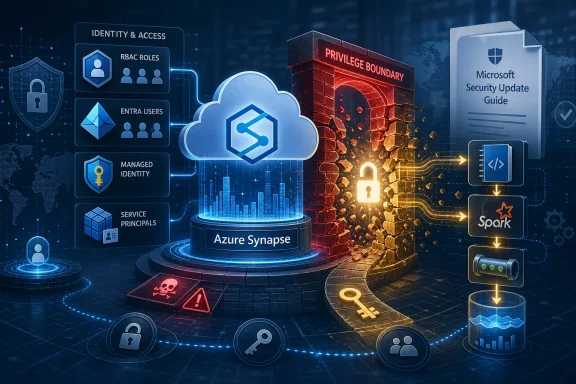
The same design also makes privilege boundaries harder to reason about. A Synapse workspace often sits at the intersection of Azure role-based access control, Synapse-specific roles, Microsoft Entra identities, managed identities, linked services, storage accounts, Key Vault references, private networking, and data-lake permissions. A flaw in one layer may not look catastrophic until it is combined with trust granted by another.
That is why “elevation of privilege” in a cloud analytics service should not be read as a narrow local-account problem. In traditional Windows patching language, elevation of privilege often evokes a low-privileged user becoming administrator on a machine. In Synapse, privilege can mean something broader and stranger: the ability to act as a more trusted service, reach data that should have been isolated, modify analytics pipelines, alter compute behavior, or pivot into adjacent resources through delegated identity.
The word authorized is also doing real work. It suggests the attacker already needs some legitimate level of access, which lowers the nightmare factor compared with unauthenticated remote code execution. But in enterprise cloud environments, “authorized” is not necessarily reassuring. Many tenants contain hundreds or thousands of identities with some degree of access to analytics workspaces, including contractors, data analysts, automation accounts, developers, service principals, and forgotten project roles.
A vulnerability that turns modest workspace access into broader authority can be exactly the sort of bug attackers prize after an initial compromise. It may not open the front door, but it can make the hallway much longer.
The Confidence Metric Cuts Both Ways
The text attached to the vulnerability describes a metric that measures confidence in both the existence of a vulnerability and the credibility of known technical details. That framing is unusually useful here because CVE-2026-26145 sits at the high-confidence, low-detail end of the spectrum.
There is strong reason to believe the vulnerability exists because Microsoft has published it through its security process. Vendor acknowledgement is usually the final stop on the credibility ladder. It means the affected technology owner has accepted that the issue is real enough to track, score, and remediate.
But the public technical record appears sparse. That limits what defenders can infer about exploitation paths, compensating controls, detections, and tenant-specific risk. The difference between “this can be exploited only through a rare misconfiguration” and “this can be reached by any contributor-level workspace user” is enormous, but a short advisory may not expose that distinction.
This is where vulnerability scoring can accidentally mislead. A high score or severe impact description communicates urgency, but it can also create the illusion of precision. Security teams may know that confidentiality, integrity, and availability are potentially at stake, while still knowing almost nothing about which logs to search, which permissions to audit first, or which user journeys were actually vulnerable.
That is not a reason to dismiss the advisory. It is a reason to treat it as a verified signal, not a complete incident playbook.
Cloud Patching Has Changed the Defender’s Job
For Windows administrators, the old reflex is straightforward: identify affected systems, test the patch, deploy the patch, watch for breakage. Azure service vulnerabilities do not always fit that muscle memory. When Microsoft fixes an “exclusively hosted” or cloud-service-side issue, the customer may not download anything at all.
That sounds easier, and sometimes it is. If the vulnerable code lives entirely inside Microsoft-operated infrastructure, remediation can happen without customers touching endpoints, rebooting servers, or scheduling maintenance windows. From a fleet-management perspective, that is one of the real advantages of cloud services.
But the simplicity is deceptive. A server-side fix does not answer whether the vulnerability was exploited before remediation. It does not tell customers whether risky permissions made exploitation easier. It does not clean up over-broad Synapse roles, stale service principals, exposed storage accounts, leaked secrets, permissive managed identities, or weak data governance. And it does not necessarily prove that every tenant’s configuration was equally safe before the fix landed.
Cloud patching moves the customer’s responsibility from binary installation status to exposure management. The right question is not only “Did Microsoft patch it?” The better question is “If this class of privilege boundary failed, what could an attacker have reached in our tenant?”
That is a harder question, and it is usually not answered by a vulnerability scanner alone.
The Real Risk Is the Identity Graph Around Synapse
Synapse is rarely dangerous in isolation. It becomes dangerous because of what it can touch. A workspace may have access to a data lake containing regulated records, a Key Vault holding secrets, pipelines that move production data, managed identities with permissions on storage accounts, or notebooks that run code close to sensitive datasets.
Privilege escalation in that context can become a graph problem. The initial foothold may be a low-level Synapse role. The next step may be abusing a workspace identity. The next may be reading linked-service credentials or modifying a pipeline. After that, the attacker may not look like a Synapse attacker at all; they may look like legitimate automation touching legitimate data.
That is why cloud EoP bugs deserve more attention than their name sometimes receives. “Elevation of privilege” sounds less dramatic than “remote code execution,” but in identity-heavy platforms the distinction can blur. If a user can make the platform perform privileged actions on their behalf, the attacker may not need traditional code execution to cause damage.
For defenders, this means the most meaningful work is often mundane. Review who has access to Synapse workspaces. Check whether contributor-style permissions have become the default answer to every data-team request. Audit managed identities and service principals attached to workspaces. Confirm that storage permissions are scoped to actual need. Revisit whether development and production analytics environments are separated by policy or merely by convention.
The vulnerability may be Microsoft’s bug. The blast radius is often the customer’s architecture.
Secrecy Protects Customers and Frustrates Them at the Same Time
There is an obvious reason Microsoft does not publish a full exploit recipe for a newly disclosed privilege escalation issue in Azure Synapse. Even after remediation, cloud services can have lagging edge cases, customer-specific dependencies, or analogous paths in neighboring services. Detailed public writeups can be useful to defenders, but they are also useful to attackers.
Yet the lack of detail has costs. Security teams are increasingly expected to make risk decisions at board speed. They need to tell leadership whether a vulnerability affects regulated data, whether exploitation was likely, whether existing monitoring would have seen it, and whether compensating controls were in place. “Microsoft says it is fixed” may be true and still insufficient.
This is the persistent bargain of managed cloud security. Customers outsource infrastructure operations but not accountability. They gain speed, scale, and vendor-run patching, while losing visibility into the exact code paths that failed. When something goes wrong, the customer sees the shadow on the wall before they see the object casting it.
Microsoft has improved cloud vulnerability transparency over the years, especially as pressure has grown around identity security, tenant isolation, and secure-by-design practices. But every terse Azure advisory is a reminder that the industry has not fully solved the communication problem. The vendor knows the most, attackers may eventually learn enough, and customers must act while standing between those two points.
The “Authorized Attacker” Phrase Should Not Calm Anyone Too Much
Security advisories often classify attacks by whether credentials or privileges are required. That is useful for scoring, but it can understate the reality of modern intrusions. Attackers regularly obtain valid credentials through phishing, token theft, infostealers, exposed secrets, over-permissioned automation, or compromised developer machines.
In that world, requiring authorization is a speed bump, not a wall. A flaw that requires low privileges may be inaccessible to the internet at large but very attractive to an attacker who has already landed inside a tenant. It is the difference between an initial-access bug and a post-compromise amplifier.
Synapse is especially relevant because analytics environments often contain broad populations of semi-technical users. Data analysts, engineers, contractors, and application teams may all have legitimate reasons to interact with a workspace. Their access may be temporary in theory and permanent in practice. Their roles may have been granted during a project sprint and never revisited.
The better defensive assumption is that some valid identities will eventually be abused. Under that model, least privilege becomes less of a compliance slogan and more of a containment strategy. If CVE-2026-26145 or a similar flaw allows an attacker to climb from one role to another, the distance between those roles determines how bad the day becomes.
Synapse Customers Need Evidence, Not Panic
The right response to this advisory is not panic-patching, because most customers may have no patch artifact to deploy. It is also not complacency, because a vendor-confirmed cloud privilege flaw in an analytics platform is exactly the kind of issue that can sit quietly inside an attacker’s privilege chain.
The first task is inventory. Many enterprises do not have a clean answer to how many Synapse workspaces exist, who owns them, which ones are dormant, and which ones have access to sensitive data. Shadow analytics environments are common because cloud platforms make experimentation easy. Security programs usually discover later that the experiment became production.
The second task is access review. Synapse-specific roles and Azure RBAC assignments should be inspected for excessive grants, especially broad contributor or owner-style permissions. Service principals deserve particular attention because they often outlive the humans and projects that created them.
The third task is log review. Teams should examine Azure activity logs, Synapse workspace activity, identity sign-ins, role assignment changes, pipeline modifications, linked-service changes, unusual notebook activity, and access to connected storage or Key Vault resources during the relevant disclosure and remediation window. The exact exploit mechanics may be unknown, but suspicious privilege changes and unexpected data access are still worth hunting.
The fourth task is architectural cleanup. If a Synapse workspace can reach far more data than it needs, or if managed identities have sweeping permissions across resource groups, the organization has a standing problem independent of this CVE. A specific vulnerability merely makes that problem easier to see.
Microsoft’s Cloud Security Bet Depends on Trust, but Trust Needs Telemetry
Azure customers do not expect Microsoft to reveal every internal implementation detail of Synapse. They do, however, increasingly expect enough telemetry to validate their own risk. That is the tension at the heart of cloud security in 2026: vendors want to abstract away the infrastructure, while customers still need evidence that their data and identities were not abused.
Microsoft’s security posture now rests not only on fixing vulnerabilities but on making customers feel that cloud fixes are auditable. When a Windows patch installs, administrators can verify build numbers, update history, and deployment rings. When a cloud service is fixed, the proof is more abstract. Customers may get an advisory, a status signal, and logs whose usefulness depends on prior configuration.
That asymmetry matters for regulated industries. A healthcare provider, bank, manufacturer, or public agency cannot simply say “the vendor handled it” if sensitive data may have been exposed. They need a defensible narrative: what was affected, when it was remediated, whether exploitation was observed, what logs were reviewed, and what controls limited impact.
The industry is moving toward that model, but slowly. Cloud providers publish more advisories than they once did. CVE records increasingly include hosted services. Customers are better at demanding logs, identity governance, and service-level security transparency. Still, the Synapse case shows how much of cloud vulnerability management remains an exercise in inference.
The Lesson Is Bigger Than One Synapse CVE
CVE-2026-26145 should be read as part of a broader pattern: privilege boundaries in cloud platforms are becoming the security story. Attackers no longer need to break every door when identity systems, service roles, and automation pathways can open them from the inside. The most valuable bugs are often the ones that transform limited access into trusted action.
For WindowsForum readers, that shift may feel familiar. Windows security spent decades learning that local administrator rights, token handling, service permissions, and kernel boundaries were not boring implementation details but the core of system defense. Azure is going through a comparable reckoning at cloud scale. The primitives are different, but the argument is the same: privilege boundaries are the product.
Synapse adds data gravity to that problem. The platform exists to concentrate and process valuable information. That makes any privilege confusion more consequential than it would be in a low-value service. If an attacker can move from authorized user to elevated actor, the prize may be the organization’s analytical crown jewels rather than a single virtual machine.
The strategic answer is not to abandon managed analytics services. It is to stop treating them as self-contained SaaS islands. Synapse workspaces should be governed like production systems, monitored like privileged infrastructure, and reviewed like identity-sensitive applications.
The Synapse Advisory Leaves a Short but Sharp Action List
The concrete message from CVE-2026-26145 is narrower than the anxiety around it: Microsoft has acknowledged an Azure Synapse elevation-of-privilege issue, but public technical detail appears limited. That combination calls for disciplined verification rather than speculation.
- Organizations should confirm whether they operate Azure Synapse workspaces and identify which ones touch sensitive data or production pipelines.
- Administrators should review Synapse roles, Azure RBAC assignments, managed identities, service principals, and linked services for excessive privilege.
- Security teams should examine activity logs for unusual role changes, pipeline edits, workspace configuration changes, notebook activity, and unexpected access to connected storage or Key Vault resources.
- Cloud governance teams should treat dormant or experimental Synapse workspaces as potential exposure, not harmless clutter.
- Risk owners should document Microsoft’s remediation status alongside the organization’s own evidence of access review and log inspection.
- Future Synapse deployments should be designed around least privilege from the start, because post-compromise privilege expansion is now one of the central cloud attack paths.
The vulnerability’s public record may be brief, but its message is not: in Azure’s analytics stack, identity design and privilege hygiene are not administrative afterthoughts. They are the difference between a contained service bug and a tenant-wide security problem.
CVE-2026-26145 will likely fade into the long ledger of cloud advisories, but the pattern behind it will not. Microsoft can and should keep tightening the hosted service code it controls; customers, meanwhile, have to assume that some future privilege boundary will fail and build Synapse environments where that failure has nowhere useful to go.
References
- CVE-2026-26145 Microsoft Azure Synapse Elevation of Privilege Vulnerability MSRC · 2026-07-02T07:00:00-07:00