

CVE-2026-50396 exposes supported Windows 11 and Windows Server 2025 systems to local privilege escalation through a use-after-free flaw in Windows kernel-mode drivers. Microsoft addressed the vulnerability in security updates released on July 14, 2026, and administrators should verify that affected machines have reached the patched build level rather than treating the update as an ordinary quality rollup.
Microsoft’s Security Response Center classifies the flaw as Important, with a CVSS 3.1 base score of 7.0. The National Vulnerability Database, which received the Microsoft-authored record on July 14, describes it as allowing an authorized local attacker to elevate privileges.
The immediate fixes are KB5101650 for Windows 11 versions 24H2 and 25H2, KB5101649 for Windows 11 version 26H1, and KB5099536 for Windows Server 2025. Microsoft has not publicly documented active exploitation in the material currently available, and the vulnerability’s “Confirmed” report-confidence rating should not be mistaken for evidence of attacks in the wild.
CVE-2026-50396 is a use-after-free vulnerability, tracked under CWE-416. This class of memory-safety defect occurs when code continues to use an object after the associated memory has been released, potentially allowing an attacker to influence what occupies that memory when it is accessed again.
Because the affected component operates in kernel mode, successful exploitation could cross the boundary between a low-privileged account and the most trusted execution context in Windows. Microsoft’s CVSS vector assigns high potential impact to confidentiality, integrity, and availability, meaning a successful attacker could theoretically access protected data, alter system state, and disrupt the machine.
That does not make CVE-2026-50396 remotely exploitable. Microsoft’s vector identifies the attack as local, requiring an attacker to already possess low-level privileges on the target system. No user interaction is required, but exploitation carries high attack complexity.
In operational terms, this is more likely to serve as the second stage of an intrusion than the initial entry point. An attacker could first obtain code execution through phishing, a malicious document, a compromised application, exposed credentials, or another vulnerability, then use a kernel privilege-escalation flaw to break out of the original account’s restrictions.
A successful elevation to SYSTEM can be particularly damaging on administrator workstations, shared endpoints, jump boxes, and servers. It may allow an intruder to interfere with security software, access credentials belonging to other users, install persistent components, or manipulate files and services that a normal account cannot reach.
The patched thresholds published through Microsoft’s CVE record are concrete:
Windows 11 version 26H1 receives KB5101649, bringing supported systems to OS Build 28000.2525. The CVE’s affected-version boundary indicates that builds starting with 28000.2269 already contain the relevant correction, but deploying the July package remains the straightforward way to bring a 26H1 machine to Microsoft’s current security baseline.
Windows Server 2025 and Server Core installations receive KB5099536, advancing the operating system to Build 26100.33158. The cumulative package also includes fixes and non-security changes inherited from the June 2026 update, so enterprises should evaluate the complete rollup during staged testing rather than attempting to isolate CVE-2026-50396 as a standalone patch.
Older Windows releases are not listed in the initial affected-product data for this CVE. Administrators should not extrapolate that list to similarly named kernel vulnerabilities or assume that every kernel-mode driver flaw affects every maintained branch of Windows.
It does not mean that Microsoft has confirmed active attacks. It also does not, by itself, show that proof-of-concept exploit code is public or that reliable exploitation is straightforward.
Those questions are represented separately. Microsoft’s vector labels the attack complexity as high, while the local attack vector and low privilege requirement establish that an attacker needs an existing foothold. The advisory’s remediation level reflects that an official fix is available.
This distinction matters when security teams translate CVSS fields into patch priorities. CVE-2026-50396 is a credible, vendor-confirmed kernel vulnerability with serious post-exploitation impact, but the currently published evidence does not put it in the same emergency category as a remotely reachable flaw or a zero-day known to be under active attack.
High attack complexity is not a permanent guarantee of safety, however. Exploit reliability can improve as researchers analyze patched binaries, compare pre-update and post-update code, and publish technical findings. Kernel privilege-escalation flaws also retain value because they can be combined with unrelated initial-access techniques.
Administrators managing fleets through Windows Server Update Services, Microsoft Intune, Windows Autopatch, Configuration Manager, or another patch platform should report on the resulting OS build, not merely whether an update deployment was offered. A device can appear in an update collection while still awaiting installation, restart, or successful servicing completion.
Endpoints that cannot immediately receive the cumulative update deserve closer controls because Microsoft has not published a CVE-specific workaround in the available record. Reducing unnecessary local accounts, restricting software execution, monitoring unexpected driver activity, and limiting interactive access to servers can reduce exposure, but none of those measures removes the vulnerable code.
The July updates also carry changes beyond CVE-2026-50396. Microsoft warns that security updates released on or after July 14 enforce registration requirements for third-party Transport Driver Interface transports, potentially breaking sockets used over unregistered third-party TDI drivers. Organizations with legacy networking, filtering, VPN, monitoring, or specialized communications software should include that compatibility change in predeployment testing.
That testing requirement should not become an excuse for an open-ended delay. CVE-2026-50396 turns an existing low-privileged foothold into a potential kernel compromise, and the durable remediation is to move Windows 11 24H2 and 25H2 to KB5101650, Windows 11 26H1 to KB5101649, and Windows Server 2025 to KB5099536 while watching Microsoft’s advisory for revisions or any later change in exploitation status.
Microsoft’s Security Response Center classifies the flaw as Important, with a CVSS 3.1 base score of 7.0. The National Vulnerability Database, which received the Microsoft-authored record on July 14, describes it as allowing an authorized local attacker to elevate privileges.
The immediate fixes are KB5101650 for Windows 11 versions 24H2 and 25H2, KB5101649 for Windows 11 version 26H1, and KB5099536 for Windows Server 2025. Microsoft has not publicly documented active exploitation in the material currently available, and the vulnerability’s “Confirmed” report-confidence rating should not be mistaken for evidence of attacks in the wild.
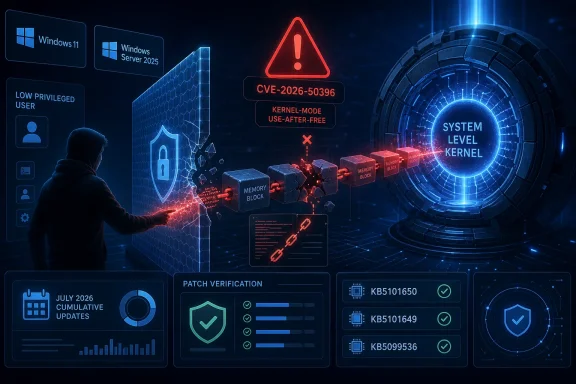 A Local Flaw With Kernel-Level Consequences
CVE-2026-50396 is a use-after-free vulnerability, tracked under CWE-416. This class of memory-safety defect occurs when code continues to use an object after the associated memory has been released, potentially allowing an attacker to influence what occupies that memory when it is accessed again.Because the affected component operates in kernel mode, successful exploitation could cross the boundary between a low-privileged account and the most trusted execution context in Windows. Microsoft’s CVSS vector assigns high potential impact to confidentiality, integrity, and availability, meaning a successful attacker could theoretically access protected data, alter system state, and disrupt the machine.
That does not make CVE-2026-50396 remotely exploitable. Microsoft’s vector identifies the attack as local, requiring an attacker to already possess low-level privileges on the target system. No user interaction is required, but exploitation carries high attack complexity.
In operational terms, this is more likely to serve as the second stage of an intrusion than the initial entry point. An attacker could first obtain code execution through phishing, a malicious document, a compromised application, exposed credentials, or another vulnerability, then use a kernel privilege-escalation flaw to break out of the original account’s restrictions.
A successful elevation to SYSTEM can be particularly damaging on administrator workstations, shared endpoints, jump boxes, and servers. It may allow an intruder to interfere with security software, access credentials belonging to other users, install persistent components, or manipulate files and services that a normal account cannot reach.
The Affected Windows Builds Are Narrowly Defined
The initial Microsoft CVE data lists Windows 11 versions 24H2, 25H2, and 26H1 alongside Windows Server 2025 and its Server Core installation option. Both x64 and Arm64 editions are included for the affected Windows 11 releases, while Windows Server 2025 is listed for x64 systems.The patched thresholds published through Microsoft’s CVE record are concrete:
- Windows 11 version 24H2 must be updated to OS Build 26100.8875 or later.
- Windows 11 version 25H2 must be updated to OS Build 26200.8875 or later.
- Windows 11 version 26H1 must be on OS Build 28000.2269 or later, although Microsoft’s current July cumulative update advances it to 28000.2525.
- Windows Server 2025 must be updated to OS Build 26100.33158 or later.
Windows 11 version 26H1 receives KB5101649, bringing supported systems to OS Build 28000.2525. The CVE’s affected-version boundary indicates that builds starting with 28000.2269 already contain the relevant correction, but deploying the July package remains the straightforward way to bring a 26H1 machine to Microsoft’s current security baseline.
Windows Server 2025 and Server Core installations receive KB5099536, advancing the operating system to Build 26100.33158. The cumulative package also includes fixes and non-security changes inherited from the June 2026 update, so enterprises should evaluate the complete rollup during staged testing rather than attempting to isolate CVE-2026-50396 as a standalone patch.
Older Windows releases are not listed in the initial affected-product data for this CVE. Administrators should not extrapolate that list to similarly named kernel vulnerabilities or assume that every kernel-mode driver flaw affects every maintained branch of Windows.
“Confirmed” Describes Evidence, Not Exploitation
The report-confidence language included with the advisory can easily sound more alarming than Microsoft intends. In CVSS 3.1, a “Confirmed” rating means that sufficiently credible technical evidence exists to establish that the vulnerability is real. That confirmation may come from detailed research, reproducible behavior, source code, or acknowledgement by the vendor.It does not mean that Microsoft has confirmed active attacks. It also does not, by itself, show that proof-of-concept exploit code is public or that reliable exploitation is straightforward.
Those questions are represented separately. Microsoft’s vector labels the attack complexity as high, while the local attack vector and low privilege requirement establish that an attacker needs an existing foothold. The advisory’s remediation level reflects that an official fix is available.
This distinction matters when security teams translate CVSS fields into patch priorities. CVE-2026-50396 is a credible, vendor-confirmed kernel vulnerability with serious post-exploitation impact, but the currently published evidence does not put it in the same emergency category as a remotely reachable flaw or a zero-day known to be under active attack.
High attack complexity is not a permanent guarantee of safety, however. Exploit reliability can improve as researchers analyze patched binaries, compare pre-update and post-update code, and publish technical findings. Kernel privilege-escalation flaws also retain value because they can be combined with unrelated initial-access techniques.
Patch Verification Matters More Than the Update Button
On individual Windows 11 PCs, the July cumulative update should arrive through Windows Update according to the device’s servicing policy. Users can confirm the installed build under Settings > System > About, or runwinver to inspect the version and OS build.Administrators managing fleets through Windows Server Update Services, Microsoft Intune, Windows Autopatch, Configuration Manager, or another patch platform should report on the resulting OS build, not merely whether an update deployment was offered. A device can appear in an update collection while still awaiting installation, restart, or successful servicing completion.
Endpoints that cannot immediately receive the cumulative update deserve closer controls because Microsoft has not published a CVE-specific workaround in the available record. Reducing unnecessary local accounts, restricting software execution, monitoring unexpected driver activity, and limiting interactive access to servers can reduce exposure, but none of those measures removes the vulnerable code.
The July updates also carry changes beyond CVE-2026-50396. Microsoft warns that security updates released on or after July 14 enforce registration requirements for third-party Transport Driver Interface transports, potentially breaking sockets used over unregistered third-party TDI drivers. Organizations with legacy networking, filtering, VPN, monitoring, or specialized communications software should include that compatibility change in predeployment testing.
That testing requirement should not become an excuse for an open-ended delay. CVE-2026-50396 turns an existing low-privileged foothold into a potential kernel compromise, and the durable remediation is to move Windows 11 24H2 and 25H2 to KB5101650, Windows 11 26H1 to KB5101649, and Windows Server 2025 to KB5099536 while watching Microsoft’s advisory for revisions or any later change in exploitation status.
References
- Primary source: MSRC
Published: 2026-07-14T07:00:00-07:00
Security Update Guide - Microsoft Security Response Center
 msrc.microsoft.com
- Related coverage: aha.org
