

CVE-2026-50332 is a Windows Kernel elevation-of-privilege vulnerability that Microsoft patched on July 14, 2026, across supported editions of Windows 10, Windows 11, and Windows Server. The flaw carries a CVSS 3.1 base score of 7.8 and an Important severity rating, making July’s cumulative security updates the direct fix for affected systems.
Microsoft’s Security Update Guide describes the vulnerability as a heap-based buffer overflow in the Windows Kernel. The National Vulnerability Database, which received the record from Microsoft on July 14, also identifies a numeric truncation error as part of the weakness profile.
This is not a remote, unauthenticated entry point. An attacker must already be authorized to run code locally with low privileges, but successful exploitation could compromise confidentiality, integrity, and availability at a high level.
The CVSS vector is
That profile makes CVE-2026-50332 more relevant to post-compromise activity than initial intrusion. Malware, a malicious local user, or an attacker who has obtained limited account access could potentially use the kernel flaw to escape the restrictions of that account and operate with substantially greater authority.
Kernel elevation vulnerabilities are valuable because the Windows Kernel sits beneath normal application and user boundaries. A successful exploit may allow an attacker to interfere with processes, security controls, credentials, files, and system configuration that would ordinarily be inaccessible to a standard user.
The two weakness identifiers add some technical shape to an otherwise brief advisory. CWE-122 denotes a heap-based buffer overflow, where data can be written beyond the allocated boundary of an object in heap memory. CWE-197 covers numeric truncation, in which converting or processing a value at a smaller size can discard significant bits and produce an unsafe length, offset, or allocation.
Microsoft has not published exploit code, a detailed trigger path, or the specific kernel routine involved. Administrators therefore should not treat the absence of extensive technical documentation as evidence that the vulnerability is theoretical.
CISA’s initial Stakeholder-Specific Vulnerability Categorization data likewise recorded no known exploitation and assessed the vulnerability as not readily automatable. Its potential technical impact was nevertheless classified as total, reflecting the consequences possible if exploitation succeeds rather than the probability that attacks will appear.
Those distinctions matter. CVE-2026-50332 was not one of the actively exploited zero-days highlighted in reporting on Microsoft’s July 2026 Patch Tuesday release, which BleepingComputer described as containing hundreds of security fixes. Cisco Talos also separated the month’s known exploited vulnerabilities from CVE-2026-50332 while including the kernel flaw among July’s security issues.
“Less likely” is a prioritization signal, not permission to leave machines exposed. The low-complexity requirement, lack of user interaction, and kernel-level impact make the vulnerability a plausible component in an exploit chain if researchers or attackers identify a reliable trigger.
Security teams should also read the advisory’s confidence information correctly. The CVSS temporal vector reports confirmed technical confidence, meaning the vulnerability and available details have been validated by Microsoft. The National Vulnerability Database’s “awaiting enrichment” notice only means NIST has not completed its independent analysis; it does not mean the vulnerability itself remains unconfirmed.
Windows Server 2022 receives KB5099540 and advances to build 20348.5386. Other supported server branches have their own July cumulative or monthly rollup packages, so administrators should use the product-specific update offered through Windows Update, Windows Update for Business, WSUS, Microsoft Configuration Manager, or the Microsoft Update Catalog.
Because Windows security fixes are cumulative, there is no separate kernel hotfix that administrators need to locate for normal deployment. Installing the applicable July 14 cumulative security update, or a later cumulative update that supersedes it, provides the CVE-2026-50332 correction.
Administrators should verify the resulting OS build rather than relying solely on a deployment console’s success status.
The July updates also carry changes beyond this kernel fix. Microsoft documents a potential BitLocker recovery prompt on a limited set of managed systems with a nonrecommended PCR7 Group Policy configuration, particularly where Secure Boot reports that PCR7 binding is not possible. Enterprise teams should audit that configuration and ensure recovery keys are escrowed before broad deployment.
Server 2022’s July package also introduces transport-driver hardening that may affect applications using sockets over unregistered third-party TDI transports. These servicing considerations support a staged rollout, but they should not become a reason to postpone the security baseline indefinitely.
The immediate task is straightforward: deploy the July 14, 2026 Windows cumulative update, confirm the resulting build, and monitor Microsoft’s Security Update Guide for revisions. CVE-2026-50332 is not known to be under attack, but an unpatched low-privilege account remains a potential route into the Windows Kernel until the corrected build is installed.
Microsoft’s Security Update Guide describes the vulnerability as a heap-based buffer overflow in the Windows Kernel. The National Vulnerability Database, which received the record from Microsoft on July 14, also identifies a numeric truncation error as part of the weakness profile.
This is not a remote, unauthenticated entry point. An attacker must already be authorized to run code locally with low privileges, but successful exploitation could compromise confidentiality, integrity, and availability at a high level.
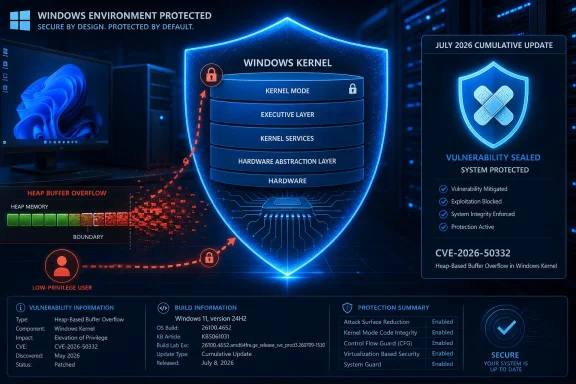 A Local Foothold Could Become a Kernel Compromise
The CVSS vector is CVSS:3.1/AV:L/AC:L/PR:L/UI:N/S:U/C:H/I:H/A:H. In practical terms, exploitation requires local access and some existing privileges, but Microsoft rates the attack complexity as low and does not require another user to click, open, or approve anything.That profile makes CVE-2026-50332 more relevant to post-compromise activity than initial intrusion. Malware, a malicious local user, or an attacker who has obtained limited account access could potentially use the kernel flaw to escape the restrictions of that account and operate with substantially greater authority.
Kernel elevation vulnerabilities are valuable because the Windows Kernel sits beneath normal application and user boundaries. A successful exploit may allow an attacker to interfere with processes, security controls, credentials, files, and system configuration that would ordinarily be inaccessible to a standard user.
The two weakness identifiers add some technical shape to an otherwise brief advisory. CWE-122 denotes a heap-based buffer overflow, where data can be written beyond the allocated boundary of an object in heap memory. CWE-197 covers numeric truncation, in which converting or processing a value at a smaller size can discard significant bits and produce an unsafe length, offset, or allocation.
Microsoft has not published exploit code, a detailed trigger path, or the specific kernel routine involved. Administrators therefore should not treat the absence of extensive technical documentation as evidence that the vulnerability is theoretical.
Microsoft Calls Exploitation Less Likely
Microsoft’s exploitability assessment lists CVE-2026-50332 as exploitation less likely. It was not publicly disclosed before the July update, and Microsoft had not detected active exploitation when the advisory was published.CISA’s initial Stakeholder-Specific Vulnerability Categorization data likewise recorded no known exploitation and assessed the vulnerability as not readily automatable. Its potential technical impact was nevertheless classified as total, reflecting the consequences possible if exploitation succeeds rather than the probability that attacks will appear.
Those distinctions matter. CVE-2026-50332 was not one of the actively exploited zero-days highlighted in reporting on Microsoft’s July 2026 Patch Tuesday release, which BleepingComputer described as containing hundreds of security fixes. Cisco Talos also separated the month’s known exploited vulnerabilities from CVE-2026-50332 while including the kernel flaw among July’s security issues.
“Less likely” is a prioritization signal, not permission to leave machines exposed. The low-complexity requirement, lack of user interaction, and kernel-level impact make the vulnerability a plausible component in an exploit chain if researchers or attackers identify a reliable trigger.
Security teams should also read the advisory’s confidence information correctly. The CVSS temporal vector reports confirmed technical confidence, meaning the vulnerability and available details have been validated by Microsoft. The National Vulnerability Database’s “awaiting enrichment” notice only means NIST has not completed its independent analysis; it does not mean the vulnerability itself remains unconfirmed.
The Affected Range Spans Clients and Servers
Microsoft’s CVE record covers Windows releases from older enterprise-maintained branches through Windows 11 version 26H1. The affected build boundaries supplied with the record include:- Windows 10 version 1607 and Windows Server 2016 builds earlier than 14393.9339 are affected.
- Windows 10 version 1809 and Windows Server 2019 builds earlier than 17763.9020 are affected.
- Windows 10 versions 21H2 and 22H2 builds earlier than 19044.7548 and 19045.7548 are affected.
- Windows Server 2022 builds earlier than 20348.5386 are affected.
- Windows 11 versions 24H2 and 25H2 builds earlier than 26100.8875 and 26200.8875 are affected.
- Windows 11 version 26H1 builds earlier than 28000.2269 are listed as affected in the CVE record, with the July cumulative update moving systems to build 28000.2525.
- Windows Server 2025 builds earlier than 26100.33158 are affected.
- Windows Server 2012 and Windows Server 2012 R2 also appear in Microsoft’s affected-product data, including Server Core installations.
Windows Server 2022 receives KB5099540 and advances to build 20348.5386. Other supported server branches have their own July cumulative or monthly rollup packages, so administrators should use the product-specific update offered through Windows Update, Windows Update for Business, WSUS, Microsoft Configuration Manager, or the Microsoft Update Catalog.
Because Windows security fixes are cumulative, there is no separate kernel hotfix that administrators need to locate for normal deployment. Installing the applicable July 14 cumulative security update, or a later cumulative update that supersedes it, provides the CVE-2026-50332 correction.
Patch Rings Still Need Operational Checks
CVE-2026-50332 does not require an emergency isolation response on the evidence currently available. It does justify normal Patch Tuesday deployment without unnecessary delay, particularly on shared workstations, Remote Desktop Session Hosts, developer machines, jump servers, and systems where users or applications can execute untrusted code.Administrators should verify the resulting OS build rather than relying solely on a deployment console’s success status.
winver, the Settings app’s Windows Update history, PowerShell inventory, or endpoint-management reporting can confirm that machines have crossed the applicable fixed-build boundary.The July updates also carry changes beyond this kernel fix. Microsoft documents a potential BitLocker recovery prompt on a limited set of managed systems with a nonrecommended PCR7 Group Policy configuration, particularly where Secure Boot reports that PCR7 binding is not possible. Enterprise teams should audit that configuration and ensure recovery keys are escrowed before broad deployment.
Server 2022’s July package also introduces transport-driver hardening that may affect applications using sockets over unregistered third-party TDI transports. These servicing considerations support a staged rollout, but they should not become a reason to postpone the security baseline indefinitely.
The immediate task is straightforward: deploy the July 14, 2026 Windows cumulative update, confirm the resulting build, and monitor Microsoft’s Security Update Guide for revisions. CVE-2026-50332 is not known to be under attack, but an unpatched low-privilege account remains a potential route into the Windows Kernel until the corrected build is installed.
References
- Primary source: MSRC
Published: 2026-07-14T07:00:00-07:00
Security Update Guide - Microsoft Security Response Center
 msrc.microsoft.com
- Related coverage: aha.org
