

CVE-2026-50353 is a high-severity Windows DirectX vulnerability that can let a locally authenticated attacker elevate privileges and take full control of an affected system. Microsoft disclosed the flaw on July 14, 2026, and delivered its fixes through the July cumulative updates for Windows 11 and Windows Server 2025.
Detailed in Microsoft’s Security Update Guide, the vulnerability carries a CVSS 3.1 score of 7.8. It affects Windows 11 versions 24H2, 25H2, and 26H1, as well as both the full and Server Core installations of Windows Server 2025.
Administrators should treat the July updates as the remediation rather than searching for a DirectX-specific installer. For Windows 11 24H2 and 25H2, the relevant cumulative package is KB5101650, which advances the operating systems to builds 26100.8875 and 26200.8875, respectively. Windows Server 2025 receives its correction through KB5099536, bringing it to build 26100.33158.
Microsoft describes CVE-2026-50353 as a use-after-free vulnerability in Windows DirectX. This class of memory-safety defect occurs when software continues to access an object after the memory assigned to it has been released, creating an opportunity for an attacker to influence what occupies that memory next.
The vulnerable component is identified more specifically as the DirectX Graphics Kernel, the kernel-mode portion of the Windows graphics subsystem. Although DirectX is commonly associated with games, graphics rendering, and GPU acceleration, the affected code sits much closer to Windows’ trusted core than an ordinary game or multimedia library.
That distinction drives the impact. Successful exploitation could allow an attacker who already has low-level access to a machine to cross the security boundary into a more privileged context. Microsoft’s CVSS vector indicates that confidentiality, integrity, and availability could all be affected at the highest level.
The attack is local rather than network-based. According to the Microsoft-provided CVSS data published by the National Vulnerability Database, exploitation requires local access and low privileges but does not require interaction from another user. Attack complexity is rated low.
CVE-2026-50353 therefore is not a vulnerability that an anonymous attacker can trigger directly across the internet. It is more useful as the second stage of an intrusion: malicious code first gains an ordinary user foothold, then exploits the graphics kernel to obtain broader control.
That chain is familiar to defenders. Browser vulnerabilities, malicious Office documents, stolen credentials, remote-management abuse, and compromised software can all provide the initial execution path. A local elevation-of-privilege flaw can then turn a constrained compromise into a system-level incident.
Windows Server 2025 administrators need KB5099536. That update reaches OS build 26100.33158 and applies to all editions, including Server Core installations covered by the CVE record.
Windows 11 26H1 deserves closer attention during inventory checks. Microsoft’s vulnerability record sets build 28000.2269 as its remediation boundary, so administrators should validate the actual OS build rather than assuming that every 26H1 installation requires the same July package used by 24H2 and 25H2.
The quickest interactive check is to run
Because Windows cumulative updates supersede earlier packages, systems do not need a separate DirectX patch after receiving an applicable cumulative update at or above the corrected build. Security scanners may continue reporting the CVE until their detection data refreshes or the endpoint completes its required restart and reports the new version.
CISA’s initial SSVC data recorded no known exploitation for CVE-2026-50353. The same assessment classified exploitation as not readily automatable while rating the potential technical impact as total. That combination supports prompt remediation without placing the issue in the same category as an internet-reachable, actively exploited zero-day.
No public proof-of-concept exploit was identified in the initial disclosure material. Microsoft also has not published detailed instructions showing how to trigger the use-after-free condition, which limits what defenders can derive from the advisory beyond affected versions, attack prerequisites, and the required updates.
The absence of a public exploit is not a reason to postpone deployment indefinitely. Kernel privilege-escalation flaws are valuable when combined with an initial-access technique, and the advisory gives would-be attackers enough information to identify the affected subsystem and weakness category. Reverse engineering of the patched and unpatched DirectX graphics components could reveal additional details after release.
Administrators should still run the package through their normal compatibility rings. Systems using GPU virtualization, graphics-intensive virtual machines, computer-aided design software, video production tools, remote graphics sessions, anti-cheat drivers, or vendor-specific display packages deserve targeted post-update testing.
Microsoft’s July release notes also describe graphics-kernel reliability work in the Windows Server 2025 update, including a fix for excessive memory consumption in virtual machines running graphics-intensive applications. That quality improvement is separate from the security description for CVE-2026-50353, but it reinforces the need to test graphics-heavy server and virtual desktop workloads rather than validating only that Windows boots.
For Windows 11 24H2 and 25H2, Microsoft reported no general known issues with KB5101650 at publication. The company did, however, temporarily withhold the update from a limited number of Dell systems with Intel processors because of a reported incompatibility involving shutdowns, heat, performance, and battery drain. Devices under that safeguard hold require closer monitoring rather than attempts to bypass the block casually.
The practical priority is to identify machines below builds 26100.8875, 26200.8875, 28000.2269, or 26100.33158, depending on the installed Windows release. Once the July cumulative updates are deployed and the corrected builds are confirmed, CVE-2026-50353’s local privilege-escalation path is closed without any separate DirectX configuration change.
Detailed in Microsoft’s Security Update Guide, the vulnerability carries a CVSS 3.1 score of 7.8. It affects Windows 11 versions 24H2, 25H2, and 26H1, as well as both the full and Server Core installations of Windows Server 2025.
Administrators should treat the July updates as the remediation rather than searching for a DirectX-specific installer. For Windows 11 24H2 and 25H2, the relevant cumulative package is KB5101650, which advances the operating systems to builds 26100.8875 and 26200.8875, respectively. Windows Server 2025 receives its correction through KB5099536, bringing it to build 26100.33158.
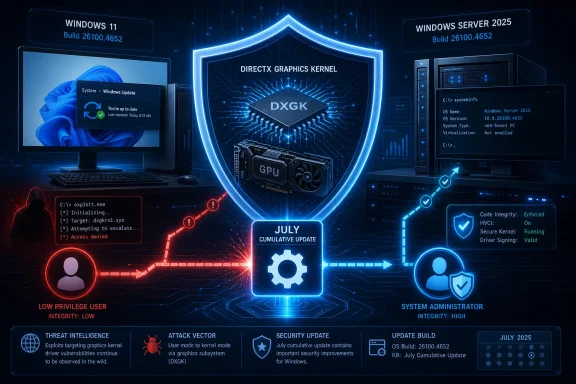 A Use-After-Free Bug Reaches the Graphics Kernel
Microsoft describes CVE-2026-50353 as a use-after-free vulnerability in Windows DirectX. This class of memory-safety defect occurs when software continues to access an object after the memory assigned to it has been released, creating an opportunity for an attacker to influence what occupies that memory next.The vulnerable component is identified more specifically as the DirectX Graphics Kernel, the kernel-mode portion of the Windows graphics subsystem. Although DirectX is commonly associated with games, graphics rendering, and GPU acceleration, the affected code sits much closer to Windows’ trusted core than an ordinary game or multimedia library.
That distinction drives the impact. Successful exploitation could allow an attacker who already has low-level access to a machine to cross the security boundary into a more privileged context. Microsoft’s CVSS vector indicates that confidentiality, integrity, and availability could all be affected at the highest level.
The attack is local rather than network-based. According to the Microsoft-provided CVSS data published by the National Vulnerability Database, exploitation requires local access and low privileges but does not require interaction from another user. Attack complexity is rated low.
CVE-2026-50353 therefore is not a vulnerability that an anonymous attacker can trigger directly across the internet. It is more useful as the second stage of an intrusion: malicious code first gains an ordinary user foothold, then exploits the graphics kernel to obtain broader control.
That chain is familiar to defenders. Browser vulnerabilities, malicious Office documents, stolen credentials, remote-management abuse, and compromised software can all provide the initial execution path. A local elevation-of-privilege flaw can then turn a constrained compromise into a system-level incident.
Microsoft’s Build Numbers Define the Safe Line
The National Vulnerability Database lists five affected Windows product configurations. Microsoft’s version boundaries show the minimum corrected build for each platform:- Windows 11 24H2 systems earlier than build 26100.8875 are affected.
- Windows 11 25H2 systems earlier than build 26200.8875 are affected.
- Windows 11 26H1 systems earlier than build 28000.2269 are affected.
- Windows Server 2025 systems earlier than build 26100.33158 are affected.
- Windows Server 2025 Server Core systems earlier than build 26100.33158 are affected.
Windows Server 2025 administrators need KB5099536. That update reaches OS build 26100.33158 and applies to all editions, including Server Core installations covered by the CVE record.
Windows 11 26H1 deserves closer attention during inventory checks. Microsoft’s vulnerability record sets build 28000.2269 as its remediation boundary, so administrators should validate the actual OS build rather than assuming that every 26H1 installation requires the same July package used by 24H2 and 25H2.
The quickest interactive check is to run
winver. Managed environments can collect the build through PowerShell, Microsoft Intune, Configuration Manager, endpoint detection platforms, or their normal vulnerability-management tooling.Because Windows cumulative updates supersede earlier packages, systems do not need a separate DirectX patch after receiving an applicable cumulative update at or above the corrected build. Security scanners may continue reporting the CVE until their detection data refreshes or the endpoint completes its required restart and reports the new version.
“Confirmed” Does Not Mean “Exploited”
The report-confidence metric in Microsoft’s advisory is easy to misread. A rating of confirmed means the vulnerability’s existence and technical basis have been established by the vendor or supported by sufficiently credible technical evidence. It does not, by itself, mean attackers are exploiting the flaw.CISA’s initial SSVC data recorded no known exploitation for CVE-2026-50353. The same assessment classified exploitation as not readily automatable while rating the potential technical impact as total. That combination supports prompt remediation without placing the issue in the same category as an internet-reachable, actively exploited zero-day.
No public proof-of-concept exploit was identified in the initial disclosure material. Microsoft also has not published detailed instructions showing how to trigger the use-after-free condition, which limits what defenders can derive from the advisory beyond affected versions, attack prerequisites, and the required updates.
The absence of a public exploit is not a reason to postpone deployment indefinitely. Kernel privilege-escalation flaws are valuable when combined with an initial-access technique, and the advisory gives would-be attackers enough information to identify the affected subsystem and weakness category. Reverse engineering of the patched and unpatched DirectX graphics components could reveal additional details after release.
Graphics Workloads Make Testing More Than a Formality
Installing the update is the only vendor-supported remediation disclosed for CVE-2026-50353. Disabling a game, changing the default GPU, or removing a particular graphics application should not be treated as an equivalent workaround because the vulnerable DirectX kernel code is part of Windows itself.Administrators should still run the package through their normal compatibility rings. Systems using GPU virtualization, graphics-intensive virtual machines, computer-aided design software, video production tools, remote graphics sessions, anti-cheat drivers, or vendor-specific display packages deserve targeted post-update testing.
Microsoft’s July release notes also describe graphics-kernel reliability work in the Windows Server 2025 update, including a fix for excessive memory consumption in virtual machines running graphics-intensive applications. That quality improvement is separate from the security description for CVE-2026-50353, but it reinforces the need to test graphics-heavy server and virtual desktop workloads rather than validating only that Windows boots.
For Windows 11 24H2 and 25H2, Microsoft reported no general known issues with KB5101650 at publication. The company did, however, temporarily withhold the update from a limited number of Dell systems with Intel processors because of a reported incompatibility involving shutdowns, heat, performance, and battery drain. Devices under that safeguard hold require closer monitoring rather than attempts to bypass the block casually.
The practical priority is to identify machines below builds 26100.8875, 26200.8875, 28000.2269, or 26100.33158, depending on the installed Windows release. Once the July cumulative updates are deployed and the corrected builds are confirmed, CVE-2026-50353’s local privilege-escalation path is closed without any separate DirectX configuration change.
References
- Primary source: MSRC
Published: 2026-07-14T07:00:00-07:00
Security Update Guide - Microsoft Security Response Center
 msrc.microsoft.com
