

Microsoft has fixed CVE-2026-50471, an Important-rated Windows NTFS remote code execution vulnerability, in the July 14, 2026 security updates. Despite the advisory’s “remote code execution” title, Microsoft’s CVSS data describes a local attack that requires a user to interact with malicious content, making rapid patching important without suggesting that unpatched PCs can be compromised directly over the network.
Detailed in Microsoft’s Security Update Guide and corroborated by the National Vulnerability Database, CVE-2026-50471 is a heap-based buffer overflow in Windows NTFS. Successful exploitation could let an unauthenticated attacker execute code with significant confidentiality, integrity, and availability impact.
The vulnerability affects supported editions of Windows 10, Windows 11, and Windows Server, including Server Core installations. Administrators should deploy the July cumulative updates and verify that systems have reached the corrected builds rather than treating the CVE title alone as a measure of network exposure.
Microsoft assigned CVE-2026-50471 a CVSS 3.1 base score of 7.8, with the vector
The attack vector is local, attack complexity is low, and no privileges are required. User interaction is required, however, indicating that an attacker must persuade a victim to open, mount, copy, or otherwise process malicious content that reaches the vulnerable NTFS code path.
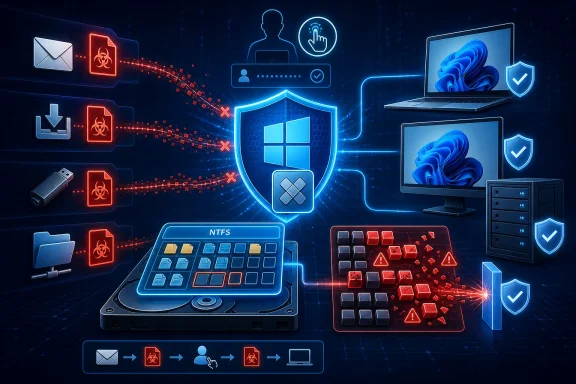
That distinction prevents “remote code execution” from being misread as a wormable SMB or Internet-facing service vulnerability. An attacker could still deliver the triggering content remotely through email, a download, removable storage, a file share, or another distribution channel, but the published scoring does not describe autonomous exploitation across the network.
The consequences remain serious after interaction occurs. Microsoft’s vector assigns high impact to confidentiality, integrity, and availability, meaning successful code execution could expose information, alter data, or disrupt the affected system.
The NVD describes the underlying weakness as CWE-122, a heap-based buffer overflow. In practical terms, NTFS mishandles data in a way that can corrupt heap memory, potentially allowing attacker-controlled operations rather than producing only a crash.
Microsoft’s corrected build thresholds include:
The NVD record also lists Windows 11 version 25H2, but its imported version range contains an apparent inconsistency: the affected release begins at build 26200 while the displayed corrected threshold references build 26100.8875. Administrators running Windows 11 25H2 should therefore verify compliance against Microsoft’s July update catalog and servicing information rather than building detection logic around that raw NVD threshold.
That shifts attention toward the paths by which untrusted files and storage images enter an environment. Email gateways, browser downloads, collaboration platforms, shared folders, virtual-disk workflows, backup restoration systems, and removable media may all provide delivery opportunities, although Microsoft has not publicly documented the exact malicious-file format or trigger sequence.
High-risk systems include administrative workstations, malware-analysis machines, file-processing servers, and endpoints used to handle files from customers or external partners. Virtualization and support teams should also consider workflows involving attached disks and images, because “local” in CVSS terminology does not necessarily mean that an attacker requires physical access to the computer.
Microsoft has not published enough technical detail to justify a reliable signature-based workaround. The generic “Report Confidence” text included in the Security Update Guide explains how CVSS confidence is measured, but it is not itself evidence that exploit code or detailed research for CVE-2026-50471 is public.
The available records confirm the vulnerability and identify the memory-corruption class, but they do not expose the vulnerable NTFS function, malformed structure, proof of concept, or exploitation technique. Defenders should avoid turning that absence of detail into an assumption of safety: the patch allows researchers and attackers to compare binaries and investigate the corrected code.
Enterprise administrators should run normal staged validation, but the practical target is straightforward: install the July 14 cumulative security update, reboot where required, and confirm the resulting Windows build. Vulnerability scanners should be checked carefully on Windows 11 25H2 because of the version-threshold discrepancy in the initial public record.
Security teams should also monitor Microsoft’s Security Update Guide for revisions. The CVE was published on July 14, 2026, and the NVD record was still awaiting its own enrichment as of July 15, leaving room for Microsoft to add exploitation guidance, acknowledgements, technical details, or corrected product metadata.
For now, the operational conclusion is concrete: CVE-2026-50471 requires user interaction rather than direct network access, but it can still end in full code execution. Systems that routinely ingest untrusted files should move toward the front of the July patch queue, with deployment considered complete only after their corrected OS builds are verified.
Detailed in Microsoft’s Security Update Guide and corroborated by the National Vulnerability Database, CVE-2026-50471 is a heap-based buffer overflow in Windows NTFS. Successful exploitation could let an unauthenticated attacker execute code with significant confidentiality, integrity, and availability impact.
The vulnerability affects supported editions of Windows 10, Windows 11, and Windows Server, including Server Core installations. Administrators should deploy the July cumulative updates and verify that systems have reached the corrected builds rather than treating the CVE title alone as a measure of network exposure.
 “Remote Code Execution” Does Not Mean Network-Exploitable Here
Microsoft assigned CVE-2026-50471 a CVSS 3.1 base score of 7.8, with the vector CVSS:3.1/AV:L/AC:L/PR:N/UI:R/S:U/C:H/I:H/A:H. Each part of that vector matters when deciding how urgently and where to deploy the fix.The attack vector is local, attack complexity is low, and no privileges are required. User interaction is required, however, indicating that an attacker must persuade a victim to open, mount, copy, or otherwise process malicious content that reaches the vulnerable NTFS code path.
That distinction prevents “remote code execution” from being misread as a wormable SMB or Internet-facing service vulnerability. An attacker could still deliver the triggering content remotely through email, a download, removable storage, a file share, or another distribution channel, but the published scoring does not describe autonomous exploitation across the network.
The consequences remain serious after interaction occurs. Microsoft’s vector assigns high impact to confidentiality, integrity, and availability, meaning successful code execution could expose information, alter data, or disrupt the affected system.
The NVD describes the underlying weakness as CWE-122, a heap-based buffer overflow. In practical terms, NTFS mishandles data in a way that can corrupt heap memory, potentially allowing attacker-controlled operations rather than producing only a crash.
The Patch Reaches Across the Windows Fleet
The affected-product data covers a broad range of client and server releases. That is expected for a vulnerability in NTFS, a foundational Windows file-system component used across desktop, server, physical, and virtual deployments.Microsoft’s corrected build thresholds include:
- Windows 10 version 1607 and Windows Server 2016 are corrected at build 14393.9339 or later.
- Windows 10 version 1809 and Windows Server 2019 are corrected at build 17763.9020 or later.
- Windows 10 version 21H2 is corrected at build 19044.7548 or later.
- Windows 10 version 22H2 is corrected at build 19045.7548 or later.
- Windows 11 version 23H2 is corrected at build 22631.7376 or later.
- Windows 11 version 24H2 is corrected at build 26100.8875 or later.
- Windows 11 version 26H1 is corrected at build 28000.2525 or later.
- Windows Server 2022 is corrected at build 20348.5386 or later.
- Windows Server 2025 is corrected at build 26100.33158 or later.
The NVD record also lists Windows 11 version 25H2, but its imported version range contains an apparent inconsistency: the affected release begins at build 26200 while the displayed corrected threshold references build 26100.8875. Administrators running Windows 11 25H2 should therefore verify compliance against Microsoft’s July update catalog and servicing information rather than building detection logic around that raw NVD threshold.
Exposure Is Broader Than Internet-Facing Servers
CVE-2026-50471 does not call for the same perimeter response as a network vulnerability in RDP, SMB Server, DHCP Server, or TCP/IP. Blocking an inbound port is not a complete mitigation because the vulnerable operation occurs locally when Windows processes attacker-supplied data.That shifts attention toward the paths by which untrusted files and storage images enter an environment. Email gateways, browser downloads, collaboration platforms, shared folders, virtual-disk workflows, backup restoration systems, and removable media may all provide delivery opportunities, although Microsoft has not publicly documented the exact malicious-file format or trigger sequence.
High-risk systems include administrative workstations, malware-analysis machines, file-processing servers, and endpoints used to handle files from customers or external partners. Virtualization and support teams should also consider workflows involving attached disks and images, because “local” in CVSS terminology does not necessarily mean that an attacker requires physical access to the computer.
Microsoft has not published enough technical detail to justify a reliable signature-based workaround. The generic “Report Confidence” text included in the Security Update Guide explains how CVSS confidence is measured, but it is not itself evidence that exploit code or detailed research for CVE-2026-50471 is public.
The available records confirm the vulnerability and identify the memory-corruption class, but they do not expose the vulnerable NTFS function, malformed structure, proof of concept, or exploitation technique. Defenders should avoid turning that absence of detail into an assumption of safety: the patch allows researchers and attackers to compare binaries and investigate the corrected code.
Patch Verification Matters More Than CVE Counting
CVE-2026-50471 was one of numerous NTFS vulnerabilities addressed in Microsoft’s unusually large July 2026 release, as cataloged by BleepingComputer. The month’s fixes include several separate NTFS remote code execution, elevation-of-privilege, and information-disclosure flaws, so deploying only a narrowly selected remediation for this CVE would miss related file-system fixes delivered through the cumulative update.Enterprise administrators should run normal staged validation, but the practical target is straightforward: install the July 14 cumulative security update, reboot where required, and confirm the resulting Windows build. Vulnerability scanners should be checked carefully on Windows 11 25H2 because of the version-threshold discrepancy in the initial public record.
Security teams should also monitor Microsoft’s Security Update Guide for revisions. The CVE was published on July 14, 2026, and the NVD record was still awaiting its own enrichment as of July 15, leaving room for Microsoft to add exploitation guidance, acknowledgements, technical details, or corrected product metadata.
For now, the operational conclusion is concrete: CVE-2026-50471 requires user interaction rather than direct network access, but it can still end in full code execution. Systems that routinely ingest untrusted files should move toward the front of the July patch queue, with deployment considered complete only after their corrected OS builds are verified.
References
- Primary source: MSRC
Published: 2026-07-14T07:00:00-07:00
Security Update Guide - Microsoft Security Response Center
 msrc.microsoft.com
