

Microsoft has fixed CVE-2026-50409, a Windows Overlay Filter information-disclosure vulnerability that can allow a locally authenticated attacker to expose sensitive information. The flaw carries a CVSS 3.1 score of 5.5, rated Medium, but its high confidentiality impact makes the July 14, 2026 security updates important on shared workstations, servers, virtual desktop infrastructure, and other systems where untrusted users can obtain local access.
Detailed in Microsoft’s Security Response Center advisory and corresponding CVE record, the vulnerability affects supported releases spanning Windows 10, Windows 11, Windows Server 2016, Windows Server 2019, Windows Server 2022, and Windows Server 2025. Microsoft classifies it as CWE-200, Exposure of Sensitive Information to an Unauthorized Actor.
The company’s published vector is
CVE-2026-50409 does not directly grant administrator privileges, execute code remotely, corrupt files, or take a machine offline. Its documented effect is confined to confidentiality: a successful attacker could obtain information that should not be available to their current security context.
Microsoft assigns the vulnerability a high confidentiality impact while recording no direct integrity or availability impact. That distinction explains why the issue receives a Medium rather than Critical or Important-looking numerical score despite involving a Windows system component.
The local attack vector is another significant constraint. An attacker must already be able to execute code or otherwise interact with the targeted Windows device under an authorized account. CVE-2026-50409 therefore does not represent a standalone network entry point comparable to an unauthenticated SMB, Remote Desktop, or HTTP vulnerability.
That does not make it harmless. Information-disclosure flaws are frequently useful as part of a longer attack chain, where leaked memory or system data helps an attacker defeat security boundaries, locate credentials, or improve the reliability of another exploit. Microsoft has not publicly specified what information can be exposed in this case, so administrators should not assume that the disclosure is limited to filenames or other low-value metadata.
Microsoft’s exploitability metrics mark exploitation maturity as unproven. The CVE record available at publication does not indicate active exploitation or public disclosure before the July update, and no public proof-of-concept is identified. Those conditions lower the immediate emergency level, but they do not eliminate the need to patch.
Microsoft’s Windows driver documentation describes WOF structures and APIs used with backing providers for Windows Imaging Format files and individually compressed files. The component participates in Windows file-storage mechanisms, including functionality associated with compact or externally backed file data.
That position matters because filter drivers operate near file-system activity and may process data on behalf of many applications. A confidentiality failure at this layer could potentially cross assumptions made by higher-level software about which information a local user is permitted to retrieve.
Microsoft has not released a technical explanation of the faulty operation, the precise disclosure mechanism, or the data structures involved. There is also no vendor-provided workaround documented in the public CVE record. Installing the applicable July 2026 cumulative update is the remediation.
The lack of technical detail is normal for a newly patched Windows vulnerability, particularly when Microsoft wants customers updated before publishing information that could accelerate exploit development. It also means defenders cannot reliably hunt for exploitation using a vulnerability-specific event ID, process pattern, or file-access signature at this stage.
That confidence value should not be confused with evidence of exploitation. It measures confidence that the vulnerability and documented technical characteristics are real. It does not mean attackers have confirmed working exploit code, and it does not elevate the vulnerability to a zero-day.
The other temporal fields reinforce that difference.
For patch teams, that supports routine but prompt deployment rather than emergency isolation of every affected machine. Environments with many local users, remote application hosts, developer workstations, build agents, or systems that execute code from less-trusted sources should place it higher in the July rollout.
Windows 11 24H2 and 25H2 administrators should verify that KB5101650 actually reaches build 26100.8875 or 26200.8875 rather than relying solely on a successful update scan. Microsoft says the update is temporarily unavailable to a limited number of Dell devices with Intel processors because of a separate compatibility issue involving possible shutdowns, heat, battery drain, and performance degradation.
That safeguard creates a narrow but relevant deployment complication: an affected Dell system may not immediately receive the cumulative update containing the CVE-2026-50409 fix. Administrators should follow Microsoft and Dell’s servicing guidance rather than bypassing an update hold without testing, particularly on portable systems covered by the compatibility block.
Administrators can verify client builds with
The practical priority is straightforward: deploy the July 14, 2026 cumulative update, confirm that devices meet or exceed Microsoft’s corrected build numbers, and investigate machines held below those levels. Until Microsoft publishes deeper technical details, build compliance remains the clearest way to determine whether CVE-2026-50409 has been removed from a Windows installation.
Detailed in Microsoft’s Security Response Center advisory and corresponding CVE record, the vulnerability affects supported releases spanning Windows 10, Windows 11, Windows Server 2016, Windows Server 2019, Windows Server 2022, and Windows Server 2025. Microsoft classifies it as CWE-200, Exposure of Sensitive Information to an Unauthorized Actor.
The company’s published vector is
CVSS:3.1/AV:L/AC:L/PR:L/UI:N/S:U/C:H/I:N/A:N. In practical terms, exploitation requires local access and low-level privileges, but does not require user interaction and is considered low complexity.
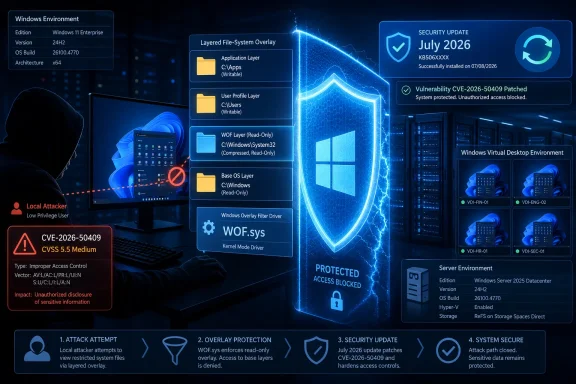 The Risk Is Data Exposure, Not System Takeover
CVE-2026-50409 does not directly grant administrator privileges, execute code remotely, corrupt files, or take a machine offline. Its documented effect is confined to confidentiality: a successful attacker could obtain information that should not be available to their current security context.Microsoft assigns the vulnerability a high confidentiality impact while recording no direct integrity or availability impact. That distinction explains why the issue receives a Medium rather than Critical or Important-looking numerical score despite involving a Windows system component.
The local attack vector is another significant constraint. An attacker must already be able to execute code or otherwise interact with the targeted Windows device under an authorized account. CVE-2026-50409 therefore does not represent a standalone network entry point comparable to an unauthenticated SMB, Remote Desktop, or HTTP vulnerability.
That does not make it harmless. Information-disclosure flaws are frequently useful as part of a longer attack chain, where leaked memory or system data helps an attacker defeat security boundaries, locate credentials, or improve the reliability of another exploit. Microsoft has not publicly specified what information can be exposed in this case, so administrators should not assume that the disclosure is limited to filenames or other low-value metadata.
Microsoft’s exploitability metrics mark exploitation maturity as unproven. The CVE record available at publication does not indicate active exploitation or public disclosure before the July update, and no public proof-of-concept is identified. Those conditions lower the immediate emergency level, but they do not eliminate the need to patch.
Windows Overlay Filter Sits Close to the File System
The affected component is the Windows Overlay Filter, commonly associated withWof.sys. It is not the similarly named DirectShow Overlay Mixer or the Unified Write Filter used to redirect writes on specialized Windows devices.Microsoft’s Windows driver documentation describes WOF structures and APIs used with backing providers for Windows Imaging Format files and individually compressed files. The component participates in Windows file-storage mechanisms, including functionality associated with compact or externally backed file data.
That position matters because filter drivers operate near file-system activity and may process data on behalf of many applications. A confidentiality failure at this layer could potentially cross assumptions made by higher-level software about which information a local user is permitted to retrieve.
Microsoft has not released a technical explanation of the faulty operation, the precise disclosure mechanism, or the data structures involved. There is also no vendor-provided workaround documented in the public CVE record. Installing the applicable July 2026 cumulative update is the remediation.
The lack of technical detail is normal for a newly patched Windows vulnerability, particularly when Microsoft wants customers updated before publishing information that could accelerate exploit development. It also means defenders cannot reliably hunt for exploitation using a vulnerability-specific event ID, process pattern, or file-access signature at this stage.
The Confirmed Rating Describes Evidence, Not Urgency
The supplied CVSS vector includesRC:C, meaning the report-confidence metric is confirmed. Microsoft, as the vendor and CVE numbering authority, has acknowledged the vulnerability and issued an official correction.That confidence value should not be confused with evidence of exploitation. It measures confidence that the vulnerability and documented technical characteristics are real. It does not mean attackers have confirmed working exploit code, and it does not elevate the vulnerability to a zero-day.
The other temporal fields reinforce that difference.
E:U records unproven exploitation maturity, while RL:O indicates an official fix is available. Read together, the metrics describe a vendor-confirmed vulnerability with an official patch but no publicly established exploitation at the time of publication.For patch teams, that supports routine but prompt deployment rather than emergency isolation of every affected machine. Environments with many local users, remote application hosts, developer workstations, build agents, or systems that execute code from less-trusted sources should place it higher in the July rollout.
The Fix Reaches Multiple Windows Generations
The affected-version information supplied by Microsoft identifies the first corrected build for each Windows branch. Systems below these levels remain exposed:- Windows 11 versions 24H2 and 25H2 are corrected at OS builds 26100.8875 and 26200.8875 through KB5101650.
- Windows 11 version 26H1 is corrected at build 28000.2525.
- Windows 10 versions 21H2 and 22H2 are corrected at builds 19044.7548 and 19045.7548.
- Windows 10 version 1809 and Windows Server 2019 are corrected at build 17763.9020.
- Windows 10 version 1607 and Windows Server 2016 are corrected at build 14393.9339.
- Windows Server 2022 is corrected at build 20348.5386, with Microsoft publishing KB5099540 for that branch.
- Windows Server 2025 is corrected at build 26100.33158 through KB5099536.
Windows 11 24H2 and 25H2 administrators should verify that KB5101650 actually reaches build 26100.8875 or 26200.8875 rather than relying solely on a successful update scan. Microsoft says the update is temporarily unavailable to a limited number of Dell devices with Intel processors because of a separate compatibility issue involving possible shutdowns, heat, battery drain, and performance degradation.
That safeguard creates a narrow but relevant deployment complication: an affected Dell system may not immediately receive the cumulative update containing the CVE-2026-50409 fix. Administrators should follow Microsoft and Dell’s servicing guidance rather than bypassing an update hold without testing, particularly on portable systems covered by the compatibility block.
Verification Should Focus on the Installed Build
Because July’s packages are cumulative, organizations do not need a separate WOF hotfix when the applicable security update has installed successfully. Windows Update, Windows Update for Business, Microsoft Intune, Windows Autopatch, WSUS, Configuration Manager, and Microsoft Update Catalog packages can deliver the correction according to the servicing channel used by the organization.Administrators can verify client builds with
winver, PowerShell inventory, endpoint-management reports, or the operating-system build fields collected by their vulnerability scanner. Server teams should check both full installations and Server Core nodes, including templates and offline images that may be used to provision new machines after the live fleet is patched.The practical priority is straightforward: deploy the July 14, 2026 cumulative update, confirm that devices meet or exceed Microsoft’s corrected build numbers, and investigate machines held below those levels. Until Microsoft publishes deeper technical details, build compliance remains the clearest way to determine whether CVE-2026-50409 has been removed from a Windows installation.
References
- Primary source: MSRC
Published: 2026-07-14T07:00:00-07:00
Security Update Guide - Microsoft Security Response Center
 msrc.microsoft.com
- Official source: learn.microsoft.com
