

CVE-2026-50510 affects the GitHub Copilot plugin for JetBrains IDEs before version 1.13.0-251, allowing a malicious local resource to trigger code execution after user interaction. Developers using IntelliJ IDEA, PyCharm, WebStorm, Rider, Android Studio, or another JetBrains-based environment with Copilot installed should update the plugin immediately.
Microsoft disclosed the vulnerability on July 14, 2026, through the Microsoft Security Response Center’s Security Update Guide. The National Vulnerability Database lists it as a high-severity flaw with a CVSS 3.1 base score of 7.8 and identifies GitHub Copilot Plugin for JetBrains IDEs versions from 1.0.0 up to, but not including, 1.13.0-251 as affected.
Despite Microsoft’s “Remote Code Execution” title, the scoring vector describes a local, user-assisted attack, not an unauthenticated exploit that can be launched directly across the network. An attacker would need to persuade a developer to interact with attacker-controlled content or resources before code could run on the workstation.
Microsoft describes CVE-2026-50510 as an improper restriction of names used for files and other resources. The issue is categorized as CWE-641, a weakness that occurs when software fails to adequately constrain the names or identifiers accepted for resources it later accesses or processes.
The advisory does not provide a proof of concept or a detailed attack sequence. It also does not identify the exact Copilot operation that consumes the unsafe name, leaving administrators without enough information to build a reliable detection rule around a specific filename, project structure, or repository artifact.
The available CVSS vector supplies more useful boundaries. Attack complexity is low, no privileges are required, and user interaction is required. A successful exploit can have a high impact on confidentiality, integrity, and availability, meaning an attacker could potentially read sensitive information, modify data, or disrupt the compromised development environment.
That combination points toward a delivery mechanism such as a crafted project, repository, file, or similarly attacker-controlled development resource. That is an inference from Microsoft’s weakness classification and scoring rather than a confirmed exploit recipe, and teams should avoid treating any single suspected vector as definitive until Microsoft or the reporting researcher publishes further technical details.
Instead, an attacker must get malicious content onto the developer’s machine or induce the developer to open or process it. In practice, that can still be a credible remote attack: adversaries routinely deliver repositories, sample projects, coding assignments, issue attachments, dependency updates, and pull requests through online channels.
The victim’s interaction is the bridge between remote delivery and local execution. This makes the flaw relevant to developers who review code from external contributors, clone unfamiliar repositories, evaluate third-party projects, or regularly switch between customer and partner codebases.
CISA’s initial SSVC data records no known exploitation and marks the flaw as not automatable. The National Vulnerability Database was still awaiting its own enrichment as of July 15, so Microsoft remains the primary source for the severity, affected-version range, and technical classification.
There is no public indication that CVE-2026-50510 was exploited before disclosure. It is also not one of the July 2026 vulnerabilities identified by Microsoft and government cyber authorities as being under active attack.
Code execution under the developer’s account could therefore extend beyond the local IDE. The attacker’s practical reach would depend on the account’s privileges, available credentials, endpoint controls, network segmentation, and whether sensitive secrets are stored in files or exposed through active processes.
JetBrains installations are also less likely than Windows itself to be covered by a company’s established monthly patch workflow. Copilot may have been installed directly by a developer, deployed through JetBrains settings synchronization, or managed through an organization’s plugin controls. Security teams cannot safely assume that installing the July Windows cumulative update also resolves this issue.
CVE-2026-50510 is a product-level Copilot plugin vulnerability, not a Windows operating-system flaw. Windows Update, WSUS, and the normal Windows cumulative-update channel are therefore not substitutes for verifying the plugin version inside each affected JetBrains IDE.
Organizations should inventory both centrally managed and user-installed copies. A workstation with several JetBrains products may have separate plugin state depending on the deployment and configuration, so checking one IDE does not necessarily establish that every installation is protected.
Until every endpoint is updated, sensible containment measures include limiting work with untrusted repositories and avoiding the opening of unsolicited projects in an IDE carrying the vulnerable plugin. Removing or disabling Copilot temporarily may reduce exposure where an immediate update is not possible, although Microsoft has not published that step as a formal workaround in the available CVE record.
Enterprise teams should also review controls that limit the damage of developer-tool compromise. Standard-user accounts, protected credential stores, short-lived cloud tokens, application control, endpoint detection, and separation between development workstations and production administration can keep a local code-execution flaw from becoming a broader infrastructure incident.
Detection is more difficult because Microsoft has not documented the resulting process tree, command line, file pattern, or other exploit artifacts. Defenders can still investigate unexpected child processes launched by JetBrains products, unusual script interpreters, outbound connections following the opening of an unfamiliar project, and access to credential or configuration directories.
Those behaviors are not unique to CVE-2026-50510 and may occur during legitimate development. They are best used as investigation leads rather than definitive indicators of compromise.
GitHub introduced public-preview cloud and local sandboxes for Copilot in June 2026, positioning isolation as a way to contain tool execution. Those sandbox capabilities are relevant to the broader risk of agentic development, but the CVE record does not say that enabling a sandbox mitigates CVE-2026-50510.
Administrators should therefore treat sandboxing as defense in depth, not as an alternative to the fixed plugin. The same applies to repository trust prompts, endpoint security software, and restrictions on agent tools: each can reduce exposure or impact, but none changes Microsoft’s affected-version boundary.
The immediate milestone is straightforward. Every JetBrains endpoint running GitHub Copilot should report version 1.13.0-251 or newer, while security teams watch for any later advisory revision that explains the delivery mechanism or introduces exploit indicators.
Microsoft disclosed the vulnerability on July 14, 2026, through the Microsoft Security Response Center’s Security Update Guide. The National Vulnerability Database lists it as a high-severity flaw with a CVSS 3.1 base score of 7.8 and identifies GitHub Copilot Plugin for JetBrains IDEs versions from 1.0.0 up to, but not including, 1.13.0-251 as affected.
Despite Microsoft’s “Remote Code Execution” title, the scoring vector describes a local, user-assisted attack, not an unauthenticated exploit that can be launched directly across the network. An attacker would need to persuade a developer to interact with attacker-controlled content or resources before code could run on the workstation.
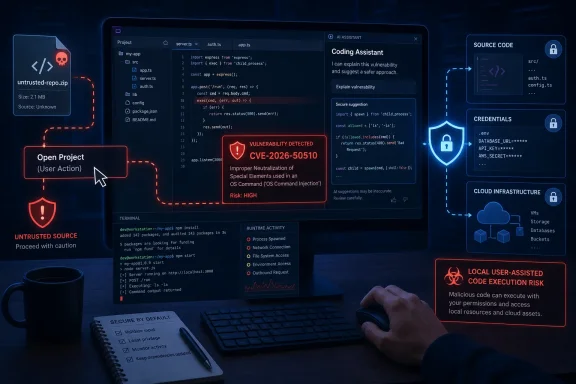 A Naming Weakness Becomes Code Execution
Microsoft describes CVE-2026-50510 as an improper restriction of names used for files and other resources. The issue is categorized as CWE-641, a weakness that occurs when software fails to adequately constrain the names or identifiers accepted for resources it later accesses or processes.The advisory does not provide a proof of concept or a detailed attack sequence. It also does not identify the exact Copilot operation that consumes the unsafe name, leaving administrators without enough information to build a reliable detection rule around a specific filename, project structure, or repository artifact.
The available CVSS vector supplies more useful boundaries. Attack complexity is low, no privileges are required, and user interaction is required. A successful exploit can have a high impact on confidentiality, integrity, and availability, meaning an attacker could potentially read sensitive information, modify data, or disrupt the compromised development environment.
That combination points toward a delivery mechanism such as a crafted project, repository, file, or similarly attacker-controlled development resource. That is an inference from Microsoft’s weakness classification and scoring rather than a confirmed exploit recipe, and teams should avoid treating any single suspected vector as definitive until Microsoft or the reporting researcher publishes further technical details.
“Remote Code Execution” Does Not Mean Zero-Click
The remote-code-execution label deserves qualification because it can imply that an exposed service is reachable directly over the Internet. CVE-2026-50510 carries a local attack vector in Microsoft’s CVSS assessment, so simply having the vulnerable JetBrains plugin installed does not appear sufficient for remote compromise.Instead, an attacker must get malicious content onto the developer’s machine or induce the developer to open or process it. In practice, that can still be a credible remote attack: adversaries routinely deliver repositories, sample projects, coding assignments, issue attachments, dependency updates, and pull requests through online channels.
The victim’s interaction is the bridge between remote delivery and local execution. This makes the flaw relevant to developers who review code from external contributors, clone unfamiliar repositories, evaluate third-party projects, or regularly switch between customer and partner codebases.
CISA’s initial SSVC data records no known exploitation and marks the flaw as not automatable. The National Vulnerability Database was still awaiting its own enrichment as of July 15, so Microsoft remains the primary source for the severity, affected-version range, and technical classification.
There is no public indication that CVE-2026-50510 was exploited before disclosure. It is also not one of the July 2026 vulnerabilities identified by Microsoft and government cyber authorities as being under active attack.
Developer Workstations Carry More Than Source Code
A 7.8 rating may place CVE-2026-50510 below the critical tier, but the affected endpoint matters. Developer systems frequently contain source repositories, package-registry tokens, Git credentials, SSH keys, cloud command-line sessions, signing material, database connections, and access to CI/CD infrastructure.Code execution under the developer’s account could therefore extend beyond the local IDE. The attacker’s practical reach would depend on the account’s privileges, available credentials, endpoint controls, network segmentation, and whether sensitive secrets are stored in files or exposed through active processes.
JetBrains installations are also less likely than Windows itself to be covered by a company’s established monthly patch workflow. Copilot may have been installed directly by a developer, deployed through JetBrains settings synchronization, or managed through an organization’s plugin controls. Security teams cannot safely assume that installing the July Windows cumulative update also resolves this issue.
CVE-2026-50510 is a product-level Copilot plugin vulnerability, not a Windows operating-system flaw. Windows Update, WSUS, and the normal Windows cumulative-update channel are therefore not substitutes for verifying the plugin version inside each affected JetBrains IDE.
Organizations should inventory both centrally managed and user-installed copies. A workstation with several JetBrains products may have separate plugin state depending on the deployment and configuration, so checking one IDE does not necessarily establish that every installation is protected.
The Update Is the Primary Control
The concrete remediation is to move GitHub Copilot Plugin for JetBrains IDEs to version 1.13.0-251 or later. Administrators should confirm the installed version rather than relying solely on an update notification or assuming automatic plugin updates completed successfully.Until every endpoint is updated, sensible containment measures include limiting work with untrusted repositories and avoiding the opening of unsolicited projects in an IDE carrying the vulnerable plugin. Removing or disabling Copilot temporarily may reduce exposure where an immediate update is not possible, although Microsoft has not published that step as a formal workaround in the available CVE record.
Enterprise teams should also review controls that limit the damage of developer-tool compromise. Standard-user accounts, protected credential stores, short-lived cloud tokens, application control, endpoint detection, and separation between development workstations and production administration can keep a local code-execution flaw from becoming a broader infrastructure incident.
Detection is more difficult because Microsoft has not documented the resulting process tree, command line, file pattern, or other exploit artifacts. Defenders can still investigate unexpected child processes launched by JetBrains products, unusual script interpreters, outbound connections following the opening of an unfamiliar project, and access to credential or configuration directories.
Those behaviors are not unique to CVE-2026-50510 and may occur during legitimate development. They are best used as investigation leads rather than definitive indicators of compromise.
Copilot’s Execution Boundary Needs the Same Discipline as Build Tools
GitHub has been expanding Copilot from code completion into an agent capable of reading projects, invoking tools, changing files, and participating in development workflows. That added capability makes plugin trust boundaries increasingly important: malformed project-controlled data can become more dangerous when an assistant is permitted to take actions instead of merely display suggestions.GitHub introduced public-preview cloud and local sandboxes for Copilot in June 2026, positioning isolation as a way to contain tool execution. Those sandbox capabilities are relevant to the broader risk of agentic development, but the CVE record does not say that enabling a sandbox mitigates CVE-2026-50510.
Administrators should therefore treat sandboxing as defense in depth, not as an alternative to the fixed plugin. The same applies to repository trust prompts, endpoint security software, and restrictions on agent tools: each can reduce exposure or impact, but none changes Microsoft’s affected-version boundary.
The immediate milestone is straightforward. Every JetBrains endpoint running GitHub Copilot should report version 1.13.0-251 or newer, while security teams watch for any later advisory revision that explains the delivery mechanism or introduces exploit indicators.
References
- Primary source: MSRC
Published: 2026-07-14T07:00:00-07:00
Security Update Guide - Microsoft Security Response Center
 msrc.microsoft.com
- Official source: docs.github.com
Browsing security advisories in the GitHub Advisory Database - GitHub Docs
You can browse the GitHub Advisory Database to find CVEs and GitHub-originated advisories affecting the open source world. docs.github.com
- Related coverage: github.blog
Security reviews now available in the GitHub Copilot app - GitHub Changelog
You can now run a security review on your in-flight code changes directly from the GitHub Copilot app. The /security-review slash command is shipping in public preview, bringing the same…github.blog
- Related coverage: windowscentral.com
Microsoft denies injecting ads into GitHub pull requests — blames "programming logic issue" for 11,000 "coding agent tip" insertions | Windows Central
Over 11,000 pull requests have been spotted with the same "tips" injected into descriptions.www.windowscentral.com
