

CVE-2026-50676 is a high-impact Windows Media vulnerability that can let a locally authenticated attacker elevate privileges on Windows 11 24H2, 25H2, and 26H1. Microsoft fixed the flaw in its July 14, 2026 security updates, bringing affected systems to builds 26100.8875, 26200.8875, or 28000.2525.
Detailed in Microsoft’s Security Update Guide and corroborated by the National Vulnerability Database, the vulnerability carries a CVSS 3.1 base score of 7.8 and an Important severity rating. Microsoft says it was neither publicly disclosed nor known to have been exploited when the update shipped.
The practical response is straightforward: install KB5101650 on Windows 11 24H2 and 25H2, or KB5101649 on Windows 11 26H1. Administrators should verify the resulting OS build rather than relying only on a successful deployment status from Windows Update, Intune, Configuration Manager, or another patch-management service.
Microsoft describes CVE-2026-50676 as improper synchronization during concurrent access to a shared resource in Windows Media. The weakness is categorized as both CWE-362, a race condition, and CWE-416, a use-after-free vulnerability.
A race condition occurs when software behavior depends on the timing or order of operations that may execute concurrently. If Windows Media fails to synchronize those operations correctly, an attacker may be able to influence an object while another thread still expects it to remain in a valid state.
The associated use-after-free classification supplies an important additional clue. It indicates that the vulnerable code may continue using memory after the object occupying it has been released, potentially allowing attacker-controlled data to replace or alter what the program expects to find there.
Microsoft has not published exploit code, a detailed reproduction procedure, or the precise Windows Media operation that triggers the flaw. That limits immediate defensive options outside patching, but it also avoids giving would-be attackers a ready-made technical roadmap.
The CVSS vector is
A successful exploit could produce high confidentiality, integrity, and availability impact. That combination is characteristic of a privilege-escalation flaw that could allow an attacker to move from a constrained account or process into a much more powerful security context.
That prerequisite lowers its exposure compared with an unauthenticated network vulnerability, but it does not make the bug a minor concern. Local elevation vulnerabilities are commonly used as the second stage of an attack after phishing, credential theft, malicious downloads, browser compromise, or exploitation of an exposed application has established an initial foothold.
The absence of required user interaction is particularly relevant. Once an attacker can execute code under a low-privilege identity, exploitation would not depend on convincing an administrator to approve a User Account Control prompt or open additional content.
CISA’s initial Stakeholder-Specific Vulnerability Categorization lists no observed exploitation and considers automated exploitation unlikely. It nevertheless assigns the vulnerability total technical impact, reflecting the degree of control that successful privilege escalation could provide on the affected machine.
The Zero Day Initiative’s July 2026 security update review likewise records CVE-2026-50676 as neither publicly disclosed nor exploited at release. That makes this a preventive patching exercise rather than an active incident response trigger, unless an organization has separate evidence of suspicious activity.
Microsoft’s report-confidence status of Confirmed should not be confused with evidence of attacks. In CVSS terminology, Confirmed means the vendor acknowledges that the vulnerability exists and regards the available technical evidence as credible. It does not mean exploitation has been confirmed in the wild.
That distinction matters because scanner dashboards sometimes display “Confirmed” alongside exploitability information without making the underlying metric obvious. Here, the vulnerability itself is confirmed, while public disclosure and active exploitation were both reported as “No” at publication.
Windows 11 26H1 receives the fix through KB5101649, which advances that release to build 28000.2525. Version 26H1 is associated with newer hardware and has a narrower deployment footprint than the established 24H2 and 25H2 branches, but machines running it are explicitly included in the affected-product data.
The CVE record does not list Windows 11 23H2, Windows 10, or Windows Server as affected. Administrators should avoid extrapolating beyond Microsoft’s published product matrix, particularly because “Windows Media” is a broad component label rather than a reference to one consumer-facing media application.
Installing or removing Media Player is therefore not a documented mitigation. The vulnerable code may be part of the Windows media stack used by multiple applications and services, including software that does not present itself as a media player.
Microsoft has also not documented a registry change, Group Policy setting, service-disablement procedure, or feature-removal workaround for CVE-2026-50676. The cumulative security update is the supported remediation.
Enterprise administrators should query the OS build across their fleet after deployment. Checking only for the KB identifier can produce misleading results when machines are pending a restart, have suffered a rollback, or have received a later cumulative update that supersedes the July package.
Because Windows cumulative updates are superseding, a later security update should also contain the correction. The meaningful compliance test is whether the installed build meets or exceeds the fixed baseline for the applicable Windows version.
Security teams should give additional attention to shared workstations, developer endpoints, virtual desktops, kiosk-like systems that permit user code execution, and machines used by contractors or other lower-trust accounts. Those environments offer the local access required by the CVSS vector and may give an attacker a useful path from limited execution to broader system control.
Application-control technologies such as Windows Defender Application Control and AppLocker may reduce the opportunity to launch an exploit, while Microsoft Defender for Endpoint can help identify suspicious post-compromise behavior. Neither control repairs the underlying memory-safety problem, and neither should be treated as a replacement for the July update.
Organizations that defer cumulative updates for testing should keep the delay short and monitor Microsoft’s Windows release-health information for emerging compatibility issues. Microsoft’s KB5101650 documentation reported no known issues at publication, although that status can change as deployment expands.
CVE-2026-50676 was not one of the actively exploited vulnerabilities drawing the most attention in Microsoft’s unusually large July 2026 release. Its combination of low attack complexity, no required user interaction, and potentially complete impact still makes it a credible link in a multi-stage Windows compromise.
The immediate milestone is therefore measurable: Windows 11 24H2 and 25H2 devices should reach their KB5101650 baselines, while 26H1 systems should reach build 28000.2525 through KB5101649. Any supported machine below those builds remains on the vulnerable side of the Windows Media race condition.
Detailed in Microsoft’s Security Update Guide and corroborated by the National Vulnerability Database, the vulnerability carries a CVSS 3.1 base score of 7.8 and an Important severity rating. Microsoft says it was neither publicly disclosed nor known to have been exploited when the update shipped.
The practical response is straightforward: install KB5101650 on Windows 11 24H2 and 25H2, or KB5101649 on Windows 11 26H1. Administrators should verify the resulting OS build rather than relying only on a successful deployment status from Windows Update, Intune, Configuration Manager, or another patch-management service.
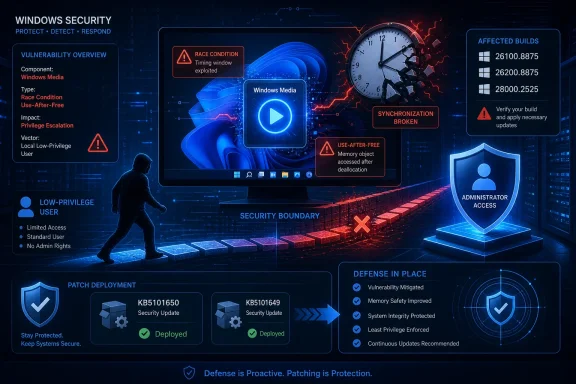 A Race Condition Opens the Privilege Boundary
Microsoft describes CVE-2026-50676 as improper synchronization during concurrent access to a shared resource in Windows Media. The weakness is categorized as both CWE-362, a race condition, and CWE-416, a use-after-free vulnerability.A race condition occurs when software behavior depends on the timing or order of operations that may execute concurrently. If Windows Media fails to synchronize those operations correctly, an attacker may be able to influence an object while another thread still expects it to remain in a valid state.
The associated use-after-free classification supplies an important additional clue. It indicates that the vulnerable code may continue using memory after the object occupying it has been released, potentially allowing attacker-controlled data to replace or alter what the program expects to find there.
Microsoft has not published exploit code, a detailed reproduction procedure, or the precise Windows Media operation that triggers the flaw. That limits immediate defensive options outside patching, but it also avoids giving would-be attackers a ready-made technical roadmap.
The CVSS vector is
CVSS:3.1/AV:L/AC:L/PR:L/UI:N/S:U/C:H/I:H/A:H. In practical terms, exploitation requires local access and low-level privileges, but it does not require another user to click a file, open a prompt, or take any other action.A successful exploit could produce high confidentiality, integrity, and availability impact. That combination is characteristic of a privilege-escalation flaw that could allow an attacker to move from a constrained account or process into a much more powerful security context.
Local Access Does Not Make the Flaw Harmless
CVE-2026-50676 is not a drive-by remote-code-execution vulnerability. An attacker cannot exploit it directly across the network according to the published CVSS assessment, and the attacker must already possess authorization to execute code locally.That prerequisite lowers its exposure compared with an unauthenticated network vulnerability, but it does not make the bug a minor concern. Local elevation vulnerabilities are commonly used as the second stage of an attack after phishing, credential theft, malicious downloads, browser compromise, or exploitation of an exposed application has established an initial foothold.
The absence of required user interaction is particularly relevant. Once an attacker can execute code under a low-privilege identity, exploitation would not depend on convincing an administrator to approve a User Account Control prompt or open additional content.
CISA’s initial Stakeholder-Specific Vulnerability Categorization lists no observed exploitation and considers automated exploitation unlikely. It nevertheless assigns the vulnerability total technical impact, reflecting the degree of control that successful privilege escalation could provide on the affected machine.
The Zero Day Initiative’s July 2026 security update review likewise records CVE-2026-50676 as neither publicly disclosed nor exploited at release. That makes this a preventive patching exercise rather than an active incident response trigger, unless an organization has separate evidence of suspicious activity.
Microsoft’s report-confidence status of Confirmed should not be confused with evidence of attacks. In CVSS terminology, Confirmed means the vendor acknowledges that the vulnerability exists and regards the available technical evidence as credible. It does not mean exploitation has been confirmed in the wild.
That distinction matters because scanner dashboards sometimes display “Confirmed” alongside exploitability information without making the underlying metric obvious. Here, the vulnerability itself is confirmed, while public disclosure and active exploitation were both reported as “No” at publication.
The Fix Lands in Three Windows 11 Build Lines
The initial CVE record identifies affected x64 and Arm64 installations across three current Windows 11 branches. Systems running builds below the July security baseline remain vulnerable:- Windows 11 24H2 is affected before OS build 26100.8875.
- Windows 11 25H2 is affected before OS build 26200.8875.
- Windows 11 26H1 is affected before OS build 28000.2525.
Windows 11 26H1 receives the fix through KB5101649, which advances that release to build 28000.2525. Version 26H1 is associated with newer hardware and has a narrower deployment footprint than the established 24H2 and 25H2 branches, but machines running it are explicitly included in the affected-product data.
The CVE record does not list Windows 11 23H2, Windows 10, or Windows Server as affected. Administrators should avoid extrapolating beyond Microsoft’s published product matrix, particularly because “Windows Media” is a broad component label rather than a reference to one consumer-facing media application.
Installing or removing Media Player is therefore not a documented mitigation. The vulnerable code may be part of the Windows media stack used by multiple applications and services, including software that does not present itself as a media player.
Microsoft has also not documented a registry change, Group Policy setting, service-disablement procedure, or feature-removal workaround for CVE-2026-50676. The cumulative security update is the supported remediation.
Patch Verification Matters More Than Component Hunting
For unmanaged PCs, users can open Settings, select Windows Update, and install the July 2026 cumulative update. After the required restart,winver should report at least build 26100.8875 for 24H2, 26200.8875 for 25H2, or 28000.2525 for 26H1.Enterprise administrators should query the OS build across their fleet after deployment. Checking only for the KB identifier can produce misleading results when machines are pending a restart, have suffered a rollback, or have received a later cumulative update that supersedes the July package.
Because Windows cumulative updates are superseding, a later security update should also contain the correction. The meaningful compliance test is whether the installed build meets or exceeds the fixed baseline for the applicable Windows version.
Security teams should give additional attention to shared workstations, developer endpoints, virtual desktops, kiosk-like systems that permit user code execution, and machines used by contractors or other lower-trust accounts. Those environments offer the local access required by the CVSS vector and may give an attacker a useful path from limited execution to broader system control.
Application-control technologies such as Windows Defender Application Control and AppLocker may reduce the opportunity to launch an exploit, while Microsoft Defender for Endpoint can help identify suspicious post-compromise behavior. Neither control repairs the underlying memory-safety problem, and neither should be treated as a replacement for the July update.
Organizations that defer cumulative updates for testing should keep the delay short and monitor Microsoft’s Windows release-health information for emerging compatibility issues. Microsoft’s KB5101650 documentation reported no known issues at publication, although that status can change as deployment expands.
CVE-2026-50676 was not one of the actively exploited vulnerabilities drawing the most attention in Microsoft’s unusually large July 2026 release. Its combination of low attack complexity, no required user interaction, and potentially complete impact still makes it a credible link in a multi-stage Windows compromise.
The immediate milestone is therefore measurable: Windows 11 24H2 and 25H2 devices should reach their KB5101650 baselines, while 26H1 systems should reach build 28000.2525 through KB5101649. Any supported machine below those builds remains on the vulnerable side of the Windows Media race condition.
References
- Primary source: MSRC
Published: 2026-07-14T07:00:00-07:00
Security Update Guide - Microsoft Security Response Center
 msrc.microsoft.com
- Related coverage: aha.org
- Related coverage: tomshardware.com
Windows Server vulnerability can grant system privileges with just a malformed packet — domain controllers are being exploited in the wild | Tom's Hardware
System administrators, run the May 12 patch immediately if you haven't already.www.tomshardware.com
