

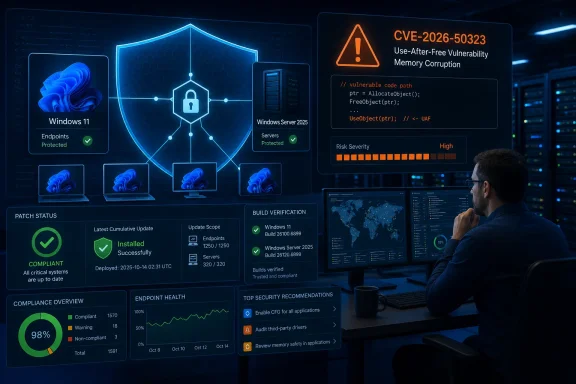
Microsoft rates the flaw Important, with a CVSS 3.1 base score of 7.0. The Microsoft Security Response Center describes it as a Windows Runtime memory-management error that allows an authorized local attacker to elevate privileges, potentially gaining broad control over the affected machine.
The National Vulnerability Database received the Microsoft-issued record on July 14 but was still awaiting its own enrichment at publication time. Its entry confirms the use-after-free classification, CWE-416, affected Windows versions, and Microsoft's scoring.
Exploitation Starts From an Existing Foothold
CVE-2026-50323 is not remotely exploitable by itself. Microsoft's CVSS vector specifies a local attack vector and requires the attacker to possess low-level privileges before attempting exploitation.
That distinction matters, but it does not make the vulnerability harmless. Local elevation-of-privilege bugs commonly serve as the second stage of an attack: phishing, stolen credentials, a malicious application, or another vulnerability first provides limited access, after which the privilege-escalation flaw is used to escape those restrictions.
Successful exploitation could affect confidentiality, integrity, and availability at a high level. No user interaction is required once the attacker has local access, although Microsoft assigns the vulnerability high attack complexity, indicating that exploitation depends on conditions beyond simply executing a readily available command.
The use-after-free designation points to an object being accessed after Windows has released its associated memory. Attackers can sometimes manipulate the reclaimed memory so that a privileged component processes attacker-controlled data, but Microsoft has not published technical details showing the vulnerable Windows Runtime function, trigger sequence, or resulting privilege level.
Microsoft also has not provided proof-of-concept code. Zero Day Initiative and SANS Internet Storm Center tracking for the July release list CVE-2026-50323 as neither publicly disclosed nor known to be exploited in the wild as of July 14.
That leaves defenders with a confirmed vulnerability and a vendor patch, but little technical material from which to build a reliable standalone detection. In this case, build compliance is more useful than searching for a speculative exploit signature.
Three Windows Branches Receive Different Build Floors
Microsoft's CVE record identifies Windows 11 24H2 and 25H2 on both x64 and Arm64 hardware, plus Windows Server 2025 and its Server Core installation option. Windows 11 26H1 also appears in the affected-product data, although its version boundary requires closer reading.
For the mainstream Windows 11 branches, July's cumulative update is KB5101650. Patched systems should report OS build 26100.8875 on Windows 11 24H2 or 26200.8875 on Windows 11 25H2.
Windows Server 2025 receives KB5099536, raising the operating system to build 26100.33158. That package applies to both the Desktop Experience and Server Core variants covered by the CVE.
Windows 11 26H1 has a less obvious status. Microsoft's CVE data marks versions earlier than build 28000.2269 as affected, while build 28000.2269 was already delivered by June's KB5095051. The current July update is nevertheless KB5101649, which advances 26H1 to build 28000.2525 and contains the latest security fixes.
Administrators should therefore use the following current targets rather than treating the CVE's lower boundary as a reason to defer July patching:
- Windows 11 24H2 should be updated to build 26100.8875 or later through KB5101650.
- Windows 11 25H2 should be updated to build 26200.8875 or later through KB5101650.
- Windows 11 26H1 should be updated to build 28000.2525 or later through KB5101649.
- Windows Server 2025 should be updated to build 26100.33158 or later through KB5099536.
The CVE record does not list Windows 11 23H2, Windows 10, Windows Server 2022, or older supported server releases as affected. Administrators should still install those products' July updates because Microsoft's monthly release addresses many vulnerabilities beyond CVE-2026-50323.
The Confidence Metric Does Not Change the Patch Decision
The explanatory text attached to Microsoft's vulnerability page describes a metric concerned with confidence in a vulnerability's existence and the credibility of available technical details. That language can be misleading when viewed without the actual CVE record because it reads like a warning that the underlying bug may still be hypothetical.
CVE-2026-50323 is not merely an uncorroborated third-party claim. Microsoft assigned the identifier, named the affected component, classified the weakness as CWE-416, supplied a CVSS vector, identified affected build ranges, and shipped servicing updates. Those actions provide strong vendor confirmation even though Microsoft has withheld the engineering detail needed to reproduce the flaw.
Confidence and exploitation maturity are separate ideas. A vulnerability can be conclusively confirmed while no public exploit exists, just as a technically incomplete report can become urgent if attackers begin using it. Here, the available evidence supports the existence and impact of the flaw, while current reporting does not indicate active exploitation.
The lack of public exploitation may justify a normal expedited deployment rather than emergency isolation of every affected endpoint. It does not justify waiting indefinitely, particularly on shared workstations, administrative jump boxes, developer systems, virtual desktop hosts, and Windows Server 2025 machines where a low-privileged account may coexist with valuable administrative activity.
Build Verification Is the Useful Control
For individual PCs, Windows Update should install the applicable cumulative package automatically unless updates have been paused or controlled by organizational policy. The installed build can be checked by running winver or by reviewing Settings > System > About.
Enterprise teams should query build numbers through Microsoft Intune, Configuration Manager, Windows Update for Business reporting, PowerShell inventory, or their endpoint-management platform. Merely confirming that a July update was approved in WSUS does not prove that endpoints downloaded it, installed it, and completed any required restart.
Because the exploit requires local access, existing controls still reduce exposure while deployment proceeds. Removing unnecessary local administrator assignments, limiting interactive logons to servers, enforcing application control, protecting privileged credentials, and investigating unusual process launches under elevated security contexts all make the flaw harder to incorporate into a successful attack chain.
Those measures are layers rather than substitutes. Microsoft has not documented a registry workaround, Group Policy mitigation, or Windows feature that can be disabled to remove the vulnerable path. Installing the corrected Windows build remains the definitive remediation.
CVE-2026-50323 is one of numerous Windows Runtime elevation-of-privilege fixes in Microsoft's unusually large July 2026 release, so patch validation should cover the complete cumulative update rather than this identifier alone. For administrators, the next milestone is concrete: confirm KB5101650, KB5101649, or KB5099536 across the applicable fleet and investigate every device that remains below its patched build floor.
References
- CVE-2026-50323 Windows Runtime Elevation of Privilege Vulnerability MSRC · 2026-07-14T07:00:00-07:00