

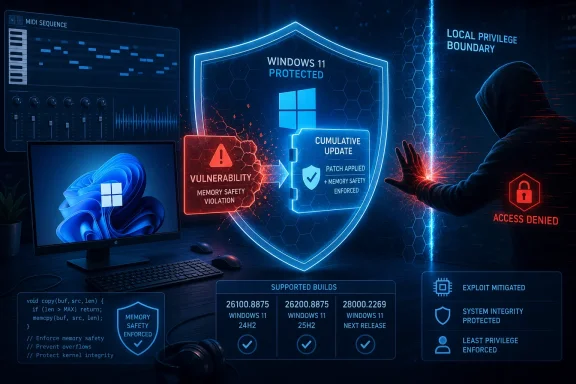
Microsoft’s July 14 security release fixes CVE-2026-56183, a high-severity elevation-of-privilege flaw in the Windows MIDI Service Module that affects Windows 11 24H2, 25H2, and 26H1. The practical priority is straightforward: organizations should ensure affected endpoints have reached build 26100.8875, 26200.8875, or later; Windows 11 26H1 needed build 28000.2269 or later.
Microsoft’s Security Response Center describes the issue as a use-after-free vulnerability. An attacker who already has local authorization on a vulnerable PC could exploit the MIDI service component to elevate privileges, potentially gaining broad control over confidentiality, integrity, and availability on that machine. The advisory was published on July 14, 2026, alongside Microsoft’s July Patch Tuesday updates.
This is not a remote, wormable bug and does not require ordinary users to panic about MIDI devices. It is, however, a meaningful post-compromise weakness: the kind of flaw that can turn a constrained foothold from malware, an abused account, or a local application exploit into a much more serious endpoint incident.
The Windows MIDI Service Module is an easily overlooked component because it is associated with a niche-sounding technology. But the service is part of Windows’ modern MIDI architecture, intended to support improved device interoperability and newer MIDI workflows. Its limited visibility should not lead administrators to assume the affected code is absent from ordinary desktops.
Microsoft’s affected-product data identifies the following Windows 11 branches on x64 and Arm64 systems:
The 26H1 timeline is more unusual. Microsoft’s vulnerability data says the affected range ends at build 28000.2269, which was delivered in KB5095051 on June 9, 2026. In other words, the affected 26H1 branch appears to have received the code fix a month before Microsoft published CVE-2026-56183 in its July advisory. Devices subsequently updated to July’s KB5101649, build 28000.2525, are also beyond the vulnerable range.
That distinction matters for patch reporting. A scanner that merely flags the newly published CVE without evaluating the installed build could incorrectly identify an already-current 26H1 machine as exposed.
The combination paints a more useful picture than the headline score alone. An attacker must first be able to execute code locally and authenticate with at least a low-privileged account. They do not need to persuade another user to open a file, click a link, or approve an elevation prompt as part of exploiting this specific flaw.
At the same time, Microsoft rates attack complexity as high. That usually means reliable exploitation depends on conditions beyond simply invoking a vulnerable function: timing, memory layout behavior, system state, or other factors may affect whether a use-after-free can be turned into a working privilege escalation.
That should temper — but not erase — the urgency. A high-complexity local EoP is still valuable to attackers who have already breached a workstation. Modern intrusion chains commonly begin with an unprivileged user context and then seek local administrator or SYSTEM-level access to disable defenses, dump credentials, establish persistence, or move laterally.
The public CVE record’s temporal metrics list exploit code maturity as unproven while rating report confidence as confirmed. Put plainly, Microsoft has confirmed the bug and its security impact, but there is no public indication in the advisory that a dependable exploit is available or that the flaw is being exploited in the wild.
That is preferable operationally. Disabling a Windows service that is part of an evolving media and device architecture can create unexpected compatibility problems, especially on developer workstations, audio-production systems, accessibility setups, or endpoints using hardware controllers. It would also be a poor substitute for remediating the underlying memory-safety defect.
Administrators should verify update compliance through their existing endpoint-management tooling, whether that is Windows Update for Business, Microsoft Intune, WSUS, Configuration Manager, or an RMM platform. The key check is the installed OS build, not whether a device has a MIDI peripheral attached.
A concise validation approach is:
The three issues should not be treated as duplicates. CVE-2026-50342 is described as an improper-access-control vulnerability and carries a substantially higher CVSS 3.1 score of 8.8. CVE-2026-56183 and CVE-2026-56187 are both use-after-free flaws, each rated 7.0. Together, they reinforce the value of deploying the month’s cumulative update rather than attempting to prioritize one individual MIDI advisory in isolation.
For Windows enthusiasts, the release is a reminder that services introduced to modernize specialized platform capabilities can become part of the core endpoint attack surface even if most users never interact with them directly. For enterprise IT, the lesson is more routine but more important: local privilege escalation remains a patch-management problem, and build-level verification is the fastest way to close it.
The next meaningful change to watch is not a new workaround but whether Microsoft revises CVE-2026-56183 with exploitation evidence or further technical detail. Until then, systems at or above the fixed build thresholds are protected by the vendor’s available remediation.
Microsoft’s Security Response Center describes the issue as a use-after-free vulnerability. An attacker who already has local authorization on a vulnerable PC could exploit the MIDI service component to elevate privileges, potentially gaining broad control over confidentiality, integrity, and availability on that machine. The advisory was published on July 14, 2026, alongside Microsoft’s July Patch Tuesday updates.
This is not a remote, wormable bug and does not require ordinary users to panic about MIDI devices. It is, however, a meaningful post-compromise weakness: the kind of flaw that can turn a constrained foothold from malware, an abused account, or a local application exploit into a much more serious endpoint incident.
 The affected build numbers matter more than the MIDI label
The Windows MIDI Service Module is an easily overlooked component because it is associated with a niche-sounding technology. But the service is part of Windows’ modern MIDI architecture, intended to support improved device interoperability and newer MIDI workflows. Its limited visibility should not lead administrators to assume the affected code is absent from ordinary desktops.Microsoft’s affected-product data identifies the following Windows 11 branches on x64 and Arm64 systems:
- Windows 11 version 24H2 is vulnerable before OS build 26100.8875.
- Windows 11 version 25H2 is vulnerable before OS build 26200.8875.
- Windows 11 version 26H1 is vulnerable before OS build 28000.2269.
The 26H1 timeline is more unusual. Microsoft’s vulnerability data says the affected range ends at build 28000.2269, which was delivered in KB5095051 on June 9, 2026. In other words, the affected 26H1 branch appears to have received the code fix a month before Microsoft published CVE-2026-56183 in its July advisory. Devices subsequently updated to July’s KB5101649, build 28000.2525, are also beyond the vulnerable range.
That distinction matters for patch reporting. A scanner that merely flags the newly published CVE without evaluating the installed build could incorrectly identify an already-current 26H1 machine as exposed.
A local attack with high impact but higher complexity
Microsoft assigned CVE-2026-56183 a CVSS 3.1 base score of 7.0, rated Important in the company’s security update guide. The vector is notable: local attack vector, high attack complexity, low privileges required, no user interaction, unchanged scope, and high impact to confidentiality, integrity, and availability.The combination paints a more useful picture than the headline score alone. An attacker must first be able to execute code locally and authenticate with at least a low-privileged account. They do not need to persuade another user to open a file, click a link, or approve an elevation prompt as part of exploiting this specific flaw.
At the same time, Microsoft rates attack complexity as high. That usually means reliable exploitation depends on conditions beyond simply invoking a vulnerable function: timing, memory layout behavior, system state, or other factors may affect whether a use-after-free can be turned into a working privilege escalation.
That should temper — but not erase — the urgency. A high-complexity local EoP is still valuable to attackers who have already breached a workstation. Modern intrusion chains commonly begin with an unprivileged user context and then seek local administrator or SYSTEM-level access to disable defenses, dump credentials, establish persistence, or move laterally.
The public CVE record’s temporal metrics list exploit code maturity as unproven while rating report confidence as confirmed. Put plainly, Microsoft has confirmed the bug and its security impact, but there is no public indication in the advisory that a dependable exploit is available or that the flaw is being exploited in the wild.
No public workaround means patching is the mitigation
Microsoft has not published a workaround, feature toggle, registry adjustment, or service-disablement guidance for CVE-2026-56183. For managed environments, that makes normal cumulative-update deployment the correct response rather than an attempt to surgically remove or disable the MIDI stack.That is preferable operationally. Disabling a Windows service that is part of an evolving media and device architecture can create unexpected compatibility problems, especially on developer workstations, audio-production systems, accessibility setups, or endpoints using hardware controllers. It would also be a poor substitute for remediating the underlying memory-safety defect.
Administrators should verify update compliance through their existing endpoint-management tooling, whether that is Windows Update for Business, Microsoft Intune, WSUS, Configuration Manager, or an RMM platform. The key check is the installed OS build, not whether a device has a MIDI peripheral attached.
A concise validation approach is:
- Windows 11 24H2 devices should report build 26100.8875 or newer.
- Windows 11 25H2 devices should report build 26200.8875 or newer.
- Windows 11 26H1 devices should report build 28000.2269 or newer.
- Devices pending a reboot after installing the cumulative update should not be counted as fully remediated until restart and build verification are complete.
Three MIDI bugs arrived in the same security release
CVE-2026-56183 was not the only Windows MIDI Service Module elevation-of-privilege issue disclosed in July. Microsoft’s Patch Tuesday materials also list CVE-2026-50342 and CVE-2026-56187 in the same component.The three issues should not be treated as duplicates. CVE-2026-50342 is described as an improper-access-control vulnerability and carries a substantially higher CVSS 3.1 score of 8.8. CVE-2026-56183 and CVE-2026-56187 are both use-after-free flaws, each rated 7.0. Together, they reinforce the value of deploying the month’s cumulative update rather than attempting to prioritize one individual MIDI advisory in isolation.
For Windows enthusiasts, the release is a reminder that services introduced to modernize specialized platform capabilities can become part of the core endpoint attack surface even if most users never interact with them directly. For enterprise IT, the lesson is more routine but more important: local privilege escalation remains a patch-management problem, and build-level verification is the fastest way to close it.
The next meaningful change to watch is not a new workaround but whether Microsoft revises CVE-2026-56183 with exploitation evidence or further technical detail. Until then, systems at or above the fixed build thresholds are protected by the vendor’s available remediation.
References
- Primary source: MSRC
Published: 2026-07-14T07:00:00-07:00
Security Update Guide - Microsoft Security Response Center
 msrc.microsoft.com
