

Microsoft has fixed CVE-2026-50398, an Important-rated Windows Media elevation-of-privilege vulnerability that can be exploited by an authenticated attacker across a network. The flaw carries a CVSS 3.1 base score of 8.8 and can expose the confidentiality, integrity, and availability of a compromised system.
Published by the Microsoft Security Response Center on July 14, 2026, the vulnerability affects Windows 11 versions 24H2, 25H2, and 26H1, along with Windows Server 2025 and its Server Core installation option. Microsoft says the issue is not publicly disclosed, has not been observed in active attacks, and is considered less likely to be exploited.
For most Windows 11 systems, remediation arrives through the July cumulative updates. Administrators should verify installed build numbers rather than relying solely on a successful Windows Update status from an earlier maintenance cycle.
Microsoft describes CVE-2026-50398 as improper synchronization when Windows Media performs concurrent operations on a shared resource. The CVE record maps the underlying weakness to both CWE-362, a race condition, and CWE-416, a use-after-free condition.
A race condition appears when security-relevant behavior depends on the order or timing of two operations. If one thread releases or changes an object while another thread still expects that object to remain valid, an attacker may be able to manipulate the resulting state. A use-after-free occurs when software continues accessing memory after the associated object has been released.
Microsoft has not published proof-of-concept code, a vulnerable function name, or a step-by-step attack scenario. That limits immediate defensive opportunities beyond installing the update, because security teams do not yet have a specific Windows Media process, event, file type, or network pattern to monitor.
The vulnerability nevertheless has a serious theoretical impact. Microsoft’s CVSS vector assigns high potential losses across confidentiality, integrity, and availability, meaning successful exploitation could allow an attacker to cross a privilege boundary and substantially control the affected system.
The “network” attack vector deserves careful interpretation. It does not mean that any unauthenticated internet user can automatically compromise a Windows PC simply because it is online. The vector also specifies that the attacker must already possess low-level privileges, while no separate user interaction is required.
That combination makes CVE-2026-50398 especially relevant to post-compromise activity. An attacker who has obtained valid credentials or limited access through another vulnerability, malware infection, exposed service, or stolen session could potentially use the Windows Media flaw to gain more powerful privileges without convincing another user to open a file or approve a prompt.
For Windows 11 versions 24H2 and 25H2, the July 14 cumulative update is KB5101650. Microsoft’s release information identifies builds 26100.8875 and 26200.8875 as the patched baselines, although one localized support-page heading displays 26200.8870 while the CVE data and update reporting identify 26200.8875. Administrators should use the CVE’s affected-version boundary and the build shown by
Windows 11 version 26H1 has a less conventional timeline. Microsoft lists build 28000.2269 as the first non-affected build, corresponding to June 9 update KB5095051. The newer July update, KB5101649, moves 26H1 devices to build 28000.2525, so systems receiving current cumulative updates are already beyond the vulnerable boundary.
That does not make the July advisory irrelevant to 26H1. Microsoft sometimes discloses a CVE after a corrective change has already shipped for a particular branch. Devices running an early 26H1 image below 28000.2269 remain exposed, while machines patched in June or July meet the published remediation threshold.
Windows 11 version 26H1 is also a hardware-focused release intended primarily for select new devices rather than a conventional feature update offered broadly to existing PCs. Its inclusion matters most to OEM deployments, validation labs, and IT teams managing newly introduced hardware.
It does not indicate that attackers are exploiting the flaw. Microsoft’s separate exploitability fields say CVE-2026-50398 was neither publicly disclosed nor exploited when the advisory was released. CISA’s initial SSVC assessment likewise recorded no known exploitation and classified exploitation as not readily automatable, while recognizing that the technical impact could be total.
These distinctions matter when triaging a busy Patch Tuesday. The 8.8 score reflects what could happen under the modeled attack conditions; the exploitability assessment reflects Microsoft’s view of how practical exploitation currently appears. Neither should be used alone.
The low attack-complexity rating suggests an attacker would not need rare timing conditions or unusual environmental preparation once the required access is established. Race-condition vulnerabilities can still be difficult to turn into reliable exploits, however, particularly when an attacker must control object lifetime and memory behavior across different builds, architectures, and security configurations.
Microsoft’s “Exploitation Less Likely” assessment provides some breathing room for staged deployment, but it is not a reason to defer indefinitely. Privilege-escalation flaws are valuable components in attack chains because they can convert an initial low-privilege foothold into administrative control. Public analysis or patch comparison can also change the risk picture after release.
The practical response is to deploy the relevant cumulative update and confirm the resulting OS build. Windows 11 users can check the build by running
Because Windows updates are cumulative, devices do not need a standalone CVE-2026-50398 package. A machine at or above the fixed build contains the security correction even if the update history does not mention the CVE by name.
Administrators should prioritize systems where authenticated network access is available to large user populations, contractors, application accounts, or potentially compromised endpoints. Windows Server 2025 installations deserve particular attention because an elevation path on a server can expose shared data, service credentials, and downstream management infrastructure.
Microsoft currently reports no known issues for Windows 11 update KB5101650. Normal deployment safeguards still apply: test the cumulative update against media-processing applications, remote desktop workflows, endpoint security software, and line-of-business workloads before expanding it across production rings.
The immediate milestone is straightforward. Windows 11 24H2 systems should reach build 26100.8875 or later, Windows 11 25H2 should reach 26200.8875 or later, and Windows 11 26H1 should be at least 28000.2269. Windows Server 2025 estates should verify build 26100.33158 or later rather than assuming that an earlier July servicing action closed the vulnerability.
Published by the Microsoft Security Response Center on July 14, 2026, the vulnerability affects Windows 11 versions 24H2, 25H2, and 26H1, along with Windows Server 2025 and its Server Core installation option. Microsoft says the issue is not publicly disclosed, has not been observed in active attacks, and is considered less likely to be exploited.
For most Windows 11 systems, remediation arrives through the July cumulative updates. Administrators should verify installed build numbers rather than relying solely on a successful Windows Update status from an earlier maintenance cycle.
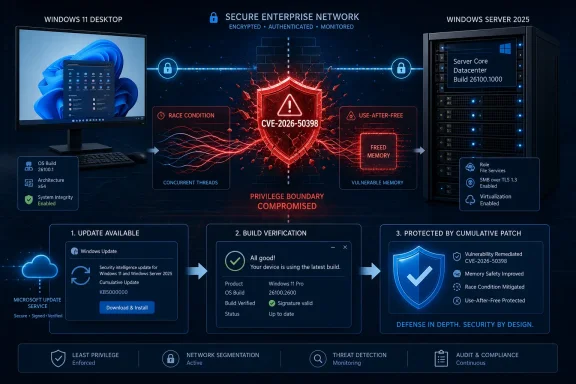 A Race Condition Opens the Privilege Boundary
Microsoft describes CVE-2026-50398 as improper synchronization when Windows Media performs concurrent operations on a shared resource. The CVE record maps the underlying weakness to both CWE-362, a race condition, and CWE-416, a use-after-free condition.A race condition appears when security-relevant behavior depends on the order or timing of two operations. If one thread releases or changes an object while another thread still expects that object to remain valid, an attacker may be able to manipulate the resulting state. A use-after-free occurs when software continues accessing memory after the associated object has been released.
Microsoft has not published proof-of-concept code, a vulnerable function name, or a step-by-step attack scenario. That limits immediate defensive opportunities beyond installing the update, because security teams do not yet have a specific Windows Media process, event, file type, or network pattern to monitor.
The vulnerability nevertheless has a serious theoretical impact. Microsoft’s CVSS vector assigns high potential losses across confidentiality, integrity, and availability, meaning successful exploitation could allow an attacker to cross a privilege boundary and substantially control the affected system.
The “network” attack vector deserves careful interpretation. It does not mean that any unauthenticated internet user can automatically compromise a Windows PC simply because it is online. The vector also specifies that the attacker must already possess low-level privileges, while no separate user interaction is required.
That combination makes CVE-2026-50398 especially relevant to post-compromise activity. An attacker who has obtained valid credentials or limited access through another vulnerability, malware infection, exposed service, or stolen session could potentially use the Windows Media flaw to gain more powerful privileges without convincing another user to open a file or approve a prompt.
The Affected List Is Narrower Than “Windows Media” Suggests
The CVE record currently identifies five affected platform groups:- Windows 11 version 24H2 is affected on x64 and ARM64 systems before build 26100.8875.
- Windows 11 version 25H2 is affected on x64 and ARM64 systems before build 26200.8875.
- Windows 11 version 26H1 is affected on x64 and ARM64 systems before build 28000.2269.
- Windows Server 2025 is affected before build 26100.33158.
- Windows Server 2025 Server Core is affected before build 26100.33158.
For Windows 11 versions 24H2 and 25H2, the July 14 cumulative update is KB5101650. Microsoft’s release information identifies builds 26100.8875 and 26200.8875 as the patched baselines, although one localized support-page heading displays 26200.8870 while the CVE data and update reporting identify 26200.8875. Administrators should use the CVE’s affected-version boundary and the build shown by
winver or their device-management inventory when validating remediation.Windows 11 version 26H1 has a less conventional timeline. Microsoft lists build 28000.2269 as the first non-affected build, corresponding to June 9 update KB5095051. The newer July update, KB5101649, moves 26H1 devices to build 28000.2525, so systems receiving current cumulative updates are already beyond the vulnerable boundary.
That does not make the July advisory irrelevant to 26H1. Microsoft sometimes discloses a CVE after a corrective change has already shipped for a particular branch. Devices running an early 26H1 image below 28000.2269 remain exposed, while machines patched in June or July meet the published remediation threshold.
Windows 11 version 26H1 is also a hardware-focused release intended primarily for select new devices rather than a conventional feature update offered broadly to existing PCs. Its inclusion matters most to OEM deployments, validation labs, and IT teams managing newly introduced hardware.
Confirmed Does Not Mean Exploited
The advisory’s report-confidence metric is marked Confirmed. In CVSS terminology, that indicates the vendor has confirmed the vulnerability or that sufficiently detailed technical evidence exists to establish it as genuine.It does not indicate that attackers are exploiting the flaw. Microsoft’s separate exploitability fields say CVE-2026-50398 was neither publicly disclosed nor exploited when the advisory was released. CISA’s initial SSVC assessment likewise recorded no known exploitation and classified exploitation as not readily automatable, while recognizing that the technical impact could be total.
These distinctions matter when triaging a busy Patch Tuesday. The 8.8 score reflects what could happen under the modeled attack conditions; the exploitability assessment reflects Microsoft’s view of how practical exploitation currently appears. Neither should be used alone.
The low attack-complexity rating suggests an attacker would not need rare timing conditions or unusual environmental preparation once the required access is established. Race-condition vulnerabilities can still be difficult to turn into reliable exploits, however, particularly when an attacker must control object lifetime and memory behavior across different builds, architectures, and security configurations.
Microsoft’s “Exploitation Less Likely” assessment provides some breathing room for staged deployment, but it is not a reason to defer indefinitely. Privilege-escalation flaws are valuable components in attack chains because they can convert an initial low-privilege foothold into administrative control. Public analysis or patch comparison can also change the risk picture after release.
Patch Validation Matters More Than Media Workarounds
Microsoft has not documented a registry workaround, Group Policy mitigation, or Windows Media feature that administrators should disable. Removing a media player application would not necessarily eliminate vulnerable operating-system components, and disabling broad media functionality without vendor guidance could introduce compatibility problems while providing uncertain protection.The practical response is to deploy the relevant cumulative update and confirm the resulting OS build. Windows 11 users can check the build by running
winver, while enterprise teams can query inventory through Microsoft Intune, Configuration Manager, Windows Update for Business reporting, PowerShell, or their endpoint-management platform.Because Windows updates are cumulative, devices do not need a standalone CVE-2026-50398 package. A machine at or above the fixed build contains the security correction even if the update history does not mention the CVE by name.
Administrators should prioritize systems where authenticated network access is available to large user populations, contractors, application accounts, or potentially compromised endpoints. Windows Server 2025 installations deserve particular attention because an elevation path on a server can expose shared data, service credentials, and downstream management infrastructure.
Microsoft currently reports no known issues for Windows 11 update KB5101650. Normal deployment safeguards still apply: test the cumulative update against media-processing applications, remote desktop workflows, endpoint security software, and line-of-business workloads before expanding it across production rings.
The immediate milestone is straightforward. Windows 11 24H2 systems should reach build 26100.8875 or later, Windows 11 25H2 should reach 26200.8875 or later, and Windows 11 26H1 should be at least 28000.2269. Windows Server 2025 estates should verify build 26100.33158 or later rather than assuming that an earlier July servicing action closed the vulnerability.
References
- Primary source: MSRC
Published: 2026-07-14T07:00:00-07:00
Security Update Guide - Microsoft Security Response Center
 msrc.microsoft.com
- Related coverage: aha.org
