

Microsoft has fixed CVE-2026-58610, a Windows Media Foundation remote code execution vulnerability caused by a heap-based buffer overflow, in the July 14, 2026 security updates. The flaw carries a CVSS 3.1 score of 7.8 and affects supported Windows 10, Windows 11, and Windows Server releases, making the monthly cumulative update the only documented remediation.
Detailed in Microsoft’s Security Update Guide and recorded by the National Vulnerability Database, CVE-2026-58610 can allow an unauthenticated attacker to execute code after convincing a user to interact with malicious media content. Microsoft rates the vulnerability Important, says exploitation is unlikely, and reports no evidence that it was publicly disclosed or exploited before patches became available.
There are no Microsoft-provided mitigations or workarounds. Administrators who delay the July update therefore retain the vulnerable Media Foundation code path.
The vulnerability’s name can give the impression of a network service that an attacker can compromise directly. Its CVSS vector tells a more constrained story: AV:L/AC:L/PR:N/UI:R/S:U/C:H/I:H/A:H.
The local attack vector and required user interaction mean an attacker cannot simply send arbitrary packets to an exposed Windows machine and take control. Instead, the attacker needs the targeted system to process specially crafted content, most likely through an application or workflow that invokes Windows Media Foundation.
No existing account or privileges are required, and Microsoft rates attack complexity as low. Once triggered, successful exploitation could compromise confidentiality, integrity, and availability within the security context of the affected application or user.
That distinction explains the 7.8 score and Important rating. The possible outcome is serious, but the path to that outcome includes a delivery and interaction step that is absent from unauthenticated, network-reachable vulnerabilities.
Microsoft’s short public description does not identify a particular media container, codec, file extension, or application as the trigger. It would therefore be premature to assume that blocking one file type, removing a single player, or changing a default application provides meaningful protection.
CVE-2026-58610 is classified as CWE-122, a heap-based buffer overflow. This class of memory corruption occurs when software writes more data into a heap allocation than the allocated region can hold, potentially damaging adjacent objects or control data.
Microsoft has not published the affected function, malformed data structure, or memory layout. That limited disclosure reduces immediate guidance for intrusion-detection authors, application developers, and administrators attempting to build controls around the vulnerable processing path.
It does not, however, reduce confidence that the vulnerability exists. Microsoft is the CVE Numbering Authority for the record, has acknowledged the flaw, identified its weakness class and affected products, and shipped corrected Windows builds. The vulnerability’s existence is therefore vendor-confirmed even though its deeper technical details remain private.
CISA’s initial SSVC data listed no known exploitation and assessed the flaw as not readily automatable, while recognizing that successful exploitation could have a total technical impact. That aligns with a vulnerability requiring a user or application to process attacker-controlled content rather than one suitable for straightforward Internet-wide scanning.
The presence of Server Core in the affected list is important. Removing the graphical shell does not necessarily remove multimedia components or every service and application capable of reaching Media Foundation functionality. Administrators should rely on Microsoft’s product applicability data rather than assuming a headless installation is insulated from media-processing bugs.
Because Windows cumulative updates supersede earlier packages, administrators do not need to locate and deploy a separate Media Foundation hotfix. Installing the correct July 2026 cumulative security update brings in the correction alongside the month’s other Windows fixes.
Enterprise exposure is broader than visible media-player usage. Document-management systems, communications clients, asset catalogues, digital-signage tools, browser components, and line-of-business applications may process media through Windows APIs without users explicitly launching a player.
Security teams should pay particular attention to systems that automatically ingest, index, convert, preview, or generate thumbnails for externally supplied content. A required-interaction score does not always mean a person must deliberately double-click a file; an application action performed on the user’s behalf may be enough if it reaches the vulnerable component.
Until Microsoft or a researcher publishes further technical analysis, defenders have no reliable filename pattern or codec-specific indicator to monitor. Gateway filtering should consequently remain broad and risk-based, focusing on unexpected media attachments, archives from unknown senders, and untrusted content entering automated processing pipelines.
Endpoint telemetry may still expose the later stages of an attack. Administrators can watch for media-handling applications spawning shells, script interpreters, download utilities, or unfamiliar child processes, as well as unusual outbound connections immediately after a media file is opened. Those behaviors are not unique to CVE-2026-58610, but they can reveal exploitation attempts that move beyond the initial memory corruption.
That crowded release means organizations will understandably prioritize known exploitation and unauthenticated server vulnerabilities first. CVE-2026-58610 does not currently warrant emergency isolation ahead of actively exploited flaws, but it should not be deferred beyond the normal July deployment cycle.
Administrators should confirm that managed devices have installed the applicable July cumulative update and reached the corrected OS build, rather than relying only on a successful update scan. Systems that handle untrusted media at scale deserve accelerated testing and deployment because their exposure can exceed that of an ordinary workstation.
Patching is the primary control: Microsoft lists neither a workaround nor a component-level mitigation. Until more technical details emerge, the practical boundary is straightforward—Windows systems below their July 14, 2026 security build remain exposed whenever Media Foundation is asked to process attacker-controlled content.
Detailed in Microsoft’s Security Update Guide and recorded by the National Vulnerability Database, CVE-2026-58610 can allow an unauthenticated attacker to execute code after convincing a user to interact with malicious media content. Microsoft rates the vulnerability Important, says exploitation is unlikely, and reports no evidence that it was publicly disclosed or exploited before patches became available.
There are no Microsoft-provided mitigations or workarounds. Administrators who delay the July update therefore retain the vulnerable Media Foundation code path.
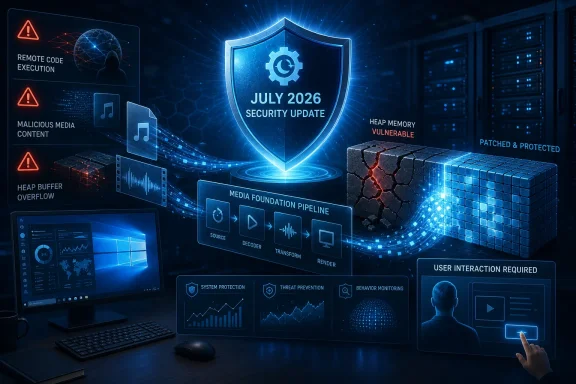 “Remote Code Execution” Still Requires a Local Trigger
The vulnerability’s name can give the impression of a network service that an attacker can compromise directly. Its CVSS vector tells a more constrained story: AV:L/AC:L/PR:N/UI:R/S:U/C:H/I:H/A:H.The local attack vector and required user interaction mean an attacker cannot simply send arbitrary packets to an exposed Windows machine and take control. Instead, the attacker needs the targeted system to process specially crafted content, most likely through an application or workflow that invokes Windows Media Foundation.
No existing account or privileges are required, and Microsoft rates attack complexity as low. Once triggered, successful exploitation could compromise confidentiality, integrity, and availability within the security context of the affected application or user.
That distinction explains the 7.8 score and Important rating. The possible outcome is serious, but the path to that outcome includes a delivery and interaction step that is absent from unauthenticated, network-reachable vulnerabilities.
Microsoft’s short public description does not identify a particular media container, codec, file extension, or application as the trigger. It would therefore be premature to assume that blocking one file type, removing a single player, or changing a default application provides meaningful protection.
A Heap Overflow in a Widely Used Media Layer
Windows Media Foundation is Microsoft’s multimedia framework for decoding, encoding, playback, capture, and media transformation. It is not limited to the Media Player interface: third-party and Microsoft applications can call its APIs when processing audio and video.CVE-2026-58610 is classified as CWE-122, a heap-based buffer overflow. This class of memory corruption occurs when software writes more data into a heap allocation than the allocated region can hold, potentially damaging adjacent objects or control data.
Microsoft has not published the affected function, malformed data structure, or memory layout. That limited disclosure reduces immediate guidance for intrusion-detection authors, application developers, and administrators attempting to build controls around the vulnerable processing path.
It does not, however, reduce confidence that the vulnerability exists. Microsoft is the CVE Numbering Authority for the record, has acknowledged the flaw, identified its weakness class and affected products, and shipped corrected Windows builds. The vulnerability’s existence is therefore vendor-confirmed even though its deeper technical details remain private.
CISA’s initial SSVC data listed no known exploitation and assessed the flaw as not readily automatable, while recognizing that successful exploitation could have a total technical impact. That aligns with a vulnerability requiring a user or application to process attacker-controlled content rather than one suitable for straightforward Internet-wide scanning.
The Patch Reaches Across Windows Generations
The affected-product record spans desktop and server editions, including older releases maintained through enterprise servicing or Extended Security Updates. Microsoft identifies the following product families as affected:- Windows 10 versions 1607, 1809, 21H2, and 22H2 are affected on applicable architectures.
- Windows 11 versions 24H2, 25H2, and 26H1 are affected on x64 and Arm64 systems.
- Windows Server 2016, Windows Server 2019, Windows Server 2022, and Windows Server 2025 are affected.
- Server Core installations are included for the relevant Windows Server releases.
The presence of Server Core in the affected list is important. Removing the graphical shell does not necessarily remove multimedia components or every service and application capable of reaching Media Foundation functionality. Administrators should rely on Microsoft’s product applicability data rather than assuming a headless installation is insulated from media-processing bugs.
Because Windows cumulative updates supersede earlier packages, administrators do not need to locate and deploy a separate Media Foundation hotfix. Installing the correct July 2026 cumulative security update brings in the correction alongside the month’s other Windows fixes.
Risk Depends on Where Media Content Enters
For individual Windows PCs, the most plausible exposure begins with an untrusted download, message attachment, shared file, or website-driven workflow that results in media content being opened or inspected. Normal controls against phishing and unknown files remain useful, but they are not substitutes for updating.Enterprise exposure is broader than visible media-player usage. Document-management systems, communications clients, asset catalogues, digital-signage tools, browser components, and line-of-business applications may process media through Windows APIs without users explicitly launching a player.
Security teams should pay particular attention to systems that automatically ingest, index, convert, preview, or generate thumbnails for externally supplied content. A required-interaction score does not always mean a person must deliberately double-click a file; an application action performed on the user’s behalf may be enough if it reaches the vulnerable component.
Until Microsoft or a researcher publishes further technical analysis, defenders have no reliable filename pattern or codec-specific indicator to monitor. Gateway filtering should consequently remain broad and risk-based, focusing on unexpected media attachments, archives from unknown senders, and untrusted content entering automated processing pipelines.
Endpoint telemetry may still expose the later stages of an attack. Administrators can watch for media-handling applications spawning shells, script interpreters, download utilities, or unfamiliar child processes, as well as unusual outbound connections immediately after a media file is opened. Those behaviors are not unique to CVE-2026-58610, but they can reveal exploitation attempts that move beyond the initial memory corruption.
Deployment Should Follow the Cumulative Update, Not the CVSS Number
CVE-2026-58610 was one of several Media Foundation vulnerabilities included in Microsoft’s unusually large July 2026 Patch Tuesday release. BleepingComputer counted 570 Microsoft vulnerabilities in the release, while Trend Micro’s Zero Day Initiative separately listed CVE-2026-58610 as an Important, non-public, non-exploited RCE issue.That crowded release means organizations will understandably prioritize known exploitation and unauthenticated server vulnerabilities first. CVE-2026-58610 does not currently warrant emergency isolation ahead of actively exploited flaws, but it should not be deferred beyond the normal July deployment cycle.
Administrators should confirm that managed devices have installed the applicable July cumulative update and reached the corrected OS build, rather than relying only on a successful update scan. Systems that handle untrusted media at scale deserve accelerated testing and deployment because their exposure can exceed that of an ordinary workstation.
Patching is the primary control: Microsoft lists neither a workaround nor a component-level mitigation. Until more technical details emerge, the practical boundary is straightforward—Windows systems below their July 14, 2026 security build remain exposed whenever Media Foundation is asked to process attacker-controlled content.
References
- Primary source: MSRC
Published: 2026-07-14T07:00:00-07:00
Security Update Guide - Microsoft Security Response Center
 msrc.microsoft.com
- Official source: support.microsoft.com
July 14, 2026—KB5099539 (OS Builds 19045.7548 and 19044.7548) | Microsoft Support
July 14, 2026—KB5099539 (OS Builds 19045.7548 and 19044.7548)support.microsoft.com
