

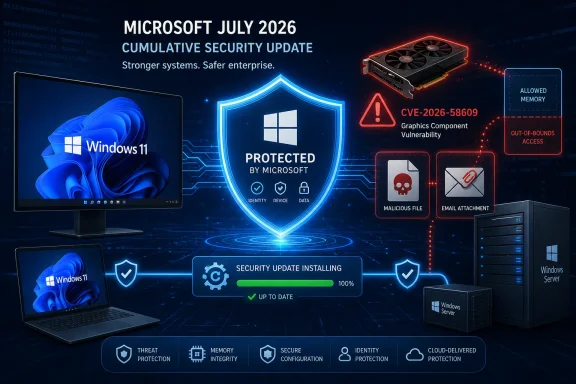
Microsoft has patched CVE-2026-58609, a high-severity Windows Graphics Component vulnerability that could let an attacker execute code after convincing a user to interact with malicious content. The fix arrived in the July 14, 2026 cumulative security updates for supported Windows client and server releases.
Detailed in Microsoft’s Security Update Guide, the flaw carries a CVSS 3.1 score of 7.8 and an Important severity rating. Microsoft describes it as an out-of-bounds read in the Microsoft Graphics Component, while the National Vulnerability Database classifies the underlying weakness as CWE-125.
The vulnerability was not publicly disclosed or known to be exploited when Microsoft released the patches. Microsoft also assessed exploitation as “less likely,” but the potential outcome is serious: successful exploitation could compromise confidentiality, integrity, and availability on the affected system.
The vulnerability’s title says remote code execution, but its CVSS vector lists the attack vector as local. That distinction matters because CVE-2026-58609 is not documented as a wormable network flaw that an attacker can trigger simply by sending packets to an exposed Windows service.
Microsoft’s vector is
Microsoft has not publicly explained the exact file format, application path, or graphics-processing operation needed to trigger the bug. Administrators should therefore avoid narrowing their controls to a single assumed attachment type. The published information establishes that interaction is required, but not precisely what that interaction looks like.
That makes email attachments, downloaded files, collaboration platforms, browser-delivered content, and shared storage plausible delivery channels rather than confirmed exploit methods. Until Microsoft or an independent researcher publishes deeper technical analysis, security teams should treat those as defensive considerations, not established details of the vulnerability.
The lack of a network attack vector lowers immediate exposure for unattended systems. It does not remove risk from workstations where users routinely process files from customers, vendors, job applicants, or other external parties.
The CVSS impact fields are all rated high. Microsoft’s assessment indicates that successful exploitation could allow an attacker to read protected information, modify data, and disrupt the affected process or system. Scope remains unchanged, meaning the exploit operates within the security authority of the vulnerable component rather than directly crossing into another security domain.
What privileges the attacker ultimately receives will depend on the context in which the vulnerable graphics component is running. If malicious content is processed inside an application running with standard-user rights, the code should initially inherit that user’s permissions. If the affected process is elevated or operates under a more privileged account, the resulting damage could be considerably greater.
That is one reason least-privilege policies remain relevant even after a vulnerability has been assigned an RCE label. Preventing users from routinely running applications as administrators can constrain the first stage of an attack, although it is not a replacement for installing the security update.
CISA’s initial Stakeholder-Specific Vulnerability Categorization assessment recorded no known exploitation and classified the attack as not readily automatable. It nevertheless assigned “total” technical impact, reflecting the breadth of potential damage if exploitation succeeds.
Affected platforms include:
Windows 10 version 22H2 systems covered by Extended Security Updates receive KB5099539, bringing them to build 19045.7548. The same package brings supported Windows 10 version 21H2 installations to build 19044.7548.
Windows Server 2025 receives KB5099536, moving to build 26100.33158. Older server releases have their own July cumulative or security-only packages, so administrators should verify compliance by operating-system version and build rather than expecting one KB number across the estate.
Because Windows cumulative updates supersede earlier packages, machines do not need a separate CVE-2026-58609 installer. The mitigation is included in the applicable July 2026 security update.
That should inform deployment order without becoming a reason to defer the fix indefinitely. General-purpose desktops, virtual desktop infrastructure, Remote Desktop Session Hosts, jump boxes, and systems used to inspect external documents have a more credible exposure path than isolated servers that never process user-supplied content.
Server Core is still listed as affected, however. Administrators should not assume that removing the graphical shell also removes graphics libraries or every path through which data can reach them. Server applications, document converters, preview services, reporting tools, and automated workflows may invoke components that are not visible during normal interactive use.
For managed environments, the practical response is straightforward:
Those unrelated changes may be more visible during deployment than the graphics fix itself. Organizations delaying the cumulative update because of application testing should document the resulting exposure and consider accelerating validation on high-interaction endpoints.
The public record remains thin on exploit mechanics. There is no published proof of concept, no identified malicious campaign, and no disclosed trigger format as of July 15, 2026. The National Vulnerability Database is also awaiting its own enrichment and currently displays Microsoft’s supplied scoring.
That gap cuts both ways. It limits an attacker’s ready-made technical guidance, but it also prevents defenders from building precise detections around a known file signature, process chain, or crash pattern. Installing the cumulative update is the only documented remediation, while filtering and endpoint controls remain supplementary safeguards.
CVE-2026-58609 does not warrant the emergency posture reserved for an exploited, network-reachable zero-day. It does warrant inclusion in the current Windows patch cycle, especially on endpoints and servers that process files originating outside the organization.
Detailed in Microsoft’s Security Update Guide, the flaw carries a CVSS 3.1 score of 7.8 and an Important severity rating. Microsoft describes it as an out-of-bounds read in the Microsoft Graphics Component, while the National Vulnerability Database classifies the underlying weakness as CWE-125.
The vulnerability was not publicly disclosed or known to be exploited when Microsoft released the patches. Microsoft also assessed exploitation as “less likely,” but the potential outcome is serious: successful exploitation could compromise confidentiality, integrity, and availability on the affected system.
 “Remote Code Execution” Comes With a Local Catch
The vulnerability’s title says remote code execution, but its CVSS vector lists the attack vector as local. That distinction matters because CVE-2026-58609 is not documented as a wormable network flaw that an attacker can trigger simply by sending packets to an exposed Windows service.Microsoft’s vector is
AV:L/AC:L/PR:N/UI:R/S:U/C:H/I:H/A:H. In practical terms, exploitation has low complexity and does not require the attacker to hold existing privileges, but it does require user interaction. The attacker must get malicious content onto the machine and persuade the targeted user to open, view, or otherwise process it through an affected component.Microsoft has not publicly explained the exact file format, application path, or graphics-processing operation needed to trigger the bug. Administrators should therefore avoid narrowing their controls to a single assumed attachment type. The published information establishes that interaction is required, but not precisely what that interaction looks like.
That makes email attachments, downloaded files, collaboration platforms, browser-delivered content, and shared storage plausible delivery channels rather than confirmed exploit methods. Until Microsoft or an independent researcher publishes deeper technical analysis, security teams should treat those as defensive considerations, not established details of the vulnerability.
The lack of a network attack vector lowers immediate exposure for unattended systems. It does not remove risk from workstations where users routinely process files from customers, vendors, job applicants, or other external parties.
One Memory Error, Full-System Impact
An out-of-bounds read occurs when software accesses memory beyond the boundary of the buffer it was intended to read. Such bugs are often associated with crashes or information disclosure, but Microsoft says this case can be developed into code execution.The CVSS impact fields are all rated high. Microsoft’s assessment indicates that successful exploitation could allow an attacker to read protected information, modify data, and disrupt the affected process or system. Scope remains unchanged, meaning the exploit operates within the security authority of the vulnerable component rather than directly crossing into another security domain.
What privileges the attacker ultimately receives will depend on the context in which the vulnerable graphics component is running. If malicious content is processed inside an application running with standard-user rights, the code should initially inherit that user’s permissions. If the affected process is elevated or operates under a more privileged account, the resulting damage could be considerably greater.
That is one reason least-privilege policies remain relevant even after a vulnerability has been assigned an RCE label. Preventing users from routinely running applications as administrators can constrain the first stage of an attack, although it is not a replacement for installing the security update.
CISA’s initial Stakeholder-Specific Vulnerability Categorization assessment recorded no known exploitation and classified the attack as not readily automatable. It nevertheless assigned “total” technical impact, reflecting the breadth of potential damage if exploitation succeeds.
The Affected Windows Footprint Is Broad
Microsoft’s CVE record covers currently serviced Windows 11 releases, Windows 10 editions still receiving security updates, and multiple generations of Windows Server. Server Core installations are affected as well, showing that the vulnerable graphics code is present even where the full desktop experience is not normally used.Affected platforms include:
- Windows 11 versions 24H2, 25H2, and 26H1 are affected on x64 and Arm64 systems.
- Windows 10 versions 1607, 1809, 21H2, and 22H2 are affected where the relevant edition remains supported or enrolled in Extended Security Updates.
- Windows Server 2012 and Windows Server 2012 R2 are affected, including Server Core installations.
- Windows Server 2016, Windows Server 2019, Windows Server 2022, and Windows Server 2025 are affected.
- Windows Server 2025 Server Core is affected alongside the Desktop Experience installation.
Windows 10 version 22H2 systems covered by Extended Security Updates receive KB5099539, bringing them to build 19045.7548. The same package brings supported Windows 10 version 21H2 installations to build 19044.7548.
Windows Server 2025 receives KB5099536, moving to build 26100.33158. Older server releases have their own July cumulative or security-only packages, so administrators should verify compliance by operating-system version and build rather than expecting one KB number across the estate.
Because Windows cumulative updates supersede earlier packages, machines do not need a separate CVE-2026-58609 installer. The mitigation is included in the applicable July 2026 security update.
Patch Priority Depends on Workload, Not the Label Alone
CVE-2026-58609 was one of 145 remote-code-execution vulnerabilities addressed in Microsoft’s unusually large July 2026 Patch Tuesday release, according to BleepingComputer’s review. It was not among the month’s known zero-days, and its local vector and user-interaction requirement make it less urgent than an actively exploited, unauthenticated network vulnerability.That should inform deployment order without becoming a reason to defer the fix indefinitely. General-purpose desktops, virtual desktop infrastructure, Remote Desktop Session Hosts, jump boxes, and systems used to inspect external documents have a more credible exposure path than isolated servers that never process user-supplied content.
Server Core is still listed as affected, however. Administrators should not assume that removing the graphical shell also removes graphics libraries or every path through which data can reach them. Server applications, document converters, preview services, reporting tools, and automated workflows may invoke components that are not visible during normal interactive use.
For managed environments, the practical response is straightforward:
- Deploy the July 2026 cumulative update to pilot rings and systems that regularly handle untrusted files.
- Verify that Windows 11 24H2 and 25H2 devices report build 26100.8875 or 26200.8875, respectively.
- Verify that Windows 11 26H1 devices report build 28000.2525.
- Include supported Windows 10 ESU devices and Server Core installations in compliance queries.
- Continue blocking executable and unusual attachment types while applying reputation, sandboxing, and Mark of the Web controls to downloaded content.
- Review applications that automatically render images, generate previews, convert documents, or ingest customer-supplied files.
Those unrelated changes may be more visible during deployment than the graphics fix itself. Organizations delaying the cumulative update because of application testing should document the resulting exposure and consider accelerating validation on high-interaction endpoints.
Confidence Is High, Exploit Detail Remains Low
The vulnerability’s existence is not speculative. Microsoft acknowledged the flaw, assigned the CVE, provided affected-version boundaries, scored its impact, and shipped corrected builds on July 14. That gives defenders high confidence that CVE-2026-58609 is real and patched.The public record remains thin on exploit mechanics. There is no published proof of concept, no identified malicious campaign, and no disclosed trigger format as of July 15, 2026. The National Vulnerability Database is also awaiting its own enrichment and currently displays Microsoft’s supplied scoring.
That gap cuts both ways. It limits an attacker’s ready-made technical guidance, but it also prevents defenders from building precise detections around a known file signature, process chain, or crash pattern. Installing the cumulative update is the only documented remediation, while filtering and endpoint controls remain supplementary safeguards.
CVE-2026-58609 does not warrant the emergency posture reserved for an exploited, network-reachable zero-day. It does warrant inclusion in the current Windows patch cycle, especially on endpoints and servers that process files originating outside the organization.
References
- Primary source: MSRC
Published: 2026-07-14T07:00:00-07:00
Security Update Guide - Microsoft Security Response Center
 msrc.microsoft.com
