

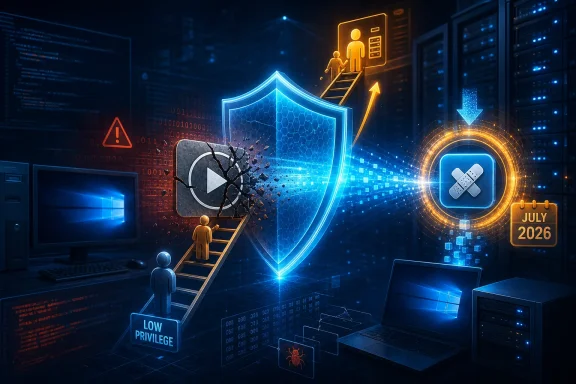
Detailed in Microsoft’s Security Update Guide, the vulnerability is not remotely exploitable and does not provide an initial route into a PC. An attacker must already have low-privilege access, but successful exploitation could compromise confidentiality, integrity, and availability at the higher privilege level.
The practical response is straightforward: install the July cumulative security update applicable to each Windows release. There is no indication that removing a media player, changing file associations, or disabling media playback provides equivalent protection.
A Memory-Safety Bug Inside Windows Media
Microsoft describes CVE-2026-50358 as a use-after-free vulnerability, classified under CWE-416. This type of memory-safety error occurs when software continues using memory after the underlying object has been released, potentially allowing an attacker to influence what occupies that memory next.
The public description does not identify the precise Windows Media component, affected function, or trigger. It also does not state whether exploitation involves a crafted media file, a local API call, or a particular Windows service. Administrators should therefore avoid assuming that blocking a specific file extension or uninstalling the user-facing Media Player application removes the vulnerable code.
The “Windows Media” product label can cover operating-system technologies used beyond the visible playback application. Multimedia parsing, codecs, frameworks, and supporting services may be called by other programs, including browsers, communications tools, management software, and line-of-business applications.
Microsoft’s CVSS vector is AV:L/AC:H/PR:L/UI:N/S:U/C:H/I:H/A:H. In practical terms, exploitation requires local access and existing low-level privileges, but it does not require another user to click a prompt, open a document, or perform another action.
The high attack-complexity rating is an important qualifier. Microsoft says successful exploitation requires an attacker to win a race condition, meaning the attacker must manipulate timing or concurrent operations so the vulnerable code enters a useful state. That generally makes reliable exploitation more difficult, but it is not a reason to defer patching a privilege-escalation flaw.
The Attacker Needs a Foothold First
CVE-2026-50358 is best understood as a second-stage vulnerability. It cannot be launched directly over the network according to Microsoft’s scoring, and an attacker needs permission to execute code locally before attempting exploitation.
That limits the immediate exposure compared with a pre-authentication remote-code-execution flaw. It does not make the vulnerability harmless, particularly on systems where users, services, scripts, or remote-management sessions operate without administrative rights.
Privilege-escalation vulnerabilities are commonly paired with another weakness. A phishing payload, malicious installer, compromised account, browser exploit, or exposed remote-access service may provide the initial foothold; a local flaw can then help the attacker escape the restrictions of the compromised account.
The absence of required user interaction also matters. Once an attacker can run code under a low-privilege identity, exploitation does not depend on persuading a second user or administrator to take an additional action. That makes the vulnerability relevant to post-compromise activity and chained attacks.
CISA’s initial vulnerability enrichment recorded no known exploitation and judged the flaw not readily automatable. The SANS Internet Storm Center’s July 14 tracking likewise listed CVE-2026-50358 as neither publicly disclosed nor exploited. It was not one of the zero-days highlighted in broader reporting on Microsoft’s July 2026 Patch Tuesday release.
That status describes what was known at publication, not what will remain true. Once a security update becomes available, researchers and attackers can compare patched and unpatched binaries to locate the changed code. A difficult race condition may slow weaponization, but it does not prevent it.
The Affected List Reaches Across Windows Generations
Microsoft’s CVE record covers supported Windows client and server branches spanning several generations. The affected releases include Windows 10 Version 1607, Windows 10 Version 1809, Windows 10 Version 21H2, Windows 10 Version 22H2, Windows 11 Version 24H2, Windows 11 Version 25H2, and Windows 11 version 26H1.
Server exposure extends across Windows Server 2016, Windows Server 2019, Windows Server 2022, and Windows Server 2025, including applicable Server Core installations. The inclusion of Server Core reinforces that the vulnerable surface is not limited to a desktop media-player interface.
Microsoft’s CVE data identifies these fixed build thresholds:
- Windows 10 Version 1607 and Windows Server 2016 require build 14393.9339 or later.
- Windows 10 Version 1809 and Windows Server 2019 require build 17763.9020 or later.
- Windows 10 Version 21H2 requires build 19044.7548 or later.
- Windows 10 Version 22H2 requires build 19045.7548 or later.
- Windows 11 Version 24H2 requires build 26100.8875 or later.
- Windows 11 Version 25H2 requires build 26200.8875 or later.
- Windows 11 version 26H1 requires build 28000.2269 or later.
Windows Server 2022 is updated through the July 14 release associated with KB5099540, moving systems to OS Build 20348.5386. Other branches receive their corresponding cumulative security packages through Windows Update, Windows Server Update Services, Microsoft Configuration Manager, Windows Autopatch, or the Microsoft Update Catalog.
The presence of older Windows 10 releases in the CVE record does not mean every ordinary consumer installation remains entitled to a security update. Several branches continue only under specific servicing channels, editions, or extended-support arrangements. Administrators must match the update to the edition and lifecycle status actually deployed rather than relying on the product name alone.
Patch Priority Depends on Where Local Code Can Run
For managed Windows 11 endpoints, the flaw belongs in the normal July cumulative-update rollout, with accelerated deployment on machines exposed to untrusted code. Developer workstations, shared desktops, virtual desktop infrastructure, jump hosts, and systems used for malware analysis deserve particular attention because local execution opportunities are more common.
Windows servers require a more contextual decision. A tightly controlled server with no interactive users and strict application allow-listing has less exposure than a Remote Desktop Session Host or multi-user application server. Even so, Server Core should not be treated as unaffected merely because it lacks the conventional desktop experience.
Security teams should prioritize systems where a compromised non-administrative account would create a path toward sensitive credentials, security tooling, or lateral movement. Endpoint detection and response can reduce the chance that the initial foothold goes unnoticed, but it does not correct the underlying memory-management error.
Administrators should verify deployment using the OS build rather than trusting that an update installation returned success. Servicing failures, pending restarts, supersedence issues, and machines that have fallen out of management scope can all leave a vulnerable build behind.
A practical validation query should flag devices below the fixed build for their servicing branch. Any exception should be documented with the machine’s role, compensating controls, expected patch date, and the reason installation has been delayed.
Sparse Disclosure Should Not Become False Precision
Microsoft has confirmed the vulnerability’s existence, root-cause category, attack prerequisites, impact, and affected product range. That gives defenders enough information to patch and triage it, but not enough to build a reliable vulnerability-specific detection rule.
There is no public function name, proof-of-concept exploit, event-log signature, or disclosed attack sequence tied to CVE-2026-50358. Claims that a particular media format, codec, process, or Windows application is the sole trigger would therefore go beyond Microsoft’s published evidence.
Defenders can still monitor for broader signs of local privilege escalation: unexpected child processes crossing integrity levels, suspicious service creation, security-tool tampering, unusual token manipulation, and low-privilege processes suddenly operating as SYSTEM. Those signals are useful for detecting post-compromise behavior, although none uniquely identifies this Windows Media flaw.
The concrete milestone is installation of the July 14, 2026 cumulative update and confirmation that every device has reached its branch’s fixed build. Until Microsoft publishes additional technical detail, build-level remediation remains the only dependable CVE-specific control.
References
- CVE-2026-50358 Windows Media Elevation of Privilege Vulnerability MSRC · 2026-07-14T07:00:00-07:00