

Microsoft’s July 14, 2026 security updates fix CVE-2026-58538, an elevation-of-privilege vulnerability in the Windows Bluetooth Service. The flaw is rated 7.8 High and affects supported Windows client and server releases, making this a patching priority for organizations that allow local users, contractors, or application workloads on shared Windows endpoints.
Microsoft’s Security Update Guide classifies the issue as a local privilege-escalation vulnerability rather than a remote Bluetooth attack. That distinction matters: the available advisory information does not indicate that a nearby attacker can compromise a PC simply by discovering or pairing with Bluetooth. Instead, the risk is that an attacker who already has code execution or a foothold on a Windows machine could potentially use the Bluetooth Service weakness to obtain higher permissions.
The practical response is straightforward: deploy the July 2026 cumulative update appropriate to every supported Windows build in scope, then confirm the installed OS build rather than treating Bluetooth configuration changes as a substitute for patching.
“Bluetooth Service” can easily suggest a radio-range vulnerability, rogue peripheral, or device-pairing problem. CVE-2026-58538 is not presently documented that way. Microsoft identifies the affected component and impact, but has not publicly provided a technical root cause, attack steps, proof of concept, or a detailed explanation of the required local access conditions.
That limited disclosure is normal for a newly released Patch Tuesday fix. It is also worth resisting assumptions: an elevation-of-privilege bug in a Windows service can be important even when Bluetooth hardware is disabled, absent, or unused in day-to-day operations. Services and their supporting components may still exist on the operating system, while the exact reachability of this particular flaw depends on details Microsoft has not disclosed.
Microsoft has assigned a CVSS 3.1 base score of 7.8, a High severity rating commonly associated with local attack complexity that can have substantial impact after compromise. Third-party vulnerability trackers list no remote exploitation path, consistent with Microsoft’s elevation-of-privilege classification. Neither Microsoft’s advisory nor the available public listings indicate active exploitation as of July 15, 2026.
The important operational conclusion is less dramatic but more useful: this is a post-compromise amplifier. A phishing payload, malicious installer, abused browser process, or low-privilege insider account should not be able to turn ordinary user-level access into administrative control. Patching removes one possible route across that boundary.
For widely deployed current releases, the key packages include:
For Windows 10, the support position remains particularly relevant. KB5099539 applies to Windows 10 systems covered by Extended Security Updates, as well as the specified LTSC editions. A Windows 10 device outside its applicable servicing channel will not receive this protection simply because the CVE affects a legacy Windows product family.
Administrators should follow their usual phased deployment process, especially where endpoint security products, legacy networking tools, nonstandard transport drivers, or tightly controlled server workloads are involved. The Bluetooth vulnerability itself does not appear to demand an emergency configuration workaround; it demands reliable completion of the cumulative-update process.
A sensible validation pass should include:
But disabling an adapter or instructing users not to pair peripherals should not be recorded as closure for CVE-2026-58538. Microsoft has supplied a software fix through the July cumulative updates, while public technical detail is too limited to establish whether every relevant code path depends on active radio hardware, a connected peripheral, or a particular Bluetooth usage scenario.
Security teams should also avoid prematurely treating the CVSS score as proof that this is an easy path to SYSTEM. A score conveys impact and broad exploitability characteristics; it does not disclose the bug class, prerequisite access, reliability, or exploit maturity. Those unanswered questions are exactly why a new local privilege-escalation CVE should be patched before public research fills in the gaps.
CVE-2026-58538 is not, based on today’s disclosures, a reason to panic about nearby Bluetooth attackers. It is a reason to complete July’s Windows servicing cycle promptly, verify the resulting build numbers, and treat any remaining unpatched systems as an unnecessary opportunity for a local compromise to become an administrative one.
Microsoft’s Security Update Guide classifies the issue as a local privilege-escalation vulnerability rather than a remote Bluetooth attack. That distinction matters: the available advisory information does not indicate that a nearby attacker can compromise a PC simply by discovering or pairing with Bluetooth. Instead, the risk is that an attacker who already has code execution or a foothold on a Windows machine could potentially use the Bluetooth Service weakness to obtain higher permissions.
The practical response is straightforward: deploy the July 2026 cumulative update appropriate to every supported Windows build in scope, then confirm the installed OS build rather than treating Bluetooth configuration changes as a substitute for patching.
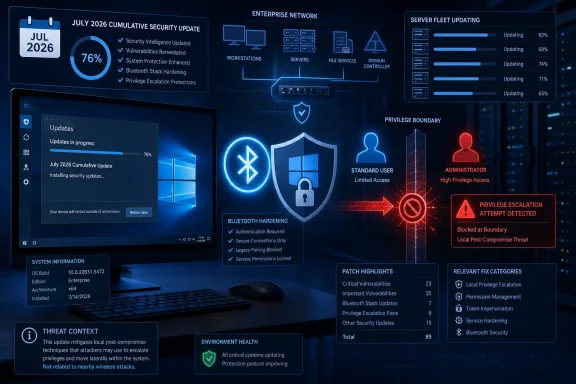 The Bluetooth label should not distract from the privilege boundary
“Bluetooth Service” can easily suggest a radio-range vulnerability, rogue peripheral, or device-pairing problem. CVE-2026-58538 is not presently documented that way. Microsoft identifies the affected component and impact, but has not publicly provided a technical root cause, attack steps, proof of concept, or a detailed explanation of the required local access conditions.That limited disclosure is normal for a newly released Patch Tuesday fix. It is also worth resisting assumptions: an elevation-of-privilege bug in a Windows service can be important even when Bluetooth hardware is disabled, absent, or unused in day-to-day operations. Services and their supporting components may still exist on the operating system, while the exact reachability of this particular flaw depends on details Microsoft has not disclosed.
Microsoft has assigned a CVSS 3.1 base score of 7.8, a High severity rating commonly associated with local attack complexity that can have substantial impact after compromise. Third-party vulnerability trackers list no remote exploitation path, consistent with Microsoft’s elevation-of-privilege classification. Neither Microsoft’s advisory nor the available public listings indicate active exploitation as of July 15, 2026.
The important operational conclusion is less dramatic but more useful: this is a post-compromise amplifier. A phishing payload, malicious installer, abused browser process, or low-privilege insider account should not be able to turn ordinary user-level access into administrative control. Patching removes one possible route across that boundary.
July’s cumulative updates carry the fix
Microsoft included the CVE-2026-58538 remediation in its July 14 cumulative updates. The affected product families listed by vulnerability databases include Windows 10, Windows 11, Windows Server 2019, Windows Server 2022, and Windows Server 2025, so administrators should use the Security Update Guide’s product-specific entries and their normal update management tooling to establish the applicable KB for each fleet.For widely deployed current releases, the key packages include:
- Windows 11 version 24H2 and Windows 11 version 25H2 receive KB5101650, updating devices to OS Builds 26100.8875 and 26200.8875 respectively.
- Windows Server 2025 receives KB5099536, advancing the build to 26100.33158.
- Windows 10 version 22H2 and Windows 10 Enterprise LTSC 2021 or IoT Enterprise LTSC 2021 receive KB5099539, advancing to Builds 19045.7548 and 19044.7548.
For Windows 10, the support position remains particularly relevant. KB5099539 applies to Windows 10 systems covered by Extended Security Updates, as well as the specified LTSC editions. A Windows 10 device outside its applicable servicing channel will not receive this protection simply because the CVE affects a legacy Windows product family.
Validate deployment by build, not by a successful scan
The July update set includes changes unrelated to CVE-2026-58538, including Secure Boot certificate deployment work and a networking hardening change affecting unregistered third-party TDI transports. Microsoft says it is not currently aware of known issues for KB5101650, KB5099536, or KB5099539, but that should not be confused with a guarantee that specialized line-of-business software will be unaffected.Administrators should follow their usual phased deployment process, especially where endpoint security products, legacy networking tools, nonstandard transport drivers, or tightly controlled server workloads are involved. The Bluetooth vulnerability itself does not appear to demand an emergency configuration workaround; it demands reliable completion of the cumulative-update process.
A sensible validation pass should include:
- Confirming that managed Windows 11 24H2 and 25H2 endpoints have reached Builds 26100.8875 or 26200.8875 after KB5101650 deployment.
- Confirming Windows Server 2025 has reached Build 26100.33158 after KB5099536 deployment.
- Confirming eligible Windows 10 22H2 and LTSC devices have reached Builds 19045.7548 or 19044.7548 after KB5099539 deployment.
- Reviewing update failures and pending restart states, because an offered or downloaded update is not the same thing as an installed security fix.
- Testing applications that depend on older third-party networking transports, since Microsoft’s July updates enforce TDI transport registration requirements.
Disabling Bluetooth is defense in depth, not remediation
Organizations with no business need for Bluetooth can still reduce their general attack surface through device-control policies, Bluetooth adapter restrictions, and service-management baselines. Those are reasonable hardening measures, particularly on servers, kiosks, privileged access workstations, and sensitive shared endpoints.But disabling an adapter or instructing users not to pair peripherals should not be recorded as closure for CVE-2026-58538. Microsoft has supplied a software fix through the July cumulative updates, while public technical detail is too limited to establish whether every relevant code path depends on active radio hardware, a connected peripheral, or a particular Bluetooth usage scenario.
Security teams should also avoid prematurely treating the CVSS score as proof that this is an easy path to SYSTEM. A score conveys impact and broad exploitability characteristics; it does not disclose the bug class, prerequisite access, reliability, or exploit maturity. Those unanswered questions are exactly why a new local privilege-escalation CVE should be patched before public research fills in the gaps.
CVE-2026-58538 is not, based on today’s disclosures, a reason to panic about nearby Bluetooth attackers. It is a reason to complete July’s Windows servicing cycle promptly, verify the resulting build numbers, and treat any remaining unpatched systems as an unnecessary opportunity for a local compromise to become an administrative one.
References
- Primary source: MSRC
Published: 2026-07-14T07:00:00-07:00
Security Update Guide - Microsoft Security Response Center
 msrc.microsoft.com
