

Bitdefender has documented three techniques that abuse Windows bind links to make endpoint detection and response products inspect one file while Windows executes another. The finding matters because the gap appears only after an intruder obtains local administrator rights—the precise stage at which ransomware operators often try to disable security tooling before deploying encryption or stealing credentials.
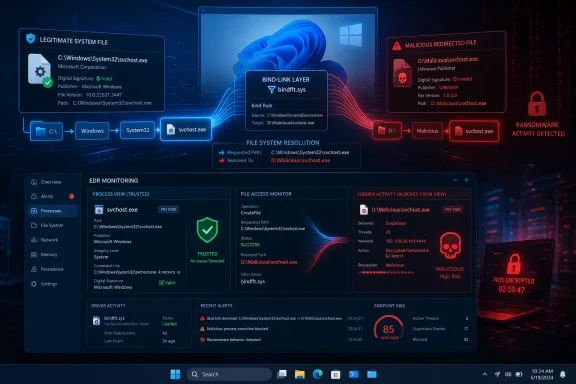
As reported by IT Brief UK, the techniques—File-Binding, Process-Binding and Silo-Binding—target trust decisions built around a process or DLL’s reported path. An EDR agent may see a legitimate Microsoft-signed binary at a familiar location, while the bind-link mechanism redirects access to attacker-controlled content in memory. The original file is not replaced on disk, so ordinary file enumeration can still return the clean version.
Bitdefender’s research is not a remote-code-execution disclosure or a conventional Windows vulnerability with a patch number. It is a warning that a documented Windows filesystem facility can be turned into an EDR blind spot once a machine is already under administrative control.
Bind links are implemented by the Windows Bind Filter driver,
That behavior is useful in legitimate Windows scenarios, but it creates a difficult security problem: the path used for a trust decision may not identify the same content Windows ultimately opens. If a security product authorizes an image, DLL or policy target at process creation and later relies on that initial pathname, it can be reasoning about the wrong object.
The redirection is non-persistent and disappears after a restart, according to Bitdefender. That makes incident response harder as well as detection harder. An investigator can find a process history that suggests a trusted executable ran, reboot the host, and no longer have the transient binding that altered the path resolution.
Microsoft’s driver documentation confirms an important part of the underlying design. Beginning with Windows 11 version 24H2, filesystem minifilters can veto certain bind-link creations on the system boot partition, provided they are positioned below BindFlt in the filter stack. Microsoft also makes clear that this veto capability does not extend to other partitions. That is a mitigation primitive for security vendors, not a universal operating-system block on bind-link abuse.
Bitdefender says the techniques affect Windows 10 version 1803, also known as RS4, and later Windows 10 releases, along with Windows 11, once an attacker has local administrator privileges. The 24H2 veto feature therefore should not be read as a full remediation for older estates—or, for that matter, for every filesystem location on newer Windows 11 deployments.
Process-Binding extends the same concept to executable images. In this model, monitoring may report that a trusted process was started while a different executable actually runs through the redirected path. That has obvious implications for controls that allow or deny execution based primarily on image names, locations, hashes collected at initial inspection, or publisher trust attached to the visible path.
Silo-Binding is the more consequential technique because it uses separate filesystem views. Bitdefender described an isolated environment where malicious code can see the attacker-controlled mapping while monitoring products outside that context continue to see legitimate files. In a demonstration cited by IT Brief UK, researchers ran Invoke-Mimikatz while disguising its execution as a Windows system process from the perspective of the observing security stack.
That demonstration should not be confused with a claim that every EDR, every AppLocker deployment, or every Sysmon configuration is bypassed by default. Product architecture, sensor placement, driver altitude, policy design and telemetry collection all matter. But Bitdefender’s point is sharper: any control that treats a pathname as a durable identity is exposed to a class of deception that occurs below its usual line of sight.
For enterprise defenders, however, “requires admin” is not an adequate endpoint. Post-compromise techniques are central to modern intrusion chains. An attacker may arrive through stolen credentials, a help-desk social-engineering incident, an exposed management platform, a vulnerable application, or a local privilege-escalation flaw. Once elevated rights are obtained, the next priority is often suppressing Microsoft Defender, EDR telemetry, logging or application-control enforcement long enough to move laterally and stage payloads.
That is why Bitdefender compares bind-link abuse with bring-your-own-vulnerable-driver tactics. Both are usually relevant after an adversary has already reached a privileged position; both aim to turn that privilege into reduced visibility and weakened defenses. The difference is that bind-link abuse does not require loading a known-vulnerable third-party driver. It relies on native Windows behavior.
The practical message for administrators is that prevention of local elevation remains essential, but it cannot be the only assumption behind endpoint monitoring. Security operations teams should plan for the possibility that an endpoint’s own process-path telemetry can be manipulated after compromise.
For IT teams that operate their own detection stack, that translates into a review of assumptions rather than a single registry change or Group Policy setting. The immediate checks are operational:
Administrators should also separate telemetry loss from complete endpoint compromise. If an intruder can successfully redirect an EDR sensor DLL or evade a process-based enforcement decision, security teams need alternate evidence: network detections, identity logs, domain-controller auditing, backup monitoring and centralized event collection that cannot be quietly rewritten from the affected endpoint.
That finding is adjacent to, rather than identical with, the bind-link techniques. Its importance is in the attack chain: local groups intended to grant developers convenient access to container tooling can become highly sensitive trust boundaries. On shared workstations, jump boxes and developer endpoints, membership in
The larger lesson from both disclosures is that endpoint security cannot stop at whether a payload was initially blocked. Once an attacker can administer Windows, the contest shifts toward whether defenders can still trust the endpoint’s explanation of what it is running. Bind links challenge that trust at the path-resolution layer—and Windows security products now need to prove they are watching there, too.
As reported by IT Brief UK, the techniques—File-Binding, Process-Binding and Silo-Binding—target trust decisions built around a process or DLL’s reported path. An EDR agent may see a legitimate Microsoft-signed binary at a familiar location, while the bind-link mechanism redirects access to attacker-controlled content in memory. The original file is not replaced on disk, so ordinary file enumeration can still return the clean version.
Bitdefender’s research is not a remote-code-execution disclosure or a conventional Windows vulnerability with a patch number. It is a warning that a documented Windows filesystem facility can be turned into an EDR blind spot once a machine is already under administrative control.
 The trusted path is no longer enough
Bind links are implemented by the Windows Bind Filter driver, bindflt.sys. They provide a way to bind a filesystem namespace to a virtual path, allowing a path resolution to be redirected without leaving behind the conventional artifacts associated with copying, replacing or renaming a file.That behavior is useful in legitimate Windows scenarios, but it creates a difficult security problem: the path used for a trust decision may not identify the same content Windows ultimately opens. If a security product authorizes an image, DLL or policy target at process creation and later relies on that initial pathname, it can be reasoning about the wrong object.
The redirection is non-persistent and disappears after a restart, according to Bitdefender. That makes incident response harder as well as detection harder. An investigator can find a process history that suggests a trusted executable ran, reboot the host, and no longer have the transient binding that altered the path resolution.
Microsoft’s driver documentation confirms an important part of the underlying design. Beginning with Windows 11 version 24H2, filesystem minifilters can veto certain bind-link creations on the system boot partition, provided they are positioned below BindFlt in the filter stack. Microsoft also makes clear that this veto capability does not extend to other partitions. That is a mitigation primitive for security vendors, not a universal operating-system block on bind-link abuse.
Bitdefender says the techniques affect Windows 10 version 1803, also known as RS4, and later Windows 10 releases, along with Windows 11, once an attacker has local administrator privileges. The 24H2 veto feature therefore should not be read as a full remediation for older estates—or, for that matter, for every filesystem location on newer Windows 11 deployments.
Three routes to the same monitoring failure
The first technique, File-Binding, redirects a trusted file or DLL path to malicious content. Bitdefender said this can be used to interfere with the Antimalware Scan Interface, known as AMSI, affect user-mode EDR sensor DLLs, or distort forensic logging. The key risk is not simply loading an unsigned DLL; it is causing a security product to encounter an expected path while the system resolves that path elsewhere.Process-Binding extends the same concept to executable images. In this model, monitoring may report that a trusted process was started while a different executable actually runs through the redirected path. That has obvious implications for controls that allow or deny execution based primarily on image names, locations, hashes collected at initial inspection, or publisher trust attached to the visible path.
Silo-Binding is the more consequential technique because it uses separate filesystem views. Bitdefender described an isolated environment where malicious code can see the attacker-controlled mapping while monitoring products outside that context continue to see legitimate files. In a demonstration cited by IT Brief UK, researchers ran Invoke-Mimikatz while disguising its execution as a Windows system process from the perspective of the observing security stack.
That demonstration should not be confused with a claim that every EDR, every AppLocker deployment, or every Sysmon configuration is bypassed by default. Product architecture, sensor placement, driver altitude, policy design and telemetry collection all matter. But Bitdefender’s point is sharper: any control that treats a pathname as a durable identity is exposed to a class of deception that occurs below its usual line of sight.
Administrator access is a condition, not a comfort blanket
Microsoft reportedly assessed the issue as low severity because exploiting it requires administrative access. That classification is understandable in the narrow vulnerability-management sense: bind links do not by themselves hand an unprivileged attacker SYSTEM or let an internet attacker compromise a workstation.For enterprise defenders, however, “requires admin” is not an adequate endpoint. Post-compromise techniques are central to modern intrusion chains. An attacker may arrive through stolen credentials, a help-desk social-engineering incident, an exposed management platform, a vulnerable application, or a local privilege-escalation flaw. Once elevated rights are obtained, the next priority is often suppressing Microsoft Defender, EDR telemetry, logging or application-control enforcement long enough to move laterally and stage payloads.
That is why Bitdefender compares bind-link abuse with bring-your-own-vulnerable-driver tactics. Both are usually relevant after an adversary has already reached a privileged position; both aim to turn that privilege into reduced visibility and weakened defenses. The difference is that bind-link abuse does not require loading a known-vulnerable third-party driver. It relies on native Windows behavior.
The practical message for administrators is that prevention of local elevation remains essential, but it cannot be the only assumption behind endpoint monitoring. Security operations teams should plan for the possibility that an endpoint’s own process-path telemetry can be manipulated after compromise.
Detection engineering has to follow the file, not just the launch
Bitdefender’s proposed direction is straightforward: do not make a one-time trust decision based solely on the image path observed at process creation. Security products should revalidate the underlying file or object whenever it is reopened, and correlate the result with lower-level filesystem activity.For IT teams that operate their own detection stack, that translates into a review of assumptions rather than a single registry change or Group Policy setting. The immediate checks are operational:
- Review whether EDR and allowlisting policies rely chiefly on executable paths, especially paths under
C:\Windows,C:\Program Files, or vendor security-agent directories. - Confirm that endpoint agents, their drivers and their tamper-protection components are fully current, then ask the vendor explicitly whether they detect or veto suspicious bind-link activity.
- Treat unexplained mismatches between process identity, loaded-module telemetry, file hashes and observed behavior as high-priority investigation triggers.
- Restrict local administrator assignment, audit privileged-group changes, and reduce standing administrative access through just-in-time elevation where possible.
- Test detection coverage in a controlled lab before assuming that Windows 11 24H2’s bind-link veto mechanism protects an endpoint product automatically.
Administrators should also separate telemetry loss from complete endpoint compromise. If an intruder can successfully redirect an EDR sensor DLL or evade a process-based enforcement decision, security teams need alternate evidence: network detections, identity logs, domain-controller auditing, backup monitoring and centralized event collection that cannot be quietly rewritten from the affected endpoint.
Docker Desktop adds a second local-access concern
Bitdefender also reported a Docker Desktop issue in which a non-administrator member of the localdocker-users group could escalate to SYSTEM. Docker reportedly updated its documentation after disclosure to warn administrators about the security implications.That finding is adjacent to, rather than identical with, the bind-link techniques. Its importance is in the attack chain: local groups intended to grant developers convenient access to container tooling can become highly sensitive trust boundaries. On shared workstations, jump boxes and developer endpoints, membership in
docker-users should be reviewed with the same seriousness normally applied to local Administrators and other privileged operator groups.The larger lesson from both disclosures is that endpoint security cannot stop at whether a payload was initially blocked. Once an attacker can administer Windows, the contest shifts toward whether defenders can still trust the endpoint’s explanation of what it is running. Bind links challenge that trust at the path-resolution layer—and Windows security products now need to prove they are watching there, too.