

Verdict: do not rush every SharePoint Framework solution through a Heft migration before September 2026—but do identify and move the projects whose Gulp-based build pipelines are business-critical, customized, or difficult to repair. Microsoft’s current July 2026 roadmap targets SPFx 1.24 General Availability for September 2026, not SPFx 1.25, and that release is the practical support boundary: existing Gulp projects may still run, but Microsoft’s future toolchain fixes will focus on Heft.
For teams maintaining SharePoint Online web parts, the immediate job is an engineering inventory rather than a blanket dependency update. Treat every SPFx repository as one of three categories: safe to defer, ready for a controlled migration, or too customized to upgrade without a dedicated project.
Start now with this sequence:
The version number is not a cosmetic detail. Microsoft’s July 2026 SharePoint Framework roadmap now identifies September as the planned general-availability release for SPFx 1.24, changing the versioning and scope described in the May roadmap. Teams planning around “SPFx 1.25 in September” should correct their internal roadmaps, test plans, and upgrade documentation now.
According to Microsoft’s roadmap, SPFx 1.24 GA is planned to include SharePoint Copilot Apps GA, SPFx CLI GA, navigation customizers, updated open-source templates, and continued npm dependency-security work. Those are meaningful additions, but the build-system transition is likely to matter more to organizations with a substantial installed base of custom web parts.
Microsoft’s published toolchain guidance is clear on the key point: SPFx 1.22 introduced the Heft-based build toolchain for newly generated projects. Existing projects upgraded to newer SPFx versions could continue using Gulp during a transition period. From SPFx 1.24 onward, that technical compatibility does not equal continuing support: Gulp projects may still build, but future fixes are expected to concentrate on Heft.
That distinction should change how administrators and developers interpret a successful build. A Gulp project that compiles after the September release is not necessarily broken. It is simply no longer on the toolchain Microsoft intends to maintain.
The urgent candidates are not necessarily the oldest web parts. They are the projects where the build pipeline has become part of the product. A custom task that transforms files, injects assets, changes packaging behavior, or produces organization-specific output can be more consequential than the web part’s visible user interface.
Use this decision matrix when prioritizing the portfolio:
The most dangerous category is the project that appears ordinary until its deployment pipeline is inspected. A repository may have a modest React component tree while relying on handwritten Gulp logic, environment-specific build assumptions, or CI scripts that nobody has exercised outside the main branch in years.
Microsoft’s guidance indicates that gulpfile customizations, build tasks, webpack changes, config.json-era patterns, and CI scripts can require redesign or relocation. In practice, that means teams should resist the temptation to judge readiness solely by whether dependency installation completes.
A proper migration test should answer four operational questions:
That does not mean every customization must be preserved. The Heft transition is an opportunity to ask whether a decade-old asset copy task, webpack override, or build-time transform is still necessary. Retaining every historical behavior without examining its purpose is how a toolchain migration becomes permanent technical debt in a newer format.
For SharePoint administrators, the important change is governance rather than a tenant-side switch. There is no indication that every existing Gulp web part will immediately stop functioning at release. The risk accumulates when a future dependency, tooling, or build issue needs support and the project is still attached to the legacy chain.
Development leads should therefore establish a simple policy: new SPFx work should use the Heft-based toolchain, while existing Gulp solutions require an explicit exception and a migration owner. That prevents the September boundary from becoming an excuse to create more unsupported projects.
The roadmap also makes SPFx CLI GA worth watching. Microsoft has positioned the CLI as a replacement for the older Yeoman generator approach and as a way to support organization-specific templates and scaffold adjustments. For teams standardizing new development, that could make it easier to encode approved project baselines rather than relying on manually maintained starter repositories.
WindowsForum readers following recent SharePoint security coverage will recognize that distinction. Patch management for server-side issues and lifecycle management for custom SharePoint Framework solutions are different disciplines, but both depend on knowing what is deployed, who owns it, and whether it can be rebuilt quickly.
By September, the organizations in the best position will not be the ones that upgraded every repository first. They will be the ones that can point to each Gulp project and say, with evidence, whether it is simple enough to defer, already validated on Heft, or important enough to migrate before Microsoft’s support focus moves on.
For teams maintaining SharePoint Online web parts, the immediate job is an engineering inventory rather than a blanket dependency update. Treat every SPFx repository as one of three categories: safe to defer, ready for a controlled migration, or too customized to upgrade without a dedicated project.
Start now with this sequence:
- List every deployed SPFx solution, including web parts, extensions, command sets, and any legacy customizations.
- Identify projects still built with Gulp and record every
gulpfilecustomization, custom build task, webpack change, old configuration pattern, and CI dependency. - Mark solutions that support finance, HR, operations, intranet publishing, or other business-critical workflows as migration priorities if they depend on customized Gulp behavior.
- Create a separate Heft migration branch and validate local builds, production builds, packaging, deployment, and CI behavior before changing the production branch.
- Leave simple, stable Gulp web parts in place only if they have a documented owner, a reproducible build, and a planned retirement or migration date.
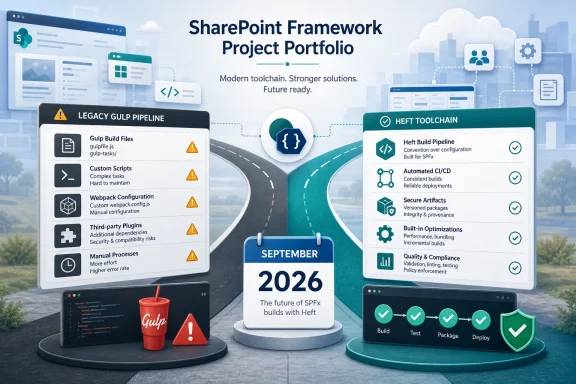 Microsoft Has Moved the September Target to SPFx 1.24
The version number is not a cosmetic detail. Microsoft’s July 2026 SharePoint Framework roadmap now identifies September as the planned general-availability release for SPFx 1.24, changing the versioning and scope described in the May roadmap. Teams planning around “SPFx 1.25 in September” should correct their internal roadmaps, test plans, and upgrade documentation now.According to Microsoft’s roadmap, SPFx 1.24 GA is planned to include SharePoint Copilot Apps GA, SPFx CLI GA, navigation customizers, updated open-source templates, and continued npm dependency-security work. Those are meaningful additions, but the build-system transition is likely to matter more to organizations with a substantial installed base of custom web parts.
Microsoft’s published toolchain guidance is clear on the key point: SPFx 1.22 introduced the Heft-based build toolchain for newly generated projects. Existing projects upgraded to newer SPFx versions could continue using Gulp during a transition period. From SPFx 1.24 onward, that technical compatibility does not equal continuing support: Gulp projects may still build, but future fixes are expected to concentrate on Heft.
That distinction should change how administrators and developers interpret a successful build. A Gulp project that compiles after the September release is not necessarily broken. It is simply no longer on the toolchain Microsoft intends to maintain.
Which SPFx Projects Need a Heft Migration Before Support Ends?
The lowest-risk candidates for a deferred migration are small web parts with conventional project structures, no custom Gulp tasks, no webpack modifications, and a straightforward CI pipeline. If their release cadence is low and the package can be rebuilt reliably, they can be scheduled behind more urgent work.The urgent candidates are not necessarily the oldest web parts. They are the projects where the build pipeline has become part of the product. A custom task that transforms files, injects assets, changes packaging behavior, or produces organization-specific output can be more consequential than the web part’s visible user interface.
Use this decision matrix when prioritizing the portfolio:
| Project condition | Recommended action before September 2026 |
|---|---|
| A standard web part with no Gulp customizations and a simple, reproducible build. | Plan a controlled Heft pilot, but it can follow higher-risk solutions. |
| A web part with custom Gulp tasks or webpack changes. | Begin migration discovery immediately and allocate time for redesign rather than a routine package upgrade. |
| A solution with CI scripts that call Gulp directly or assume Gulp-generated artifacts. | Treat the CI pipeline as part of the migration scope and validate it in an isolated branch. |
| A legacy extension, command set, or solution built around older configuration conventions. | Perform a deeper architecture review before selecting a migration date. |
| A business-critical solution with limited source knowledge or no active owner. | Stabilize ownership, document the current build, and migrate before an emergency requires a toolchain fix. |
This Is Not a Normal SPFx Version Upgrade
A conventional SPFx upgrade can be largely about aligning package versions and resolving application-level compatibility issues. A Gulp-to-Heft migration is different because it changes the machinery that turns source code into a deployable SharePoint package.Microsoft’s guidance indicates that gulpfile customizations, build tasks, webpack changes, config.json-era patterns, and CI scripts can require redesign or relocation. In practice, that means teams should resist the temptation to judge readiness solely by whether dependency installation completes.
A proper migration test should answer four operational questions:
- Can developers create a production-quality build on a clean workstation without undocumented local fixes?
- Does the new build produce the expected package and assets for the deployment path already used by the organization?
- Does the CI system execute the new toolchain without relying on direct Gulp calls or legacy artifact assumptions?
- Can the team diagnose a failed production build after the people who wrote the original Gulp customizations are unavailable?
That does not mean every customization must be preserved. The Heft transition is an opportunity to ask whether a decade-old asset copy task, webpack override, or build-time transform is still necessary. Retaining every historical behavior without examining its purpose is how a toolchain migration becomes permanent technical debt in a newer format.
The Practical September Timeline for IT Teams
July and August 2026 should be used for discovery and test migrations, not broad production rollout. The goal is to know which repositories are genuinely tied to Gulp before SPFx 1.24 GA lands in September.For SharePoint administrators, the important change is governance rather than a tenant-side switch. There is no indication that every existing Gulp web part will immediately stop functioning at release. The risk accumulates when a future dependency, tooling, or build issue needs support and the project is still attached to the legacy chain.
Development leads should therefore establish a simple policy: new SPFx work should use the Heft-based toolchain, while existing Gulp solutions require an explicit exception and a migration owner. That prevents the September boundary from becoming an excuse to create more unsupported projects.
The roadmap also makes SPFx CLI GA worth watching. Microsoft has positioned the CLI as a replacement for the older Yeoman generator approach and as a way to support organization-specific templates and scaffold adjustments. For teams standardizing new development, that could make it easier to encode approved project baselines rather than relying on manually maintained starter repositories.
Unsupported Does Not Mean Unsafe—But It Does Mean Exposed
Gulp’s status after SPFx 1.24 is a supportability issue, not a newly disclosed SharePoint vulnerability. Still, it belongs in the same operational conversation as patching and software lifecycle management: unsupported tooling increases the cost and uncertainty of response when an urgent change arrives.WindowsForum readers following recent SharePoint security coverage will recognize that distinction. Patch management for server-side issues and lifecycle management for custom SharePoint Framework solutions are different disciplines, but both depend on knowing what is deployed, who owns it, and whether it can be rebuilt quickly.
By September, the organizations in the best position will not be the ones that upgraded every repository first. They will be the ones that can point to each Gulp project and say, with evidence, whether it is simple enough to defer, already validated on Heft, or important enough to migrate before Microsoft’s support focus moves on.
References
- Primary source: learn.microsoft.com
Loading…
learn.microsoft.com - Independent coverage: devblogs.microsoft.com
Loading…
devblogs.microsoft.com - Independent coverage: github.com
Loading…
github.com - Independent coverage: developer.microsoft.com
Loading…
developer.microsoft.com - Independent coverage: microsoft.com
Microsoft 365 Roadmap | Microsoft 365
The Microsoft 365 Roadmap lists updates that are currently planned for applicable subscribers. Check here for more information on the status of new features and updates.www.microsoft.com
- Primary source: WindowsForum
Loading…
windowsforum.com
