

LegacyHive is a newly public, unpatched local privilege-escalation flaw in the Windows User Profile Service, or ProfSvc, that can let a standard Windows user coerce a SYSTEM-level component into loading another user’s registry hive. The immediate concern is not a remote break-in: attackers first need code execution on the machine. But on shared desktops, jump boxes, terminal servers, developer workstations, and other multi-user systems, that foothold could be turned into access to administrator-profile registry data and potentially a route to SYSTEM.
The proof of concept was published on July 14, 2026, shortly after Microsoft’s July Patch Tuesday release, by the researcher known as Nightmare-Eclipse or Chaotic Eclipse. SecurityWeek first reported that the released code works on systems carrying July 2026 updates, while CrowdStrike noted that the public version was deliberately restricted compared with the researcher’s claims about the original exploit. As of July 17, Microsoft has not published a CVE, security advisory, or update that addresses LegacyHive.
That leaves administrators with an awkward but familiar zero-day problem: there is no vendor patch to deploy, yet there is enough public technical detail for defenders to assume that capable attackers will study, adapt, and operationalize the technique.
Windows’ User Profile Service manages profile loading and related per-user state. Registry files such as
According to SOC Prime’s technical breakdown, LegacyHive abuses a gap between that trusted service and attacker-influenced profile path handling. The attack chain reportedly combines a manipulated
The important point for IT teams is the privilege boundary being crossed. A non-administrative account does not directly open a protected administrator hive through normal access controls. Instead, it manipulates conditions so ProfSvc resolves a path and performs the hive-load operation on its behalf. That is the classic confused deputy problem: a privileged service is tricked into using its authority for an untrusted caller’s objective.
The public proof of concept reportedly requires credentials for a second standard account and identifies a third target account, which can be an administrator. Successful exploitation mounts the target user’s hive under the attacker’s current-user classes registry area. That requirement reduces the threat’s usefulness for a completely isolated single-account home PC, but it does not make the issue academic. Help desks, managed service providers, enterprise desktops, Remote Desktop Session Host environments, labs, classrooms, and development systems frequently contain multiple local or domain identities.
CrowdStrike cautioned that it had not independently verified the researcher’s broader assertion that an unreduced exploit could avoid those restrictions and load hives beyond
That does not mean every Windows release, configuration, or profile scenario has been exhaustively validated. It means the usual monthly patch baseline is not presently sufficient as a mitigation. Organizations should record LegacyHive as an active local escalation exposure rather than closing the ticket with “current on Patch Tuesday.”
The absence of a Microsoft-issued CVE also complicates routine vulnerability-management workflows. Asset scanners generally depend on a CVE, affected-build guidance, or a KB supersedence chain. None is available publicly for LegacyHive yet. Security teams will need to track it by the vulnerability name, the affected service name
GovCERT.HK has already issued a high-threat alert describing LegacyHive as a privilege-escalation risk in Microsoft Windows User Profile Service and warning that proof-of-concept code is public. That advisory is a useful indication that the issue has moved beyond a niche researcher release into the operational security queue, even without a formal Microsoft bulletin.
There is also a practical difference between exposure and exploitability. LegacyHive is a local attack. It does not replace phishing defenses, browser hardening, remote-access controls, or endpoint protection; it amplifies the damage after one of those controls fails. A standard user account, a malicious installer, a weaponized attachment that executes code, or a compromised application sandbox may be enough to create the starting point an attacker needs.
For Windows environments with Microsoft Defender for Endpoint, Sysmon, EDR telemetry, or a SIEM capable of correlating process, file, and registry events, the most valuable hunt is not simply a keyword search for “LegacyHive.” The exploit can be rebuilt and renamed. The durable indicators are a profile-service hive-load event that does not align with a normal logon, unexpected access to another account’s profile files, and a rapid sequence involving reparse points, object-manager links, and registry changes from a low-integrity or standard-user process.
A short containment priority list is warranted:
Endpoint teams should also preserve relevant telemetry longer than usual. A race-condition exploit may fail repeatedly before it succeeds, so a single failed-looking attempt can be less meaningful than a cluster of brief file, registry, and process anomalies from the same account.
That is a more demanding repair than blocking one proof-of-concept filename or one registry value. LegacyHive’s lesson is that profile-management code sits at an uncomfortable intersection of legacy registry behavior, filesystem indirection, user-controlled configuration, and SYSTEM-level operations. Fixing the precise path race may be straightforward; fixing the trust model safely across supported Windows versions could take longer.
For now, Windows administrators should treat LegacyHive as an unpatched post-compromise escalation path, verify that July 2026 patch compliance is not being misreported as mitigation, and turn the User Profile Service into a monitored security boundary. The next concrete milestone is a Microsoft advisory with affected-build details and a KB-backed fix; until that arrives, detection quality and local code-execution controls are the controls that matter most.
The proof of concept was published on July 14, 2026, shortly after Microsoft’s July Patch Tuesday release, by the researcher known as Nightmare-Eclipse or Chaotic Eclipse. SecurityWeek first reported that the released code works on systems carrying July 2026 updates, while CrowdStrike noted that the public version was deliberately restricted compared with the researcher’s claims about the original exploit. As of July 17, Microsoft has not published a CVE, security advisory, or update that addresses LegacyHive.
That leaves administrators with an awkward but familiar zero-day problem: there is no vendor patch to deploy, yet there is enough public technical detail for defenders to assume that capable attackers will study, adapt, and operationalize the technique.
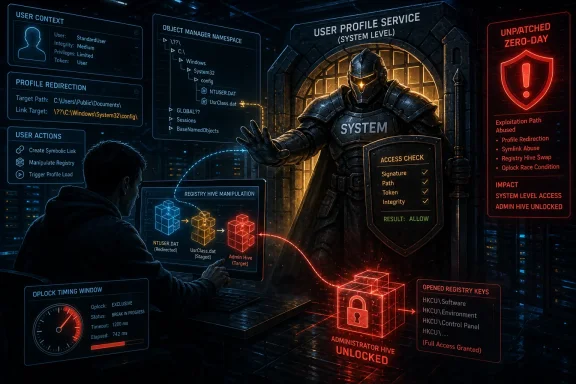 ProfSvc Becomes the Confused Deputy
Windows’ User Profile Service manages profile loading and related per-user state. Registry files such as NTUSER.DAT and UsrClass.dat are central to that design: they store a user’s settings, shell associations, COM registration data, and other profile-scoped configuration. The service necessarily performs sensitive work, and it operates with SYSTEM privileges.According to SOC Prime’s technical breakdown, LegacyHive abuses a gap between that trusted service and attacker-influenced profile path handling. The attack chain reportedly combines a manipulated
Local AppData registry value, Windows Object Manager symbolic links, and an opportunistic lock, or oplock, used to time a path swap during a file operation.The important point for IT teams is the privilege boundary being crossed. A non-administrative account does not directly open a protected administrator hive through normal access controls. Instead, it manipulates conditions so ProfSvc resolves a path and performs the hive-load operation on its behalf. That is the classic confused deputy problem: a privileged service is tricked into using its authority for an untrusted caller’s objective.
The public proof of concept reportedly requires credentials for a second standard account and identifies a third target account, which can be an administrator. Successful exploitation mounts the target user’s hive under the attacker’s current-user classes registry area. That requirement reduces the threat’s usefulness for a completely isolated single-account home PC, but it does not make the issue academic. Help desks, managed service providers, enterprise desktops, Remote Desktop Session Host environments, labs, classrooms, and development systems frequently contain multiple local or domain identities.
CrowdStrike cautioned that it had not independently verified the researcher’s broader assertion that an unreduced exploit could avoid those restrictions and load hives beyond
UsrClass.dat. That distinction matters. The publicly demonstrated behavior is serious enough to demand attention, but claims of universal or guaranteed SYSTEM compromise should not be treated as established fact until they are independently reproduced or Microsoft provides technical guidance.July’s Cumulative Updates Are Not a Fix
Administrators should not mistake a fully patched July system for a protected system in this case. The most consequential finding from SecurityWeek, CrowdStrike, and SOC Prime is that LegacyHive was reported to work against currently supported Windows desktop and server installations after the July 2026 cumulative updates.That does not mean every Windows release, configuration, or profile scenario has been exhaustively validated. It means the usual monthly patch baseline is not presently sufficient as a mitigation. Organizations should record LegacyHive as an active local escalation exposure rather than closing the ticket with “current on Patch Tuesday.”
The absence of a Microsoft-issued CVE also complicates routine vulnerability-management workflows. Asset scanners generally depend on a CVE, affected-build guidance, or a KB supersedence chain. None is available publicly for LegacyHive yet. Security teams will need to track it by the vulnerability name, the affected service name
ProfSvc, and the behavior of the published technique rather than by a patch identifier.GovCERT.HK has already issued a high-threat alert describing LegacyHive as a privilege-escalation risk in Microsoft Windows User Profile Service and warning that proof-of-concept code is public. That advisory is a useful indication that the issue has moved beyond a niche researcher release into the operational security queue, even without a formal Microsoft bulletin.
There is also a practical difference between exposure and exploitability. LegacyHive is a local attack. It does not replace phishing defenses, browser hardening, remote-access controls, or endpoint protection; it amplifies the damage after one of those controls fails. A standard user account, a malicious installer, a weaponized attachment that executes code, or a compromised application sandbox may be enough to create the starting point an attacker needs.
Detection Needs to Follow the Service, Not the Name
Until Microsoft provides a correction, defenders should focus on behavior that is unusual for ordinary profile activity. SOC Prime recommends watching for suspicious registry hive loads associated with accounts that are not interactively signing in, as well as object-directory activity beneathBaseNamedObjectsRestricted.For Windows environments with Microsoft Defender for Endpoint, Sysmon, EDR telemetry, or a SIEM capable of correlating process, file, and registry events, the most valuable hunt is not simply a keyword search for “LegacyHive.” The exploit can be rebuilt and renamed. The durable indicators are a profile-service hive-load event that does not align with a normal logon, unexpected access to another account’s profile files, and a rapid sequence involving reparse points, object-manager links, and registry changes from a low-integrity or standard-user process.
A short containment priority list is warranted:
- Investigate unexpected profile hive loading by
svchost.exeinstances hosting the User Profile Service, especially where the source account and target profile do not match normal sign-in activity. - Alert on unusual creation or modification of user-profile registry values that redirect local application-data paths outside conventional profile directories.
- Treat suspicious symbolic-link, reparse-point, and Object Manager directory activity from standard-user processes as high-value escalation telemetry when it occurs near profile operations.
- Use WDAC, AppLocker, or comparable application-control policy to limit execution of unsigned or unapproved binaries by standard users.
- Reduce local administrator sprawl and avoid leaving privileged accounts logged on to shared or lower-trust systems.
Endpoint teams should also preserve relevant telemetry longer than usual. A race-condition exploit may fail repeatedly before it succeeds, so a single failed-looking attempt can be less meaningful than a cluster of brief file, registry, and process anomalies from the same account.
The Fix Has to Be Architectural, Not Cosmetic
SOC Prime’s analysis argues that the durable remediation is path canonicalization and validation: ProfSvc must resolve the actual destination path, ensure it remains inside the legitimate user-profile boundary, and reject device or Object Manager namespace prefixes supplied through untrusted configuration. The service also needs reparse-point-aware file handling and should avoid carrying out user-influenced I/O as SYSTEM where a lower-privilege security context is possible.That is a more demanding repair than blocking one proof-of-concept filename or one registry value. LegacyHive’s lesson is that profile-management code sits at an uncomfortable intersection of legacy registry behavior, filesystem indirection, user-controlled configuration, and SYSTEM-level operations. Fixing the precise path race may be straightforward; fixing the trust model safely across supported Windows versions could take longer.
For now, Windows administrators should treat LegacyHive as an unpatched post-compromise escalation path, verify that July 2026 patch compliance is not being misreported as mitigation, and turn the User Profile Service into a monitored security boundary. The next concrete milestone is a Microsoft advisory with affected-build details and a KB-backed fix; until that arrives, detection quality and local code-execution controls are the controls that matter most.
References
- Primary source: SOC Prime
Published: 2026-07-16T14:40:10.958269
LegacyHive: The Windows User Profile Service Bug That Loads Another User’s Registry Hive Nightmare | SOC Prime
Summary LegacyHive is an unpatched local privilege escalation vulnerability in the Windows User Profile Service (ProfSvc). An attacker can use a combination of registry poisoning, object-manager symbolic links, and a TOCTOU race condition via oplocks to force a SYSTEM-level service to load a...socprime.com
- Related coverage: securityweek.com
Nightmare Eclipse Drops 'LegacyHive' Windows Zero-Day - SecurityWeek
Nightmare Eclipse has dropped the LegacyHive zero-day exploit, a privilege escalation in the Windows User Profile Service.www.securityweek.com
- Related coverage: expertinsights.com
Nightmare Eclipse Releases LegacyHive Windows Zero-Day With Stripped PoC After Patch Tuesday
The Windows User Profile Service local privilege escalation flaw works on systems running the July 2026 updates, but the researcher scaled the exploit back to slow immediate weaponization. expertinsights.com
- Related coverage: securitytoday.de
LegacyHive PoC Meets Latest Windows Patches - SecurityToday
Public Windows EoP PoC for LegacyHive emerges post-Patch Tuesday. Detection, hardening, and communication strategies for Hive Load threats.www.securitytoday.de - Related coverage: it-connect.fr
LegacyHive : la zero-day Windows publiée juste après le Patch Tuesday de juillet
Nightmare Eclipse a publié LegacyHive, une zero-day dans le service de profils utilisateur de Windows. Elle fonctionne sur les machines Windows et WS à jour.www.it-connect.fr - Related coverage: pulse.adyog.com
LegacyHive Windows Zero-Day PoC: Privilege Escalation With No CVE — adyog
A working Windows exploit has no CVE number. That single fact means it's invisible to the tools most security budgets are built around.pulse.adyog.com