

Moonshot AI’s Kimi K3 is not yet the outright best AI model in the world, and Moonshot itself concedes that it trails Anthropic’s Claude Fable 5 and OpenAI’s GPT-5.6 Sol in overall performance. But its July 16 release has changed the more important calculation: a 2.8-trillion-parameter Chinese model that can beat Claude Opus 4.8 and GPT-5.5 on coding and general-agent tests, offer a one-million-token context window, process text and images natively, and undercut leading U.S. API prices is a direct challenge to the business case for closed frontier models.
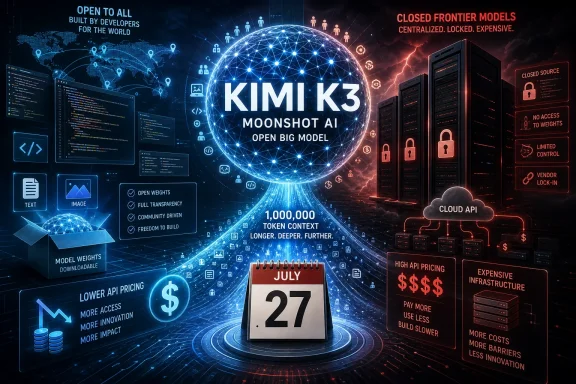
The decisive date is July 27. That is when Moonshot says it will publish Kimi K3’s full code and model weights, allowing outside developers to download, self-host and modify it. Until then, K3 is available through Kimi.com, Moonshot’s mobile apps and its API. Once the files arrive, however, the argument moves beyond another cloud-service launch: enterprises, researchers and governments will be able to test whether Moonshot’s benchmark claims survive the messy realities of deployment.
That distinction is what makes K3 more consequential than its impressive parameter count. Plenty of companies can announce a large model; few can plausibly put a near-frontier system in the hands of developers who would otherwise pay a U.S. lab every time they need inference, customization or data residency. Moonshot’s release is therefore not merely China closing a model-quality gap. It is China attacking the distribution model through which U.S. AI labs turn technical leadership into durable revenue.
Kimi K3 arrives with unusually clear trade-offs. It is not being sold as a universal replacement for the two leading proprietary systems, because the company has acknowledged that Claude Fable 5 and GPT-5.6 Sol retain their overall leads. Instead, Moonshot is making a narrower and potentially more commercially powerful claim: for many demanding coding, agentic and long-context jobs, a cheaper model that performs near the frontier may be good enough to reshape procurement decisions.
The API arithmetic explains why the market reacted. Moonshot is charging $3 per million input tokens and $15 per million output tokens, with lower rates for cached inputs. OpenAI’s GPT-5.6 Sol is listed at $5 per million input tokens and $30 per million output tokens, while Anthropic’s Claude Fable 5 costs about $10 per million input tokens and $50 per million output tokens.
For an individual user, the difference between a $15 and $50 output-token rate can look abstract. For a company operating coding agents, document-analysis systems or internal knowledge workflows at scale, it is not abstract at all. Output tokens are especially material when a model is writing code, reasoning through a task, generating reports or iterating within an agent loop. The cost advantage is not proof that K3 is the better choice, but it means Moonshot does not need to win every benchmark to force a fresh comparison.
CNBC’s reporting captured the strategic point in a Bank of America note led by analyst Alex Liu: despite hardware and compute-capacity constraints in China, K3 shows that pre-training scale combined with architectural innovation can still produce step-change gains in Chinese flagship models. Liu’s sharper conclusion was that K3 “raises the capability ceiling for China AI models, shifting the burden of proof to other independent AI labs.”
That burden now falls on both sides of the Pacific. U.S. labs need to demonstrate that their performance edge is wide enough to justify a substantial recurring price premium. China’s independent labs need to show that their own models can compete not just with yesterday’s open alternatives, but with a Moonshot system backed by Alibaba and Tencent and priced for a broader global market.
That is a genuine milestone for an open model. Vercel chief executive Guillermo Rauch called it “the first time that an open model is ahead of all proprietary ones for this comprehensive web engineering benchmark.” But he immediately supplied the necessary caution: “benchmarks don’t always tell the full story.”
They do not. A model that excels at frontend engineering may still behave differently on codebase navigation, production debugging, multimodal review, latency-sensitive assistance, tool use, reliability under heavy concurrency or the tedious operational work that separates an impressive demo from a dependable enterprise system. Moonshot’s own position contains that caveat: K3 is below Fable 5 and GPT-5.6 Sol in overall rankings even as it exceeds older near-frontier U.S. models in selected coding and agent evaluations.
Wharton professor Ethan Mollick’s description — “closest to the frontier yet” — is a more useful framing than either triumphalism or dismissal. K3 is important precisely because it appears to be a credible near-frontier system without a closed-model gate around it. It does not need to be the global number one in every category to alter how developers think about the frontier.
The model’s architecture also matters, even if users will ultimately judge it by outcomes rather than terminology. TradingKey reported that K3 uses Moonshot’s proprietary KDA hybrid linear attention mechanism and attention residual technology. Moonshot positions those techniques around long-range programming, knowledge work and reasoning; native visual understanding and the one-million-token context window broaden the kinds of workflows it can attempt.
A million tokens does not automatically mean a million tokens of useful recall. Long-context systems can lose precision, become expensive to run, or behave unpredictably when prompts become genuinely enormous. Yet the capability has practical significance when paired with coding and agentic claims: teams will test it against sprawling repositories, large sets of product requirements, legal or technical corpora, and lengthy work histories that would otherwise need aggressive summarization or retrieval pipelines.
July 17, 2026: The 2026 World Artificial Intelligence Conference opens in Shanghai with more than 1,100 exhibiting companies and over 3,000 exhibits.
July 17, 2026: Shares in Chinese AI competitors fall sharply as investors reassess the competitive field; TradingKey reported Zhipu closing down 28.49% at HKD 1,107 and MiniMax down 15.62% at HKD 216.
July 27, 2026: Moonshot says it will release K3’s full model weights and code, enabling outside developers to download, run and customize the model.
That promise deserves precision. “Open” is often used loosely in AI marketing, where a company may release a model for API use but withhold weights, training data, code, licensing freedoms or deployment rights. The practical threshold here is whether developers can meaningfully self-host and alter K3 after Moonshot’s release. The BBC’s reporting identified that prospect as central to the announcement, not a footnote.
Self-hosting a model this large will not be casual or cheap. The BBC correctly noted that its size will require substantial computing equipment for local operation. That limitation means K3 will not suddenly run on an ordinary workstation, nor will every smaller business replace cloud APIs with an in-house installation. But “not easy for everyone” is different from “controlled by one vendor.” Large enterprises, cloud providers, research institutions, national labs and well-funded software companies can make the infrastructure investment — and can tune the system around their data, security rules and specialized workflows.
This is where K3’s release could be most uncomfortable for proprietary-model vendors. An API provider can compete on capability, service quality, safety tooling and integration. It has a much harder time protecting margins when customers have access to a model that is close enough to self-host, fine-tune and route around the provider for a growing share of tasks.
The United States is moving in another direction. Cryptopolitan reported that public access to GPT-5.6 Sol had just widened after clearance by the Trump administration, ending weeks of restricted availability. Anthropic’s Mythos 5, meanwhile, remains limited to a small group of U.S. organizations under a Commerce Department export-control order. The BBC separately reported that the U.S. government had temporarily forced Anthropic to withdraw its Fable and Mythos models over severe cybersecurity concerns before lifting the restrictions.
Those facts do not prove that one regulatory philosophy will win. They do show why K3’s timing is so potent. As Washington increasingly treats frontier software as strategic infrastructure, Moonshot is betting that openness, lower pricing and developer modification will become competitive weapons. The result is a collision between two theories of advantage: one that tries to protect the highest-end systems through control, and another that tries to spread near-frontier capability widely enough that control becomes less valuable.
Xiaoyin Qu, a former Meta product manager, compressed the political unease into a single question: “What does it mean for USA to keep its tech advantage?” David Sacks, a tech adviser to the Trump administration, described K3’s capabilities as “concerning.” Those reactions are not simply about whether a leaderboard has shifted. They reflect anxiety that export controls aimed at constraining China’s compute resources may be less decisive if Chinese labs can compensate through architecture, training efficiency and aggressive open-weight distribution.
Zhipu and MiniMax were particularly exposed because they are independent Chinese labs competing in the same broad contest for developer attention, capital and perceived leadership. If Moonshot can show that a giant, near-frontier open model can be monetized at lower rates, then every lab must answer a difficult question: where does its own moat come from? It cannot merely be size, because K3 is nearly triple the size of its predecessor, according to Bank of America’s assessment reported by TradingKey. It cannot merely be being Chinese, because Moonshot is now raising the local standard. And it cannot merely be cheaper, because K3’s prices have already put U.S. frontier pricing under pressure.
Alibaba’s reaction is more complicated. It is a Moonshot backer, along with Tencent, and Moonshot raised $2 billion in May at a valuation above $20 billion. But a powerful model from a portfolio company can still unsettle Alibaba’s broader AI narrative, particularly if K3 makes the “open-source leader” position of its own offerings harder to sustain. A rising ecosystem does not distribute value equally among its participants.
The key is to test the jobs that matter rather than replaying generic benchmark prompts. A frontend team should evaluate frontend work; a financial-services firm should assess its own document flows and controls; an internal developer platform should measure K3 against the codebases, test suites and tool chains it actually uses. Token price matters only after teams establish how many tokens a model consumes, how often it succeeds without intervention, and how much operator review its outputs require.
The decisive date is July 27. That is when Moonshot says it will publish Kimi K3’s full code and model weights, allowing outside developers to download, self-host and modify it. Until then, K3 is available through Kimi.com, Moonshot’s mobile apps and its API. Once the files arrive, however, the argument moves beyond another cloud-service launch: enterprises, researchers and governments will be able to test whether Moonshot’s benchmark claims survive the messy realities of deployment.
That distinction is what makes K3 more consequential than its impressive parameter count. Plenty of companies can announce a large model; few can plausibly put a near-frontier system in the hands of developers who would otherwise pay a U.S. lab every time they need inference, customization or data residency. Moonshot’s release is therefore not merely China closing a model-quality gap. It is China attacking the distribution model through which U.S. AI labs turn technical leadership into durable revenue.
 Moonshot Has Put a Price on the Closed-Model Premium
Kimi K3 arrives with unusually clear trade-offs. It is not being sold as a universal replacement for the two leading proprietary systems, because the company has acknowledged that Claude Fable 5 and GPT-5.6 Sol retain their overall leads. Instead, Moonshot is making a narrower and potentially more commercially powerful claim: for many demanding coding, agentic and long-context jobs, a cheaper model that performs near the frontier may be good enough to reshape procurement decisions.The API arithmetic explains why the market reacted. Moonshot is charging $3 per million input tokens and $15 per million output tokens, with lower rates for cached inputs. OpenAI’s GPT-5.6 Sol is listed at $5 per million input tokens and $30 per million output tokens, while Anthropic’s Claude Fable 5 costs about $10 per million input tokens and $50 per million output tokens.
| Model | Overall standing reported | Coding / agent result | Input price per million tokens | Output price per million tokens |
|---|---|---|---|---|
| Moonshot Kimi K3 | Below Claude Fable 5 and GPT-5.6 Sol | Beat Claude Opus 4.8 and GPT-5.5 on coding and general-agent tests | $3 | $15 |
| OpenAI GPT-5.6 Sol | Ahead of Kimi K3 overall | Trailed K3 in Arena.ai Frontend Code Arena | $5 | $30 |
| Anthropic Claude Fable 5 | Ahead of Kimi K3 overall | Trailed K3 in Arena.ai Frontend Code Arena | About $10 | About $50 |
| Anthropic Claude Opus 4.8 | Behind Kimi K3 in cited tests | Lost to K3 on coding and general-agent tests | — | — |
| OpenAI GPT-5.5 | Behind Kimi K3 in cited tests | Lost to K3 on coding and general-agent tests | — | — |
CNBC’s reporting captured the strategic point in a Bank of America note led by analyst Alex Liu: despite hardware and compute-capacity constraints in China, K3 shows that pre-training scale combined with architectural innovation can still produce step-change gains in Chinese flagship models. Liu’s sharper conclusion was that K3 “raises the capability ceiling for China AI models, shifting the burden of proof to other independent AI labs.”
That burden now falls on both sides of the Pacific. U.S. labs need to demonstrate that their performance edge is wide enough to justify a substantial recurring price premium. China’s independent labs need to show that their own models can compete not just with yesterday’s open alternatives, but with a Moonshot system backed by Alibaba and Tencent and priced for a broader global market.
The Benchmark Story Is Real, but It Is Not the Whole Story
Kimi K3’s most eye-catching result is on Arena.ai’s Frontend Code Arena, a blind human-preference evaluation for web-interface work. TradingKey reported that K3 reached a score of 1,679 less than a day after release, compared with 1,631 for Claude Fable 5 and 1,618 for GPT-5.6 Sol. Cryptopolitan likewise reported that K3 matched GPT-5.6 Sol in Arena.ai’s general-text category.That is a genuine milestone for an open model. Vercel chief executive Guillermo Rauch called it “the first time that an open model is ahead of all proprietary ones for this comprehensive web engineering benchmark.” But he immediately supplied the necessary caution: “benchmarks don’t always tell the full story.”
They do not. A model that excels at frontend engineering may still behave differently on codebase navigation, production debugging, multimodal review, latency-sensitive assistance, tool use, reliability under heavy concurrency or the tedious operational work that separates an impressive demo from a dependable enterprise system. Moonshot’s own position contains that caveat: K3 is below Fable 5 and GPT-5.6 Sol in overall rankings even as it exceeds older near-frontier U.S. models in selected coding and agent evaluations.
Wharton professor Ethan Mollick’s description — “closest to the frontier yet” — is a more useful framing than either triumphalism or dismissal. K3 is important precisely because it appears to be a credible near-frontier system without a closed-model gate around it. It does not need to be the global number one in every category to alter how developers think about the frontier.
The model’s architecture also matters, even if users will ultimately judge it by outcomes rather than terminology. TradingKey reported that K3 uses Moonshot’s proprietary KDA hybrid linear attention mechanism and attention residual technology. Moonshot positions those techniques around long-range programming, knowledge work and reasoning; native visual understanding and the one-million-token context window broaden the kinds of workflows it can attempt.
A million tokens does not automatically mean a million tokens of useful recall. Long-context systems can lose precision, become expensive to run, or behave unpredictably when prompts become genuinely enormous. Yet the capability has practical significance when paired with coding and agentic claims: teams will test it against sprawling repositories, large sets of product requirements, legal or technical corpora, and lengthy work histories that would otherwise need aggressive summarization or retrieval pipelines.
Timeline
July 16, 2026: Moonshot AI officially releases Kimi K3, according to TradingKey, making it available through its web service, apps and API.July 17, 2026: The 2026 World Artificial Intelligence Conference opens in Shanghai with more than 1,100 exhibiting companies and over 3,000 exhibits.
July 17, 2026: Shares in Chinese AI competitors fall sharply as investors reassess the competitive field; TradingKey reported Zhipu closing down 28.49% at HKD 1,107 and MiniMax down 15.62% at HKD 216.
July 27, 2026: Moonshot says it will release K3’s full model weights and code, enabling outside developers to download, run and customize the model.
July 27 Is When the Story Stops Being a Launch Event
For now, K3 is a service people can try and an API businesses can call. On July 27, assuming Moonshot delivers the promised full-code release, it is supposed to become something more disruptive: the world’s first open-source model in the three-trillion-parameter class that outside developers can freely download, run and customize.That promise deserves precision. “Open” is often used loosely in AI marketing, where a company may release a model for API use but withhold weights, training data, code, licensing freedoms or deployment rights. The practical threshold here is whether developers can meaningfully self-host and alter K3 after Moonshot’s release. The BBC’s reporting identified that prospect as central to the announcement, not a footnote.
Self-hosting a model this large will not be casual or cheap. The BBC correctly noted that its size will require substantial computing equipment for local operation. That limitation means K3 will not suddenly run on an ordinary workstation, nor will every smaller business replace cloud APIs with an in-house installation. But “not easy for everyone” is different from “controlled by one vendor.” Large enterprises, cloud providers, research institutions, national labs and well-funded software companies can make the infrastructure investment — and can tune the system around their data, security rules and specialized workflows.
This is where K3’s release could be most uncomfortable for proprietary-model vendors. An API provider can compete on capability, service quality, safety tooling and integration. It has a much harder time protecting margins when customers have access to a model that is close enough to self-host, fine-tune and route around the provider for a growing share of tasks.
China’s AI Strategy Is Becoming a Distribution Strategy
K3 was unveiled on the same day that China’s top AI conference opened in Shanghai, and Xi Jinping used his first appearance at the country’s leading AI summit to argue that the technology “should not be a solo performance by a single country.” It is a geopolitical statement, but it also describes a commercial strategy: make advanced capability broadly available, then let adoption create the ecosystem.The United States is moving in another direction. Cryptopolitan reported that public access to GPT-5.6 Sol had just widened after clearance by the Trump administration, ending weeks of restricted availability. Anthropic’s Mythos 5, meanwhile, remains limited to a small group of U.S. organizations under a Commerce Department export-control order. The BBC separately reported that the U.S. government had temporarily forced Anthropic to withdraw its Fable and Mythos models over severe cybersecurity concerns before lifting the restrictions.
Those facts do not prove that one regulatory philosophy will win. They do show why K3’s timing is so potent. As Washington increasingly treats frontier software as strategic infrastructure, Moonshot is betting that openness, lower pricing and developer modification will become competitive weapons. The result is a collision between two theories of advantage: one that tries to protect the highest-end systems through control, and another that tries to spread near-frontier capability widely enough that control becomes less valuable.
Xiaoyin Qu, a former Meta product manager, compressed the political unease into a single question: “What does it mean for USA to keep its tech advantage?” David Sacks, a tech adviser to the Trump administration, described K3’s capabilities as “concerning.” Those reactions are not simply about whether a leaderboard has shifted. They reflect anxiety that export controls aimed at constraining China’s compute resources may be less decisive if Chinese labs can compensate through architecture, training efficiency and aggressive open-weight distribution.
The Market Sold the Labs Most Exposed to a New Price Ceiling
Investors understood the immediate commercial threat. Cryptopolitan reported that Z.ai fell as much as 30% in Hong Kong trading, MiniMax Group dropped as much as 16%, Alibaba fell 4%, Bloomberg’s Asian semiconductor index declined by more than 6%, and Nasdaq 100 futures fell 2%. The breadth of that reaction suggests K3 was interpreted not simply as a rival-model announcement, but as a warning about AI economics.Zhipu and MiniMax were particularly exposed because they are independent Chinese labs competing in the same broad contest for developer attention, capital and perceived leadership. If Moonshot can show that a giant, near-frontier open model can be monetized at lower rates, then every lab must answer a difficult question: where does its own moat come from? It cannot merely be size, because K3 is nearly triple the size of its predecessor, according to Bank of America’s assessment reported by TradingKey. It cannot merely be being Chinese, because Moonshot is now raising the local standard. And it cannot merely be cheaper, because K3’s prices have already put U.S. frontier pricing under pressure.
Alibaba’s reaction is more complicated. It is a Moonshot backer, along with Tencent, and Moonshot raised $2 billion in May at a valuation above $20 billion. But a powerful model from a portfolio company can still unsettle Alibaba’s broader AI narrative, particularly if K3 makes the “open-source leader” position of its own offerings harder to sustain. A rising ecosystem does not distribute value equally among its participants.
What K3 changes before the weights arrive
The immediate evidence is enough to establish a few concrete conclusions:- Kimi K3 is not the overall leader by Moonshot’s own reported rankings; Claude Fable 5 and GPT-5.6 Sol remain ahead.
- It has nevertheless established a meaningful lead in a highly visible web-engineering benchmark, with Arena.ai’s 1,679 score above both Fable 5 and GPT-5.6 Sol.
- Its $3 input and $15 output pricing makes near-frontier experimentation materially less expensive than using the cited U.S. flagships.
- The one-million-token context window, native image handling and coding focus make it especially relevant to agentic software-development and knowledge-work tests.
- The full test of Moonshot’s open-model thesis begins on July 27, when developers are expected to receive the ability to download, self-host and modify K3.
Enterprise IT Should Treat K3 as a Validation Project, Not an Instant Migration
The sensible enterprise response is neither panic nor blanket adoption. K3 should be treated as a serious candidate for controlled evaluation the moment its weights are published, especially by organizations with expensive coding-agent workloads, strict data-location needs or a strategic reason to reduce dependency on a single U.S. model provider.The key is to test the jobs that matter rather than replaying generic benchmark prompts. A frontend team should evaluate frontend work; a financial-services firm should assess its own document flows and controls; an internal developer platform should measure K3 against the codebases, test suites and tool chains it actually uses. Token price matters only after teams establish how many tokens a model consumes, how often it succeeds without intervention, and how much operator review its outputs require.
Action checklist for admins
- Inventory AI workloads by task type, token volume, sensitivity and current model cost.
- Build a controlled K3 evaluation suite using representative coding, image and long-context tasks.
- Compare quality, latency, output length, tool-use reliability and human-review time against current models.
- Assess self-hosting requirements, including accelerator capacity, networking, identity controls, logging and incident response.
- Review licensing, supply-chain assurance and governance rules before permitting use with proprietary or regulated data.
- Keep an API-based fallback path until independent testing confirms real-world reliability.
References
- Primary source: Cryptopolitan
Published: 2026-07-17T18:35:38+00:00
China's Moonshot AI Kimi K3 narrows the gap with OpenAI and Anthropic - Cryptopolitan
Chinese startup Moonshot AI on Friday released Kimi K3, a 2.8-trillion-parameter open-source model said to rival top US systems at a lower price, sendingwww.cryptopolitan.com - Independent coverage: BBC
Published: 2026-07-17T16:53:04.631000+00:00
China's Moonshot AI claims Kimi K3 can rival OpenAI and Anthropic - BBC News
The company has unveiled a massive new artificial intelligence model it says can take on top American firms.www.bbc.co.uk - Independent coverage: TradingKey
Published: 2026-07-17T12:20:12.107926
Chinese AI Startup Moonshot AI Launches Kimi K3 Model, Saying It Rivals OpenAI and Anthropic
TradingKey - On July 16, Eastern Time, Chinese AI startup Moonshot AI officially released its next-generation large language model, Kimi K3, on Thursday. With a total scale of 2.8 trillion parameters, it is currently the world's largest open-source AI model.www.tradingkey.com - Independent coverage: CNBC
Published: 2026-07-17T08:38:30+00:00
Chinese startup Moonshot AI unveils Kimi model it says rivals OpenAI, Anthropic
It's the latest AI model from China to close the performance gap with leading U.S. AI labs.www.cnbc.com - Independent coverage: International Business Times, Singapore Edition
Published: 2026-07-17T07:06:56+00:00
Kimi K3: China's Moonshot Unveils World's Largest Open-Weight ...
Moonshot AI's Kimi K3, the world's largest open-weight AI model, rivals top OpenAI and Anthropic systems, signalling China's rapid rise in the global AI race.www.ibtimes.sg - Independent coverage: South China Morning Post
Published: 2026-07-17T04:31:25+00:00
Moonshot AI unveils world’s largest open-source AI model as China narrows gap with US rivals | South China Morning Post
Kimi K3 is designed for long-horizon coding, knowledge work and reasoning tasks, according to a blog post by Moonshot AI.amp.scmp.com
