

Microsoft 365 procurement teams should not treat September 30, 2026 as a single Copilot discount deadline. The practical choice is between a one-year commitment that preserves a validation window, a three-year commitment that trades flexibility for price certainty, or waiting and accepting post-promotion pricing risk—and that decision must be modeled separately for E3, E5, and Microsoft 365 Copilot.
Microsoft has extended its listed Microsoft 365 E3 and E5 CSP promotions through September 30, 2026, while separate Copilot offers end on the same date. The shared expiration date is easy to misread: the offers have different seat thresholds, customer eligibility rules, discount levels, and commitment lengths. A procurement team that simply asks for “the Copilot deal” could end up comparing offers that do not apply to its tenant.
The timing also matters because Microsoft’s commercial suite price update took effect on July 1, 2026. U.S. list pricing for Microsoft 365 E3 with Teams rose from $36 to $39 per user per month, while Microsoft 365 E5 with Teams rose from $57 to $60. Existing customers move to the new price at renewal, making the promotion deadline particularly relevant to organizations with renewal anniversaries late in 2026 or early in 2027.
Microsoft’s E3 and E5 promotions apply to annual subscriptions, with either annual or monthly billing available. However, commitment duration and billing cadence are not the same thing: monthly billing does not convert a one-year or three-year commercial commitment into a month-to-month exit option.
For Microsoft 365 E3, Microsoft lists two distinct offers through September 30:
Copilot promotions have their own ladder:
For Copilot, this is especially important when an organization has not settled its eligibility criteria. A business may expect broad knowledge-worker deployment, then find that a smaller population has the data access, training, workflow fit, and manager support needed to use Copilot productively. A one-year term makes that discovery less financially binding.
The same logic applies to E5. A move from E3 to E5 should reflect deliberate use of the additional capabilities, not merely a discount comparison. Organizations should be able to identify which tools, controls, or operational outcomes require E5 before using a promotion as justification for a wholesale tier upgrade.
The tradeoff is obvious: a one-year term provides less price certainty after the first anniversary. But for uncertain Copilot rollouts, flexibility can be more valuable than a larger-looking discount.
The E3 and E5 three-year offers are listed at 10% off for qualifying new-to-offer customers with 100 to 9,999 seats. The Copilot three-year offer is listed at 15% off for 300 to 9,999 licenses. Those figures may look compelling against Microsoft’s July list-price increase, but the savings only exist if the organization would have bought and retained those licenses anyway.
A three-year commitment is therefore a forecast. If an enterprise commits to 2,000 Copilot licenses because a promotional model looks favorable, but only 900 users consistently need them, the headline discount does not solve the over-licensing problem. Conversely, an organization that knows it will sustain deployment can gain budget predictability through a period when list pricing has already moved higher.
Waiting means the organization should budget against the post-July 1, 2026 list price baseline at its renewal. For U.S. customers, that is $39 per user per month for Microsoft 365 E3 with Teams and $60 for Microsoft 365 E5 with Teams. It also means accepting that the September 30 promotions may not remain available in the same form.
This route is sensible if the business cannot meet an offer’s seat threshold, cannot prove new-to-offer eligibility, or cannot responsibly commit for one or three years. A discount that locks in the wrong scope is not savings; it is deferred waste.
A useful renewal worksheet should contain three separate models:
WindowsForum readers have already been tracking how the July pricing changes shift Microsoft 365 renewals from a routine purchasing exercise into a cost-governance decision. The September offers reinforce that point: licensing teams should first establish the required service level, then test the promotion against it—not reverse the sequence.
A practical timeline is straightforward:
The second risk is confusing billing frequency with flexibility. An annual subscription billed monthly is still an annual commitment. Finance may see smoother cash flow, while IT and procurement remain responsible for the committed license quantity.
The third risk is treating eligibility as settled before checkout. Because Microsoft directs partners to validate final price, eligibility, and promotion IDs in Partner Center, procurement documentation should include that confirmation. A projected discount should remain a projected discount until the applicable offer is verified.
The decision before September 30 is not whether Microsoft’s discounts are attractive in isolation. It is whether the organization can validate its Copilot demand in one year, confidently carry its E3, E5, or Copilot seat commitments for three, or preserve flexibility and renew later at the new pricing baseline.
Microsoft has extended its listed Microsoft 365 E3 and E5 CSP promotions through September 30, 2026, while separate Copilot offers end on the same date. The shared expiration date is easy to misread: the offers have different seat thresholds, customer eligibility rules, discount levels, and commitment lengths. A procurement team that simply asks for “the Copilot deal” could end up comparing offers that do not apply to its tenant.
The timing also matters because Microsoft’s commercial suite price update took effect on July 1, 2026. U.S. list pricing for Microsoft 365 E3 with Teams rose from $36 to $39 per user per month, while Microsoft 365 E5 with Teams rose from $57 to $60. Existing customers move to the new price at renewal, making the promotion deadline particularly relevant to organizations with renewal anniversaries late in 2026 or early in 2027.
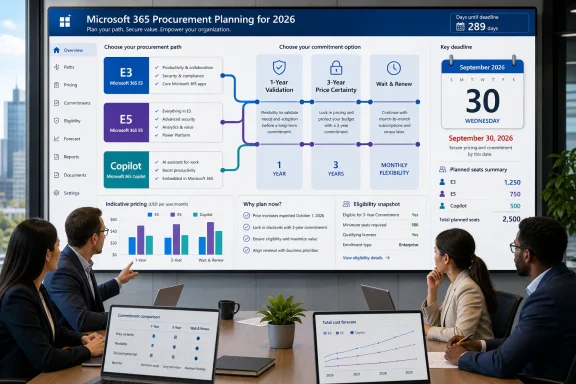 September 30 Is a Stack of Offers, Not One Renewal Event
Microsoft’s E3 and E5 promotions apply to annual subscriptions, with either annual or monthly billing available. However, commitment duration and billing cadence are not the same thing: monthly billing does not convert a one-year or three-year commercial commitment into a month-to-month exit option.For Microsoft 365 E3, Microsoft lists two distinct offers through September 30:
- Targeted customers with 250 to 9,999 seats can receive 20% off a one-year E3 offer.
- New-to-offer customers with 100 to 9,999 seats can receive 10% off a three-year E3 offer.
- New-to-offer customers with 1 to 9,999 seats can receive 15% off a one-year E5 offer.
- New-to-offer customers with 100 to 9,999 seats can receive 10% off a three-year E5 offer.
Copilot promotions have their own ladder:
- Microsoft offers 15% off a one-year SMB Copilot offer for 300 to 9,999 licenses.
- Microsoft offers 30% off a one-year SMB Copilot offer for 1,000 to 9,999 licenses.
- Microsoft offers 15% off a three-year Copilot offer for 300 to 9,999 licenses.
Build the Decision Around Three Procurement Scenarios
The right scenario depends on workload maturity, renewal timing, and how confident IT leadership is that its seat demand will remain stable. The promotion itself should be the final variable, not the opening premise.One-year validation preserves the right to change course
A one-year E3, E5, or Copilot promotion is the strongest fit when the organization is still testing license assignment, governance, adoption, and business value. It gives IT a defined period to measure actual usage without locking its current assumptions into a longer commercial term.For Copilot, this is especially important when an organization has not settled its eligibility criteria. A business may expect broad knowledge-worker deployment, then find that a smaller population has the data access, training, workflow fit, and manager support needed to use Copilot productively. A one-year term makes that discovery less financially binding.
The same logic applies to E5. A move from E3 to E5 should reflect deliberate use of the additional capabilities, not merely a discount comparison. Organizations should be able to identify which tools, controls, or operational outcomes require E5 before using a promotion as justification for a wholesale tier upgrade.
The tradeoff is obvious: a one-year term provides less price certainty after the first anniversary. But for uncertain Copilot rollouts, flexibility can be more valuable than a larger-looking discount.
Three-year commitments buy predictability, not automatic savings
Three-year offers are appropriate when license demand is stable and the organization has already done the operational work. That normally means finance can forecast the committed population, IT has a deployment standard, and procurement has confirmed that expected staffing, acquisitions, and business-unit changes will not make the seat count unrealistic.The E3 and E5 three-year offers are listed at 10% off for qualifying new-to-offer customers with 100 to 9,999 seats. The Copilot three-year offer is listed at 15% off for 300 to 9,999 licenses. Those figures may look compelling against Microsoft’s July list-price increase, but the savings only exist if the organization would have bought and retained those licenses anyway.
A three-year commitment is therefore a forecast. If an enterprise commits to 2,000 Copilot licenses because a promotional model looks favorable, but only 900 users consistently need them, the headline discount does not solve the over-licensing problem. Conversely, an organization that knows it will sustain deployment can gain budget predictability through a period when list pricing has already moved higher.
Waiting preserves optionality but exposes the organization to the new baseline
The third scenario is not inaction; it is a conscious decision to avoid a promotion that does not fit. This may be the most prudent path for organizations undergoing restructuring, major workforce changes, tenant consolidation, security redesign, or a still-unresolved Copilot governance program.Waiting means the organization should budget against the post-July 1, 2026 list price baseline at its renewal. For U.S. customers, that is $39 per user per month for Microsoft 365 E3 with Teams and $60 for Microsoft 365 E5 with Teams. It also means accepting that the September 30 promotions may not remain available in the same form.
This route is sensible if the business cannot meet an offer’s seat threshold, cannot prove new-to-offer eligibility, or cannot responsibly commit for one or three years. A discount that locks in the wrong scope is not savings; it is deferred waste.
Run E3, E5, and Copilot as Separate Worksheets
Procurement teams should avoid a single blended “Microsoft 365 renewal” spreadsheet. E3, E5, and Copilot each have different eligibility tests and different reasons for being licensed. Combining them too early hides the decision that matters: which population needs which product, for how long, and under what commercial condition.A useful renewal worksheet should contain three separate models:
- The E3 model should identify the existing eligible population, the renewal date, the projected seat count, and whether the targeted 20% one-year offer or the new-to-offer 10% three-year offer is actually available.
- The E5 model should identify the users for whom E5 is operationally justified, then compare the qualifying 15% one-year and 10% three-year offers rather than assuming an E3-to-E5 move is a simple upgrade.
- The Copilot model should separate the 300-seat threshold from the 1,000-seat threshold, because the 30% one-year SMB offer changes the economics only for the larger 1,000-to-9,999-license range.
WindowsForum readers have already been tracking how the July pricing changes shift Microsoft 365 renewals from a routine purchasing exercise into a cost-governance decision. The September offers reinforce that point: licensing teams should first establish the required service level, then test the promotion against it—not reverse the sequence.
The Calendar Needs to Start Before September
September 30 should be the final checkpoint, not the start of negotiations. Microsoft has explicitly directed partners to confirm offer details in Partner Center at checkout, so organizations need time for partner verification, internal approvals, and any corrections to their assumed eligibility.A practical timeline is straightforward:
- Now through August: Separate E3, E5, and Copilot populations; document the renewal anniversary and current seat counts for each.
- By early September: Ask the CSP partner to verify the exact promotion ID, seat threshold, new-to-offer status where applicable, commitment length, and final checkout price.
- Before September 30: Secure commercial approval only after comparing one-year, three-year, and no-promotion scenarios using the same projected seat population.
- At renewal: Recheck entitlement assumptions and add-on overlap, especially where packaging changes have altered what is included in E3 or E5.
Where the Discount Can Mislead
The major risk is using the end date to manufacture urgency. Microsoft’s offer structure rewards certain seat bands and qualifying customer positions, but it does not establish that E5 is the right tier or that Copilot should be broadly assigned.The second risk is confusing billing frequency with flexibility. An annual subscription billed monthly is still an annual commitment. Finance may see smoother cash flow, while IT and procurement remain responsible for the committed license quantity.
The third risk is treating eligibility as settled before checkout. Because Microsoft directs partners to validate final price, eligibility, and promotion IDs in Partner Center, procurement documentation should include that confirmation. A projected discount should remain a projected discount until the applicable offer is verified.
Frequently Asked Questions
Do all Microsoft 365 E3 and E5 customers qualify for a September 30 promotion?
No. The listed offers have different seat ranges and eligibility rules, including targeted-customer and new-to-offer conditions. Partners must confirm final eligibility in Partner Center at checkout.Is the 30% Copilot discount available for a three-year commitment?
No. Microsoft lists the 30% Copilot SMB promotion as a one-year offer for 1,000 to 9,999 licenses. The listed three-year Copilot offer is 15% off for 300 to 9,999 licenses.Does monthly billing mean the organization can cancel monthly?
No. Microsoft describes these as annual subscriptions with annual or monthly billing. Billing cadence should not be confused with the underlying commitment period.Should an organization choose E5 because the offer is available?
Not automatically. E5 should be selected where its capabilities are needed and the qualifying population is durable enough to support the term. A promotion changes price, not technical requirements.The decision before September 30 is not whether Microsoft’s discounts are attractive in isolation. It is whether the organization can validate its Copilot demand in one year, confidently carry its E3, E5, or Copilot seat commitments for three, or preserve flexibility and renew later at the new pricing baseline.
References
- Primary source: learn.microsoft.com
July 2026 announcements - Partner Center announcements | Microsoft Learn
July 2026 announcements for Microsoft Partner Center including new capabilities, promotions, offers, markets, or changes to existing offers.learn.microsoft.com - Independent coverage: microsoft.com
Microsoft 365 Pricing and Packaging Updates | Microsoft Licensing Resources
On December 4, Microsoft announced a global price and packaging update for select Microsoft 365 commercial suites and standalone components, including Enterprise, Business, Frontline, and Government commercial equivalents.www.microsoft.com
- Independent coverage: partner.microsoft.com
Copilot monetization for SMBs: Turn adoption into sustained AI value
Turn Copilot adoption into sustained SMB value with agents, analytics, governance, skilling, and repeatable partner services.partner.microsoft.com
- Independent coverage: blogs.windows.com
Stay secure with Windows 11, Copilot+ PCs and Windows 365 before support ends for Windows 10
When we launched Windows in 1985, we set out to revolutionize computing—guided by the belief that technology should be accessible, intuitive and powerful for everyone. Nearly 40 years later, that same vision continues to drive us forward. Today, Wiblogs.windows.com - Primary source: WindowsForum
Microsoft 365 Subscription Hike: Copilot Takes Center Stage | Windows Forum
Microsoft has once again shaken the table, and this time, it's your wallet that might feel the quake. In a move sparking widespread discussion—and, let’s be...windowsforum.com
