

CVE-2026-53402 is a newly published Linux kernel vulnerability in the framebuffer console, or fbcon, that can turn a failed console-font change into a deterministic out-of-bounds read and a potential disclosure of kernel memory. For Windows administrators, the immediate boundary is clear: native Windows is not affected, but Linux hosts, virtual machines, appliances, and custom-kernel WSL 2 deployments should identify their running kernels and apply vendor fixes.
The NVD entry, published July 19, identifies
The vulnerability affects a relatively specialized part of the graphics stack, but it is a kernel-space memory-safety flaw in code that handles user-influenced console font configuration. That makes accurate exposure assessment more important than broad assumptions based on a desktop’s normal graphical workload.
The fault sits in the rollback logic that runs when
Before that failure occurs, the code may call
The problem is that the old error path restored the configured font’s
That disagreement is the dangerous part. Subsequent console rendering through routines such as
This is not a conventional remote-network bug, nor does the published record claim a complete privilege-escalation exploit. It instead depends on reaching a particular console-font operation, provoking the allocation or resize failure, and then driving rendering with inflated character indices. Still, reliable out-of-bounds reads in kernel code deserve prompt remediation, especially on multi-user Linux systems or systems that expose local console-management capabilities to less-trusted software.
This is also not the first time
For IT teams, that history argues against treating the framebuffer console as irrelevant simply because most endpoints boot into a graphical desktop. Fbcon can be active during boot, recovery work, direct virtual-terminal sessions, embedded use cases, serial or physical console administration, and virtualized environments configured for Linux text consoles.
The public CVE metadata lists the vulnerable lineage from Linux 6.0 onward, while also identifying fixed maintained branches. The practical fixed baselines currently listed are:
Package Advisories Matter More Than
A first pass starts with the running kernel:
But that command is only an inventory signal. Administrators should match the installed kernel package against their distribution or platform vendor’s security advisory and changelog, looking for CVE-2026-53402 or the relevant fbcon backport. A distro kernel labeled with an older upstream base can still contain the fix; an apparently recent custom build can omit it.
For systems managed as fleets, security teams should include hosts that are easy to overlook:
WSL 2 is different, but the supplied NVD and kernel.org data do not establish that Microsoft’s shipping WSL kernel contains the vulnerable code or that it has issued a corresponding fix. Microsoft delivers the WSL kernel separately from the Windows operating system and provides
Administrators using a custom WSL 2 kernel through
Where an immediate update cannot be scheduled, reducing access to local virtual-terminal and console-font administration can lower practical exposure. That is a temporary compensating control, not a fix. The trigger involves a failure path that may be easier to reach under memory pressure, and relying on a system to avoid allocation failures is not a security strategy.
The key operational lesson from CVE-2026-53402 is that rollback code is security-critical code. The vulnerable path was designed to recover cleanly from a failed resize, yet it restored only part of a console state transition. The upstream repair closes that gap; the next milestone for administrators is ensuring their vendor kernel has incorporated it—and that the kernel actually running after maintenance is the patched one.
The NVD entry, published July 19, identifies
drivers/video/fbdev/core/fbcon.c and specifically the fbcon_do_set_font() error-handling path. The Linux kernel CVE record says the issue is fixed in Linux 6.12.96, 6.18.39, and 7.1.3, with the upstream fix present in Linux 7.2-rc1. NVD had not assigned a CVSS score as of July 20, so organizations should not mistake the absence of a severity number for an absence of security impact.The vulnerability affects a relatively specialized part of the graphics stack, but it is a kernel-space memory-safety flaw in code that handles user-influenced console font configuration. That makes accurate exposure assessment more important than broad assumptions based on a desktop’s normal graphical workload.
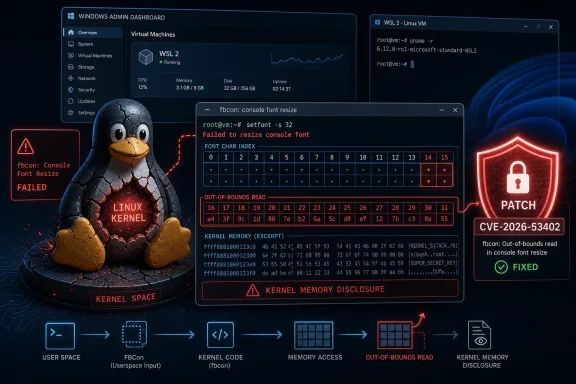 A Failed Font Resize Leaves the Console in Two States at Once
The fault sits in the rollback logic that runs when fbcon_do_set_font() cannot complete a font change. A likely trigger is failure inside vc_resize() while the system is under memory pressure, according to the kernel.org description carried into NVD.Before that failure occurs, the code may call
set_vc_hi_font() to enable a high-font mode. This changes vc_hi_font_mask and alters the console screen buffer to support character indices beyond the conventional 256-character font range. The operation then attempts the resize required to finish switching fonts.The problem is that the old error path restored the configured font’s
charcount but did not restore the high-font state or the screen buffer. In practical terms, the font could be reverted to a 256-character array while the virtual-terminal subsystem still believed it was allowed to accept character indices above 255.That disagreement is the dangerous part. Subsequent console rendering through routines such as
fbcon_putcs() can use those larger character values to index the now-reverted 256-character font data. The result is an out-of-bounds read in kernel memory, with the kernel CVE description warning of potential memory disclosure.This is not a conventional remote-network bug, nor does the published record claim a complete privilege-escalation exploit. It instead depends on reaching a particular console-font operation, provoking the allocation or resize failure, and then driving rendering with inflated character indices. Still, reliable out-of-bounds reads in kernel code deserve prompt remediation, especially on multi-user Linux systems or systems that expose local console-management capabilities to less-trusted software.
The Fix Restores Both the Font and Its Operating Mode
The patch is deliberately narrow: it adds the missing rollback of the high-font mask and screen-buffer state in theerr_out path. That returns the virtual console to one internally consistent state if vc_resize() fails—either the new font setup completes, or all of the related font and buffer changes are undone.This is also not the first time
fbcon_do_set_font() has drawn security attention. Previous Linux CVEs have addressed incomplete restoration of old font data, allocation cleanup after a failed font operation, and integer-overflow risks in related font-size calculations. The pattern is instructive for kernel maintainers: font switching is not merely a metadata update; it changes data structures and interpretation rules across the console stack.For IT teams, that history argues against treating the framebuffer console as irrelevant simply because most endpoints boot into a graphical desktop. Fbcon can be active during boot, recovery work, direct virtual-terminal sessions, embedded use cases, serial or physical console administration, and virtualized environments configured for Linux text consoles.
The public CVE metadata lists the vulnerable lineage from Linux 6.0 onward, while also identifying fixed maintained branches. The practical fixed baselines currently listed are:
- Linux 6.12.96 or later in the 6.12 stable series.
- Linux 6.18.39 or later in the 6.18 stable series.
- Linux 7.1.3 or later in the 7.1 stable series.
- Linux 7.2-rc1 or later in the upstream development line.
Package Advisories Matter More Than uname -r Alone
A first pass starts with the running kernel:uname -rBut that command is only an inventory signal. Administrators should match the installed kernel package against their distribution or platform vendor’s security advisory and changelog, looking for CVE-2026-53402 or the relevant fbcon backport. A distro kernel labeled with an older upstream base can still contain the fix; an apparently recent custom build can omit it.
For systems managed as fleets, security teams should include hosts that are easy to overlook:
- Hypervisor guests and cloud instances running distribution-supplied kernels.
- Embedded Linux systems with physical or virtual framebuffer consoles.
- Recovery environments, kiosk images, developer workstations, and jump hosts.
- Build agents or CI runners that compile, boot, or test custom kernels.
- WSL 2 installations configured to boot a locally built kernel image.
WSL 2 is different, but the supplied NVD and kernel.org data do not establish that Microsoft’s shipping WSL kernel contains the vulnerable code or that it has issued a corresponding fix. Microsoft delivers the WSL kernel separately from the Windows operating system and provides
wsl --status and wsl --version for checking the installed environment. wsl --update updates the WSL package and kernel servicing components, but it should not be used as a substitute for confirming Microsoft’s eventual security disposition.Administrators using a custom WSL 2 kernel through
.wslconfig should treat it as a standard Linux-kernel deployment. Check uname -r from inside the distribution, review the source branch and applied patches, then rebuild or replace the image if it carries an affected fbcon implementation.Patch First, Then Decide Whether Exposure Is Material
The appropriate response is routine but should be timely: deploy the kernel update supplied by the operating-system or appliance vendor, reboot into it where required, and confirm the active kernel after restart. For immutable images and cloud templates, update the golden image rather than relying on a one-off host repair.Where an immediate update cannot be scheduled, reducing access to local virtual-terminal and console-font administration can lower practical exposure. That is a temporary compensating control, not a fix. The trigger involves a failure path that may be easier to reach under memory pressure, and relying on a system to avoid allocation failures is not a security strategy.
The key operational lesson from CVE-2026-53402 is that rollback code is security-critical code. The vulnerable path was designed to recover cleanly from a failed resize, yet it restored only part of a console state transition. The upstream repair closes that gap; the next milestone for administrators is ensuring their vendor kernel has incorporated it—and that the kernel actually running after maintenance is the patched one.
References
- Primary source: NVD / Linux Kernel
Published: 2026-07-20T01:02:01-07:00
NVD - CVE-2026-53402
 nvd.nist.gov
- Security advisory: MSRC
Published: 2026-07-20T01:02:01-07:00
Original feed URL
Security Update Guide - Microsoft Security Response Center
 msrc.microsoft.com
