Cassava Technologies says its Africa Data Centres JHB1 facility in Johannesburg has been designated a Microsoft Azure ExpressRoute Metro peering location, giving South African organizations a second local site for redundant private connectivity into Azure.
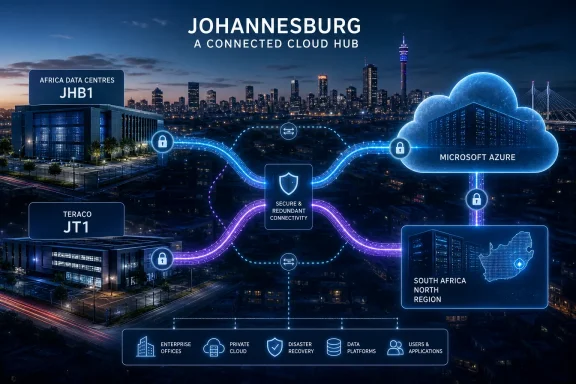
The announcement, published by Zawya on July 20, says JHB1 joins Teraco’s JT1 as the two Johannesburg endpoints for Azure ExpressRoute Metro. Microsoft’s ExpressRoute Metro documentation also lists Johannesburg Metro with Teraco JT1 and Africa Data Centres JHB1, connected to the South Africa North Azure region.
Standard ExpressRoute provides a private connection between an organization’s network and Microsoft cloud services, avoiding public-internet transit for Azure workloads. ExpressRoute Metro extends that model across two peering locations in the same metro area, allowing a single circuit to use geographically separate facilities.
That matters for companies running production Azure environments from Johannesburg. A fault affecting one data center, cross-connect, or local path should not necessarily take down the cloud connection if the second metro location remains available. It is redundancy at the physical connectivity layer, rather than simply an additional VPN or internet circuit.
Cassava describes the development as Africa’s first ExpressRoute Metro deployment. The company’s JHB1 site is the second local peering point in the Johannesburg metro, rather than a replacement for the existing Teraco location.
For IT teams, the appeal is less about a new Azure region and more about reducing the operational work around connectivity: provisioning, routing, availability design, and security can be sourced from one provider. That may be particularly relevant to regulated South African organizations with continuity, risk-management, and data-protection requirements.
The announcement does not change Azure service availability or regional residency. Workloads still run in Microsoft’s existing South Africa North region or elsewhere, depending on customer architecture. It improves the route enterprises can use to reach those services.
Organizations already using ExpressRoute in Johannesburg should review whether their provider supports ExpressRoute Metro and whether their circuit design can use both JHB1 and JT1.
The report also underscores an important design limitation: ExpressRoute Metro provides site diversity within Johannesburg, but it is not Microsoft’s maximum-resiliency configuration. Organizations still need to validate their own carrier, last-mile, customer-edge, gateway, routing, and application failover designs; an existing ExpressRoute circuit does not automatically receive Metro-level resilience.

 itweb.africa

The announcement, published by Zawya on July 20, says JHB1 joins Teraco’s JT1 as the two Johannesburg endpoints for Azure ExpressRoute Metro. Microsoft’s ExpressRoute Metro documentation also lists Johannesburg Metro with Teraco JT1 and Africa Data Centres JHB1, connected to the South Africa North Azure region.
 What ExpressRoute Metro changes
Standard ExpressRoute provides a private connection between an organization’s network and Microsoft cloud services, avoiding public-internet transit for Azure workloads. ExpressRoute Metro extends that model across two peering locations in the same metro area, allowing a single circuit to use geographically separate facilities.That matters for companies running production Azure environments from Johannesburg. A fault affecting one data center, cross-connect, or local path should not necessarily take down the cloud connection if the second metro location remains available. It is redundancy at the physical connectivity layer, rather than simply an additional VPN or internet circuit.
Cassava describes the development as Africa’s first ExpressRoute Metro deployment. The company’s JHB1 site is the second local peering point in the Johannesburg metro, rather than a replacement for the existing Teraco location.
Liquid C2 to sell managed connectivity
Cassava’s cloud and cybersecurity business, Liquid C2, plans to offer the connection under a managed service called Secure CloudConnect. The company says the service combines private Azure connectivity with security controls and management.For IT teams, the appeal is less about a new Azure region and more about reducing the operational work around connectivity: provisioning, routing, availability design, and security can be sourced from one provider. That may be particularly relevant to regulated South African organizations with continuity, risk-management, and data-protection requirements.
The announcement does not change Azure service availability or regional residency. Workloads still run in Microsoft’s existing South Africa North region or elsewhere, depending on customer architecture. It improves the route enterprises can use to reach those services.
Practical impact
Windows and Microsoft 365 administrators are unlikely to see a direct desktop-facing change. The immediate audience is network, cloud, and security teams supporting Azure-hosted line-of-business applications, virtual desktops, identity services, backups, and hybrid environments where private connectivity and predictable failure handling are requirements.Organizations already using ExpressRoute in Johannesburg should review whether their provider supports ExpressRoute Metro and whether their circuit design can use both JHB1 and JT1.
Update: Additional details (July 20, 2026)
ITWeb Africa reports that Liquid C2 is currently the only provider with an on-net presence at both Johannesburg ExpressRoute Metro endpoints: Africa Data Centres JHB1 and Teraco JT1. That position allows it to offer a managed service spanning both sites, rather than requiring customers to combine separate colocation, carrier, and security arrangements.The report also underscores an important design limitation: ExpressRoute Metro provides site diversity within Johannesburg, but it is not Microsoft’s maximum-resiliency configuration. Organizations still need to validate their own carrier, last-mile, customer-edge, gateway, routing, and application failover designs; an existing ExpressRoute circuit does not automatically receive Metro-level resilience.
Africa’s cloud infrastructure gets resilience boost | ITWeb Africa
As the first ExpressRoute Metro location in Africa, Johannesburg joins a select group of global technology hubs offering organisations access to a new level of cloud resilience and security.
Update: Additional details (July 20, 2026)
Microsoft’s ExpressRoute Metro documentation lists Equinix and OpenAccessDC as the available service providers for Johannesburg Metro. The metro’s two peering facilities are Teraco JT1 and Africa Data Centres JHB1, with connectivity to the South Africa North Azure region.Cassava Technologies Launches Africa’s First Azure ExpressRoute Metro in Johannesburg | Streamline
Cassava Technologies designates its Johannesburg JHB1 facility as Africa’s first Microsoft Azure ExpressRoute Metro location, elevating continental cloud...
streamlinefeed.co.ke
References
- Primary source: Zawya
Published: 2026-07-20T08:06:24.550000+00:00
- Related coverage: za.liquid.tech
Liquid South Africa | Liquid C2 secures gold-level in Google’s Verified Peering Provider...
Liquid C2, has achieved gold-level status in Google’s Verified Peering Provider programme. This accreditation highlights the strength...za.liquid.tech - Official source: learn.microsoft.com
Locations and connectivity providers for Azure ExpressRoute | Microsoft Learn
This article provides a detailed overview of available providers and services per each ExpressRoute location to connect to Azure.learn.microsoft.com - Related coverage: tech.africa
Liquid C2 and Google Cloud open Africa first AI centre in Joburg
Liquid C2 and Google Cloud launch Africa first Partner Experience Centre in Johannesburg with Gemini Enterprise AI tools for the partner ecosystem.tech.africa

Last edited: