

CD Projekt Red is preparing to make Windows 11, an SSD, and DirectX 12 the baseline for the next version of The Witcher 3: Wild Hunt, ending official Windows 10 testing for the 2015 RPG and raising its minimum PC specification ahead of the 2027 Songs of the Past expansion. The developer’s support notice does not assign the change to October 2026, however; it says the requirements take effect with the game’s next update.
The timing matters because Windows 10 itself reached end of support on October 14, 2025. Microsoft still offers Extended Security Updates for some users through October 12, 2027, but CD Projekt Red is drawing a separate line: even a fully patched Windows 10 machine enrolled in ESU will no longer be an officially tested configuration for The Witcher 3 or Cyberpunk 2077.
That distinction is the practical headline for PC players. The game will not abruptly cease to launch on Windows 10 simply because the publisher retires formal support. But anyone who encounters a post-update crash, graphics issue, mod conflict, or performance regression on Windows 10 should not expect CD Projekt Red to reproduce or resolve it.
According to CD Projekt Red’s technical-support announcement, the new minimum specification for The Witcher 3: Wild Hunt will be:
That is a material shift for a title that originally targeted Windows 7-era hardware and shipped with a DirectX 11 renderer. The current-generation update released in late 2022 already increased the game’s technical ambition with ray tracing, revised textures, faster-loading options, and a separate DirectX 12 path. The coming change goes further by removing the older compatibility lane rather than simply treating DX12 as an optional enhancement.
For players with a reasonably recent desktop or gaming laptop, the listed GPU and CPU floor is not especially extreme. A GTX 1660, Ryzen 5 2600, and Core i5-8400 are all parts from the 2018 period. The potential pain point is not raw performance but platform eligibility: some machines still capable of running the existing version well may lack the TPM, Secure Boot configuration, or supported processor required for a conventional Windows 11 installation.
CD Projekt Red’s own wording is also careful. The studio is ending testing and support, not claiming that Windows 10 will technically become incapable of running the game overnight. That leaves room for legacy installations to keep functioning, particularly before the update arrives, but it removes the assurance that future patches will preserve that compatibility.
CD Projekt Red explicitly points to the absence of ongoing security updates, official platform support, and continuing GPU-driver support in explaining its decision. That rationale is broader than a simple minimum-spec increase. It is a statement that Windows 10 is no longer a reliable certification target for the developer’s current plans.
There is an important wrinkle for organizations and households relying on Windows 10 Extended Security Updates. ESU can reduce the operating system’s security exposure, but it does not restore vendor testing by game developers. Administrators who have deliberately retained Windows 10 for application compatibility should therefore separate two questions: whether the PC remains securely supported by Microsoft, and whether a specific game publisher considers it a supported platform.
For home users, the answer may be as simple as delaying the game update. For managed environments, especially those with shared gaming, lab, or event PCs, it is a reminder that game updates can introduce OS requirements without an obvious Windows Update-style lifecycle notification.
The storage requirement may prove more consequential than the Windows 11 line for older systems. The Witcher 3 can be playable from a hard drive today, although load times and asset delivery vary sharply by configuration. CD Projekt Red says SSD-only support is intended to improve loading, asset streaming, and general performance. That fits the direction of modern open-world games, where storage latency increasingly affects traversal stability as much as it affects loading screens.
That does not automatically mean ray tracing will become mandatory. The company’s announced minimum GPU class, the GTX 1660 and Radeon RX 5500 XT, does not support hardware-accelerated ray tracing in the way newer RTX and Radeon RX 6000-series cards do. Instead, the practical implication is that the standard rendering pipeline itself will be the modern DirectX 12 version.
The change could also affect the modding ecosystem. The Witcher 3 has a substantial PC mod community, and CD Projekt Red’s REDkit has made more ambitious projects possible. Mods that depend on the existing game version, old render behavior, or specific script and asset assumptions may need updates when the new patch lands.
That does not mean all mods will fail, nor has CD Projekt Red published a compatibility list. But players with heavily customized installs should treat the next update as a migration event, not a routine download. Backing up saves, noting installed mod versions, and waiting for mod authors to validate their work will be more sensible than updating automatically on day one.
CD Projekt Red also points players toward the ability to revert to an earlier version of the game. That is a valuable escape hatch for users locked to Windows 10 hardware, HDD-based systems, or older mod packs. It should not be mistaken for indefinite support, however. Reverting preserves a known-working build; it does not provide access to new content or guarantee compatibility with future storefront, driver, or cloud-save changes.
The expansion returns players to Geralt of Rivia, rather than putting Ciri directly in the lead. In CD Projekt Red’s first-quarter 2026 earnings release, joint CEO Michał Nowakowski framed Geralt’s return as a trip down memory lane before the studio “passes the baton” to Ciri in The Witcher 4. That supports the idea of a franchise handoff, but the company has not formally described Songs of the Past as a direct narrative bridge or revealed its setting, villains, or place in the game’s branching endings.
For Windows players, the immediate takeaway is more prosaic. There is no confirmed October 2026 cutoff for The Witcher 3 itself, and no announced release date for Songs of the Past. What is confirmed is that the next game update will redefine the supported PC baseline around Windows 11, SSD storage, and DirectX 12.
Anyone planning to return to the Northern Realms in 2027 should check their system now—not because Geralt’s story is ending this October, but because the version of The Witcher 3 that receives its next chapter will no longer be built around the Windows 10 era.
The timing matters because Windows 10 itself reached end of support on October 14, 2025. Microsoft still offers Extended Security Updates for some users through October 12, 2027, but CD Projekt Red is drawing a separate line: even a fully patched Windows 10 machine enrolled in ESU will no longer be an officially tested configuration for The Witcher 3 or Cyberpunk 2077.
That distinction is the practical headline for PC players. The game will not abruptly cease to launch on Windows 10 simply because the publisher retires formal support. But anyone who encounters a post-update crash, graphics issue, mod conflict, or performance regression on Windows 10 should not expect CD Projekt Red to reproduce or resolve it.
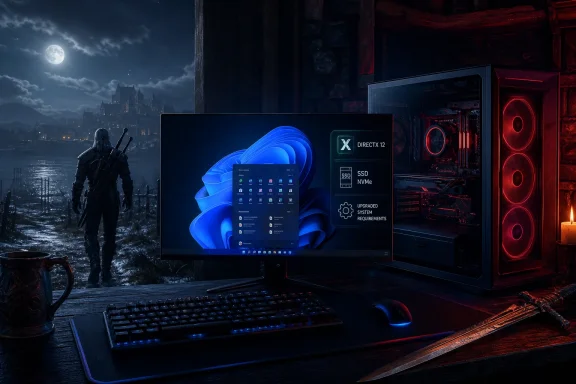 The next update turns an old game into a current-platform title
According to CD Projekt Red’s technical-support announcement, the new minimum specification for The Witcher 3: Wild Hunt will be:- AMD Ryzen 5 2600 or Intel Core i5-8400.
- Nvidia GeForce GTX 1660 or AMD Radeon RX 5500 XT with 6GB of VRAM.
- 12GB of system memory.
- 70GB of SSD storage.
- 64-bit Windows 11.
That is a material shift for a title that originally targeted Windows 7-era hardware and shipped with a DirectX 11 renderer. The current-generation update released in late 2022 already increased the game’s technical ambition with ray tracing, revised textures, faster-loading options, and a separate DirectX 12 path. The coming change goes further by removing the older compatibility lane rather than simply treating DX12 as an optional enhancement.
For players with a reasonably recent desktop or gaming laptop, the listed GPU and CPU floor is not especially extreme. A GTX 1660, Ryzen 5 2600, and Core i5-8400 are all parts from the 2018 period. The potential pain point is not raw performance but platform eligibility: some machines still capable of running the existing version well may lack the TPM, Secure Boot configuration, or supported processor required for a conventional Windows 11 installation.
CD Projekt Red’s own wording is also careful. The studio is ending testing and support, not claiming that Windows 10 will technically become incapable of running the game overnight. That leaves room for legacy installations to keep functioning, particularly before the update arrives, but it removes the assurance that future patches will preserve that compatibility.
Windows 10’s long tail is now a game-support problem
Microsoft’s retirement of Windows 10 has increasingly become a secondary support burden for software makers, driver vendors, and game studios. The operating system continues to run on a large installed base, including PCs that cannot officially make the jump to Windows 11. Yet a publisher maintaining a tested Windows 10 configuration must account for older driver branches, less predictable update states, and a platform Microsoft no longer services in the standard way.CD Projekt Red explicitly points to the absence of ongoing security updates, official platform support, and continuing GPU-driver support in explaining its decision. That rationale is broader than a simple minimum-spec increase. It is a statement that Windows 10 is no longer a reliable certification target for the developer’s current plans.
There is an important wrinkle for organizations and households relying on Windows 10 Extended Security Updates. ESU can reduce the operating system’s security exposure, but it does not restore vendor testing by game developers. Administrators who have deliberately retained Windows 10 for application compatibility should therefore separate two questions: whether the PC remains securely supported by Microsoft, and whether a specific game publisher considers it a supported platform.
For home users, the answer may be as simple as delaying the game update. For managed environments, especially those with shared gaming, lab, or event PCs, it is a reminder that game updates can introduce OS requirements without an obvious Windows Update-style lifecycle notification.
The storage requirement may prove more consequential than the Windows 11 line for older systems. The Witcher 3 can be playable from a hard drive today, although load times and asset delivery vary sharply by configuration. CD Projekt Red says SSD-only support is intended to improve loading, asset streaming, and general performance. That fits the direction of modern open-world games, where storage latency increasingly affects traversal stability as much as it affects loading screens.
DirectX 12 becomes the only path forward
The retirement of DirectX 11 support is the clearest technical signal that Songs of the Past will not be built as a conservative add-on for the original 2015 PC release. CD Projekt Red has not yet detailed the expansion’s engine-level features, rendering targets, or performance expectations. Still, a DX12-only game build gives the studio a cleaner technical base for graphics changes and newer hardware support.That does not automatically mean ray tracing will become mandatory. The company’s announced minimum GPU class, the GTX 1660 and Radeon RX 5500 XT, does not support hardware-accelerated ray tracing in the way newer RTX and Radeon RX 6000-series cards do. Instead, the practical implication is that the standard rendering pipeline itself will be the modern DirectX 12 version.
The change could also affect the modding ecosystem. The Witcher 3 has a substantial PC mod community, and CD Projekt Red’s REDkit has made more ambitious projects possible. Mods that depend on the existing game version, old render behavior, or specific script and asset assumptions may need updates when the new patch lands.
That does not mean all mods will fail, nor has CD Projekt Red published a compatibility list. But players with heavily customized installs should treat the next update as a migration event, not a routine download. Backing up saves, noting installed mod versions, and waiting for mod authors to validate their work will be more sensible than updating automatically on day one.
CD Projekt Red also points players toward the ability to revert to an earlier version of the game. That is a valuable escape hatch for users locked to Windows 10 hardware, HDD-based systems, or older mod packs. It should not be mistaken for indefinite support, however. Reverting preserves a known-working build; it does not provide access to new content or guarantee compatibility with future storefront, driver, or cloud-save changes.
Songs of the Past is the reason for the reset, not a release-date confirmation
The broader context is CD Projekt Red’s newly announced third expansion, The Witcher 3: Wild Hunt — Songs of the Past. The studio confirmed in May that the expansion is being co-developed with Fool’s Theory and will arrive on PC, PlayStation 5, and Xbox Series X|S in 2027. More details are promised for late summer 2026.The expansion returns players to Geralt of Rivia, rather than putting Ciri directly in the lead. In CD Projekt Red’s first-quarter 2026 earnings release, joint CEO Michał Nowakowski framed Geralt’s return as a trip down memory lane before the studio “passes the baton” to Ciri in The Witcher 4. That supports the idea of a franchise handoff, but the company has not formally described Songs of the Past as a direct narrative bridge or revealed its setting, villains, or place in the game’s branching endings.
For Windows players, the immediate takeaway is more prosaic. There is no confirmed October 2026 cutoff for The Witcher 3 itself, and no announced release date for Songs of the Past. What is confirmed is that the next game update will redefine the supported PC baseline around Windows 11, SSD storage, and DirectX 12.
Anyone planning to return to the Northern Realms in 2027 should check their system now—not because Geralt’s story is ending this October, but because the version of The Witcher 3 that receives its next chapter will no longer be built around the Windows 10 era.
References
- Primary source: ScreenRant
Published: 2026-07-20T05:00:11+00:00
The Witcher 3: Wild Hunt As We Know It Ends October 2026
The Witcher 3's sudden return to prominence does have at least one negative consequence for those playing on older systems. screenrant.com
- Related coverage: press.cdprojektred.com
The Witcher 3: Wild Hunt - Songs of the Past Announced - CD PROJEKT RED Press Center
press.cdprojektred.com
- Related coverage: support.cdprojektred.com
《巫師 3:狂獵》最低系統配備需求即將迎來變更 — The Witcher 3: Wild Hunt | 技術支援:CD PROJEKT RED
歡迎來到 CD PROJEKT RED 技術支援!這裡有我們的遊戲和服務說明以及常見問與答。support.cdprojektred.com - Related coverage: as.com
Es oficial: CD Projekt anuncia Songs of the Past, la nueva expansión de The Witcher 3: Wild Hunt
Geralt volverá en 2027 con Songs of the Past, la nueva expansión de The Witcher 3 co-desarrollada por Fool’s Theory.as.com
