

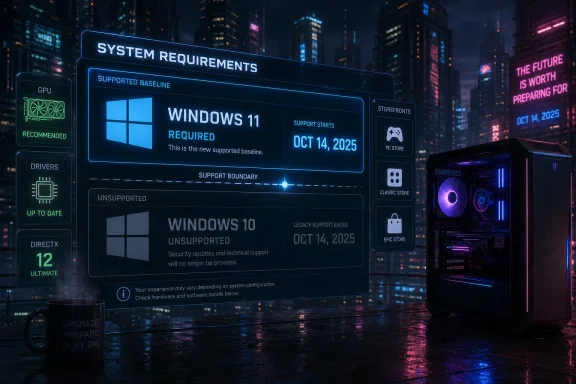
CD Projekt Red is again changing Cyberpunk 2077’s PC system requirements, with Windows 11 set to become the minimum supported Windows version after Microsoft ended mainstream Windows 10 support on October 14, 2025, according to a new OpenCritic report on the change. The practical effect is subtler than the headline suggests: the game is not being remotely deleted from Windows 10 PCs, and “unsupported” does not automatically mean “unplayable.” But it is another marker in a much larger shift, where game studios are beginning to treat Windows 10 not as the default PC gaming platform, but as legacy terrain. For Windows users, the message is increasingly blunt: the operating system under your games now matters almost as much as the GPU beside them.
The important thing about this Cyberpunk 2077 requirements change is not that CD Projekt Red suddenly discovered Windows 11. It is that the studio is aligning its support policy with Microsoft’s calendar, turning an operating-system lifecycle decision into a game-support boundary.
That is a familiar move in enterprise IT, where vendors routinely peg support matrices to Microsoft lifecycles. It feels more jarring in PC gaming because the culture has long been built around improvisation. If a game launches, modders, driver updates, launch arguments, DLL swaps, and stubborn players often keep it alive well past its official shelf life.
Cyberpunk 2077 is especially symbolic because it has already lived several technical lives. It launched in December 2020 as an ambitious but troubled cross-generation blockbuster, became a cautionary tale, then slowly clawed its way back through major patches, the Phantom Liberty expansion, and the sweeping 2.0-era overhaul. Its requirements have changed before because the game itself changed.
This latest shift is different. It is less about Night City becoming more demanding and more about the PC platform beneath it becoming less supportable. Windows 10 did not stop running games on October 14, 2025. But after that date, every developer still testing against it is choosing to carry extra support weight for an operating system Microsoft itself has moved beyond.
That history matters because it undercuts the easy reading that this is simply a Windows 11 promotion by proxy. Cyberpunk 2077 has repeatedly been rebaselined around the version of the game CD Projekt Red actually intends to maintain. The 2020 minimum spec belonged to one game; the post-2.0 spec belongs to another.
The February 2022 change was not especially surprising. Windows 7 had already become a liability for modern game development, driver support, and platform services. Even then, a subset of PC players bristled at the idea that a game they had bought could move away from an operating system it once listed.
The September 2023 overhaul was more consequential. Phantom Liberty and Update 2.0 did not merely add content; they reshaped systems, AI, progression, combat, and technical expectations. The move from hard-drive-era assumptions to SSD-focused requirements was a signal that CD Projekt Red was no longer optimizing around the lowest common denominator of the game’s troubled launch window.
The Windows 10 cutoff belongs to that same lineage, but it arrives with a different emotional charge. Many players still use Windows 10 not because they are clinging to ancient hardware in the abstract, but because Windows 11’s requirements, interface changes, and telemetry posture remain contentious. For them, this is not just a game requirement update. It is another shove from an ecosystem that has been shoving for years.
That difference matters. A game can continue to run on an unsupported OS for months or years, especially if it is not receiving deep engine changes. Players on Windows 10 may still be able to launch Cyberpunk 2077, load saves, run mods, and keep wandering Night City. What changes is the burden of proof when something breaks.
If a future patch causes instability on Windows 10, CD Projekt Red can reasonably say the OS is outside the support matrix. If a GPU driver regression appears only on Windows 10, the studio has less reason to chase it. If a launcher, overlay, anti-cheat-adjacent component, or dependency starts behaving differently, Windows 10 users become edge cases rather than first-class customers.
That is the quiet power of a requirements page. It does not need to brick anything. It changes who is entitled to expect a fix.
For administrators, support engineers, and technically minded players, this distinction is familiar. Unsupported platforms often work until they do not. The danger is not immediate failure; it is the accumulation of unresolved incompatibilities.
Games are sometimes treated as if they exist outside normal software lifecycle rules, but modern PC games are deeply entangled with them. They depend on graphics drivers, runtime libraries, platform overlays, storefront APIs, input stacks, audio systems, cloud-save clients, modding tools, and anti-tamper systems. A big game is not a single executable so much as a small city of dependencies.
That dependency city is exactly where Windows 10 becomes harder to justify. Nvidia, AMD, Intel, Valve, Epic, GOG, Microsoft, and middleware providers all make their own support decisions. Once enough of those decisions tilt toward Windows 11, a game studio can keep Windows 10 on paper only by spending more time testing combinations that the rest of the ecosystem is slowly abandoning.
The irony is that Windows 10 remains, by ordinary human standards, a modern operating system. It is not Windows XP in 2014 or Windows 7 in 2022. It still feels current to millions of users, and for many workloads it remains stable, familiar, and fast enough.
But lifecycle policy does not measure familiarity. It measures patchability, vendor obligation, and risk allocation. By that logic, Windows 10 has crossed the line from mainstream platform to managed exception.
Microsoft’s hardware requirements drew a hard boundary around CPU generations, TPM 2.0, Secure Boot, and other platform capabilities. Some Windows 10 machines that remain perfectly serviceable for gaming do not meet the official Windows 11 requirements. Others can be upgraded through workarounds, but doing so puts users in a gray zone that many ordinary players should not be expected to navigate.
That is what makes game requirement changes politically sensitive. A studio can say it is only following Microsoft’s support lifecycle, and technically it is. But to the player with a capable GPU, enough RAM, and an SSD, the unsupported operating system may feel like an arbitrary gate.
There is also a trust issue. Windows 11 has improved since launch, but it has not persuaded every Windows 10 user that the trade is painless. Interface changes, account nudges, advertising surfaces, AI integration, and shifting defaults have all contributed to the sense that an OS upgrade is no longer just an OS upgrade. It is a renegotiation of the relationship between the user and the platform owner.
For gamers, that relationship used to be mediated mostly by performance. Does the game run faster? Are frame times smoother? Are drivers better? The Windows 11 migration asks a broader question: are you willing to accept Microsoft’s new baseline for what a consumer PC should be?
That matters because Cyberpunk 2077’s post-launch identity has been tied to technology. Ray tracing, path tracing, DLSS, frame generation, XeSS, FSR, high-density urban rendering, and demanding CPU workloads have all made the game a benchmark as much as a role-playing game. It is not just something players install; it is something reviewers and hardware vendors use to test the state of the PC.
A game with that role cannot easily remain anchored to an aging OS forever. Every additional supported configuration has a cost. Test matrices expand, QA time gets divided, and bugs that affect a shrinking segment of users compete with work on current hardware and software paths.
This is not a moral defense of every requirements bump. Studios can hide behind “compatibility” language when they simply do not want to optimize. But Cyberpunk 2077 is one of the clearer cases where the technical direction of the game and the lifecycle direction of Windows are pointing the same way.
The studio’s calculation is likely straightforward: Windows 10 users can keep playing at their own risk, but future validation belongs to Windows 11.
GOG is especially relevant because CD Projekt owns it and because GOG’s DRM-free posture gives users more practical control. A player with a downloaded offline installer or a deliberately preserved game build has a different relationship to support than a player whose Steam installation updates automatically. The unsupported platform may still run the old build perfectly well.
That difference creates a quiet divide in PC ownership. The player who treats games as durable software artifacts has more room to resist platform churn. The player who treats games as live, auto-updating services is more exposed to changing requirements.
Steam can mitigate some of this through branch options when developers provide them, but that is not guaranteed. Epic is more oriented around the current version. GOG remains the most natural home for players who want to freeze a working setup, but even there, support is not the same as archival access.
For Windows 10 holdouts, the practical advice is therefore less dramatic than “upgrade immediately” and more operational. Back up saves. Know which version you are running. Avoid assuming a future patch will be reversible. Treat your working installation like something worth preserving, not a permanent entitlement from the cloud.
Gaming PCs are often underestimated as security targets because they are framed as entertainment devices. In reality, they are frequently high-value personal machines with saved credentials, payment methods, email sessions, Discord accounts, browser profiles, cryptocurrency wallets, and remote-access tools. The same PC that runs Cyberpunk 2077 may also run tax software, work VPNs, or admin consoles.
The modding ecosystem adds another layer. Cyberpunk 2077 has an active modding scene, and mods are one of PC gaming’s great strengths. They are also a route through which users download unsigned code, scripts, archives, injectors, and tools from a range of sources. An unsupported OS does not make every mod dangerous, but it reduces the margin for error.
This is where Microsoft’s position becomes difficult to dismiss, even for users who dislike Windows 11. An unpatched OS connected to the internet is not just a personal preference. It can become a liability, particularly in households and small businesses where gaming PCs share networks with more sensitive devices.
Extended Security Updates soften that reality for some users, but they do not restore Windows 10 to being a mainstream consumer platform. They buy time. They do not reverse the direction of travel.
That is not meant as a sneer. It is a real problem because support boundaries often become visible only after a failure. A user can run unsupported software happily for months, then discover during a crash, data-loss event, or compatibility break that the safety net was removed long before the incident.
The same dynamic applies in small offices and mixed-use environments. A workstation that doubles as a gaming PC may be kept on Windows 10 because a peripheral, line-of-business app, or user preference blocks migration. Cyberpunk 2077 dropping support will not drive enterprise policy by itself, but it contributes to the broader signal that Windows 10 exceptions are becoming more expensive to justify.
IT departments do not need every application to demand Windows 11 before they move. They need enough signals that the ecosystem has turned. A high-profile game like Cyberpunk 2077 is one of those signals because it reflects consumer hardware realities as much as corporate policy.
The change also complicates the informal support many IT pros provide to friends and family. The old answer — “Windows 10 is fine for now” — is becoming harder to give without caveats. Fine for browsing? Maybe, with ESU and care. Fine for a long-lived gaming library? Increasingly dependent on which games, which storefronts, and which drivers.
If a new Cyberpunk 2077 patch exposes a rendering bug on Windows 10 with a particular GPU, the fix might need to come from CD Projekt Red, the GPU vendor, Microsoft, or some combination of all three. Once Windows 10 is outside the preferred support path, the chance of that bug getting priority falls.
That is why “the game still launches” is an incomplete measure of support. A game can launch but stutter. It can run but crash during specific missions. It can work in rasterized mode but fail with ray tracing. It can behave until a driver update changes shader compilation, overlay injection, or frame generation behavior.
Cyberpunk 2077 is particularly exposed to this because its PC identity is feature-rich. It is not a static DirectX 11 game from 2012. It is a modern rendering showcase layered with upscalers, ray-tracing modes, HDR behavior, input systems, and platform integrations. The more advanced the stack, the less attractive it is to validate against an unsupported OS.
This is the hidden cost of being a flagship PC title. Players expect Cyberpunk 2077 to keep demonstrating the future. That expectation makes it harder for CD Projekt Red to keep carrying the past.
The cleanest route is upgrading to Windows 11 on supported hardware. For players whose PCs meet the requirements, that is the path most likely to preserve access to future patches, driver testing, and vendor support. It is also the path Microsoft, GPU vendors, and game studios increasingly assume.
For unsupported but technically capable PCs, the picture is murkier. Some users will install Windows 11 through workarounds, accepting the risk that Microsoft’s official support posture may not match their actual experience. Enthusiasts have been doing this for years, but it is not a comforting recommendation for ordinary players.
Staying on Windows 10 with Extended Security Updates is a time-buying strategy. It may keep the OS patched for critical issues, depending on edition and enrollment, but it does not force game studios to keep testing against it. ESU helps security more than compatibility.
Freezing a known-good Cyberpunk 2077 installation is another option, especially on GOG. That approach is appealing for players who treat the game as essentially complete and do not need every future update. But it requires discipline: disable automatic updates where possible, archive installers, and accept that online-adjacent features may change around you.
There is also the console route. Cyberpunk 2077’s current-generation console versions are not the same proposition as the compromised last-generation launch builds. For some users with aging Windows 10 PCs, a PlayStation 5 or Xbox Series X|S may be a more predictable way to keep playing than fighting the PC platform’s next support cycle.
 CD Projekt Red Turns an OS Deadline Into a Gaming Deadline
The important thing about this Cyberpunk 2077 requirements change is not that CD Projekt Red suddenly discovered Windows 11. It is that the studio is aligning its support policy with Microsoft’s calendar, turning an operating-system lifecycle decision into a game-support boundary.That is a familiar move in enterprise IT, where vendors routinely peg support matrices to Microsoft lifecycles. It feels more jarring in PC gaming because the culture has long been built around improvisation. If a game launches, modders, driver updates, launch arguments, DLL swaps, and stubborn players often keep it alive well past its official shelf life.
Cyberpunk 2077 is especially symbolic because it has already lived several technical lives. It launched in December 2020 as an ambitious but troubled cross-generation blockbuster, became a cautionary tale, then slowly clawed its way back through major patches, the Phantom Liberty expansion, and the sweeping 2.0-era overhaul. Its requirements have changed before because the game itself changed.
This latest shift is different. It is less about Night City becoming more demanding and more about the PC platform beneath it becoming less supportable. Windows 10 did not stop running games on October 14, 2025. But after that date, every developer still testing against it is choosing to carry extra support weight for an operating system Microsoft itself has moved beyond.
This Is the Third Requirements Reset, Not a One-Off
The OpenCritic report usefully frames the new change as part of a longer pattern. CD Projekt Red previously raised Cyberpunk 2077’s minimum requirements in February 2022, when it dropped Windows 7 support, and again in September 2023, when the studio reworked expectations around storage, memory, CPU, and graphics hardware.That history matters because it undercuts the easy reading that this is simply a Windows 11 promotion by proxy. Cyberpunk 2077 has repeatedly been rebaselined around the version of the game CD Projekt Red actually intends to maintain. The 2020 minimum spec belonged to one game; the post-2.0 spec belongs to another.
The February 2022 change was not especially surprising. Windows 7 had already become a liability for modern game development, driver support, and platform services. Even then, a subset of PC players bristled at the idea that a game they had bought could move away from an operating system it once listed.
The September 2023 overhaul was more consequential. Phantom Liberty and Update 2.0 did not merely add content; they reshaped systems, AI, progression, combat, and technical expectations. The move from hard-drive-era assumptions to SSD-focused requirements was a signal that CD Projekt Red was no longer optimizing around the lowest common denominator of the game’s troubled launch window.
The Windows 10 cutoff belongs to that same lineage, but it arrives with a different emotional charge. Many players still use Windows 10 not because they are clinging to ancient hardware in the abstract, but because Windows 11’s requirements, interface changes, and telemetry posture remain contentious. For them, this is not just a game requirement update. It is another shove from an ecosystem that has been shoving for years.
Unsupported Is Not the Same as Broken
The most important practical distinction is also the easiest to lose in the noise: dropping support for Windows 10 does not necessarily mean Cyberpunk 2077 will stop launching on Windows 10 the next morning. In software terms, unsupported usually means the developer will no longer test, troubleshoot, or guarantee behavior on that platform.That difference matters. A game can continue to run on an unsupported OS for months or years, especially if it is not receiving deep engine changes. Players on Windows 10 may still be able to launch Cyberpunk 2077, load saves, run mods, and keep wandering Night City. What changes is the burden of proof when something breaks.
If a future patch causes instability on Windows 10, CD Projekt Red can reasonably say the OS is outside the support matrix. If a GPU driver regression appears only on Windows 10, the studio has less reason to chase it. If a launcher, overlay, anti-cheat-adjacent component, or dependency starts behaving differently, Windows 10 users become edge cases rather than first-class customers.
That is the quiet power of a requirements page. It does not need to brick anything. It changes who is entitled to expect a fix.
For administrators, support engineers, and technically minded players, this distinction is familiar. Unsupported platforms often work until they do not. The danger is not immediate failure; it is the accumulation of unresolved incompatibilities.
Windows 10’s End Was Always Going to Reach the Game Library
Microsoft’s October 14, 2025 end-of-support date for Windows 10 was never going to remain confined to Windows Update. Once Microsoft stopped providing free security fixes and mainstream technical support for the operating system, third-party vendors had to decide how long they wanted to keep validating against it.Games are sometimes treated as if they exist outside normal software lifecycle rules, but modern PC games are deeply entangled with them. They depend on graphics drivers, runtime libraries, platform overlays, storefront APIs, input stacks, audio systems, cloud-save clients, modding tools, and anti-tamper systems. A big game is not a single executable so much as a small city of dependencies.
That dependency city is exactly where Windows 10 becomes harder to justify. Nvidia, AMD, Intel, Valve, Epic, GOG, Microsoft, and middleware providers all make their own support decisions. Once enough of those decisions tilt toward Windows 11, a game studio can keep Windows 10 on paper only by spending more time testing combinations that the rest of the ecosystem is slowly abandoning.
The irony is that Windows 10 remains, by ordinary human standards, a modern operating system. It is not Windows XP in 2014 or Windows 7 in 2022. It still feels current to millions of users, and for many workloads it remains stable, familiar, and fast enough.
But lifecycle policy does not measure familiarity. It measures patchability, vendor obligation, and risk allocation. By that logic, Windows 10 has crossed the line from mainstream platform to managed exception.
The Windows 11 Upgrade Is Still Not Just a Click
If this were simply a story about users refusing to upgrade, the answer would be easy. Install Windows 11, update your drivers, and move on. But the Windows 11 migration has never been that clean.Microsoft’s hardware requirements drew a hard boundary around CPU generations, TPM 2.0, Secure Boot, and other platform capabilities. Some Windows 10 machines that remain perfectly serviceable for gaming do not meet the official Windows 11 requirements. Others can be upgraded through workarounds, but doing so puts users in a gray zone that many ordinary players should not be expected to navigate.
That is what makes game requirement changes politically sensitive. A studio can say it is only following Microsoft’s support lifecycle, and technically it is. But to the player with a capable GPU, enough RAM, and an SSD, the unsupported operating system may feel like an arbitrary gate.
There is also a trust issue. Windows 11 has improved since launch, but it has not persuaded every Windows 10 user that the trade is painless. Interface changes, account nudges, advertising surfaces, AI integration, and shifting defaults have all contributed to the sense that an OS upgrade is no longer just an OS upgrade. It is a renegotiation of the relationship between the user and the platform owner.
For gamers, that relationship used to be mediated mostly by performance. Does the game run faster? Are frame times smoother? Are drivers better? The Windows 11 migration asks a broader question: are you willing to accept Microsoft’s new baseline for what a consumer PC should be?
CD Projekt Red Is Choosing the Future It Has to Test
From CD Projekt Red’s perspective, the case for moving on is not hard to understand. Cyberpunk 2077 is no longer an active content platform in the way it was around Phantom Liberty, but it remains a showcase game for graphics features, upscaling technologies, and high-end PC hardware. It is the kind of title Nvidia, AMD, Intel, and Microsoft all like to point at when demonstrating where PC gaming is going.That matters because Cyberpunk 2077’s post-launch identity has been tied to technology. Ray tracing, path tracing, DLSS, frame generation, XeSS, FSR, high-density urban rendering, and demanding CPU workloads have all made the game a benchmark as much as a role-playing game. It is not just something players install; it is something reviewers and hardware vendors use to test the state of the PC.
A game with that role cannot easily remain anchored to an aging OS forever. Every additional supported configuration has a cost. Test matrices expand, QA time gets divided, and bugs that affect a shrinking segment of users compete with work on current hardware and software paths.
This is not a moral defense of every requirements bump. Studios can hide behind “compatibility” language when they simply do not want to optimize. But Cyberpunk 2077 is one of the clearer cases where the technical direction of the game and the lifecycle direction of Windows are pointing the same way.
The studio’s calculation is likely straightforward: Windows 10 users can keep playing at their own risk, but future validation belongs to Windows 11.
The Storefront Problem Is Where Things Get Messy
The most interesting practical wrinkle is not the executable. It is the storefront layer. Cyberpunk 2077 exists across Steam, GOG, and the Epic Games Store, and each of those environments has its own update behavior, launcher dependencies, cloud-save systems, refund policies, and user expectations.GOG is especially relevant because CD Projekt owns it and because GOG’s DRM-free posture gives users more practical control. A player with a downloaded offline installer or a deliberately preserved game build has a different relationship to support than a player whose Steam installation updates automatically. The unsupported platform may still run the old build perfectly well.
That difference creates a quiet divide in PC ownership. The player who treats games as durable software artifacts has more room to resist platform churn. The player who treats games as live, auto-updating services is more exposed to changing requirements.
Steam can mitigate some of this through branch options when developers provide them, but that is not guaranteed. Epic is more oriented around the current version. GOG remains the most natural home for players who want to freeze a working setup, but even there, support is not the same as archival access.
For Windows 10 holdouts, the practical advice is therefore less dramatic than “upgrade immediately” and more operational. Back up saves. Know which version you are running. Avoid assuming a future patch will be reversible. Treat your working installation like something worth preserving, not a permanent entitlement from the cloud.
Security Is the Argument Microsoft Wins by Default
The strongest case against staying on Windows 10 is not gaming performance. It is security. Once an operating system leaves mainstream support, every unpatched vulnerability becomes part of a widening risk surface, especially on machines used for browsing, messaging, mod downloads, community tools, and storefront logins.Gaming PCs are often underestimated as security targets because they are framed as entertainment devices. In reality, they are frequently high-value personal machines with saved credentials, payment methods, email sessions, Discord accounts, browser profiles, cryptocurrency wallets, and remote-access tools. The same PC that runs Cyberpunk 2077 may also run tax software, work VPNs, or admin consoles.
The modding ecosystem adds another layer. Cyberpunk 2077 has an active modding scene, and mods are one of PC gaming’s great strengths. They are also a route through which users download unsigned code, scripts, archives, injectors, and tools from a range of sources. An unsupported OS does not make every mod dangerous, but it reduces the margin for error.
This is where Microsoft’s position becomes difficult to dismiss, even for users who dislike Windows 11. An unpatched OS connected to the internet is not just a personal preference. It can become a liability, particularly in households and small businesses where gaming PCs share networks with more sensitive devices.
Extended Security Updates soften that reality for some users, but they do not restore Windows 10 to being a mainstream consumer platform. They buy time. They do not reverse the direction of travel.
Enterprise IT Has Seen This Movie Before
For sysadmins, CD Projekt Red’s move will look less like a gaming controversy and more like a familiar lifecycle cascade. First the platform vendor ends support. Then hardware vendors narrow driver validation. Then application vendors update requirements. Then the help desk starts hearing from users who insist that “it still worked yesterday.”That is not meant as a sneer. It is a real problem because support boundaries often become visible only after a failure. A user can run unsupported software happily for months, then discover during a crash, data-loss event, or compatibility break that the safety net was removed long before the incident.
The same dynamic applies in small offices and mixed-use environments. A workstation that doubles as a gaming PC may be kept on Windows 10 because a peripheral, line-of-business app, or user preference blocks migration. Cyberpunk 2077 dropping support will not drive enterprise policy by itself, but it contributes to the broader signal that Windows 10 exceptions are becoming more expensive to justify.
IT departments do not need every application to demand Windows 11 before they move. They need enough signals that the ecosystem has turned. A high-profile game like Cyberpunk 2077 is one of those signals because it reflects consumer hardware realities as much as corporate policy.
The change also complicates the informal support many IT pros provide to friends and family. The old answer — “Windows 10 is fine for now” — is becoming harder to give without caveats. Fine for browsing? Maybe, with ESU and care. Fine for a long-lived gaming library? Increasingly dependent on which games, which storefronts, and which drivers.
The Real Cutoff Is Driver Confidence
The operating system requirement gets the headline, but GPU driver support may be the more practical cutoff. PC gaming lives and dies on graphics drivers, and major games are tuned around driver behavior almost as much as around DirectX or Vulkan itself.If a new Cyberpunk 2077 patch exposes a rendering bug on Windows 10 with a particular GPU, the fix might need to come from CD Projekt Red, the GPU vendor, Microsoft, or some combination of all three. Once Windows 10 is outside the preferred support path, the chance of that bug getting priority falls.
That is why “the game still launches” is an incomplete measure of support. A game can launch but stutter. It can run but crash during specific missions. It can work in rasterized mode but fail with ray tracing. It can behave until a driver update changes shader compilation, overlay injection, or frame generation behavior.
Cyberpunk 2077 is particularly exposed to this because its PC identity is feature-rich. It is not a static DirectX 11 game from 2012. It is a modern rendering showcase layered with upscalers, ray-tracing modes, HDR behavior, input systems, and platform integrations. The more advanced the stack, the less attractive it is to validate against an unsupported OS.
This is the hidden cost of being a flagship PC title. Players expect Cyberpunk 2077 to keep demonstrating the future. That expectation makes it harder for CD Projekt Red to keep carrying the past.
Players Still Have Options, but None Are Perfect
The OpenCritic report notes that players who cannot upgrade still have options, and that is the right framing. There is no single cliff edge for every Windows 10 Cyberpunk 2077 player. There is a set of trade-offs.The cleanest route is upgrading to Windows 11 on supported hardware. For players whose PCs meet the requirements, that is the path most likely to preserve access to future patches, driver testing, and vendor support. It is also the path Microsoft, GPU vendors, and game studios increasingly assume.
For unsupported but technically capable PCs, the picture is murkier. Some users will install Windows 11 through workarounds, accepting the risk that Microsoft’s official support posture may not match their actual experience. Enthusiasts have been doing this for years, but it is not a comforting recommendation for ordinary players.
Staying on Windows 10 with Extended Security Updates is a time-buying strategy. It may keep the OS patched for critical issues, depending on edition and enrollment, but it does not force game studios to keep testing against it. ESU helps security more than compatibility.
Freezing a known-good Cyberpunk 2077 installation is another option, especially on GOG. That approach is appealing for players who treat the game as essentially complete and do not need every future update. But it requires discipline: disable automatic updates where possible, archive installers, and accept that online-adjacent features may change around you.
There is also the console route. Cyberpunk 2077’s current-generation console versions are not the same proposition as the compromised last-generation launch builds. For some users with aging Windows 10 PCs, a PlayStation 5 or Xbox Series X|S may be a more predictable way to keep playing than fighting the PC platform’s next support cycle.
Night City Becomes a Windows 10 Warning Label
The concrete lessons from this change are smaller than the discourse around it, but they are more useful. Cyberpunk 2077 is not disappearing from Windows 10 in a puff of corporate smoke. It is becoming a case study in how modern PC games age when the operating system underneath them ages first.- Cyberpunk 2077’s new requirements mark Windows 11 as the supported Windows baseline after Microsoft’s October 14, 2025 end-of-support date for Windows 10.
- Windows 10 players may still be able to run the game, but future bugs tied to the operating system are less likely to receive official attention.
- The earlier 2022 and 2023 requirements changes show that CD Projekt Red has repeatedly rebaselined the game around the version it actively maintains.
- Players who want to stay on Windows 10 should preserve working installs, back up saves, and understand how their storefront handles automatic updates.
- Extended Security Updates can reduce security risk for some Windows 10 machines, but they do not guarantee game compatibility or developer testing.
- For IT pros, this is another signal that Windows 10 exceptions are shifting from “normal legacy” to “managed risk.”
References
- Primary source: OpenCritic
Published: Thu, 28 May 2026 18:23:36 GMT
Cyberpunk 2077 Quietly Changing Its System Requirements Again
CDPR is raising the PC system requirements for Cyberpunk 2077 for a third time, with the latest change announced more quietly than the first. opencritic.com
- Related coverage: gamesradar.com
The Witcher 3 system requirements change for the first time in 4 years as CDPR wants "to ensure smooth performance and compatibility going forward" for Songs of the Past | GamesRadar+
They last changed in 2022 alongside the next-gen updatewww.gamesradar.com - Related coverage: pcgamer.com
The Witcher 3 reveals new system requirements and it's now Windows 11 or nothing | PC Gamer
It's been 11 years, you know.www.pcgamer.com - Related coverage: support.cdprojektred.com

Cyberpunk 2077 System Requirements — Cyberpunk 2077 | Technical Support — CD PROJEKT RED
Welcome to CD PROJEKT RED Technical Support! Here you will find help regarding our games and services, as well as answers to frequently asked questions.
support.cdprojektred.com
- Related coverage: tomshardware.com
Cyberpunk 2077 System Requirements: Don't Believe CD Projekt Red | Tom's Hardware
The Cyberpunk 2077 system requirements are quite tame, but the baseline hardware won't support a ray tracing, DLSS, or other high-tech visuals. Here's the hardware you'll really want to make the game look its best when it launches on November 19.www.tomshardware.com - Related coverage: gamespot.com
Cyberpunk 2077 PC System Requirements: Minimum And Recommended Specs
Check below to see if your rig can handle CD Projekt Red's Cyberpunk 2077. www.gamespot.com
- Related coverage: windowscentral.com
Cyberpunk 2077's new Patch 2.21 adds DLSS 4 ahead of NVIDIA's RTX 5000 GPU launch | Windows Central
Patch 2.21 has come to Cyberpunk 2077, bringing DLSS 4 and plenty of great bugfixes across Xbox, Windows PC, and PS5. Here's everything new from the update.www.windowscentral.com - Related coverage: techspot.com
Cyberpunk 2077 updated system requirements revealed, including specific resolutions and ray tracing | TechSpot
We'll start with the updated, non-RT system requirements first. As a quick side note, though, the minimum and recommended settings haven't changed from the last time CDPR...www.techspot.com - Related coverage: game8.co
System Requirements | Recommended and Minimum Specs | Cyberpunk 2077|Game8
Find out the system requirements to play Cyberpunk 2077. Read on to learn the minimum and recommended specs to play the game and run it smoothly.game8.co
- Related coverage: cyberpunk.net
Patch 2.31
Patch 2.31 for Cyberpunk 2077 is being rolled out on PC, PlayStation 5, Xbox Series X|S, Mac and Nintendo Switch 2! www.cyberpunk.net
- Related coverage: gadgets360.com
Cyberpunk 2077 (2020) | Price, Review, System Requirements, Download
Cyberpunk 2077 best price is Rs. 2999 as on 11th June 2026. See full PC system requirements, expert reviews, user ratings, how to download Cyberpunk 2077, and more.www.gadgets360.com - Related coverage: pcgamesn.com
Cyberpunk 2077 | PCGamesN
All of the latest Cyberpunk 2077 news and guides to help you survive the darkness of Night City in CD Projekt Red's neon-bathed RPG. www.pcgamesn.com
- Related coverage: techradar.com
'This update will not be introducing any new in-game content' — Cyberpunk 2077 will soon recieve Sony's updated PSSR tech on PlayStation as CD Projekt Red confirms that it 'is solely focused on allowing it to take advantage of the expanded hardware c
CD Projekt Red has announced that Cyberpunk 2077 will soon receive Sony's updated PSSR (PlayStation Spectral Super Resolution) upscaling technology on PS5 Pro.www.techradar.com
- Related coverage: windowslatest.com
Microsoft gives up, extends Windows 10's support for free if you meet the requirements
Windows 10 support is NOT ending on October 14, 2025, if you're ready to link your Microsoft account and sync Settings to the cloud. www.windowslatest.com
