

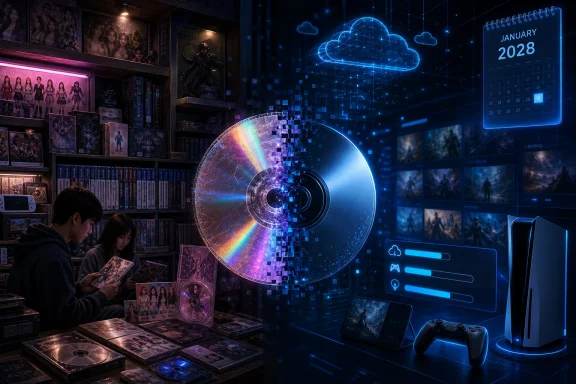
The compact disc, once treated as a relic of the pre-streaming era, is enjoying an unexpected revival in 2026. U.S. CD sales rose 16% during the first half of the year to 16.3 million units, according to Luminate’s midyear data, with K-pop collectors, younger buyers, and nostalgia helping drive the increase. That rebound arrives just as Sony prepares to discontinue physical discs for new PlayStation releases beginning in January 2028, creating an obvious question for the games industry: if music fans are rediscovering physical ownership, could video games eventually experience the same reversal?
Physical entertainment has rarely disappeared as quickly or cleanly as technology companies expected. Vinyl records survived CDs, CDs survived downloads, printed books survived e-readers, and Blu-ray continues to attract enthusiasts despite streaming becoming the default way to watch films and television.
Video games appear to be following a harsher trajectory. Digital storefronts do more than provide a convenient alternative to discs; they give platform holders control over distribution, pricing, licensing, updates, account access, and the secondary market.
Digital distribution changed that relationship. Consumers increasingly purchase a license tied to an account and governed by a platform agreement, while the game itself may require downloads, authentication, patches, or access to remote servers.
The PC market made this transition earlier than consoles. Boxed Windows games gradually became containers for product keys, installer clients, and download codes, while Steam demonstrated that users would accept digital libraries if the service offered convenience, deep discounts, cloud saves, automatic updates, and long-term continuity.
This distinction matters. Sony is not remotely disabling existing PlayStation discs or making every current disc drive useless on a specific date, but it is closing the door on new physical releases within its ecosystem.
The announcement also indicates where Sony expects the next PlayStation generation to go. An all-digital PlayStation 6 has not been formally confirmed merely by ending new disc production, but the decision makes a permanently digital future significantly easier to anticipate.
Instead, CDs are finding a new purpose alongside streaming. They are becoming collectible merchandise, affordable memorabilia, fan-club artifacts, display pieces, and direct expressions of support for artists.
A dedicated fan may therefore buy several copies of the same album. The tracks are important, but the physical package, rarity, artist connection, and completion of a collection can matter just as much.
This model helped lift total U.S. CD sales by 16% during the first six months of 2026. Even after removing K-pop releases, however, the market reportedly remained 6.7% higher than in the equivalent period of 2025, suggesting that the growth is broader than one unusually powerful fandom.
That behavior demonstrates that physical media no longer needs to be the primary delivery mechanism to remain commercially attractive. A disc can function as both media and merchandise, or even primarily as merchandise.
For games, this creates an opportunity—but also a warning. Collectibility can sustain premium products and limited editions, but it may not generate enough volume to preserve physical distribution as a universal retail system.
A modern game disc may be far less self-sufficient. It can contain a launch build, an incomplete portion of the game, or little more than installation data that must be supplemented by a substantial download.
Multiplayer games also depend on authentication systems, matchmaking infrastructure, anti-cheat services, seasonal content, and publisher-controlled servers. A disc cannot preserve those functions by itself.
The disc may preserve version 1.0 while the product that players recognize several years later is effectively version 8.4. In extreme cases, the launch build may contain serious technical problems or lack major promised features.
This does not make physical games meaningless. It does mean that their preservation value depends on what is actually stored on the disc and whether the software can operate without remote infrastructure.
As a result, physical ownership does not eliminate storage requirements. Players still need SSD space, and they may still face lengthy installations and updates before playing.
The disc primarily acts as a distribution source and license token. That is useful, particularly for resale and offline installation, but it weakens the intuitive argument that physical copies provide an entirely independent experience.
A digital unit can be delivered repeatedly without pressing another disc or shipping another box. Bandwidth and infrastructure still cost money, but the incremental expense of fulfilling one additional download is generally much lower than producing and transporting one more physical copy.
Electronic Arts’ recent financial reporting illustrates the direction of travel. Its full-game digital revenue has continued to rise while packaged-goods revenue has declined, and the company explicitly recognizes the higher margin associated with digital distribution.
This gives the company enormous commercial leverage. It can determine promotional visibility, sale timing, payment systems, regional availability, and the rules under which customers retain access.
The customer gains convenience but loses competitive shopping options. Once physical retail disappears, there is no equivalent of checking several stores for a lower new-copy price or buying a used copy from another player.
Digital licensing prevents that transfer unless the platform deliberately creates a resale mechanism. No major console ecosystem currently offers a broad, consumer-controlled marketplace for reselling standard digital game licenses.
From an executive perspective, eliminating discs therefore does more than reduce manufacturing costs. It removes a competing ownership model that allows value to circulate outside the platform’s storefront.
That spending was down 11% from 2024. The decline was less severe than the previous year’s 28% drop, but an improving rate of contraction is not the same as growth.
That ratio helps explain why Sony was willing to absorb the public backlash surrounding its 2028 announcement. If only a shrinking minority buys discs, the company may conclude that maintaining the entire production and distribution pipeline no longer produces an acceptable return.
The calculation will not feel fair to every customer. A minority can still represent millions of people, particularly on a platform as large as PlayStation, but corporations generally optimize around revenue, margins, and projected behavior rather than the emotional importance of a format.
Nintendo’s audience also has a distinctive relationship with physical games. Cartridges are portable, easy to lend, often retain resale value, and appeal to families that prefer giving a tangible product as a gift.
The future is therefore unlikely to be uniform. PlayStation may become digital-only while Nintendo preserves physical releases longer, and specialist publishers may continue serving collectors through cartridges, archival packages, or platform-independent merchandise.
PC gamers accepted this transition because digital platforms eventually delivered substantial benefits. However, the market also reveals the risks of allowing a handful of storefronts and launchers to mediate access to nearly every purchase.
The platform also earned trust through longevity. A Windows game purchased many years ago will often remain visible in the user’s library even if it is no longer available for new customers to buy.
Sony cannot assume that customers will accept an all-digital PlayStation simply because PC users accepted Steam. It must provide comparable confidence, pricing flexibility, preservation policies, and account portability.
Console users operate inside a more controlled market. A digital-only PlayStation owner cannot install a competing general-purpose store or purchase an Xbox license and run it locally.
That makes console digitization fundamentally different. The hardware vendor controls the device, operating system, certification process, storefront, payment channel, and account framework.
This model is not practical for every release, especially competitive multiplayer games, but it proves that companies can combine digital convenience with meaningful customer control. Sony, Microsoft, and Nintendo could adopt stronger offline guarantees even if they stop manufacturing physical media.
Physical games do not solve every problem. A damaged disc can fail, online-only software can shut down, and incomplete retail builds may become unusable without downloads.
Nevertheless, a functional disc can provide an additional route to installation and authentication that does not depend entirely on storefront availability. Removing that route concentrates risk in the platform account.
Collectors increasingly examine whether a game is complete on disc before purchasing it. That scrutiny will grow as physical releases become rarer and more expensive.
A box containing a download code may satisfy merchandising goals, but it does not preserve software. Once the code is redeemed or the associated server disappears, the package becomes a display object.
The end of physical publishing could make acquisition even more difficult. Preservation organizations may receive no stable retail build, no offline installer, and no transferable artifact that can be cataloged through conventional processes.
This is why game preservation cannot rely on collectors alone. Publishers and platform holders need formal archival programs, while lawmakers may eventually need to clarify exemptions for maintaining abandoned software.
Games already use this approach, but frequently in an unsatisfying way. Collector’s editions may include statues, maps, art books, steel cases, soundtrack codes, and other extras while omitting the physical game itself.
Publishers could also sell numbered print runs, alternate cover art, developer notes, soundtrack CDs, behind-the-scenes books, or replica props. These additions would make the product attractive without pretending that a bare plastic case can compete with instant downloads on convenience alone.
The challenge is pricing. Collectors may pay $100 or more for a carefully designed edition, but the mainstream customer may not accept a large premium merely to preserve resale rights.
That approach could raise revenue, but it could also become exploitative. Games already rely heavily on scarcity, fear of missing out, loot-box psychology, premium currencies, and limited-time products.
Physical collecting should not become another system designed to pressure vulnerable players into completing artificial sets. Transparency about print quantities, included content, and future availability would be essential.
This would reduce the risk of manufacturing discs containing unfinished software. It would also give collectors a product with genuine archival value rather than a launch-day build destined to require a massive update.
The problem is not that digital delivery lacks advantages. The problem is that an entirely digital market can withdraw alternatives without replacing the consumer protections that physical competition provided.
A closed digital storefront faces fewer pressures. The platform may hold sales, but the customer cannot choose a competing store for the same console license.
Digital games can remain at full list price long after physical copies have been discounted. Once discs disappear, customers become more dependent on the platform holder’s promotional calendar.
Resale is even more difficult. The platform would need to create a secure license-transfer market and decide whether the publisher, previous owner, and platform should share the transaction value.
Companies have little incentive to build such a system while customers continue buying non-transferable licenses. Regulatory pressure or a major competitive move may be necessary before digital resale becomes realistic.
Physical installation can reduce the initial download, although patches often remain necessary. Removing discs may therefore affect rural users, military personnel, travelers, and customers in regions where broadband infrastructure is expensive or unreliable.
Without new discs entering circulation, the used market gradually becomes an archive of older platforms. Prices for desirable titles may rise, while common games lose relevance as compatible hardware ages.
Retailers will respond by expanding into collectibles, cards, retro hardware, repairs, accessories, and events. In effect, they may follow the same fandom economy that is helping physical music survive.
Digital storefronts replace that visibility with algorithmic placement and paid promotion. Smaller publishers may save manufacturing costs but find themselves competing in an overcrowded interface where only a limited number of products receive prominent exposure.
This shift can strengthen the biggest franchises. Established brands can drive customers directly to a store page, while lesser-known games become increasingly dependent on platform featuring, influencers, social media, and recommendation algorithms.
The trade-off is lost backward compatibility with disc libraries. A future PlayStation could theoretically support an external drive for older games, but Sony would need to maintain the necessary hardware interface, firmware, authentication, and licensing support.
If no compatible drive exists, customers with large physical libraries may have to keep aging consoles connected indefinitely. That would turn backward compatibility from a durable platform feature into a hardware preservation problem.
However, cartridges cost more to manufacture than optical discs, and increasingly large games can exceed practical storage capacities. Publishers may respond with partial downloads, code-in-box releases, or game-key products that preserve the appearance of physical retail without delivering a complete copy.
Nintendo can benefit from Sony’s decision only if its own physical products retain meaningful functionality. A plastic card that merely authorizes a download will not satisfy preservation-focused buyers.
Even so, Sony’s announcement creates room for Microsoft to offer optional physical publishing or external-drive compatibility as a differentiator. Such a move would conflict with Microsoft’s broader service strategy, but it could rebuild trust among players who feel increasingly marginalized by both major console platforms.
The more likely outcome is selective support rather than a full physical revival. Microsoft could authorize limited runs for major games, anniversary editions, or preservation-focused releases while keeping ordinary distribution digital.
If platform holders permit it, these publishers could become the boutique labels of gaming. They would not restore mass-market disc sales, but they could preserve a curated selection of culturally significant or commercially promising releases.
Sony’s January 2028 policy appears to prevent new PlayStation disc releases altogether, which would close that route on its platform. Other hardware makers could choose a more flexible licensing approach.
Regulators could require clearer language distinguishing ownership from licensing. They could also examine minimum support periods, access after storefront closures, offline functionality, interoperability, and the right of libraries or researchers to preserve discontinued software.
Legislation will move slowly compared with platform strategy. By the time comprehensive protections arrive, physical distribution may already have vanished from much of the market.
Such a system might include transferable licenses, downloadable offline installers, clearly defined end-of-service plans, local network backups, long-term authentication keys, and complete archival editions. Platform holders already possess the technical ability to implement many of these features; the obstacle is largely commercial incentive.
The CD revival does not prove that physical games are about to return. It proves something more limited but still important: people continue to value tangible ownership even after streaming becomes dominant, and younger consumers are not inherently opposed to physical media simply because they grew up with digital services.
Physical games are therefore unlikely to regain their former position as the default way to buy software, but they do not have to disappear entirely. They could survive as premium collectibles, complete archival editions, enthusiast releases, and a competitive counterweight to closed digital stores—provided platform holders allow that market to exist.
Sony appears willing to conclude that the benefits of ending new PlayStation discs outweigh the anger of collectors, rural users, preservation advocates, retailers, and players who rely on resale. Whether that judgment proves correct will depend less on how loudly customers protest in 2026 than on what they buy, which platforms they choose, and whether competitors offer a credible alternative before January 2028.
The future of physical games will not look like the shelves of the PlayStation 2 era, just as the modern CD market does not recreate the record-store economy of 1999. Yet the resurgence of compact discs shows that supposedly obsolete formats can acquire new value when they provide identity, permanence, collectibility, and a sense of connection that streaming cannot reproduce. If game publishers learn that lesson, physical gaming may not stage a mass-market comeback—but it could evolve into a smaller, stronger, and more purposeful form of ownership that remains relevant long after discs stop being the industry default.
 Background
Physical entertainment has rarely disappeared as quickly or cleanly as technology companies expected. Vinyl records survived CDs, CDs survived downloads, printed books survived e-readers, and Blu-ray continues to attract enthusiasts despite streaming becoming the default way to watch films and television.Video games appear to be following a harsher trajectory. Digital storefronts do more than provide a convenient alternative to discs; they give platform holders control over distribution, pricing, licensing, updates, account access, and the secondary market.
From cartridges and discs to account-bound licenses
For decades, buying a console game meant acquiring a cartridge or optical disc that could usually be played, loaned, traded, or resold without asking the publisher for permission. The physical object provided a practical sense of ownership, even though copyright law always placed limits on what the buyer could reproduce or distribute.Digital distribution changed that relationship. Consumers increasingly purchase a license tied to an account and governed by a platform agreement, while the game itself may require downloads, authentication, patches, or access to remote servers.
The PC market made this transition earlier than consoles. Boxed Windows games gradually became containers for product keys, installer clients, and download codes, while Steam demonstrated that users would accept digital libraries if the service offered convenience, deep discounts, cloud saves, automatic updates, and long-term continuity.
Sony’s January 2028 cutoff
Sony Interactive Entertainment announced that physical disc production for new PlayStation games will end in January 2028. Existing disc games will remain supported, and publishers may continue ordering copies of previously released titles, but games entering the PlayStation catalog after the cutoff will not receive conventional disc releases.This distinction matters. Sony is not remotely disabling existing PlayStation discs or making every current disc drive useless on a specific date, but it is closing the door on new physical releases within its ecosystem.
The announcement also indicates where Sony expects the next PlayStation generation to go. An all-digital PlayStation 6 has not been formally confirmed merely by ending new disc production, but the decision makes a permanently digital future significantly easier to anticipate.
Why CDs Are Growing Again
The CD revival is real, but it should not be mistaken for a return to the mass-market conditions of the 1990s or early 2000s. Streaming still dominates music consumption, and most listeners will not abandon subscription services for shelves filled with jewel cases.Instead, CDs are finding a new purpose alongside streaming. They are becoming collectible merchandise, affordable memorabilia, fan-club artifacts, display pieces, and direct expressions of support for artists.
K-pop turned albums into collectible packages
K-pop releases have been particularly effective at transforming the album from a music container into a broader fan product. Multiple editions may feature different artwork, photo books, cards, posters, packaging, or other randomized and exclusive items.A dedicated fan may therefore buy several copies of the same album. The tracks are important, but the physical package, rarity, artist connection, and completion of a collection can matter just as much.
This model helped lift total U.S. CD sales by 16% during the first six months of 2026. Even after removing K-pop releases, however, the market reportedly remained 6.7% higher than in the equivalent period of 2025, suggesting that the growth is broader than one unusually powerful fandom.
Ownership without playback
The most revealing statistic may be that roughly half of the Gen Z and Millennial consumers buying CDs do not own a CD player. These customers can stream the same music immediately, yet they still value a physical representation of it.That behavior demonstrates that physical media no longer needs to be the primary delivery mechanism to remain commercially attractive. A disc can function as both media and merchandise, or even primarily as merchandise.
For games, this creates an opportunity—but also a warning. Collectibility can sustain premium products and limited editions, but it may not generate enough volume to preserve physical distribution as a universal retail system.
Why Games Are Not Music
A music CD and a modern game disc may look similar, but they occupy very different technical and commercial roles. Assuming that rising CD sales automatically predict a physical gaming comeback ignores the way modern games are built, distributed, updated, and monetized.A CD usually contains a finished album
A conventional audio CD generally includes the complete recording in a standardized, directly readable format. It does not need a day-one patch, an online account, a 100GB installation, or a server-side entitlement check before the listener can hear the first track.A modern game disc may be far less self-sufficient. It can contain a launch build, an incomplete portion of the game, or little more than installation data that must be supplemented by a substantial download.
Multiplayer games also depend on authentication systems, matchmaking infrastructure, anti-cheat services, seasonal content, and publisher-controlled servers. A disc cannot preserve those functions by itself.
Games are software products under continuous development
Music recordings are typically static after release. Games increasingly operate as evolving services that receive balance changes, new modes, downloadable expansions, security fixes, compatibility updates, and rotating content.The disc may preserve version 1.0 while the product that players recognize several years later is effectively version 8.4. In extreme cases, the launch build may contain serious technical problems or lack major promised features.
This does not make physical games meaningless. It does mean that their preservation value depends on what is actually stored on the disc and whether the software can operate without remote infrastructure.
Installation is now standard
Console discs are no longer used like older cartridges, where the system ran most software directly from the physical medium. Modern consoles normally copy game data to internal storage because optical drives cannot deliver assets quickly enough for contemporary game engines.As a result, physical ownership does not eliminate storage requirements. Players still need SSD space, and they may still face lengthy installations and updates before playing.
The disc primarily acts as a distribution source and license token. That is useful, particularly for resale and offline installation, but it weakens the intuitive argument that physical copies provide an entirely independent experience.
The Economics Favor Digital Distribution
Sony’s decision is controversial, but its financial logic is straightforward. Digital sales remove several costs while giving the platform holder a stronger position in every transaction.Manufacturing and retail costs disappear
Physical distribution requires disc replication, packaging, freight, warehousing, inventory planning, retailer margins, and management of unsold stock. Publishers also face the risk of manufacturing too many copies of an underperforming game or too few copies of an unexpected hit.A digital unit can be delivered repeatedly without pressing another disc or shipping another box. Bandwidth and infrastructure still cost money, but the incremental expense of fulfilling one additional download is generally much lower than producing and transporting one more physical copy.
Electronic Arts’ recent financial reporting illustrates the direction of travel. Its full-game digital revenue has continued to rise while packaged-goods revenue has declined, and the company explicitly recognizes the higher margin associated with digital distribution.
Platform holders become the only checkout counter
A PlayStation disc can be sold by multiple retailers and later resold by its owner. A digital PlayStation license is normally purchased through Sony’s storefront, where Sony controls the transaction and receives its platform share.This gives the company enormous commercial leverage. It can determine promotional visibility, sale timing, payment systems, regional availability, and the rules under which customers retain access.
The customer gains convenience but loses competitive shopping options. Once physical retail disappears, there is no equivalent of checking several stores for a lower new-copy price or buying a used copy from another player.
Used games generate no publisher revenue
The resale market allows one disc to serve multiple owners over its lifetime. That benefits consumers and retailers, but the publisher and platform holder generally receive revenue only from the original sale.Digital licensing prevents that transfer unless the platform deliberately creates a resale mechanism. No major console ecosystem currently offers a broad, consumer-controlled marketplace for reselling standard digital game licenses.
From an executive perspective, eliminating discs therefore does more than reduce manufacturing costs. It removes a competing ownership model that allows value to circulate outside the platform’s storefront.
The State of Physical Game Sales
The U.S. market provides little evidence of a mass physical-game rebound. New physical video game spending fell to approximately $1.5 billion in 2025, the lowest level in Circana’s tracked history, which stretches back to 1995.That spending was down 11% from 2024. The decline was less severe than the previous year’s 28% drop, but an improving rate of contraction is not the same as growth.
Digital is already the default
Sony has reported that digital downloads account for the large majority of full-game purchases on PlayStation. The exact percentage changes from quarter to quarter, but recent figures have placed the digital share at roughly 85%.That ratio helps explain why Sony was willing to absorb the public backlash surrounding its 2028 announcement. If only a shrinking minority buys discs, the company may conclude that maintaining the entire production and distribution pipeline no longer produces an acceptable return.
The calculation will not feel fair to every customer. A minority can still represent millions of people, particularly on a platform as large as PlayStation, but corporations generally optimize around revenue, margins, and projected behavior rather than the emotional importance of a format.
The decline is uneven
Physical demand remains stronger in some genres, regions, and communities. Major single-player releases, family games, role-playing games, horror titles, and prestige collector products can attract buyers who want permanent shelf copies.Nintendo’s audience also has a distinctive relationship with physical games. Cartridges are portable, easy to lend, often retain resale value, and appeal to families that prefer giving a tangible product as a gift.
The future is therefore unlikely to be uniform. PlayStation may become digital-only while Nintendo preserves physical releases longer, and specialist publishers may continue serving collectors through cartridges, archival packages, or platform-independent merchandise.
The Windows PC Market Shows What Comes Next
Windows gaming offers the clearest preview of a post-disc console market. Optical drives have disappeared from most gaming laptops and many desktop builds, while major PC releases rarely receive functional retail discs.PC gamers accepted this transition because digital platforms eventually delivered substantial benefits. However, the market also reveals the risks of allowing a handful of storefronts and launchers to mediate access to nearly every purchase.
Steam replaced the box with a service
Steam succeeded because it offered more than a download button. Valve built a persistent library, automatic patching, cloud synchronization, community tools, workshop support, regional pricing, refunds, gifting, family features, and frequent promotions.The platform also earned trust through longevity. A Windows game purchased many years ago will often remain visible in the user’s library even if it is no longer available for new customers to buy.
Sony cannot assume that customers will accept an all-digital PlayStation simply because PC users accepted Steam. It must provide comparable confidence, pricing flexibility, preservation policies, and account portability.
PC still has storefront competition
Windows users can buy games from Steam, GOG, Epic Games Store, Microsoft, publisher-operated stores, authorized key sellers, subscription services, and direct developer channels. Not every option is equally attractive, but the existence of alternatives creates some competitive pressure.Console users operate inside a more controlled market. A digital-only PlayStation owner cannot install a competing general-purpose store or purchase an Xbox license and run it locally.
That makes console digitization fundamentally different. The hardware vendor controls the device, operating system, certification process, storefront, payment channel, and account framework.
GOG demonstrates an alternative model
GOG has shown that digital distribution does not inherently require strict platform dependency. Many of its Windows games are offered without conventional digital rights management and can be backed up using offline installers.This model is not practical for every release, especially competitive multiplayer games, but it proves that companies can combine digital convenience with meaningful customer control. Sony, Microsoft, and Nintendo could adopt stronger offline guarantees even if they stop manufacturing physical media.
Ownership, Licensing, and Preservation
The debate over game discs is often framed as nostalgia versus convenience, but the deeper dispute concerns control. Consumers want confidence that a purchase will remain usable, while publishers want flexibility to manage services, licenses, and infrastructure.A purchase can still depend on permission
Digital storefronts commonly use the language of buying and owning, even when the legal arrangement is a revocable license. In normal circumstances, most customers can access their libraries without difficulty, but the limitations become visible when a game is delisted, an account is suspended, a service closes, or a licensing agreement expires.Physical games do not solve every problem. A damaged disc can fail, online-only software can shut down, and incomplete retail builds may become unusable without downloads.
Nevertheless, a functional disc can provide an additional route to installation and authentication that does not depend entirely on storefront availability. Removing that route concentrates risk in the platform account.
Preservation requires complete builds
A valuable physical release should contain a playable version of the game, not merely a key or partial installer. Publishers can strengthen preservation by waiting for major updates before pressing complete editions or by shipping later “game of the year” versions with patches and expansions included.Collectors increasingly examine whether a game is complete on disc before purchasing it. That scrutiny will grow as physical releases become rarer and more expensive.
A box containing a download code may satisfy merchandising goals, but it does not preserve software. Once the code is redeemed or the associated server disappears, the package becomes a display object.
Institutions face legal and technical barriers
Museums, libraries, historians, and researchers cannot preserve online-dependent games as easily as books, films, or recordings. They may need server code, account systems, proprietary development tools, and legal permission to bypass discontinued authentication mechanisms.The end of physical publishing could make acquisition even more difficult. Preservation organizations may receive no stable retail build, no offline installer, and no transferable artifact that can be cataloged through conventional processes.
This is why game preservation cannot rely on collectors alone. Publishers and platform holders need formal archival programs, while lawmakers may eventually need to clarify exemptions for maintaining abandoned software.
Could Games Copy the K-pop Model?
The music industry’s physical revival offers one particularly relevant lesson: the product does not have to compete directly with streaming. It can complement digital access by becoming a premium collectible.Games already use this approach, but frequently in an unsatisfying way. Collector’s editions may include statues, maps, art books, steel cases, soundtrack codes, and other extras while omitting the physical game itself.
The disc as a collectible entitlement
A future physical game could include both a playable archival build and a digital license. The buyer would gain immediate download convenience while retaining a tangible backup, display item, and transferable object.Publishers could also sell numbered print runs, alternate cover art, developer notes, soundtrack CDs, behind-the-scenes books, or replica props. These additions would make the product attractive without pretending that a bare plastic case can compete with instant downloads on convenience alone.
The challenge is pricing. Collectors may pay $100 or more for a carefully designed edition, but the mainstream customer may not accept a large premium merely to preserve resale rights.
Multiple versions carry risks
K-pop’s multiple-edition strategy encourages enthusiastic fans to buy several copies. Game publishers could imitate that behavior through variant covers, retailer exclusives, character-themed packages, or randomized inserts.That approach could raise revenue, but it could also become exploitative. Games already rely heavily on scarcity, fear of missing out, loot-box psychology, premium currencies, and limited-time products.
Physical collecting should not become another system designed to pressure vulnerable players into completing artificial sets. Transparency about print quantities, included content, and future availability would be essential.
Complete editions may be the strongest opportunity
Instead of pressing every game at launch, publishers could release premium physical editions after development stabilizes. A final package might contain the base game, expansions, major patches, documentary material, and a digital soundtrack.This would reduce the risk of manufacturing discs containing unfinished software. It would also give collectors a product with genuine archival value rather than a launch-day build destined to require a massive update.
Consumer Impact
For many players, digital purchasing is genuinely better. It eliminates disc swapping, enables remote installation, reduces household clutter, and makes a library accessible from any compatible console after signing in.The problem is not that digital delivery lacks advantages. The problem is that an entirely digital market can withdraw alternatives without replacing the consumer protections that physical competition provided.
Prices may become less competitive
Retailers discount physical inventory to clear shelf space and recover capital. Used copies create additional competition, while customers can compare stores, trade games, and borrow from friends.A closed digital storefront faces fewer pressures. The platform may hold sales, but the customer cannot choose a competing store for the same console license.
Digital games can remain at full list price long after physical copies have been discounted. Once discs disappear, customers become more dependent on the platform holder’s promotional calendar.
Lending and resale become policy decisions
A physical disc can usually be handed to a friend with no technical process. Digital lending requires platform-supported family systems, and those systems may impose household, device, geographic, or time restrictions.Resale is even more difficult. The platform would need to create a secure license-transfer market and decide whether the publisher, previous owner, and platform should share the transaction value.
Companies have little incentive to build such a system while customers continue buying non-transferable licenses. Regulatory pressure or a major competitive move may be necessary before digital resale becomes realistic.
Connectivity and data caps still matter
Large downloads create friction for households with slow broadband, limited monthly data, unstable connections, or multiple users competing for bandwidth. A 100GB game can take hours or days to retrieve under poor conditions.Physical installation can reduce the initial download, although patches often remain necessary. Removing discs may therefore affect rural users, military personnel, travelers, and customers in regions where broadband infrastructure is expensive or unreliable.
Retail and Industry Consequences
The decline of discs affects more than collectors. It changes the economics of game retailers, logistics providers, rental services, charities, libraries, and independent stores.Retailers lose a reason for customer visits
GameStop’s leadership has argued that physical software now represents a relatively small portion of its overall business. That diversification may protect the company, but smaller independent stores often rely more heavily on used games and trade-ins.Without new discs entering circulation, the used market gradually becomes an archive of older platforms. Prices for desirable titles may rise, while common games lose relevance as compatible hardware ages.
Retailers will respond by expanding into collectibles, cards, retro hardware, repairs, accessories, and events. In effect, they may follow the same fandom economy that is helping physical music survive.
Publishers gain efficiency but lose visibility
A physical box on a retail shelf is also an advertisement. It can attract gift buyers, parents, casual customers, and people who were not already searching for the game online.Digital storefronts replace that visibility with algorithmic placement and paid promotion. Smaller publishers may save manufacturing costs but find themselves competing in an overcrowded interface where only a limited number of products receive prominent exposure.
This shift can strengthen the biggest franchises. Established brands can drive customers directly to a store page, while lesser-known games become increasingly dependent on platform featuring, influencers, social media, and recommendation algorithms.
Hardware design will change
Once new disc production ends, optical drives become harder to justify in future consoles. Removing the drive can reduce manufacturing cost, physical size, power requirements, mechanical failure points, and design complexity.The trade-off is lost backward compatibility with disc libraries. A future PlayStation could theoretically support an external drive for older games, but Sony would need to maintain the necessary hardware interface, firmware, authentication, and licensing support.
If no compatible drive exists, customers with large physical libraries may have to keep aging consoles connected indefinitely. That would turn backward compatibility from a durable platform feature into a hardware preservation problem.
Competitive Implications
Sony’s move gives rivals a chance to distinguish themselves, although market economics may lead all major console makers toward the same destination.Nintendo has the clearest opening
Nintendo can position physical cartridges as a consumer-friendly advantage, particularly for families, gift buyers, collectors, and players concerned about resale. Its franchises also tend to retain value longer than many competing releases.However, cartridges cost more to manufacture than optical discs, and increasingly large games can exceed practical storage capacities. Publishers may respond with partial downloads, code-in-box releases, or game-key products that preserve the appearance of physical retail without delivering a complete copy.
Nintendo can benefit from Sony’s decision only if its own physical products retain meaningful functionality. A plastic card that merely authorizes a download will not satisfy preservation-focused buyers.
Xbox could reconsider its direction
Microsoft has spent years emphasizing Game Pass, cloud access, cross-device libraries, and digital distribution. Many Xbox titles already sell overwhelmingly through digital channels, while physical retail support has weakened.Even so, Sony’s announcement creates room for Microsoft to offer optional physical publishing or external-drive compatibility as a differentiator. Such a move would conflict with Microsoft’s broader service strategy, but it could rebuild trust among players who feel increasingly marginalized by both major console platforms.
The more likely outcome is selective support rather than a full physical revival. Microsoft could authorize limited runs for major games, anniversary editions, or preservation-focused releases while keeping ordinary distribution digital.
Specialist publishers may fill the gap
Limited-print companies already serve collectors by producing physical editions of games that would otherwise remain download-only. Their business model works because enthusiasts accept preorders, longer waits, and higher prices.If platform holders permit it, these publishers could become the boutique labels of gaming. They would not restore mass-market disc sales, but they could preserve a curated selection of culturally significant or commercially promising releases.
Sony’s January 2028 policy appears to prevent new PlayStation disc releases altogether, which would close that route on its platform. Other hardware makers could choose a more flexible licensing approach.
Strengths and Opportunities
A physical-game comeback is unlikely to restore the old retail model, but a smaller premium market could remain commercially and culturally valuable.- Collector editions can turn games into durable fan objects. High-quality packaging, artwork, manuals, maps, soundtracks, and complete software builds can justify physical ownership alongside digital convenience.
- Complete editions can improve preservation. Pressing games after major patches and expansions would create more useful archival versions than unstable launch builds.
- Physical products can support gifting and discovery. A boxed game remains easier to wrap, display, browse in a store, or give to someone without managing account credentials.
- Resale can make gaming more affordable. Players can recover part of a purchase price and use it to fund another game, while budget-conscious customers gain access to cheaper copies.
- Retail competition can constrain digital pricing. Even a modest physical channel gives customers an alternative when storefront prices remain high.
- Independent developers can deepen fan relationships. Carefully designed limited editions provide a premium revenue stream and a tangible connection between creators and dedicated players.
- Rival platforms can use physical support as differentiation. Nintendo, Microsoft, or future hardware makers could treat transferable media as a feature rather than an obsolete burden.
Risks and Concerns
The CD comparison also highlights the limits of a collector-led revival. A format can grow rapidly from a small base without becoming a mainstream distribution system again.- Collectors cannot necessarily sustain mass production. A niche audience may support limited editions but not the manufacturing volume required for every game to receive a retail release.
- Physical packages may contain no usable software. Code-in-box products and incomplete discs provide little protection against store closures or server shutdowns.
- Premium pricing could exclude ordinary players. If physical ownership becomes a luxury product, preservation and resale rights may effectively become privileges for wealthier consumers.
- Artificial scarcity can encourage speculation. Limited print runs may attract resellers who buy inventory primarily to raise secondary-market prices.
- Environmental costs remain relevant. Plastic cases, freight, unsold stock, and manufacturing create material waste, although digital infrastructure and large-scale data delivery also have environmental costs.
- Disc ownership does not preserve online services. Multiplayer servers, licensed content, authentication systems, and cloud-dependent features can disappear regardless of what sits on a shelf.
- Platform fragmentation could worsen. Different rules for discs, cartridges, external drives, digital licenses, and backward compatibility may leave consumers uncertain about what they actually own.
- A digital monopoly can weaken consumer choice. Once physical competition disappears, platform holders gain greater control over pricing, access, refunds, visibility, and license conditions.
What to Watch Next
The decisive developments will occur before Sony’s January 2028 cutoff. Publishers, retailers, regulators, collectors, and rival platform holders now have time to respond, although Sony is unlikely to reverse course without evidence that the policy will materially damage its business.Five signals will reveal the direction
- Sony’s PlayStation 6 hardware strategy will show whether disc compatibility survives. An external optical drive or backward-compatible accessory would soften the transition, while fully drive-free hardware would make the break more permanent.
- Nintendo’s physical policies will test whether cartridges remain commercially viable. Complete games on cartridges would strengthen Nintendo’s differentiation, while widespread download-dependent products would suggest the entire console industry is converging on digital licensing.
- Microsoft’s response will indicate whether ownership can become a competitive feature. Optional physical releases, transferable licenses, or robust offline installation could appeal to dissatisfied PlayStation customers.
- Digital consumer protections will become more important. Longer refund windows, price competition, family sharing, offline authentication, account inheritance, and license-transfer mechanisms could reduce the disadvantages of losing discs.
- Collector demand will determine whether boutique physical publishing grows. Strong sales of complete editions and premium releases could preserve physical gaming as a specialist category even after mainstream retail declines.
Regulators may enter the discussion
Governments have already shown increasing interest in digital markets, platform control, subscription cancellation, online purchases, and the preservation of games that depend on remote services. The disappearance of transferable physical products may intensify questions about whether digital goods are described fairly to consumers.Regulators could require clearer language distinguishing ownership from licensing. They could also examine minimum support periods, access after storefront closures, offline functionality, interoperability, and the right of libraries or researchers to preserve discontinued software.
Legislation will move slowly compared with platform strategy. By the time comprehensive protections arrive, physical distribution may already have vanished from much of the market.
The strongest answer may be hybrid ownership
The industry does not have to choose between 1990s-style disc retail and permanently account-bound downloads. A hybrid system could provide digital convenience while restoring some of the rights associated with physical ownership.Such a system might include transferable licenses, downloadable offline installers, clearly defined end-of-service plans, local network backups, long-term authentication keys, and complete archival editions. Platform holders already possess the technical ability to implement many of these features; the obstacle is largely commercial incentive.
The CD revival does not prove that physical games are about to return. It proves something more limited but still important: people continue to value tangible ownership even after streaming becomes dominant, and younger consumers are not inherently opposed to physical media simply because they grew up with digital services.
Physical games are therefore unlikely to regain their former position as the default way to buy software, but they do not have to disappear entirely. They could survive as premium collectibles, complete archival editions, enthusiast releases, and a competitive counterweight to closed digital stores—provided platform holders allow that market to exist.
Sony appears willing to conclude that the benefits of ending new PlayStation discs outweigh the anger of collectors, rural users, preservation advocates, retailers, and players who rely on resale. Whether that judgment proves correct will depend less on how loudly customers protest in 2026 than on what they buy, which platforms they choose, and whether competitors offer a credible alternative before January 2028.
The future of physical games will not look like the shelves of the PlayStation 2 era, just as the modern CD market does not recreate the record-store economy of 1999. Yet the resurgence of compact discs shows that supposedly obsolete formats can acquire new value when they provide identity, permanence, collectibility, and a sense of connection that streaming cannot reproduce. If game publishers learn that lesson, physical gaming may not stage a mass-market comeback—but it could evolve into a smaller, stronger, and more purposeful form of ownership that remains relevant long after discs stop being the industry default.
References
- Primary source: Operation Sports
Published: 2026-07-20T15:30:00+00:00
Music CDs Are Making a Comeback. Are Physical Games Next? - Operation Sports
Gamers have an opportunity here. www.operationsports.com
- Related coverage: gamesradar.com
As PlayStation declares nobody wants physical discs anymore, Gen Z is helping fuel a 16% surge in US music CD sales | GamesRadar+
It's been "a much-discussed physical-media pivot"www.gamesradar.com - Related coverage: techradar.com
'God of War Laufey will be available on disc' — Sony Santa Monica may have hinted at the game's release window with physical announcement | TechRadar
Following PlayStation's announcement that it will retire physical game discs, Sony Santa Monica has confirmed that God of War Laufey will be available on disc.www.techradar.com - Related coverage: tomshardware.com
GameStop CEO says Sony's decision to go disc-less is 'totally irrelevant' — claims software, including physical discs, accounts for only 12% of the company's business | Tom's Hardware
Software revenue fell by 27% in one yearwww.tomshardware.com
