

Sony’s PlayStation 6, once widely anticipated for 2027, may not arrive until 2028 or even 2029 as Sony weighs a global memory shortage, rising component costs, AI-driven demand, and the risk of launching next-generation hardware at a price mainstream console buyers will reject. The delay remains reported rather than confirmed, but the underlying supply problem is real enough for Sony to discuss publicly. What looks like a one-year scheduling slip is therefore better understood as a test of whether the traditional console business can survive the economics of the AI hardware boom. The PS6’s defining feature may not be its performance, but the compromises Sony makes to keep it affordable.
Geeky Gadgets, introducing a ZONEofTECH video, frames 2028 or 2029 as the new possible launch window after an earlier expectation of 2027. That account is broadly consistent with subsequent reporting that Sony is considering a later debut, but Sony itself has not announced a PS6 release date, price, specification, or product lineup.
The distinction matters. A delayed PS6 is plausible; a confirmed 2028 launch is not. The most defensible conclusion is that Sony has gained a powerful financial reason to extend the PS5 generation—and very little reason to commit publicly until the memory market becomes predictable.
Sony’s familiar console rhythm made 2027 look like the obvious target. A seven-year cycle would place the next PlayStation neatly after the current generation, preserving the industry’s long-standing expectation that new hardware arrives on something resembling a calendar.
Geeky Gadgets says the PS6 was originally anticipated in 2027 but could now slip into 2028 or 2029. A 2028 release would stretch the expected cycle by a year; a 2029 launch would extend it by two. That would not merely move a product launch—it would change how publishers, accessory makers, retailers, and consumers plan the end of the PS5 era.
Console cycles, however, are not laws of physics. They are business patterns that hold only when manufacturing costs, software readiness, consumer demand, and competitive timing align. Sony has little incentive to replace a functioning ecosystem simply because seven years have elapsed, particularly if replacement hardware would arrive with an unattractive price or a compromised memory configuration.
Sony’s own investor communications provide the most important reality check. In its official discussion of memory shortages and future platforms, the company said no decisions had been made about next-generation timing or pricing. Sony also said it expects memory pricing to remain elevated and supply-demand conditions to remain tight through 2027, while it considers hardware costs, promotional spending, launch strategy, and possible changes to the business model.
That does not confirm the Geeky Gadgets timeline, but it explains why the timeline is credible. If supply remains constrained through the year in which the PS6 had been anticipated, Sony must either accept expensive components, reduce the hardware target, charge buyers more, subsidize the console, or wait. Of those choices, waiting may be the least damaging.
2028 — The earliest delayed launch year now discussed by Geeky Gadgets and ZONEofTECH, as well as the year Sony reportedly plans to begin phasing out disc support.
2029 — The later possible PS6 launch year presented in the delayed-release scenario if memory supply and pricing remain unfavorable.
Sony has separately acknowledged a current memory shortage driven by surging AI infrastructure demand. That official statement is more consequential than any individual PS6 leak because it confirms that PlayStation hardware planning now competes with a capital cycle far larger than the console market itself.
The source wording should nevertheless be treated carefully. Geeky Gadgets specifically refers to high-bandwidth RAM, while Sony’s public statements discuss memory shortages and prices more broadly. Sony has not publicly confirmed the PS6 memory architecture, so the shortage should not be interpreted as proof that the console will use a particular class or configuration of memory.
The economic mechanism is more important than the technical label. Memory manufacturers prioritize the products, customers, and contracts that offer the strongest returns. AI operators and data-center builders buy at enormous scale, tolerate higher prices, and compete for production capacity years ahead of ordinary consumer demand.
A console manufacturer faces a different equation. Sony must build millions of broadly identical systems, keep them available at retail, guarantee a stable target for developers, and sell them to customers who compare the price not with a data-center accelerator but with the console already under their television. A component increase that looks manageable inside an enterprise server can destroy the value proposition of a mass-market games machine.
This is why a memory shortage can delay an entire platform rather than merely raise its bill of materials. Sony cannot casually switch configurations after launch without complicating game development and quality assurance. The hardware target must be powerful enough to remain relevant for years, but inexpensive enough to manufacture at enormous volume.
Waiting until 2028 or 2029 could improve that balance. Additional supply might come online, contracts could become more favorable, and Sony would gain time to optimize the rest of the system around whatever memory capacity it can afford. Delay would not eliminate the problem, but it could prevent a temporary market distortion from becoming a permanent architectural compromise.
At $750, the PS6 would be positioned well below the competing systems named in the report. Valve’s Steam Machine starts at $1,049, while Microsoft’s Project Helix is described as a PC-console hybrid costing more than $1,000. Microsoft has officially described Project Helix as its next-generation first-party console, built to play Xbox console and PC games, but the price cited by Geeky Gadgets remains part of the report’s market framing rather than a Sony comparison published by Microsoft.
The temptation is to call $750 affordable because it undercuts those alternatives. That is the wrong comparison for a mass-market PlayStation. Sony is not merely competing against new high-end hardware; it is competing against the PS5 already in homes, years of discounted games, subscription libraries, and the option to postpone an upgrade indefinitely.
This comparison reveals the strategic problem. Sony may be able to claim value relative to a four-figure Steam Machine or Project Helix, yet still face resistance from buyers who regard consoles as standardized, accessible appliances. A $750 machine can be cheaper than its premium rivals and expensive by PlayStation standards at the same time.
Sony has also indicated that it does not intend to sell hardware at significant losses. That makes the old console strategy—accepting a deep subsidy upfront and recovering it through software—harder to assume. Geeky Gadgets suggests Sony could still sell the PS6 at a loss and recoup money through games, subscriptions, and digital content, but Sony’s public position points toward greater caution.
The likely result is not one simple price decision but a set of compromises distributed across the product. Sony could adjust specifications, storage, accessories, industrial design, promotional spending, or the number of models offered. It could also rely more heavily on recurring revenue, where the hardware becomes the entrance fee to a long-term digital relationship rather than the primary source of profit.
Geeky Gadgets notes that analysts see considerable longevity in the PS5 generation. That matters because a successful console does not become obsolete when its successor enters development. Its useful life depends on active players, software sales, services, and publishers’ willingness to continue supporting it.
Sony’s recent financial framing emphasizes engagement and monetization of the installed base rather than hardware replacement for its own sake. Software and network services can continue producing revenue even when annual console sales slow. From that perspective, an extra year is not dead time; it is another year in which Sony can sell games, subscriptions, and digital content without funding a risky platform launch.
Developers may also benefit from a clearer target. A rushed transition can force studios to support two generations while simultaneously adapting to new architecture and performance expectations. A later PS6 would keep the PS5 as the primary baseline for longer, reducing uncertainty even if it postpones the technical ceiling.
Players would receive a mixed outcome. Those waiting for a dramatic leap would face disappointment, while current PS5 and PS5 Pro owners would see their purchases retain relevance. The most practical consequence is that buying a current-generation console becomes less risky if the successor is genuinely moving toward 2028 or 2029.
The PS5 Pro complicates that calculation. Geeky Gadgets identifies both the PS5 and PS5 Pro as current-generation systems experiencing rising prices. If the PS6 slips while today’s hardware becomes more expensive, Sony could end up extending a generation without making it more accessible.
That is the central danger in treating delay as an automatic benefit. More development time does not guarantee lower prices. If memory constraints persist, the extra years could merely normalize premium console pricing while pushing the flagship PS6 further from the mass audience that built the PlayStation brand.
None of that lineup has been formally announced by Sony under those terms. Project Canas should therefore be understood as a reported product name, not an established PlayStation brand. Even so, the strategy described makes economic sense in a market where one console can no longer satisfy every price and usage expectation.
The flagship would carry the performance narrative and compete with premium hardware. A lower-cost alternative could protect Sony’s traditional volume business by giving families and price-sensitive buyers a route into the new ecosystem. A handheld would extend PlayStation into portable use without requiring every customer to purchase the most expensive living-room system.
This would amount to a shift from the idea of a PlayStation to a family of PlayStation endpoints. Sony would still control the platform, software environment, and commercial relationship, but consumers could enter through different hardware categories.
Microsoft’s Project Helix points toward a related convergence from the Windows side. Microsoft describes it as a system designed for both Xbox console and PC games, effectively reducing the conceptual distance between a fixed console and a managed gaming PC. Valve’s Steam Machine approaches the television from the opposite direction, bringing the PC storefront and PC software model into console-like hardware.
Sony’s reported approach would preserve a more conventional console identity while dividing the market by price and mobility. That could be a stronger response than trying to match PC-console hybrids specification for specification. PlayStation’s advantage has historically been the ability to offer a predictable experience without asking customers to think like PC builders.
The lower-cost variant would be especially important if the flagship arrives near $750. A $350-to-$500 option would create a wide pricing gap, suggesting meaningful differences in capability, packaging, or both. The source material does not establish what those differences might be, and guessing would confuse strategic logic with specification leaks.
For developers, multiple devices create opportunity and complexity. A shared software foundation could expand the addressable audience, but studios would need clear performance tiers and dependable tools. Sony’s strongest version of this strategy would make scaling predictable; its weakest version would create several targets without giving developers enough control over how games behave across them.
A PS6 arriving in 2028 would therefore appear at the same moment Sony’s software business becomes more decisively digital. That alignment would reduce manufacturing and distribution costs, simplify console design choices, and direct purchases toward the PlayStation Store and digital retail channels.
For Sony, the advantages are substantial. Digital distribution removes the cost and logistics of pressing, shipping, stocking, and returning discs. It also gives the platform holder greater control over transactions while strengthening the role of accounts, subscriptions, digital libraries, and recurring engagement.
For customers, the bargain is less comfortable. Physical games can be resold, lent, collected, purchased second-hand, or retained without depending entirely on continued storefront availability. A digital-only ecosystem exchanges those properties for convenience and immediate access.
A lower console price could make that exchange easier to sell. If removing disc support helps Sony offer the reported $350-to-$500 alternative, some buyers will accept the restriction as a reasonable trade. If the flagship costs approximately $750 and still limits physical ownership, resistance will be sharper because customers will be paying more while receiving less control over the software they buy.
The timing also raises a migration question. Sony must make the transition feel like continuity rather than confiscation. Players with existing libraries will judge the PS6 not just by launch games and graphical improvements, but by how well it respects years of purchases and habits.
The source material does not establish the PS6’s compatibility policies, so no firm conclusion can be drawn. But a console launching into a digital-first era will be evaluated as an account platform from its first day. Hardware specifications may attract enthusiasts; library continuity will determine whether ordinary users feel safe upgrading.
Geeky Gadgets suggests Sony might reduce the PS6’s RAM capacity to manage costs, while relying on tighter hardware and software integration to preserve a seamless experience. That is presented as a possibility rather than a confirmed design decision, but it captures the trade-off facing every fixed platform.
A console’s advantage over a general-purpose PC is not necessarily that it contains the most expensive components. Its advantage is that developers know the target. Sony can compensate for limitations through purpose-built system design, mature development tools, predictable storage behavior, and software optimized for one hardware family.
That does not make memory capacity irrelevant. Modern games must hold increasingly complex worlds, assets, simulation data, interfaces, and system processes in a finite pool. If memory becomes the expensive constraint, developers may spend more effort on streaming, compression, asset management, and transitions between performance modes.
The result could be a PS6 designed around efficiency rather than brute-force expansion. That would fit Sony’s need to undercut four-figure competitors, but it would also make first-party engineering unusually important. Exclusive games would need to demonstrate why a tightly integrated console can produce compelling results without matching a premium hybrid component for component.
This is where the reported delay could become an advantage. Additional development time would let Sony refine tools and give studios longer to understand the final target. A technically ambitious console launched with immature software rarely feels ambitious to the person waiting through inconsistent frame rates and unfinished features.
The risk is that optimization becomes a euphemism for compromise. If Sony chooses too little memory, developers cannot manufacture capacity through good intentions. The company must avoid designing around a temporary shortage so aggressively that the PS6 carries the limitation through the rest of its life.
The Steam Machine’s $1,049 starting point makes that future tangible. It is a premium purchase even before software, peripherals, or display upgrades enter the calculation. Its appeal rests on access to the Steam ecosystem and the flexibility associated with PC gaming rather than on conventional console pricing.
Project Helix similarly embodies Microsoft’s attempt to bring Xbox console and PC games into one next-generation system. Microsoft’s official description emphasizes leading performance and a combined library, while Geeky Gadgets characterizes it as a PC-console hybrid costing more than $1,000.
Sony can respond in two ways. It can chase those systems upward, producing a premium flagship for enthusiasts, or it can define PlayStation as the disciplined alternative: capable, integrated, and less expensive. The reported $750 target suggests Sony may attempt both—moving above traditional console expectations while remaining below its premium rivals.
That middle position is strategically attractive and operationally difficult. Sony would need enough performance to prevent unfavorable comparisons with more expensive systems while preserving enough margin to avoid substantial hardware losses. Memory prices narrow that space from both sides.
The proposed affordable alternative could provide an escape route. Rather than forcing the flagship to serve every buyer, Sony could let it compete at the high end while using the $350-to-$500 model to maintain scale. Project Canas could then address customers whose priority is portability rather than maximum living-room performance.
This is less a traditional console launch than a platform segmentation exercise. The challenge for Sony will be making each product feel purposeful rather than compromised. Buyers will accept tiers when the distinctions are clear; they become frustrated when lower-priced hardware produces confusing compatibility rules or visibly inferior versions of the same games.
Valve’s Steam Machine is explicitly rooted in PC gaming, while Project Helix is designed around Xbox console and PC software. Their four-figure pricing demonstrates what happens when living-room systems inherit the economics of performance PCs instead of the subsidy and standardization traditionally associated with consoles.
Sony’s response can also influence Windows game development. If the PS5 remains a major target through 2028 or 2029, multiplatform publishers will continue designing around current-generation console constraints. That could moderate baseline PC requirements, but it may also extend the period in which game engines must scale across a particularly wide range of hardware.
A lower-memory PS6 would reinforce the importance of efficient asset streaming and scalable settings. Conversely, a late but generously equipped PS6 could raise the baseline once the transition finally occurs. In either scenario, the launch date shapes the point at which publishers feel comfortable leaving current hardware behind.
IT buyers responsible for gaming labs, esports spaces, demonstration rooms, testing fleets, or creative departments should therefore treat the PS6 delay as part of a wider procurement trend. Premium gaming systems are becoming more PC-like in cost, while consumer consoles are becoming more dependent on accounts, services, and digital distribution.
First, there are confirmed market conditions. Sony has acknowledged memory pressure connected to AI infrastructure, said future platform timing and pricing remain undecided, and indicated that it is evaluating multiple cost and business-model responses. Microsoft has officially named Project Helix and described its combined console-and-PC direction, while Valve’s Steam Machine has established the four-figure premium comparison.
Second, there is reputable reporting that Sony is considering 2028 or 2029 for its next console. That reporting supports the general idea that the seven-year schedule is under review, but consideration is not a final launch plan.
Third, there are the more specific claims presented by Geeky Gadgets through ZONEofTECH: an approximately $750 PS6, Project Canas, a $350-to-$500 alternative, and possible hardware compromises. Those details may describe a plausible strategy, but they remain unannounced.
This hierarchy does not make the story meaningless. It makes the story more useful. The strongest conclusion is not that Sony has delayed a finished console to a fixed date; it is that the economics underlying a 2027 launch have deteriorated enough for a later release to become credible.
Readers should be skeptical of any report that turns a planning scenario into a countdown. A company can explore multiple configurations and launch windows simultaneously. It can negotiate memory supply, test prices, and brief partners without having approved the final retail product.
Sony also benefits from strategic ambiguity. Announcing a late PS6 too early could weaken current hardware demand, while promising 2027 could trap the company in an unfavorable component market. Silence allows it to preserve the PS5 business while waiting for better information.
The important date is no longer simply the day the PS6 goes on sale. It is the moment memory supply, platform readiness, and consumer pricing finally intersect. If that happens in 2028, Sony can present the delay as discipline; if it takes until 2029, the PS5 will have to carry the PlayStation business substantially longer than the old seven-year model implied. Either way, the next PlayStation will arrive in a market transformed by AI infrastructure, four-figure gaming machines, and the retreat of physical media—and Sony’s success will depend less on winning the specification contest than on proving that a console can still feel powerful, accessible, and worth owning at the same time.
Geeky Gadgets, introducing a ZONEofTECH video, frames 2028 or 2029 as the new possible launch window after an earlier expectation of 2027. That account is broadly consistent with subsequent reporting that Sony is considering a later debut, but Sony itself has not announced a PS6 release date, price, specification, or product lineup.
The distinction matters. A delayed PS6 is plausible; a confirmed 2028 launch is not. The most defensible conclusion is that Sony has gained a powerful financial reason to extend the PS5 generation—and very little reason to commit publicly until the memory market becomes predictable.
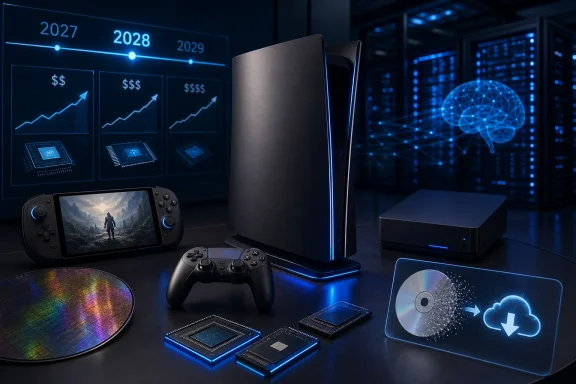 The Seven-Year Console Clock Has Stopped Being Reliable
Sony’s familiar console rhythm made 2027 look like the obvious target. A seven-year cycle would place the next PlayStation neatly after the current generation, preserving the industry’s long-standing expectation that new hardware arrives on something resembling a calendar.Geeky Gadgets says the PS6 was originally anticipated in 2027 but could now slip into 2028 or 2029. A 2028 release would stretch the expected cycle by a year; a 2029 launch would extend it by two. That would not merely move a product launch—it would change how publishers, accessory makers, retailers, and consumers plan the end of the PS5 era.
Console cycles, however, are not laws of physics. They are business patterns that hold only when manufacturing costs, software readiness, consumer demand, and competitive timing align. Sony has little incentive to replace a functioning ecosystem simply because seven years have elapsed, particularly if replacement hardware would arrive with an unattractive price or a compromised memory configuration.
Sony’s own investor communications provide the most important reality check. In its official discussion of memory shortages and future platforms, the company said no decisions had been made about next-generation timing or pricing. Sony also said it expects memory pricing to remain elevated and supply-demand conditions to remain tight through 2027, while it considers hardware costs, promotional spending, launch strategy, and possible changes to the business model.
That does not confirm the Geeky Gadgets timeline, but it explains why the timeline is credible. If supply remains constrained through the year in which the PS6 had been anticipated, Sony must either accept expensive components, reduce the hardware target, charge buyers more, subsidize the console, or wait. Of those choices, waiting may be the least damaging.
Timeline
2027 — The PS6 was originally anticipated to arrive, following Sony’s traditional seven-year console cycle.2028 — The earliest delayed launch year now discussed by Geeky Gadgets and ZONEofTECH, as well as the year Sony reportedly plans to begin phasing out disc support.
2029 — The later possible PS6 launch year presented in the delayed-release scenario if memory supply and pricing remain unfavorable.
AI Has Turned Console Memory Into Strategic Infrastructure
The stated reason for the possible delay is a global shortage of high-bandwidth memory, described by Geeky Gadgets as high-bandwidth RAM essential to next-generation systems. Demand is being driven by artificial intelligence applications and data centers, industries willing to pay heavily for memory capacity and bandwidth because their revenue depends on deploying increasingly large computing clusters.Sony has separately acknowledged a current memory shortage driven by surging AI infrastructure demand. That official statement is more consequential than any individual PS6 leak because it confirms that PlayStation hardware planning now competes with a capital cycle far larger than the console market itself.
The source wording should nevertheless be treated carefully. Geeky Gadgets specifically refers to high-bandwidth RAM, while Sony’s public statements discuss memory shortages and prices more broadly. Sony has not publicly confirmed the PS6 memory architecture, so the shortage should not be interpreted as proof that the console will use a particular class or configuration of memory.
The economic mechanism is more important than the technical label. Memory manufacturers prioritize the products, customers, and contracts that offer the strongest returns. AI operators and data-center builders buy at enormous scale, tolerate higher prices, and compete for production capacity years ahead of ordinary consumer demand.
A console manufacturer faces a different equation. Sony must build millions of broadly identical systems, keep them available at retail, guarantee a stable target for developers, and sell them to customers who compare the price not with a data-center accelerator but with the console already under their television. A component increase that looks manageable inside an enterprise server can destroy the value proposition of a mass-market games machine.
This is why a memory shortage can delay an entire platform rather than merely raise its bill of materials. Sony cannot casually switch configurations after launch without complicating game development and quality assurance. The hardware target must be powerful enough to remain relevant for years, but inexpensive enough to manufacture at enormous volume.
Waiting until 2028 or 2029 could improve that balance. Additional supply might come online, contracts could become more favorable, and Sony would gain time to optimize the rest of the system around whatever memory capacity it can afford. Delay would not eliminate the problem, but it could prevent a temporary market distortion from becoming a permanent architectural compromise.
Sony Cannot Price the PS6 Like an AI Workstation
Geeky Gadgets and ZONEofTECH place the expected PS6 launch price at approximately $750. That figure is not an official Sony price, and it should not be treated as one, but it illustrates the uncomfortable territory into which premium consoles are moving.At $750, the PS6 would be positioned well below the competing systems named in the report. Valve’s Steam Machine starts at $1,049, while Microsoft’s Project Helix is described as a PC-console hybrid costing more than $1,000. Microsoft has officially described Project Helix as its next-generation first-party console, built to play Xbox console and PC games, but the price cited by Geeky Gadgets remains part of the report’s market framing rather than a Sony comparison published by Microsoft.
The temptation is to call $750 affordable because it undercuts those alternatives. That is the wrong comparison for a mass-market PlayStation. Sony is not merely competing against new high-end hardware; it is competing against the PS5 already in homes, years of discounted games, subscription libraries, and the option to postpone an upgrade indefinitely.
| Product or variant | Form described | Stated price | Intended position | Status of details |
|---|---|---|---|---|
| PlayStation 6 | Flagship console | Approximately $750 | Main next-generation PlayStation | Reported, not announced |
| Affordable PS6 alternative | Lower-cost PlayStation option | $350–$500 | Budget-conscious buyers | Reported concept |
| Project Canas | Sony handheld | Not stated | Portable PlayStation experience | Reported product |
| Valve Steam Machine | Living-room gaming system | Starts at $1,049 | Premium PC-style gaming | Named competitor |
| Microsoft Project Helix | PC-console hybrid | Over $1,000 | Premium Xbox and PC convergence | Product confirmed; cited price remains reported |
Sony has also indicated that it does not intend to sell hardware at significant losses. That makes the old console strategy—accepting a deep subsidy upfront and recovering it through software—harder to assume. Geeky Gadgets suggests Sony could still sell the PS6 at a loss and recoup money through games, subscriptions, and digital content, but Sony’s public position points toward greater caution.
The likely result is not one simple price decision but a set of compromises distributed across the product. Sony could adjust specifications, storage, accessories, industrial design, promotional spending, or the number of models offered. It could also rely more heavily on recurring revenue, where the hardware becomes the entrance fee to a long-term digital relationship rather than the primary source of profit.
A Delay Gives the PS5 Generation Something It Lost at Launch
The case for a later PS6 is not purely defensive. The PS5 generation began under severe supply disruption, and its first years did not resemble a normal console transition. Extending the generation would give Sony and publishers more time to extract value from an installed base that remains commercially useful.Geeky Gadgets notes that analysts see considerable longevity in the PS5 generation. That matters because a successful console does not become obsolete when its successor enters development. Its useful life depends on active players, software sales, services, and publishers’ willingness to continue supporting it.
Sony’s recent financial framing emphasizes engagement and monetization of the installed base rather than hardware replacement for its own sake. Software and network services can continue producing revenue even when annual console sales slow. From that perspective, an extra year is not dead time; it is another year in which Sony can sell games, subscriptions, and digital content without funding a risky platform launch.
Developers may also benefit from a clearer target. A rushed transition can force studios to support two generations while simultaneously adapting to new architecture and performance expectations. A later PS6 would keep the PS5 as the primary baseline for longer, reducing uncertainty even if it postpones the technical ceiling.
Players would receive a mixed outcome. Those waiting for a dramatic leap would face disappointment, while current PS5 and PS5 Pro owners would see their purchases retain relevance. The most practical consequence is that buying a current-generation console becomes less risky if the successor is genuinely moving toward 2028 or 2029.
The PS5 Pro complicates that calculation. Geeky Gadgets identifies both the PS5 and PS5 Pro as current-generation systems experiencing rising prices. If the PS6 slips while today’s hardware becomes more expensive, Sony could end up extending a generation without making it more accessible.
That is the central danger in treating delay as an automatic benefit. More development time does not guarantee lower prices. If memory constraints persist, the extra years could merely normalize premium console pricing while pushing the flagship PS6 further from the mass audience that built the PlayStation brand.
A Three-Device Strategy Could Replace the Single Launch Box
The most consequential part of the Geeky Gadgets account may not be the date. It is the suggestion that Sony is considering a broader lineup consisting of the flagship PS6, a handheld called Project Canas, and a more affordable PS6 alternative priced between $350 and $500.None of that lineup has been formally announced by Sony under those terms. Project Canas should therefore be understood as a reported product name, not an established PlayStation brand. Even so, the strategy described makes economic sense in a market where one console can no longer satisfy every price and usage expectation.
The flagship would carry the performance narrative and compete with premium hardware. A lower-cost alternative could protect Sony’s traditional volume business by giving families and price-sensitive buyers a route into the new ecosystem. A handheld would extend PlayStation into portable use without requiring every customer to purchase the most expensive living-room system.
This would amount to a shift from the idea of a PlayStation to a family of PlayStation endpoints. Sony would still control the platform, software environment, and commercial relationship, but consumers could enter through different hardware categories.
Microsoft’s Project Helix points toward a related convergence from the Windows side. Microsoft describes it as a system designed for both Xbox console and PC games, effectively reducing the conceptual distance between a fixed console and a managed gaming PC. Valve’s Steam Machine approaches the television from the opposite direction, bringing the PC storefront and PC software model into console-like hardware.
Sony’s reported approach would preserve a more conventional console identity while dividing the market by price and mobility. That could be a stronger response than trying to match PC-console hybrids specification for specification. PlayStation’s advantage has historically been the ability to offer a predictable experience without asking customers to think like PC builders.
The lower-cost variant would be especially important if the flagship arrives near $750. A $350-to-$500 option would create a wide pricing gap, suggesting meaningful differences in capability, packaging, or both. The source material does not establish what those differences might be, and guessing would confuse strategic logic with specification leaks.
For developers, multiple devices create opportunity and complexity. A shared software foundation could expand the addressable audience, but studios would need clear performance tiers and dependable tools. Sony’s strongest version of this strategy would make scaling predictable; its weakest version would create several targets without giving developers enough control over how games behave across them.
Disc Support Is Becoming Part of the Launch Calculation
Geeky Gadgets says Sony plans to begin phasing out disc support in 2028. Sony has since publicly described a move away from physical production for new PlayStation releases beginning that year, turning the timing into more than a speculative PS6 detail.A PS6 arriving in 2028 would therefore appear at the same moment Sony’s software business becomes more decisively digital. That alignment would reduce manufacturing and distribution costs, simplify console design choices, and direct purchases toward the PlayStation Store and digital retail channels.
For Sony, the advantages are substantial. Digital distribution removes the cost and logistics of pressing, shipping, stocking, and returning discs. It also gives the platform holder greater control over transactions while strengthening the role of accounts, subscriptions, digital libraries, and recurring engagement.
For customers, the bargain is less comfortable. Physical games can be resold, lent, collected, purchased second-hand, or retained without depending entirely on continued storefront availability. A digital-only ecosystem exchanges those properties for convenience and immediate access.
A lower console price could make that exchange easier to sell. If removing disc support helps Sony offer the reported $350-to-$500 alternative, some buyers will accept the restriction as a reasonable trade. If the flagship costs approximately $750 and still limits physical ownership, resistance will be sharper because customers will be paying more while receiving less control over the software they buy.
The timing also raises a migration question. Sony must make the transition feel like continuity rather than confiscation. Players with existing libraries will judge the PS6 not just by launch games and graphical improvements, but by how well it respects years of purchases and habits.
The source material does not establish the PS6’s compatibility policies, so no firm conclusion can be drawn. But a console launching into a digital-first era will be evaluated as an account platform from its first day. Hardware specifications may attract enthusiasts; library continuity will determine whether ordinary users feel safe upgrading.
The Memory Shortage Will Shape Games, Not Just Hardware Prices
The easiest consequence to see is a more expensive console. The deeper consequence is that memory constraints could influence what developers are able—or required—to build.Geeky Gadgets suggests Sony might reduce the PS6’s RAM capacity to manage costs, while relying on tighter hardware and software integration to preserve a seamless experience. That is presented as a possibility rather than a confirmed design decision, but it captures the trade-off facing every fixed platform.
A console’s advantage over a general-purpose PC is not necessarily that it contains the most expensive components. Its advantage is that developers know the target. Sony can compensate for limitations through purpose-built system design, mature development tools, predictable storage behavior, and software optimized for one hardware family.
That does not make memory capacity irrelevant. Modern games must hold increasingly complex worlds, assets, simulation data, interfaces, and system processes in a finite pool. If memory becomes the expensive constraint, developers may spend more effort on streaming, compression, asset management, and transitions between performance modes.
The result could be a PS6 designed around efficiency rather than brute-force expansion. That would fit Sony’s need to undercut four-figure competitors, but it would also make first-party engineering unusually important. Exclusive games would need to demonstrate why a tightly integrated console can produce compelling results without matching a premium hybrid component for component.
This is where the reported delay could become an advantage. Additional development time would let Sony refine tools and give studios longer to understand the final target. A technically ambitious console launched with immature software rarely feels ambitious to the person waiting through inconsistent frame rates and unfinished features.
The risk is that optimization becomes a euphemism for compromise. If Sony chooses too little memory, developers cannot manufacture capacity through good intentions. The company must avoid designing around a temporary shortage so aggressively that the PS6 carries the limitation through the rest of its life.
Valve and Microsoft Are Making Sony’s Price Discipline More Valuable
Valve’s Steam Machine and Microsoft’s Project Helix are not merely competing boxes. They represent an argument that the future of gaming hardware will look more like the PC: broader software compatibility, premium components, higher prices, and fewer boundaries between desk and television.The Steam Machine’s $1,049 starting point makes that future tangible. It is a premium purchase even before software, peripherals, or display upgrades enter the calculation. Its appeal rests on access to the Steam ecosystem and the flexibility associated with PC gaming rather than on conventional console pricing.
Project Helix similarly embodies Microsoft’s attempt to bring Xbox console and PC games into one next-generation system. Microsoft’s official description emphasizes leading performance and a combined library, while Geeky Gadgets characterizes it as a PC-console hybrid costing more than $1,000.
Sony can respond in two ways. It can chase those systems upward, producing a premium flagship for enthusiasts, or it can define PlayStation as the disciplined alternative: capable, integrated, and less expensive. The reported $750 target suggests Sony may attempt both—moving above traditional console expectations while remaining below its premium rivals.
That middle position is strategically attractive and operationally difficult. Sony would need enough performance to prevent unfavorable comparisons with more expensive systems while preserving enough margin to avoid substantial hardware losses. Memory prices narrow that space from both sides.
The proposed affordable alternative could provide an escape route. Rather than forcing the flagship to serve every buyer, Sony could let it compete at the high end while using the $350-to-$500 model to maintain scale. Project Canas could then address customers whose priority is portability rather than maximum living-room performance.
This is less a traditional console launch than a platform segmentation exercise. The challenge for Sony will be making each product feel purposeful rather than compromised. Buyers will accept tiers when the distinctions are clear; they become frustrated when lower-priced hardware produces confusing compatibility rules or visibly inferior versions of the same games.
Windows Gaming Will Feel the Effects Even Without a PlayStation Port
A delayed PS6 matters to Windows users because the same component market, game engines, publishers, and platform strategies connect consoles to the PC. When AI infrastructure raises memory costs, consumer hardware categories do not remain neatly isolated.Valve’s Steam Machine is explicitly rooted in PC gaming, while Project Helix is designed around Xbox console and PC software. Their four-figure pricing demonstrates what happens when living-room systems inherit the economics of performance PCs instead of the subsidy and standardization traditionally associated with consoles.
Sony’s response can also influence Windows game development. If the PS5 remains a major target through 2028 or 2029, multiplatform publishers will continue designing around current-generation console constraints. That could moderate baseline PC requirements, but it may also extend the period in which game engines must scale across a particularly wide range of hardware.
A lower-memory PS6 would reinforce the importance of efficient asset streaming and scalable settings. Conversely, a late but generously equipped PS6 could raise the baseline once the transition finally occurs. In either scenario, the launch date shapes the point at which publishers feel comfortable leaving current hardware behind.
IT buyers responsible for gaming labs, esports spaces, demonstration rooms, testing fleets, or creative departments should therefore treat the PS6 delay as part of a wider procurement trend. Premium gaming systems are becoming more PC-like in cost, while consumer consoles are becoming more dependent on accounts, services, and digital distribution.
Action checklist for admins
- Avoid building refresh schedules around an assumed 2027 PS6 launch; Sony has not announced the date.
- Model 2028 and 2029 scenarios for gaming labs or managed entertainment spaces that depend on PlayStation hardware.
- Budget separately for hardware, subscriptions, digital software licensing, storage, and account administration.
- Review whether physical-media workflows remain necessary before Sony’s reported 2028 disc phaseout begins.
- Track memory pricing and current PS5 or PS5 Pro costs rather than assuming older hardware will automatically become cheaper.
- Document library ownership and account dependencies before moving shared or institutional systems toward digital-only purchasing.
Sony Must Separate a Real Supply Problem From a Cloud of Rumors
The PS6 discussion now contains three different levels of evidence, and treating them as interchangeable produces false certainty.First, there are confirmed market conditions. Sony has acknowledged memory pressure connected to AI infrastructure, said future platform timing and pricing remain undecided, and indicated that it is evaluating multiple cost and business-model responses. Microsoft has officially named Project Helix and described its combined console-and-PC direction, while Valve’s Steam Machine has established the four-figure premium comparison.
Second, there is reputable reporting that Sony is considering 2028 or 2029 for its next console. That reporting supports the general idea that the seven-year schedule is under review, but consideration is not a final launch plan.
Third, there are the more specific claims presented by Geeky Gadgets through ZONEofTECH: an approximately $750 PS6, Project Canas, a $350-to-$500 alternative, and possible hardware compromises. Those details may describe a plausible strategy, but they remain unannounced.
This hierarchy does not make the story meaningless. It makes the story more useful. The strongest conclusion is not that Sony has delayed a finished console to a fixed date; it is that the economics underlying a 2027 launch have deteriorated enough for a later release to become credible.
Readers should be skeptical of any report that turns a planning scenario into a countdown. A company can explore multiple configurations and launch windows simultaneously. It can negotiate memory supply, test prices, and brief partners without having approved the final retail product.
Sony also benefits from strategic ambiguity. Announcing a late PS6 too early could weaken current hardware demand, while promising 2027 could trap the company in an unfavorable component market. Silence allows it to preserve the PS5 business while waiting for better information.
The Numbers That Define Sony’s Decision
The clearest picture is not a rumored specification sheet but a small set of dates and prices that frame the choice:- The PS6 was originally anticipated for 2027 under a seven-year console rhythm.
- The possible launch window has reportedly shifted to 2028 or 2029.
- A global shortage of high-bandwidth memory, driven by AI applications and data centers, is the stated cause.
- The flagship PS6 is expected by Geeky Gadgets and ZONEofTECH to cost approximately $750, though Sony has announced no price.
- A more affordable PS6 alternative is reportedly planned between $350 and $500, alongside the handheld Project Canas.
- Sony reportedly plans to begin phasing out disc support in 2028, tying the next hardware transition to a more digital PlayStation business.
The important date is no longer simply the day the PS6 goes on sale. It is the moment memory supply, platform readiness, and consumer pricing finally intersect. If that happens in 2028, Sony can present the delay as discipline; if it takes until 2029, the PS5 will have to carry the PlayStation business substantially longer than the old seven-year model implied. Either way, the next PlayStation will arrive in a market transformed by AI infrastructure, four-figure gaming machines, and the retreat of physical media—and Sony’s success will depend less on winning the specification contest than on proving that a console can still feel powerful, accessible, and worth owning at the same time.
References
- Primary source: Geeky Gadgets
Published: 2026-07-11T09:30:13.502205
Loading…
www.geeky-gadgets.com - Related coverage: gamesradar.com
Loading…
www.gamesradar.com - Related coverage: creativebloq.com
Loading…
www.creativebloq.com - Related coverage: blog.playstation.com
Loading…
blog.playstation.com - Related coverage: tomshardware.com
Sony considering PlayStation 6 delay to 2029, while Nintendo could hike Switch 2 price, according to report — memory and storage chip shortage now impacting products outside of RAM, storage, and GPUs | Tom's Hardware
Is this just the tip of the iceberg?www.tomshardware.com - Related coverage: pcgamer.com
Loading…
www.pcgamer.com
- Related coverage: tomsguide.com
Loading…
www.tomsguide.com - Related coverage: digitaltrends.com
Loading…
www.digitaltrends.com - Related coverage: playstation.com
Loading…
www.playstation.com - Related coverage: heise.de
Loading…
www.heise.de - Related coverage: dotesports.com
PlayStation 6 reportedly being pushed to 2028 or 2029
According to Bloomberg's report, Sony is facing a major dilemma with the upcoming PlayStation 6, with delay to 2029 being a possibility.dotesports.com - Related coverage: gadgets360.com
Loading…
www.gadgets360.com