

CVE-2026-63974 is a newly published Linux kernel Bluetooth vulnerability that deserves attention from Windows power users, developers, and enterprise administrators—but not panic. The flaw is in the Linux Bluetooth Host Controller Interface synchronization path, specifically a race during Bluetooth device shutdown and reset handling. Kernel.org has assigned it a CVSS 3.1 score of 8.8 High, yet the practical exposure is narrower than that number alone suggests: it affects Linux systems that actively expose a vulnerable Bluetooth controller, while standard Windows Bluetooth operation is handled by Microsoft’s own Bluetooth stack rather than the Linux kernel. The immediate priority is therefore clear: patch Linux hosts, appliances, virtual machines, and custom Windows Subsystem for Linux environments that can access a physical Bluetooth USB adapter.
Bluetooth vulnerabilities often receive understandable attention because the radio interface sits at an awkward intersection of physical proximity, complex protocol handling, firmware behavior, operating-system drivers, and consumer convenience. A machine can have an otherwise well-managed network perimeter while its Bluetooth radio remains enabled for a headset, keyboard, mouse, phone synchronization, or industrial peripheral.
CVE-2026-63974 concerns the Linux kernel’s Bluetooth subsystem, not the BlueZ user-space daemon alone and not a vendor-specific Bluetooth driver in isolation. The relevant code is in
The vulnerable condition arises during a delicate lifecycle moment: the Bluetooth device is being closed while a reset path may also be active. In modern operating systems, shutting down a device is not simply a matter of flipping an “off” switch. Pending commands must be cancelled or completed, timers must be accounted for, queues must be drained, driver state must remain coherent, and no later work item should touch state that is already being dismantled.
The flaw’s published description is concise but technically meaningful. Because
That is a classic synchronization failure. One part of the kernel assumes the queue is being retired; another can still schedule work against it. The eventual outcome depends on timing, memory state, hardware behavior, and surrounding code. In the worst case, such races can lead to use-after-free behavior, kernel memory corruption, a system crash, or conditions that a capable attacker might turn into code execution.
That history does not mean every Linux device running an older kernel is exposed in the same way. Kernel backports are normal across enterprise and distribution-supported kernels. Red Hat, Canonical, SUSE, Debian, Android vendors, embedded-device manufacturers, and security-focused distributions may apply the patch under a different package version than the upstream release number suggests. Administrators should verify their vendor advisory and installed package revision rather than relying solely on
Small patches can address consequential kernel bugs. The number of changed lines is not a useful proxy for severity because concurrency flaws are defined by when code runs, not merely by how much code exists. A single missing state flag can allow an unsafe operation in a timing window that is hard to reproduce during ordinary testing.
A workqueue is a kernel mechanism for deferring work to an appropriate execution context. It is a powerful design tool, but it requires strict lifecycle discipline. When a device is closing, the kernel must ensure that no new task is scheduled after the decision to drain or destroy the workqueue. Otherwise, a timeout callback could run after the code assumed shutdown had completed.
Adding device close to that pathway introduces a new concurrency relationship. A code path that was safe when close occurred only in conventional teardown can become unsafe when close and recovery logic interact. The fix recognizes this changed assumption and tells the command layer to stop admitting timeout work while close is actively emptying the queue.
That distinction matters. A High CVSS score should drive remediation and defensive review, but it should not be translated into unsupported claims such as “all Bluetooth headphones can hack a PC” or “Windows Bluetooth is broken.” The responsible reading is that the kernel maintainers identified a potentially dangerous race in privileged code and shipped fixes through upstream stable branches.
The vector also indicates low attack complexity, no required privileges, and no user interaction. Taken literally, those attributes describe a concerning theoretical security posture: an attacker in Bluetooth range may not need an account or a victim click. However, CVSS is a standardized severity framework, not a guarantee that exploitation is straightforward on every device.
Yet adjacency imposes real constraints. An attacker must be near the targeted radio and must generally be able to engage the affected Bluetooth path in a useful manner. This is unlike an exposed web server that can be scanned at scale from across the world. Physical location, radio state, device discoverability, protocol state, and controller behavior all affect practical risk.
The CVSS vector attributes high potential impact to confidentiality, integrity, and availability. In a worst-case exploitation scenario, this could mean reading sensitive information, altering system state, installing persistence, or crashing the device. Those are impact categories, not confirmation that public exploit code exists.
This is a normal early-CVE condition. Security teams should not wait for a second score before patching, but they should recognize that details may evolve as distributions publish advisories, researchers analyze exploitability, and NVD completes enrichment.
This release structure reflects the Linux stable-maintenance model. A single upstream fix is normally backported to maintained stable and long-term branches, producing different commit identifiers because the surrounding code varies between branches.
A high-quality vulnerability-management workflow should combine package inventory with vendor-provided fix metadata. It should also distinguish the running kernel from the package merely installed on disk. Systems frequently receive a corrected kernel package but continue to run the older vulnerable image until a maintenance reboot.
These devices may use Bluetooth for scanning, provisioning, audio, sensor connectivity, or peripheral control. They may also have lengthy certification cycles that delay operating-system updates. Organizations should ask device manufacturers directly whether their supported firmware contains the relevant
That point is worth stating plainly because CVE reporting is increasingly cross-platform. Windows enthusiasts may see a high-severity Bluetooth CVE in an alert feed, security dashboard, browser news item, or vendor bulletin and reasonably assume their Windows laptop is directly affected. In the standard configuration, it is not.
When a USB Bluetooth adapter is attached to WSL through USB/IP, Windows cannot use that device while it is attached. The Linux guest becomes the operating environment controlling the adapter. If that WSL kernel and its Bluetooth configuration expose the affected HCI subsystem, CVE-2026-63974 becomes relevant to that Linux environment.
For ordinary WSL users who never attach a Bluetooth adapter, the practical exposure is likely low or nonexistent. WSL does not automatically make a laptop’s internal Bluetooth controller available to Linux workloads in the same way that Windows itself uses it. The risk grows for developers, hardware researchers, and lab users who deliberately pass through external USB radios.
USB passthrough can create that condition. So can specialized development environments that use external Bluetooth radios for protocol testing, IoT development, wireless security research, device provisioning, or embedded firmware work. In those cases, the Linux guest should be patched like any other Bluetooth-capable Linux host.
The hardware is shared, but the software stack is not. Users should therefore apply Windows updates to protect Windows and apply their Linux distribution’s kernel updates to protect Linux. A firmware update for the Bluetooth controller may be valuable for other issues, but it is not a substitute for the kernel-side synchronization fix described by this CVE.
However, security teams should be careful with assumptions. A USB Bluetooth adapter can be added later, an internal radio may have been overlooked in asset records, and a system image may be repurposed from desktop to server use. Inventory should establish the real hardware and runtime state before an asset is dismissed as irrelevant.
Still, for high-risk Linux endpoints awaiting an approved maintenance window, disabling the Bluetooth adapter through firmware settings, operating-system controls, or physical removal of an external dongle can be a sensible compensating control. The preferred remediation remains a supported kernel update followed by a reboot into the corrected image.
Organizations using custom kernels should assign clear ownership for security backports. The kernel’s Bluetooth subsystem is not isolated from business risk simply because the workload is an internal appliance. Local wireless exposure can still matter in offices, factories, branches, field deployments, and customer-facing installations.
If a system exhibits repeated Bluetooth failures, unexpected resets, kernel warnings, or unexplained crashes in a context where hostile nearby devices are plausible, preserve relevant logs before rebooting where feasible. That evidence can help distinguish a software defect, hardware instability, driver regression, or potential attempted exploitation.
Avoid downloading random kernel builds from untrusted sources just to chase a CVE. The safest route for most users is the distribution’s regular update channel, which integrates the kernel with signed packages, boot configuration, graphics-driver compatibility, and vendor-specific support.
Do not confuse the presence of a Bluetooth adapter with exposure to this Linux CVE. The vulnerable component is the Linux kernel Bluetooth synchronization code, not Bluetooth as a technology and not the Windows Settings app’s Bluetooth toggle.
Hardware passthrough creates an additional operational rule: while a USB device is attached to WSL, Windows cannot use it. That separation is helpful when reasoning about this CVE. The Bluetooth adapter belongs to either the Windows host or the Linux guest at a given time, and the relevant patch responsibility follows the operating system that controls it.
The second is NVD enrichment. As of July 21, 2026, the NVD entry shows the kernel.org CNA score of 8.8 but no completed NVD CVSS assessment. A later NVD analysis may add standardized configuration details, weakness mapping, or revised contextual information. That could improve automated scanner behavior, although it should not delay remediation.
Security teams should distinguish between credible research and speculative social-media claims. The existence of a High CVSS score and a kernel fix establishes that the defect matters; it does not validate every claim of universal or effortless exploitation.
That is not an argument against patching. It is an argument for applying updates through supported channels, preserving a known-good fallback kernel during the rollout period, and testing critical Bluetooth workflows in enterprise pilots before fleet-wide deployment.
For Windows-focused organizations, that reality reinforces the need to include Linux development environments, WSL hardware passthrough, dual-boot endpoints, and managed appliances in the same security conversation as Windows clients. Modern endpoint security is not solely about the host operating system visible on a user’s desktop; it is about every kernel and controller that can own a physical interface.
CVE-2026-63974 should ultimately be viewed as a focused Linux Bluetooth kernel issue with a credible high-severity rating, a specific upstream correction, and a practical remediation path. Windows-only users can avoid needless alarm, while Linux users, WSL hardware developers, and enterprise administrators should use the disclosure to verify real Bluetooth exposure, apply vendor-supported kernel updates, reboot into the patched build, and maintain clear separation between a Windows host’s Bluetooth stack and any Linux environment that has been granted control of a physical radio.
 Background
Bluetooth vulnerabilities often receive understandable attention because the radio interface sits at an awkward intersection of physical proximity, complex protocol handling, firmware behavior, operating-system drivers, and consumer convenience. A machine can have an otherwise well-managed network perimeter while its Bluetooth radio remains enabled for a headset, keyboard, mouse, phone synchronization, or industrial peripheral.CVE-2026-63974 concerns the Linux kernel’s Bluetooth subsystem, not the BlueZ user-space daemon alone and not a vendor-specific Bluetooth driver in isolation. The relevant code is in
net/bluetooth/hci_sync.c, a kernel component responsible for coordinating synchronous Host Controller Interface, or HCI, commands. HCI is the standardized control boundary between the operating system’s Bluetooth stack and the Bluetooth controller hardware.The vulnerable condition arises during a delicate lifecycle moment: the Bluetooth device is being closed while a reset path may also be active. In modern operating systems, shutting down a device is not simply a matter of flipping an “off” switch. Pending commands must be cancelled or completed, timers must be accounted for, queues must be drained, driver state must remain coherent, and no later work item should touch state that is already being dismantled.
Why device teardown is security-sensitive
Device removal and reset paths are traditionally fertile ground for kernel defects. They combine asynchronous events, timeouts, workqueues, interrupt activity, and hardware that may not respond exactly as expected. A Bluetooth controller can be unplugged, powered down, reset by firmware, suspended with the system, or forced through recovery after an error—all while the host stack still has work pending.The flaw’s published description is concise but technically meaningful. Because
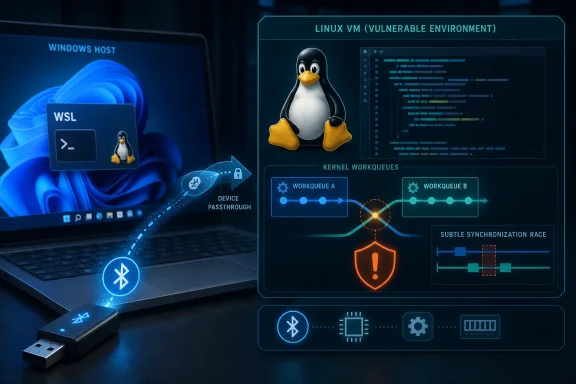
hci_dev_close_sync() can now run during the reset path, the kernel needs to set the HCI_CMD_DRAIN_WORKQUEUE command flag during closure. Without that protection, the Bluetooth subsystem may queue timeout work while the Bluetooth device workqueue is already being drained.That is a classic synchronization failure. One part of the kernel assumes the queue is being retired; another can still schedule work against it. The eventual outcome depends on timing, memory state, hardware behavior, and surrounding code. In the worst case, such races can lead to use-after-free behavior, kernel memory corruption, a system crash, or conditions that a capable attacker might turn into code execution.
A vulnerability with a long upstream history
The affected-code history reaches back years, which is common for Linux kernel CVEs. The record identifies vulnerable historical ranges involving Linux 5.18 and 5.19 development-era fixes, while the current impact statement treats Linux 6.0 and later as affected until corrected stable releases are in place.That history does not mean every Linux device running an older kernel is exposed in the same way. Kernel backports are normal across enterprise and distribution-supported kernels. Red Hat, Canonical, SUSE, Debian, Android vendors, embedded-device manufacturers, and security-focused distributions may apply the patch under a different package version than the upstream release number suggests. Administrators should verify their vendor advisory and installed package revision rather than relying solely on
uname -r.What CVE-2026-63974 Actually Fixes
The patch is small in conceptual terms: it ensures the device-close sequence declares that the HCI command workqueue is being drained. That declaration prevents timeout work from being added at the wrong time.Small patches can address consequential kernel bugs. The number of changed lines is not a useful proxy for severity because concurrency flaws are defined by when code runs, not merely by how much code exists. A single missing state flag can allow an unsafe operation in a timing window that is hard to reproduce during ordinary testing.
The role of HCI command work
Linux sends controller-management operations through HCI commands. These include tasks such as configuring the radio, initializing it, changing modes, responding to errors, resetting the controller, and closing the device. The Bluetooth stack does not always wait synchronously for hardware in a simple, blocking sequence; it often uses queued work and timeouts so the rest of the kernel remains responsive.A workqueue is a kernel mechanism for deferring work to an appropriate execution context. It is a powerful design tool, but it requires strict lifecycle discipline. When a device is closing, the kernel must ensure that no new task is scheduled after the decision to drain or destroy the workqueue. Otherwise, a timeout callback could run after the code assumed shutdown had completed.
Why the reset path changes the threat model
The key detail in the advisory is thathci_dev_close_sync() may now be called from the reset path. Reset logic is inherently abnormal: it is invoked when hardware, firmware, or protocol state may already be unreliable. A controller reset can be caused by recoverable faults, unexpected command results, device disconnects, power-state transitions, or behavior the host stack identifies as erroneous.Adding device close to that pathway introduces a new concurrency relationship. A code path that was safe when close occurred only in conventional teardown can become unsafe when close and recovery logic interact. The fix recognizes this changed assumption and tells the command layer to stop admitting timeout work while close is actively emptying the queue.
What the patch does not prove
The CVE record does not publicly establish a reliable, in-the-wild exploit chain. It does not claim that every Bluetooth packet from a nearby device can immediately seize control of an unpatched Linux machine. It also does not identify a particular consumer Bluetooth chipset, laptop brand, Linux distribution, or Windows PC model as uniquely vulnerable.That distinction matters. A High CVSS score should drive remediation and defensive review, but it should not be translated into unsupported claims such as “all Bluetooth headphones can hack a PC” or “Windows Bluetooth is broken.” The responsible reading is that the kernel maintainers identified a potentially dangerous race in privileged code and shipped fixes through upstream stable branches.
Severity: High Score, Contextual Exposure
Kernel.org’s CVSS 3.1 vector rates CVE-2026-63974 at 8.8 High. The vector classifies the attack as adjacent, meaning the attacker must generally be within the local communication environment rather than operating from anywhere on the internet. Bluetooth radio proximity fits that model.The vector also indicates low attack complexity, no required privileges, and no user interaction. Taken literally, those attributes describe a concerning theoretical security posture: an attacker in Bluetooth range may not need an account or a victim click. However, CVSS is a standardized severity framework, not a guarantee that exploitation is straightforward on every device.
Adjacent is not the same as remote
A vulnerability with an adjacent attack vector is still serious. Bluetooth coverage can extend beyond a room, particularly with higher-powered equipment, favorable antenna placement, or directional hardware. Shared offices, apartment buildings, conference venues, airports, classrooms, hospitals, manufacturing floors, and public transportation can place unknown devices within range.Yet adjacency imposes real constraints. An attacker must be near the targeted radio and must generally be able to engage the affected Bluetooth path in a useful manner. This is unlike an exposed web server that can be scanned at scale from across the world. Physical location, radio state, device discoverability, protocol state, and controller behavior all affect practical risk.
Kernel impact magnifies consequences
The potentially severe result comes from where the bug lives: the kernel. A flaw in a user-space Bluetooth service might be constrained by process permissions, sandboxing, or service hardening. A successful kernel-memory corruption path, by contrast, can undermine the boundary beneath ordinary applications and users.The CVSS vector attributes high potential impact to confidentiality, integrity, and availability. In a worst-case exploitation scenario, this could mean reading sensitive information, altering system state, installing persistence, or crashing the device. Those are impact categories, not confirmation that public exploit code exists.
NVD enrichment remains incomplete
The National Vulnerability Database entry was published on July 19, 2026, and modified on July 20, 2026. At publication, NVD had included the record but had not supplied its own CVSS 3.x or CVSS 4.0 assessment. The 8.8 score is the kernel.org CNA assessment.This is a normal early-CVE condition. Security teams should not wait for a second score before patching, but they should recognize that details may evolve as distributions publish advisories, researchers analyze exploitability, and NVD completes enrichment.
Affected Kernel Versions and Fixed Branches
The authoritative upstream status identifies the issue as affecting Linux 6.0 and later before the respective fixes were incorporated. The listed fixed points are Linux 6.12.93, 6.18.35, 7.0.12, and the Linux 7.1 release line.This release structure reflects the Linux stable-maintenance model. A single upstream fix is normally backported to maintained stable and long-term branches, producing different commit identifiers because the surrounding code varies between branches.
The practical interpretation of fixed versions
Administrators can use the following guidance as an upstream baseline:- Linux 6.12 users should be at 6.12.93 or a vendor kernel confirmed to contain the backport.
- Linux 6.18 users should be at 6.18.35 or a vendor equivalent with the patch.
- Linux 7.0 users should be at 7.0.12 or later.
- Linux 7.1 users have the fix in the original release line.
- Distribution kernels must be checked against the vendor changelog, security tracker, or package advisory because package naming frequently differs from upstream numbering.
Why version-only scanning can mislead
Endpoint-management tools often match a CVE to a kernel version and flag or clear the asset automatically. That approach is useful for rapid triage but is imperfect for Linux. Vendor backports, custom kernels, container hosts, embedded images, and live-patching frameworks can all complicate version interpretation.A high-quality vulnerability-management workflow should combine package inventory with vendor-provided fix metadata. It should also distinguish the running kernel from the package merely installed on disk. Systems frequently receive a corrected kernel package but continue to run the older vulnerable image until a maintenance reboot.
The invisible population: embedded Linux
The most difficult remediation group may be embedded products. Bluetooth-capable kiosks, point-of-sale systems, medical peripherals, warehouse scanners, vehicle systems, smart displays, rugged tablets, and industrial gateways often run a Linux kernel that is not managed like a desktop distribution.These devices may use Bluetooth for scanning, provisioning, audio, sensor connectivity, or peripheral control. They may also have lengthy certification cycles that delay operating-system updates. Organizations should ask device manufacturers directly whether their supported firmware contains the relevant
hci_sync fix rather than assuming a general “Bluetooth update” addresses the issue.Why This Matters to Windows Users
For a conventional Windows 11 PC using its built-in Bluetooth adapter, CVE-2026-63974 is not a Windows kernel vulnerability. Windows manages Bluetooth through its own kernel drivers, services, firmware interfaces, and Bluetooth stack. Installing a Windows cumulative update or replacing a Windows Bluetooth driver does not patch this specific Linux kernel defect.That point is worth stating plainly because CVE reporting is increasingly cross-platform. Windows enthusiasts may see a high-severity Bluetooth CVE in an alert feed, security dashboard, browser news item, or vendor bulletin and reasonably assume their Windows laptop is directly affected. In the standard configuration, it is not.
WSL is the important Windows-adjacent case
Windows Subsystem for Linux changes the analysis—but only under certain hardware-access arrangements. WSL 2 runs a Linux kernel in a lightweight virtual machine. Microsoft’s normal USB connectivity guidance uses USB/IP andusbipd-win for passing supported USB devices into WSL environments.When a USB Bluetooth adapter is attached to WSL through USB/IP, Windows cannot use that device while it is attached. The Linux guest becomes the operating environment controlling the adapter. If that WSL kernel and its Bluetooth configuration expose the affected HCI subsystem, CVE-2026-63974 becomes relevant to that Linux environment.
For ordinary WSL users who never attach a Bluetooth adapter, the practical exposure is likely low or nonexistent. WSL does not automatically make a laptop’s internal Bluetooth controller available to Linux workloads in the same way that Windows itself uses it. The risk grows for developers, hardware researchers, and lab users who deliberately pass through external USB radios.
Hyper-V, virtual machines, and USB passthrough
The same principle applies to other Windows-hosted Linux virtual machines. A Linux guest in Hyper-V, VMware Workstation, VirtualBox, or another virtualization platform is not affected merely because the Windows host has Bluetooth. The guest needs meaningful access to a Bluetooth controller or transport path that exercises the vulnerable Linux kernel code.USB passthrough can create that condition. So can specialized development environments that use external Bluetooth radios for protocol testing, IoT development, wireless security research, device provisioning, or embedded firmware work. In those cases, the Linux guest should be patched like any other Bluetooth-capable Linux host.
Windows dual-boot systems are two separate security domains
A dual-boot PC should be treated as two independent operating-system security domains. Booting into Windows does not invoke the vulnerable Linux code. Booting into a vulnerable Linux installation with Bluetooth enabled does.The hardware is shared, but the software stack is not. Users should therefore apply Windows updates to protect Windows and apply their Linux distribution’s kernel updates to protect Linux. A firmware update for the Bluetooth controller may be valuable for other issues, but it is not a substitute for the kernel-side synchronization fix described by this CVE.
Exposure Scenarios Worth Prioritizing
Not all devices should receive the same urgency. The vulnerability’s adjacent attack requirement means exposure is strongly shaped by where Bluetooth hardware is enabled and who can get close to it. A workstation locked in a restricted data center is different from a developer laptop used in public spaces.Higher-priority environments
The following environments warrant accelerated patching and confirmation:- Linux laptops and desktops with Bluetooth enabled should be updated promptly because they are likely to operate near unknown devices in offices, homes, events, and public places.
- Developer systems using Bluetooth USB dongles with WSL or virtual machines should be reviewed because hardware passthrough can place the vulnerable Linux kernel directly in control of the radio.
- Shared Linux workstations and lab systems should be prioritized because multiple users, removable adapters, and experimental wireless tools complicate assurance.
- Bluetooth-enabled embedded fleets should be assessed with vendors because patch latency can be substantial and devices may be deployed in publicly accessible locations.
- Security-sensitive Linux endpoints should receive rapid updates when they process credentials, source code, cryptographic keys, regulated data, or administrative access tokens.
Lower-priority—but not zero—exposure
A Linux server without any Bluetooth controller, without the relevant modules loaded, and without a passed-through radio has a much smaller practical attack surface. The kernel may contain the code, but the adjacent wireless entry point is absent. That can justify risk-based scheduling where emergency patching is operationally difficult.However, security teams should be careful with assumptions. A USB Bluetooth adapter can be added later, an internal radio may have been overlooked in asset records, and a system image may be repurposed from desktop to server use. Inventory should establish the real hardware and runtime state before an asset is dismissed as irrelevant.
Disabling Bluetooth as a short-term control
Temporarily disabling Bluetooth can reduce the immediate radio exposure where patching is delayed. It is not a universal remedy: configurations vary, drivers may remain present, and the operational cost can be high for systems that depend on wireless peripherals or device connectivity.Still, for high-risk Linux endpoints awaiting an approved maintenance window, disabling the Bluetooth adapter through firmware settings, operating-system controls, or physical removal of an external dongle can be a sensible compensating control. The preferred remediation remains a supported kernel update followed by a reboot into the corrected image.
Enterprise Response: Patch Discipline Over Panic
Enterprises should treat CVE-2026-63974 as a patch-management and asset-visibility test. The CVSS rating supports expedited review, but operational teams should resist broad, unverified changes based only on a CVE headline. The primary questions are whether the affected Linux kernel is running, whether Bluetooth hardware is accessible, and whether the approved update includes the upstream correction.A practical enterprise workflow
A disciplined response can be completed in five stages:- Identify Linux assets with Bluetooth capability. Include desktops, laptops, developer workstations, appliances, embedded systems, virtual-machine images, and WSL instances with USB passthrough.
- Determine the running kernel and package provenance. Record the active kernel, the distribution or vendor build, and whether a newer patched package has already been installed but not activated.
- Validate the vendor fix status. Use the distribution’s security advisory or package changelog rather than comparing only upstream version labels.
- Deploy tested kernel updates and reboot. Reboot or otherwise activate the corrected kernel according to the organization’s maintenance standards, then verify the active version after startup.
- Review Bluetooth policy and exception handling. Disable unnecessary radios, document systems that cannot patch immediately, and establish a timeline for vendor firmware or operating-system updates.
Enterprise Linux and long-term support
Long-term-support distributions often balance stability against rapid upstream movement. That is valuable for production systems, but it means security teams must become comfortable reading vendor backport information. A package may be secure even when its visible upstream base version looks old, while a self-built or third-party kernel may remain exposed despite a newer-looking label.Organizations using custom kernels should assign clear ownership for security backports. The kernel’s Bluetooth subsystem is not isolated from business risk simply because the workload is an internal appliance. Local wireless exposure can still matter in offices, factories, branches, field deployments, and customer-facing installations.
Incident-response considerations
There is no public evidence in the published CVE record that organizations should assume compromise solely because a vulnerable kernel was installed. Routine incident response should focus on patching, monitoring anomalous Bluetooth-controller resets or kernel crashes, and investigating suspicious local activity according to existing policies.If a system exhibits repeated Bluetooth failures, unexpected resets, kernel warnings, or unexplained crashes in a context where hostile nearby devices are plausible, preserve relevant logs before rebooting where feasible. That evidence can help distinguish a software defect, hardware instability, driver regression, or potential attempted exploitation.
Consumer Guidance for Linux and Windows Enthusiasts
For home users, the correct response is straightforward: update Linux installations normally and keep Windows updates separate. The most important action is not to hunt for obscure registry edits or disable every wireless feature indefinitely; it is to obtain the supported kernel update from the operating system vendor.If Linux is installed directly on the PC
Users of Ubuntu, Fedora, Debian, Arch, openSUSE, Linux Mint, and similar distributions should apply current system updates and reboot when a new kernel is installed. After rebooting, confirm that the system is using the new kernel rather than an older one retained in the boot menu.Avoid downloading random kernel builds from untrusted sources just to chase a CVE. The safest route for most users is the distribution’s regular update channel, which integrates the kernel with signed packages, boot configuration, graphics-driver compatibility, and vendor-specific support.
If the PC runs Windows only
A Windows-only computer does not need a Linux kernel patch for CVE-2026-63974. Continue installing Windows security updates, Bluetooth-driver updates supplied by the PC maker or hardware vendor when appropriate, and firmware updates offered through trusted channels. Those actions matter for Windows security generally, but they address different code.Do not confuse the presence of a Bluetooth adapter with exposure to this Linux CVE. The vulnerable component is the Linux kernel Bluetooth synchronization code, not Bluetooth as a technology and not the Windows Settings app’s Bluetooth toggle.
If WSL is used for hardware development
WSL users should first determine whether they have passed a Bluetooth USB device into WSL. If not, this issue is unlikely to have a direct practical effect on their normal WSL environment. If so, update WSL using its supported update mechanism, update the Linux distribution inside WSL, and confirm the version of the kernel that actually runs the virtualized environment.Hardware passthrough creates an additional operational rule: while a USB device is attached to WSL, Windows cannot use it. That separation is helpful when reasoning about this CVE. The Bluetooth adapter belongs to either the Windows host or the Linux guest at a given time, and the relevant patch responsibility follows the operating system that controls it.
Strengths and Opportunities
CVE-2026-63974 also highlights several encouraging aspects of the Linux and broader endpoint-security ecosystem.- The vulnerability was identified and fixed upstream before or alongside public CVE publication. That gives maintainers and distributions a concrete patch to backport rather than forcing them to invent mitigations.
- The affected code path is narrowly described. Administrators can connect the defect to Bluetooth HCI device shutdown and reset handling instead of treating it as an undefined, system-wide Linux failure.
- Stable-branch fixes are available. Corrections have been incorporated across maintained kernel branches, providing a clear upstream remediation route.
- The Windows impact is bounded. Standard Windows Bluetooth implementations do not run the affected Linux kernel code, reducing unnecessary disruption for Windows-only users.
- WSL’s explicit USB attachment model improves visibility. Developers generally make a deliberate choice to pass a physical USB device into Linux, which makes relevant hardware exposure easier to identify than invisible shared access would be.
- The event reinforces asset-management discipline. Organizations that can identify which endpoints have active Bluetooth controllers, custom kernels, and USB passthrough will respond more effectively to future local-interface vulnerabilities as well.
Risks and Concerns
The patch’s availability does not eliminate the risks associated with delayed adoption, unclear inventory, or misleading interpretations of severity.- Bluetooth is frequently enabled by default on mobile devices. Users may not realize their Linux laptop is exposing a radio interface whenever they use a mouse, headset, keyboard, or phone integration feature.
- Kernel updates often require reboots. A fixed package that has not been activated leaves the running system vulnerable, a common gap in desktop and server patch programs.
- Embedded Linux products can lag far behind upstream. Vendor validation, product certification, and limited support lifecycles may delay remediation long after stable kernels receive the fix.
- Custom kernels are difficult to assess automatically. A self-built image can include only part of a vendor patch set, making simple version checks unreliable.
- CVSS scores can lead to both underreaction and overreaction. Dismissing an 8.8 issue because it is “only Bluetooth” is unwise, but treating it as an internet-wide Windows takeover risk is equally inaccurate.
- Bluetooth controller and firmware complexity remains a factor. The host-side kernel patch is necessary for this CVE, yet real-world Bluetooth reliability and attack surface also depend on drivers, firmware, physical radios, and user-space configuration.
What to Watch Next
The first development to watch is distribution-specific advisory activity. Major Linux vendors may publish package identifiers, backport notes, and supported-release status that provide more useful operational direction than the upstream CVE record alone. Enterprises should update their vulnerability-management exceptions once those advisories confirm fixed package revisions.The second is NVD enrichment. As of July 21, 2026, the NVD entry shows the kernel.org CNA score of 8.8 but no completed NVD CVSS assessment. A later NVD analysis may add standardized configuration details, weakness mapping, or revised contextual information. That could improve automated scanner behavior, although it should not delay remediation.
Exploit research and proof-of-concept developments
Public technical research may clarify whether the race can be reliably reached through realistic Bluetooth traffic and which controller behaviors make it more likely. This is especially important because timing-dependent kernel defects can vary significantly by chipset, driver, traffic pattern, power management state, and system load.Security teams should distinguish between credible research and speculative social-media claims. The existence of a High CVSS score and a kernel fix establishes that the defect matters; it does not validate every claim of universal or effortless exploitation.
Kernel and Bluetooth regression monitoring
Bluetooth fixes sometimes sit in sensitive code paths because they alter reset, close, timeout, or workqueue sequencing. Users should watch release notes and distribution bug trackers for any regressions involving Bluetooth pairing, wake from sleep, controller initialization, or device reconnect behavior after installing updated kernels.That is not an argument against patching. It is an argument for applying updates through supported channels, preserving a known-good fallback kernel during the rollout period, and testing critical Bluetooth workflows in enterprise pilots before fleet-wide deployment.
The evolving role of local interfaces
CVE-2026-63974 is part of a broader security pattern. As organizations harden internet-facing services, local interfaces such as Bluetooth, USB, Wi-Fi Direct, NFC, Thunderbolt, and wireless peripheral receivers become more important in endpoint threat models. These paths are often enabled for convenience but administered with less rigor than network services.For Windows-focused organizations, that reality reinforces the need to include Linux development environments, WSL hardware passthrough, dual-boot endpoints, and managed appliances in the same security conversation as Windows clients. Modern endpoint security is not solely about the host operating system visible on a user’s desktop; it is about every kernel and controller that can own a physical interface.
CVE-2026-63974 should ultimately be viewed as a focused Linux Bluetooth kernel issue with a credible high-severity rating, a specific upstream correction, and a practical remediation path. Windows-only users can avoid needless alarm, while Linux users, WSL hardware developers, and enterprise administrators should use the disclosure to verify real Bluetooth exposure, apply vendor-supported kernel updates, reboot into the patched build, and maintain clear separation between a Windows host’s Bluetooth stack and any Linux environment that has been granted control of a physical radio.
References
- Primary source: NVD / Linux Kernel
Published: 2026-07-21T01:05:04-07:00
NVD - CVE-2026-63974
 nvd.nist.gov
- Security advisory: MSRC
Published: 2026-07-21T01:05:04-07:00
Original feed URL
Security Update Guide - Microsoft Security Response Center
 msrc.microsoft.com
- Official source: support.microsoft.com
Pair a Bluetooth device in Windows | Microsoft Support
Learn how to turn on Bluetooth in Windows and connect a Bluetooth devicesupport.microsoft.com
