

Microsoft is reportedly preparing meaningful changes to the way Xbox and Microsoft support teams handle compromised consumer accounts, following years of complaints from customers who lost access to games, cloud files, email, subscriptions, and family memories after attackers changed their security details. The immediate catalyst was a highly visible case involving a creator whose roughly 25-year-old account was restored only after his story spread across social media, but the larger issue reaches far beyond one customer: a single Microsoft account has become the master key to an enormous digital life, while the recovery system behind it often appears unable to distinguish an attacker from the person who paid for that life.
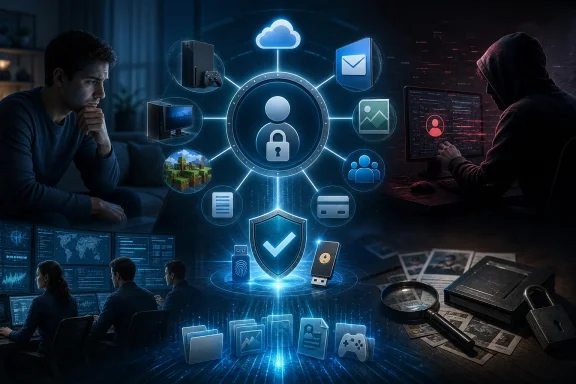
Microsoft accounts began as comparatively simple credentials for services such as Hotmail and MSN, but they have gradually evolved into a shared identity layer spanning Windows, Xbox, Outlook, OneDrive, Microsoft 365, Minecraft, the Microsoft Store, Skype, and other products. An account opened primarily to play an Xbox game years ago may now hold family photographs, tax records, personal correspondence, subscriptions, saved payment methods, achievements, cloud saves, and thousands of dollars’ worth of licensed entertainment.
That consolidation is convenient when everything works. One login can connect a Windows PC, an Xbox console, a phone, a browser, and multiple Microsoft services without requiring the user to maintain separate identities for every product.
The same consolidation creates a dangerous concentration of risk. When an attacker captures the account and replaces its aliases, password, recovery address, or authentication methods, the victim does not merely lose access to one game profile. The compromise can sever access to an entire ecosystem built over decades.
Minecraft added another layer of complexity when Microsoft required users to migrate older Mojang accounts into Microsoft accounts. The transition strengthened some security controls and unified services, but it also meant that a stolen Microsoft identity could affect both a player’s traditional Xbox library and a Minecraft license that may have originated years earlier under a different account system.
Today, the phrase “Xbox account” is often misleading. For many customers, the affected object is a Microsoft consumer identity with Xbox attached to it—and OneDrive, Outlook, Microsoft 365, Windows, and other services attached to it as well.
His case attracted widespread attention because it exposed a startling gap between two conclusions. Microsoft could apparently identify unauthorized activity, yet its standard support process could not safely return the account to the established customer.
After the story spread across social media, Xbox Support intervened and worked to restore access. The official support account subsequently invited other people experiencing similar recovery problems to contact it through direct messages.
That outreach was welcome, but it also highlighted the central problem. A security and recovery system serving hundreds of millions of users cannot depend on whether a victim has a large audience, attracts press attention, or maintains an account on a particular social network.
The result is effectively a two-tier support structure:
A recovery process that is too permissive creates a direct route for account theft. One that is too rigid can permanently exclude the legitimate owner after the attacker has already changed the information that automated systems use as proof.
Microsoft’s current documentation reflects this defensive posture. Its recovery form asks customers for historical information associated with the account, and its guidance says support representatives generally cannot manually send password-reset links or alter account details. Customers can retry an unsuccessful recovery request, but repetition does not necessarily solve a mismatch between the evidence they possess and the evidence Microsoft’s automated process expects.
Yet a rigid system may assign more weight to recalled passwords, old contacts, precise email subjects, or security information that an attacker has already replaced. That creates an absurd outcome: the victim can demonstrate a long commercial relationship with Microsoft, while the recovery mechanism still concludes that there is insufficient proof.
Billing data cannot be the only recovery method because payment cards can be shared, stolen, replaced, or accessed by family members. Nevertheless, it should be one component of a broader evidence model, particularly when combined with device history, purchase patterns, long-term location signals, account creation records, console identifiers, and historical authentication telemetry.
From the customer’s perspective, this looks like deletion. Internally, the identity, purchases, and data may still exist but be associated with a different sign-in alias or locked state.
Support needs terminology that accurately distinguishes deletion, suspension, alias replacement, quarantine, and an unresolved ownership dispute. Telling a frightened user that an account is gone when it is actually locked or renamed increases panic and can lead the person to take counterproductive actions.
The failure lies not in refusing casual overrides, but in offering too little effective recourse when normal authentication has been defeated. Security that permanently protects data from both the attacker and its legitimate owner is not a successful customer outcome.
They are much less capable of resolving ambiguous, high-impact ownership disputes. An algorithm can determine that a login is risky without understanding that a customer has owned the same Xbox console, used the same home network, paid with the same bank account, and renewed the same subscription for a decade.
An improved system should separate detection from adjudication. Automation can freeze suspicious activity and assemble evidence, but complex cases involving extensive purchases or cloud data should reach trained specialists with carefully controlled recovery tools.
Microsoft’s support documentation also warns that losing access to every verification method can create an especially difficult situation. This demonstrates why secure recovery codes, multiple authentication methods, and offline records are essential.
The objective should not be to weaken multifactor authentication. It should be to create a recovery architecture that preserves strong security while supporting a thoroughly audited exception process for demonstrably legitimate owners.
Microsoft’s terms warn that closing access to an account or service can result in the loss of content licenses, memberships, associated content, and account balances. That contractual language may describe the platform’s legal position, but it does not resolve the consumer expectation created when a storefront presents a permanent-looking purchase button and maintains the library for decades.
A proportionate system should distinguish among several categories:
Transfers would require strong fraud controls. Otherwise, criminals could falsely claim compromise to sell libraries or duplicate expensive purchases.
The answer cannot simply be that transfers are difficult. If Microsoft can verify years of transactions and determine that a takeover occurred, advising the customer to repurchase everything shifts the full cost of a security failure onto the victim.
One ruling in one jurisdiction does not create a universal global standard. It does, however, demonstrate that contractual language may not always override consumer-protection requirements, particularly when the customer paid for a library, promptly reported unauthorized activity, and can provide credible evidence of ownership.
Regulators will increasingly need to consider questions that existing rules do not answer cleanly:
A person who loses an Xbox profile may therefore face consequences on devices that have nothing to do with gaming. Conversely, malware acquired on a PC can become the entry point for stealing the Microsoft identity that controls an Xbox library.
OneDrive can synchronize deletion and corruption as well as healthy files. It is not automatically equivalent to an independent backup, especially when the same credentials control the stored data, recovery process, and devices performing synchronization.
Windows users should treat cloud synchronization as one layer in a broader resilience plan. Irreplaceable photographs, legal records, creative work, and financial documents should exist in at least one additional location not governed by the same Microsoft account.
Support systems need to recognize these dependencies. Telling the primary account holder to create a replacement identity may leave unresolved questions about shared storage, child accounts, recurring payments, Minecraft ownership, and content assigned to the original family structure.
Minecraft’s enormous audience makes its ecosystem attractive to criminals. Younger users may install files without understanding Windows security prompts, while experienced players may lower their guard because a mod appears in a familiar community or receives positive comments.
Windows SmartScreen, Microsoft Defender, browser protections, and reputation systems reduce risk but cannot guarantee that every download is safe. Attackers also increasingly target browser cookies and authentication tokens, allowing them to bypass the usefulness of a strong password in some scenarios.
Users should be especially cautious when a mod or tool asks them to:
Reports from affected customers describe disconnected departments, abandoned contact routes, repetitive scripts, and difficulty reaching a person who understands the relationship between Xbox, Microsoft accounts, and OneDrive. Anonymous sources cited in the original reporting say Microsoft is reviewing these support flows, although substantial changes may take time.
Problems arise when contractors are measured primarily by call duration, ticket closure, or script compliance. A complex account takeover may require patient evidence gathering and specialist review, making it incompatible with a support model optimized around minimizing cost per contact.
Language differences can add friction, but blaming individual agents misses the structural issue. Representatives cannot provide remedies that Microsoft’s policy, training, and account systems do not permit them to provide.
AI should not become an opaque final judge when the result could eliminate decades of purchases and personal data. High-impact denials need understandable reasons, a human appeal, and a record showing which evidence was considered.
Microsoft should also prevent automated systems from closing repeated contacts as duplicates without recognizing that duplication may indicate a failed recovery pathway rather than customer confusion.
The most important change is not another chatbot or redesigned webpage. It is a credible chain of escalation from automated recovery to specialized human adjudication.
A temporary hold need not block normal use entirely. It could permit existing trusted devices to retain limited access while preventing irreversible changes until the previous recovery channel confirms the request or a review period expires.
Microsoft already uses waiting periods in some security-information replacement scenarios. The opportunity is to make those protections more consistent, understandable, and resistant to attackers who have stolen an active session.
That integration creates risk, but it also gives Microsoft unusually rich signals for verifying a legitimate customer.
Microsoft must also confront organizational risks that technology alone cannot solve.
Review account activity periodically. Unexpected successful sign-ins, unfamiliar devices, new aliases, unexplained verification messages, and deleted security notifications should trigger immediate action.
Keep Windows, browsers, Microsoft Defender, Xbox applications, and Minecraft launchers updated. Avoid disabling security features merely because a mod, cheat, or unofficial utility claims that protection interferes with installation.
Preserve receipts for major digital purchases, Xbox console serial numbers, subscription invoices, original account details, and dates associated with important changes. These records may not guarantee approval, but they can support a manual investigation.
Customers should also avoid placing every aspect of their digital life behind one recovery channel. If the Microsoft account’s backup email is itself recoverable only through the Microsoft account, the circular dependency can become disastrous.
The company should also clarify whether recovered users can regain OneDrive data, Xbox entitlements, Minecraft licenses, subscriptions, achievements, saves, and account history together. Restoring only the sign-in address would be incomplete if the underlying services remain suspended or detached.
A customer who has paid Microsoft for 10, 15, or 25 years should not discover during a crisis that every product is integrated for billing but fragmented for support. The company must make the same ecosystem connections visible to its recovery teams that it uses to sell subscriptions and synchronize services.
The hacked-account controversy is therefore bigger than Xbox customer service. It tests whether modern platform companies accept responsibility for the digital lives they encourage customers to build inside proprietary identities.
Microsoft has the telemetry, engineering expertise, financial resources, and cross-service visibility to create a secure recovery process that does not depend on perfect memory or internet fame. If the reported Xbox review leads to specialist human appeals, protected recovery holds, better evidence handling, and continuity for legitimate purchases, it could repair years of accumulated distrust. If it produces only another automated support layer, the next viral account loss will reinforce the harshest interpretation of cloud ownership: customers may spend decades building a library and archive, yet remain one stolen credential away from losing the keys to all of it.
 Background
Microsoft accounts began as comparatively simple credentials for services such as Hotmail and MSN, but they have gradually evolved into a shared identity layer spanning Windows, Xbox, Outlook, OneDrive, Microsoft 365, Minecraft, the Microsoft Store, Skype, and other products. An account opened primarily to play an Xbox game years ago may now hold family photographs, tax records, personal correspondence, subscriptions, saved payment methods, achievements, cloud saves, and thousands of dollars’ worth of licensed entertainment.That consolidation is convenient when everything works. One login can connect a Windows PC, an Xbox console, a phone, a browser, and multiple Microsoft services without requiring the user to maintain separate identities for every product.
The same consolidation creates a dangerous concentration of risk. When an attacker captures the account and replaces its aliases, password, recovery address, or authentication methods, the victim does not merely lose access to one game profile. The compromise can sever access to an entire ecosystem built over decades.
From Xbox profile to digital identity
The original Xbox Live model centered on a gamertag, multiplayer access, achievements, and downloadable purchases. Over time, however, Microsoft integrated that gaming identity more deeply with the broader Microsoft account system.Minecraft added another layer of complexity when Microsoft required users to migrate older Mojang accounts into Microsoft accounts. The transition strengthened some security controls and unified services, but it also meant that a stolen Microsoft identity could affect both a player’s traditional Xbox library and a Minecraft license that may have originated years earlier under a different account system.
Today, the phrase “Xbox account” is often misleading. For many customers, the affected object is a Microsoft consumer identity with Xbox attached to it—and OneDrive, Outlook, Microsoft 365, Windows, and other services attached to it as well.
The Cases Forcing Microsoft to Respond
The latest scrutiny intensified after content creator Joshua Khane publicly described losing access to an account containing nearly 20 years of digital purchases, achievements, saves, OneDrive files, family photographs, videos, and music projects. Microsoft reportedly determined that the account had been compromised but initially treated it as unrecoverable, advising him to create another account rather than restoring the original identity.His case attracted widespread attention because it exposed a startling gap between two conclusions. Microsoft could apparently identify unauthorized activity, yet its standard support process could not safely return the account to the established customer.
After the story spread across social media, Xbox Support intervened and worked to restore access. The official support account subsequently invited other people experiencing similar recovery problems to contact it through direct messages.
That outreach was welcome, but it also highlighted the central problem. A security and recovery system serving hundreds of millions of users cannot depend on whether a victim has a large audience, attracts press attention, or maintains an account on a particular social network.
Virality as an unofficial escalation tier
Public-relations escalation has become an uncomfortable feature of customer support across the technology industry. Difficult cases may sit unresolved for weeks until a widely shared post reaches executives, specialist teams, or corporate communications staff with authority unavailable to frontline agents.The result is effectively a two-tier support structure:
- Customers following the official process may receive automated denials, repeated forms, or instructions to start over.
- Customers who generate enough public attention may reach an internal team capable of conducting a deeper investigation.
- Influencers and journalists may gain access to escalation paths that ordinary paying customers cannot find.
- Frontline representatives may describe an account as permanently unrecoverable even when another internal department has tools capable of restoring it.
Why Account Recovery Breaks Down
Account recovery is inherently difficult because support personnel must avoid handing an account to a convincing impostor. Attackers routinely collect personal information, purchase leaked passwords, compromise email accounts, intercept authentication codes, impersonate victims, and manipulate customer-service agents.A recovery process that is too permissive creates a direct route for account theft. One that is too rigid can permanently exclude the legitimate owner after the attacker has already changed the information that automated systems use as proof.
Microsoft’s current documentation reflects this defensive posture. Its recovery form asks customers for historical information associated with the account, and its guidance says support representatives generally cannot manually send password-reset links or alter account details. Customers can retry an unsuccessful recovery request, but repetition does not necessarily solve a mismatch between the evidence they possess and the evidence Microsoft’s automated process expects.
The evidence mismatch
Long-established customers may be able to provide compelling ownership evidence without remembering every historical detail requested by a recovery form. They might have bank statements showing years of Microsoft purchases, console serial numbers, original order confirmations, Microsoft 365 invoices, Windows devices registered to the identity, old email archives, Game Pass renewal records, or proof of the location from which the account was normally used.Yet a rigid system may assign more weight to recalled passwords, old contacts, precise email subjects, or security information that an attacker has already replaced. That creates an absurd outcome: the victim can demonstrate a long commercial relationship with Microsoft, while the recovery mechanism still concludes that there is insufficient proof.
Billing data cannot be the only recovery method because payment cards can be shared, stolen, replaced, or accessed by family members. Nevertheless, it should be one component of a broader evidence model, particularly when combined with device history, purchase patterns, long-term location signals, account creation records, console identifiers, and historical authentication telemetry.
When the username appears to vanish
A particularly frightening scenario occurs when an attacker changes the primary alias associated with the account. The victim may then enter the familiar email address and receive a message suggesting that the account does not exist.From the customer’s perspective, this looks like deletion. Internally, the identity, purchases, and data may still exist but be associated with a different sign-in alias or locked state.
Support needs terminology that accurately distinguishes deletion, suspension, alias replacement, quarantine, and an unresolved ownership dispute. Telling a frightened user that an account is gone when it is actually locked or renamed increases panic and can lead the person to take counterproductive actions.
The Security Paradox
Microsoft’s caution is not irrational. A human override capable of changing account ownership can become a highly valuable target, and social-engineering attacks have repeatedly shown that support agents can be pressured into bypassing technical safeguards.The failure lies not in refusing casual overrides, but in offering too little effective recourse when normal authentication has been defeated. Security that permanently protects data from both the attacker and its legitimate owner is not a successful customer outcome.
Automation can reject both sides safely—and uselessly
Automated risk systems are good at processing enormous volumes of events. They can detect unusual sign-ins, impossible travel, unfamiliar devices, rapid security changes, suspicious token use, and credential-stuffing attempts far faster than a human team.They are much less capable of resolving ambiguous, high-impact ownership disputes. An algorithm can determine that a login is risky without understanding that a customer has owned the same Xbox console, used the same home network, paid with the same bank account, and renewed the same subscription for a decade.
An improved system should separate detection from adjudication. Automation can freeze suspicious activity and assemble evidence, but complex cases involving extensive purchases or cloud data should reach trained specialists with carefully controlled recovery tools.
Strong authentication does not eliminate recovery risk
Two-factor authentication, passkeys, authenticator applications, and passwordless sign-in significantly reduce the likelihood of account takeover. They do not eliminate malware, stolen session tokens, compromised recovery channels, malicious browser extensions, social engineering, or weaknesses on already trusted devices.Microsoft’s support documentation also warns that losing access to every verification method can create an especially difficult situation. This demonstrates why secure recovery codes, multiple authentication methods, and offline records are essential.
The objective should not be to weaken multifactor authentication. It should be to create a recovery architecture that preserves strong security while supporting a thoroughly audited exception process for demonstrably legitimate owners.
Digital Purchases and the Ownership Problem
Customers commonly say they “own” their Xbox games, films, and other digital goods. Legally and technically, they usually hold licenses governed by service agreements, usage rules, regional restrictions, account status, and platform availability.Microsoft’s terms warn that closing access to an account or service can result in the loss of content licenses, memberships, associated content, and account balances. That contractual language may describe the platform’s legal position, but it does not resolve the consumer expectation created when a storefront presents a permanent-looking purchase button and maintains the library for decades.
One suspension can destroy unrelated value
The problem becomes particularly severe when enforcement or recovery decisions operate across the entire Microsoft identity. Misconduct in one service—or an attacker’s behavior after taking over the account—can potentially affect unrelated purchases and personal files.A proportionate system should distinguish among several categories:
- Access to multiplayer features can be restricted without disabling locally purchased single-player games.
- A communications violation should not automatically place family photographs beyond reach.
- A disputed transaction should not erase unrelated licenses accumulated over many years.
- A compromised identity should be quarantined while ownership is investigated, rather than treated as abandoned.
- A permanent service ban should still provide lawful mechanisms for retrieving eligible personal data.
Digital libraries need continuity rights
A mature digital marketplace should provide some method for preserving legitimate purchases when an identity is compromised beyond conventional repair. That might involve transferring eligible licenses to a newly verified account, creating a recovery-only identity, or issuing replacement entitlements after a forensic review.Transfers would require strong fraud controls. Otherwise, criminals could falsely claim compromise to sell libraries or duplicate expensive purchases.
The answer cannot simply be that transfers are difficult. If Microsoft can verify years of transactions and determine that a takeover occurred, advising the customer to repurchase everything shifts the full cost of a security failure onto the victim.
Consumer Protection Pressure Is Growing
A recent case in Brazil illustrates the legal risk. According to reports, a court ordered Microsoft to restore a hacked customer’s account and digital game library after support had treated the identity as unrecoverable, while also awarding damages.One ruling in one jurisdiction does not create a universal global standard. It does, however, demonstrate that contractual language may not always override consumer-protection requirements, particularly when the customer paid for a library, promptly reported unauthorized activity, and can provide credible evidence of ownership.
Regulation has not caught up with account concentration
Consumer law traditionally treats goods, services, bank accounts, communications, and data storage as distinguishable categories. A Microsoft account collapses many of them into one technical identity.Regulators will increasingly need to consider questions that existing rules do not answer cleanly:
- Does a platform have a duty to maintain a meaningful human appeal for high-value accounts?
- Must customers retain access to purchased offline content after an unrelated service suspension?
- How quickly must a provider respond when cloud data is at risk?
- What evidence should a company consider when authentication credentials have been replaced by an attacker?
- Can a service permanently block access to personal files without offering an export process?
- Should digital licenses be transferable when the original identity cannot be recovered?
The Windows and Microsoft 365 Impact
Xbox is the visible focus because game libraries carry obvious financial and emotional value. The same compromised identity may also sign into Windows PCs, synchronize browser data, store BitLocker recovery keys, manage Microsoft 365 subscriptions, and hold OneDrive documents.A person who loses an Xbox profile may therefore face consequences on devices that have nothing to do with gaming. Conversely, malware acquired on a PC can become the entry point for stealing the Microsoft identity that controls an Xbox library.
OneDrive makes recovery a data-resilience issue
Cloud storage is often marketed as a protective measure because files survive a local disk failure. That protection becomes incomplete when the only copy remains behind an identity the customer cannot recover.OneDrive can synchronize deletion and corruption as well as healthy files. It is not automatically equivalent to an independent backup, especially when the same credentials control the stored data, recovery process, and devices performing synchronization.
Windows users should treat cloud synchronization as one layer in a broader resilience plan. Irreplaceable photographs, legal records, creative work, and financial documents should exist in at least one additional location not governed by the same Microsoft account.
Family subscriptions amplify the damage
Microsoft 365 Family and shared Xbox arrangements can connect several people to a primary subscriber or family group. A compromise may therefore disrupt storage, subscriptions, parental controls, purchase access, and sign-in experiences across a household.Support systems need to recognize these dependencies. Telling the primary account holder to create a replacement identity may leave unresolved questions about shared storage, child accounts, recurring payments, Minecraft ownership, and content assigned to the original family structure.
Malware, Minecraft Mods, and the Initial Compromise
Some victims in the reported cases believe their credentials or session data were stolen through malware associated with Minecraft modifications or other unofficial software. That possibility fits a broader threat pattern in which attackers disguise credential stealers as mods, cheats, launchers, optimization tools, pirated software, or community utilities.Minecraft’s enormous audience makes its ecosystem attractive to criminals. Younger users may install files without understanding Windows security prompts, while experienced players may lower their guard because a mod appears in a familiar community or receives positive comments.
Trusted platforms do not guarantee safe files
A file appearing on a popular hosting service is not necessarily verified by Microsoft, Mojang, or the service operator. Automated scanning can miss newly created malware, and legitimate projects can be compromised through stolen developer credentials.Windows SmartScreen, Microsoft Defender, browser protections, and reputation systems reduce risk but cannot guarantee that every download is safe. Attackers also increasingly target browser cookies and authentication tokens, allowing them to bypass the usefulness of a strong password in some scenarios.
Users should be especially cautious when a mod or tool asks them to:
- Disable Microsoft Defender or add broad antivirus exclusions.
- Run a script with administrator privileges.
- install an unfamiliar launcher or authentication component.
- Paste commands into PowerShell or Windows Terminal.
- Download password-protected archives to evade scanning.
- Sign into a Microsoft account through an unusual embedded window.
- Provide authentication codes or approve unexpected prompts.
Customer Support Has Become Part of Security
Microsoft has spent years promoting a “zero trust” security philosophy to enterprises, yet consumer account recovery often feels closer to “zero discretion.” Frontline agents may lack the authority, evidence, or internal tools needed to resolve an unusual case, while automated systems send customers back through the same unsuccessful workflow.Reports from affected customers describe disconnected departments, abandoned contact routes, repetitive scripts, and difficulty reaching a person who understands the relationship between Xbox, Microsoft accounts, and OneDrive. Anonymous sources cited in the original reporting say Microsoft is reviewing these support flows, although substantial changes may take time.
Outsourcing is not the core problem
Large companies commonly use external support providers, and outsourcing does not automatically produce poor service. A well-trained partner with appropriate tools, secure procedures, clear escalation rights, and quality monitoring can deliver effective support.Problems arise when contractors are measured primarily by call duration, ticket closure, or script compliance. A complex account takeover may require patient evidence gathering and specialist review, making it incompatible with a support model optimized around minimizing cost per contact.
Language differences can add friction, but blaming individual agents misses the structural issue. Representatives cannot provide remedies that Microsoft’s policy, training, and account systems do not permit them to provide.
AI should triage, not issue irreversible verdicts
Artificial intelligence can summarize a case, identify missing evidence, translate customer statements, detect linked tickets, and route a compromise to the correct team. Those are valuable uses.AI should not become an opaque final judge when the result could eliminate decades of purchases and personal data. High-impact denials need understandable reasons, a human appeal, and a record showing which evidence was considered.
Microsoft should also prevent automated systems from closing repeated contacts as duplicates without recognizing that duplication may indicate a failed recovery pathway rather than customer confusion.
What a Real Fix Should Include
Microsoft has not publicly detailed a complete redesigned recovery system. The reported internal review nonetheless creates an opportunity to define what an effective solution would look like.The most important change is not another chatbot or redesigned webpage. It is a credible chain of escalation from automated recovery to specialized human adjudication.
A safer recovery sequence
A robust process could operate in the following order:- Immediately quarantine suspicious security changes. Microsoft should preserve the previous aliases, authentication methods, device history, and recovery information whenever a takeover is suspected.
- Block destructive actions during investigation. Attackers should not be able to delete OneDrive contents, spend balances, remove trusted devices, or permanently close the account while ownership is disputed.
- Collect multiple forms of historical evidence. The system should consider devices, consoles, locations, purchases, subscriptions, prior credentials, original aliases, billing records, and long-term usage patterns.
- Escalate high-value or ambiguous cases to trained investigators. Automation should never be the only appeal when substantial data or purchases are at risk.
- Restore the original identity when confidence is sufficient. Microsoft should revoke active sessions, reset security information, and guide the customer through new passwordless protections.
- Provide continuity when restoration is impossible. Eligible purchases and recoverable data should be transferred or exported under tightly controlled conditions.
- Explain the final decision clearly. The customer should understand what happened, what was restored, what could not be restored, and how to appeal.
A recovery hold for sensitive changes
Banks frequently delay unusual transfers or contact customers when behavior changes sharply. Microsoft could apply similar logic when a long-established account suddenly replaces all aliases and security methods from a new device or country.A temporary hold need not block normal use entirely. It could permit existing trusted devices to retain limited access while preventing irreversible changes until the previous recovery channel confirms the request or a review period expires.
Microsoft already uses waiting periods in some security-information replacement scenarios. The opportunity is to make those protections more consistent, understandable, and resistant to attackers who have stolen an active session.
Strengths and Opportunities
Microsoft enters this crisis with significant technical advantages. It operates the identity platform, Xbox network, Windows ecosystem, storefront, cloud storage service, and subscription infrastructure involved in many of these disputes.That integration creates risk, but it also gives Microsoft unusually rich signals for verifying a legitimate customer.
- Historical device intelligence can strengthen verification. Long-term use from known Xbox consoles and Windows PCs can supplement information remembered by the customer.
- Purchase records can establish continuity. Years of consistent transactions, billing addresses, gift-card redemptions, and subscription renewals can contribute to an ownership score.
- Passwordless authentication can reduce future compromises. Passkeys and Microsoft Authenticator can remove reusable passwords from many attack paths.
- Security-change delays can stop rapid takeovers. High-risk alias and recovery modifications can be placed behind cooling-off periods and notifications.
- Cross-service quarantine can preserve evidence. Microsoft can freeze destructive actions without prematurely deleting the account or its data.
- Specialist recovery teams can rebuild trust. A visible, accountable escalation unit would show customers that extraordinary cases receive more than automated rejection.
- License continuity can become a competitive advantage. Xbox could differentiate itself by promising that verified customers will not lose legitimate purchases solely because a criminal stole their identity.
- Clearer consumer education can reduce exposure. Windows Security, Xbox, and Microsoft 365 can provide coordinated warnings about recovery codes, malware, and independent backups.
Risks and Concerns
Recovery reform must avoid creating a social-engineering shortcut. Criminal groups will study every new procedure, and a transferable digital library has substantial resale value.Microsoft must also confront organizational risks that technology alone cannot solve.
- More human review will increase support costs. Skilled investigators are more expensive than automated forms and general-purpose call centers.
- Recovery tools can be abused internally. Powerful overrides require strict access controls, logging, separation of duties, and regular audits.
- Billing evidence can misidentify ownership. Families share cards and accounts, while fraudsters may possess stolen transaction details.
- License transfers could enable black markets. Any continuity mechanism must prevent duplication, resale, and manufactured compromise claims.
- Cross-service enforcement remains opaque. Customers need to know whether a restriction originates from Xbox conduct, payment fraud, cloud content, identity risk, or another system.
- Social-media escalation can worsen inequality. Support through public platforms must remain temporary rather than becoming the standard recovery route.
- Overly aggressive quarantine could lock out legitimate travelers. Risk controls must account for device upgrades, relocation, network changes, and accessibility needs.
- Data retention creates privacy questions. Preserving extensive identity history helps recovery but increases the sensitivity of Microsoft’s stored telemetry.
What Affected Users Can Do Now
No precaution guarantees recovery, especially after an attacker has replaced every security method. Windows and Xbox users can still reduce both the likelihood and potential impact of a compromise.Harden the identity
Use a unique password if the account still relies on one, and never reuse it on unrelated sites. Add multiple secure authentication methods, favor an authenticator or passkey over SMS where practical, and store recovery codes offline.Review account activity periodically. Unexpected successful sign-ins, unfamiliar devices, new aliases, unexplained verification messages, and deleted security notifications should trigger immediate action.
Keep Windows, browsers, Microsoft Defender, Xbox applications, and Minecraft launchers updated. Avoid disabling security features merely because a mod, cheat, or unofficial utility claims that protection interferes with installation.
Reduce the blast radius
Keep independent copies of irreplaceable OneDrive files. A sensible personal strategy includes the working copy, a separate local or external backup, and another protected copy that does not depend on the same Microsoft credentials.Preserve receipts for major digital purchases, Xbox console serial numbers, subscription invoices, original account details, and dates associated with important changes. These records may not guarantee approval, but they can support a manual investigation.
Customers should also avoid placing every aspect of their digital life behind one recovery channel. If the Microsoft account’s backup email is itself recoverable only through the Microsoft account, the circular dependency can become disastrous.
Respond quickly to compromise
If suspicious activity appears, act before the attacker finishes replacing security information:- Change the password from a known-clean device.
- Revoke unfamiliar sessions and remove unknown devices.
- Check aliases, recovery addresses, forwarding rules, and application permissions.
- Scan Windows for malware and review installed browser extensions.
- Preserve security-alert emails and record exact timestamps.
- Contact the bank if unauthorized purchases occurred.
- Use Microsoft’s official sign-in and recovery tools rather than third-party “recovery agents.”
- Avoid paying anyone who claims to have an internal Microsoft contact or hacking method.
What to Watch Next
The immediate question is whether Xbox’s reported review produces a formal, globally available process or remains a case-by-case response to public pressure. Microsoft needs to publish enough information for customers to understand which team handles compromised identities, when human review becomes available, and what evidence can support an appeal.The company should also clarify whether recovered users can regain OneDrive data, Xbox entitlements, Minecraft licenses, subscriptions, achievements, saves, and account history together. Restoring only the sign-in address would be incomplete if the underlying services remain suspended or detached.
Signals that reform is real
Several developments would indicate that Microsoft is making structural progress:- A dedicated compromised-account escalation path appears in official support channels.
- Customers receive case numbers and can track recovery investigations.
- High-value denials include access to a meaningful human appeal.
- Microsoft preserves accounts and data during ownership disputes.
- Frontline agents stop advising verified hack victims to repurchase entire libraries.
- Xbox publishes a policy covering license continuity after confirmed account takeover.
- Support works without requiring public posts or social-media direct messages.
- Microsoft reports recovery performance, including resolution time and appeal outcomes.
A test of Microsoft’s trust strategy
Microsoft frequently describes trust and security as foundations of its business. For consumers, those principles become tangible only when something goes wrong.A customer who has paid Microsoft for 10, 15, or 25 years should not discover during a crisis that every product is integrated for billing but fragmented for support. The company must make the same ecosystem connections visible to its recovery teams that it uses to sell subscriptions and synchronize services.
The hacked-account controversy is therefore bigger than Xbox customer service. It tests whether modern platform companies accept responsibility for the digital lives they encourage customers to build inside proprietary identities.
Microsoft has the telemetry, engineering expertise, financial resources, and cross-service visibility to create a secure recovery process that does not depend on perfect memory or internet fame. If the reported Xbox review leads to specialist human appeals, protected recovery holds, better evidence handling, and continuity for legitimate purchases, it could repair years of accumulated distrust. If it produces only another automated support layer, the next viral account loss will reinforce the harshest interpretation of cloud ownership: customers may spend decades building a library and archive, yet remain one stolen credential away from losing the keys to all of it.
References
- Primary source: Windows Central
Published: 2026-07-21T16:22:50+00:00
Loading…
www.windowscentral.com - Related coverage: gamesradar.com
Loading…
www.gamesradar.com - Official source: support.microsoft.com
Help with the Microsoft account recovery form | Microsoft Support
These steps will help guide you when filling out the account recovery form.support.microsoft.com - Related coverage: tech.yahoo.com
Loading…
tech.yahoo.com - Related coverage: tomshardware.com
Loading…
www.tomshardware.com