

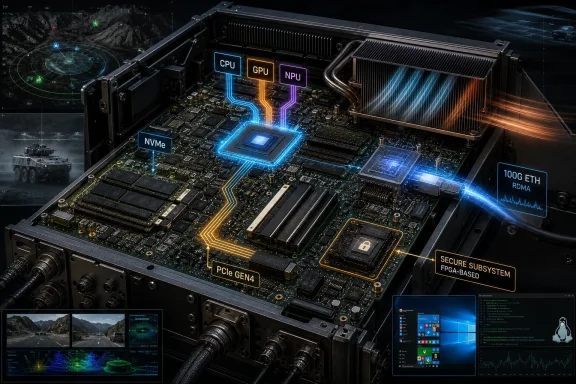
Abaco Systems has introduced the SBC3618, an Intel Core Ultra Series 3 single-board computer aligned with the SOSA compute-intensive profile. It combines CPU, GPU, and NPU acceleration with a 100G Ethernet data plane, RDMA, PCIe Gen4 expansion, configurable power, and Windows and Linux support. Early-access hardware is available now, while production is planned for Q1 2027. The immediate takeaway for prospective buyers is straightforward: use the early-access period to validate concurrent CPU, GPU, and NPU operation, 100G RDMA, the intended power mode, chassis cooling, and the complete operating-system and driver stack before committing to the production design.
The SBC3618 is best understood as an attempt to consolidate several computing roles into one rugged, standards-aligned card. Abaco is positioning heterogeneous local acceleration, high-speed data movement, and a programmable power envelope as a foundation for sensor fusion, autonomy, electronic warfare, and tactical-edge AI. For Windows and Linux integrators, the central question is not whether the board has attractive specifications. It is whether those capabilities can operate together, continuously and predictably, inside the constraints of a deployed sensor system.
The value proposition is therefore not simply “three processors in one.” It is the ability to partition a sensor-processing pipeline across the hardware that best suits each stage without automatically adding a separate accelerator card.
A tactical platform might use CPU resources for control and application logic, GPU resources for parallel preprocessing, and the NPU for portions of an inference pipeline. Other designs might leave signal processing on specialized FPGA or acquisition hardware while using the SBC3618 for orchestration, fusion, inference, networking, and storage management. The available network and expansion interfaces leave room for either a consolidated or distributed architecture.
This flexibility does not make workload placement automatic. An application benefits from the NPU only if its model, framework, compiler, runtime, operators, and drivers provide a usable execution path. Unsupported operations may fall back to the CPU or GPU, changing latency and power consumption. Some workloads may remain more practical on the GPU, while others may be limited by memory movement, storage, or network ingestion rather than arithmetic throughput.
The SBC3618 should consequently be evaluated as a heterogeneous platform rather than reduced to a single processor-performance number. Its practical advantage will depend on the interaction among its computing engines, memory system, network interfaces, storage, power policy, cooling configuration, drivers, and application software.
At the tactical edge, theoretical peak performance is secondary to what can be sustained inside an enclosure with strict limits on heat, airflow, electrical supply, space, and reliability. A processor that delivers high throughput briefly may be less useful than a more conservatively configured system that maintains predictable operation for hours under a realistic sensor load.
According to Abaco, the SBC3618 provides a programmable 15-to-65W power envelope. This gives integrators a broad tuning range, but it also means that “SBC3618 performance” is incomplete unless the configured power level, cooling system, workload, ambient conditions, and duration of the test are disclosed.
Results obtained at 65W cannot be assumed at 15W. Conversely, operating near the upper end may require cooling and power-distribution capacity that a particular chassis cannot provide. The lower range may be appropriate for missions that prioritize energy efficiency, limited cooling capacity, or platform endurance. Higher settings may provide more headroom for concurrent processing, provided the enclosure can remove the resulting heat.
A configurable envelope could allow one basic board architecture to serve several platform designs, reducing software variation across deployments. It can also complicate comparisons if benchmark results are published without identifying the operating mode. Integrators should insist that all performance data include the power setting and thermal conditions under which it was recorded.
Abaco plans convection- and conduction-cooled variants. These labels describe two general cooling approaches, but they should not be interpreted as confirmation of every mechanical or thermal implementation detail before the relevant product documentation is reviewed.
The shared processor and power specifications do not establish that the two variants will deliver identical sustained performance in every enclosure. Cooling is a system-level property. Chassis construction, ambient temperature, card spacing, adjacent heat sources, fan behavior where applicable, conductive interfaces, and power distribution can all affect the processor state that can be maintained.
Early-access testing should therefore use a representative chassis rather than only an open development bench. A bench result can help with software development, but it may reveal little about sustained clocks, latency, or throttling in the final platform.
That context is important. A high-performance board may solve an immediate processing problem, but proprietary dependencies can make its eventual replacement costly. The larger objective of a modular architecture is to let systems evolve by replacing compatible functional elements rather than rebuilding the entire sensor platform around each generation of compute hardware.
The wording nevertheless requires precision. SOSA aligned is not automatically the same as formally certified, qualified for a particular mission, or proven interoperable in a customer’s completed system. Alignment describes a relationship to the applicable architectural profile and interfaces. Integration is still required across the backplane, switching fabric, management plane, timing design, software stack, security controls, cooling system, and environmental requirements.
This distinction is particularly important during early access. A card may target the correct slot profile while firmware, drivers, platform-management behavior, thermal controls, documentation, and optional features continue to mature. Physical compatibility alone does not demonstrate that another component can be substituted without exposing hidden dependencies.
The SBC3618 should therefore be judged not only on CPU, GPU, or NPU throughput but also on its behavior as a replaceable element in a longer-lived modular system. Interface documentation, management support, driver packaging, firmware policy, error reporting, production continuity, and upgrade procedures may prove as consequential as raw inference performance.
Prospective buyers should ask Abaco to identify the exact profile and revision targeted by the board, the status of any applicable conformance work, and the interfaces that will be supported in early-access and production configurations. Those answers belong in the system qualification plan rather than being inferred from the SOSA-aligned label.
Radar, electronic-warfare, imaging, and multi-sensor systems can generate streams that must move among acquisition hardware, processing cards, storage, accelerators, and network endpoints. Repeatedly copying those streams through conventional software paths can consume CPU resources and add latency. RDMA is designed to reduce portions of that overhead by enabling more direct movement between memory regions on connected systems.
The inclusion of RDMA does not guarantee 100G application throughput. Performance will depend on the network interface implementation, packet sizes, protocol configuration, switches, peer hardware, memory behavior, queues, drivers, CPU involvement, and the application’s ability to consume incoming data. The relevant measurement is not merely link rate but useful payload throughput and latency under the complete mission workload.
Pairing a 100G data plane with CPU, GPU, and NPU acceleration is nevertheless a coherent design choice. Integrated accelerators are valuable only if data can reach the appropriate processing engine without overwhelming the CPU with transfer and copy operations.
PCIe Gen4 provides another path for expansion. A deployment may require specialized acquisition interfaces, additional storage, FPGA resources, or other mission-specific hardware that is not included on the base card. The SBC3618 can then serve as the general-purpose compute and management anchor while specialized processing remains elsewhere in the system.
There is a useful architectural tension here. Integrated accelerators encourage consolidation, while high-speed network and expansion interfaces preserve distributed processing options. That is not a contradiction. It allows an integrator to decide where each workload belongs rather than being forced into a CPU-only, discrete-GPU, or fully centralized design.
Up to 64GB of LPDDR5 memory and up to 1TB of NVMe storage support this role but also establish boundaries. The memory capacity may accommodate substantial applications and local models, but model size is only one consideration. Working sets, buffering, intermediate data, operating-system overhead, and concurrent applications all compete for capacity and bandwidth.
Likewise, 1TB of NVMe storage may provide useful local working space, but temporary buffering and long-duration mission recording are different requirements. Buyers will need details about the supplied storage option, endurance, sustained writes, error reporting, power-loss behavior, sanitization, replacement, and environmental qualification. A headline capacity does not answer those operational questions.
A deterministic network design can help prioritize time-critical traffic, coordinate distributed components, and control the jitter introduced when urgent and non-urgent flows compete for resources. For some systems, a known delivery interval is more important than another increment of average throughput.
The word optional is significant. Integrators should not assume that every SBC3618 configuration includes the required TSN capability or that it becomes operational through a single software toggle. The complete implementation may depend on the ordered hardware, compatible switches, time sources, synchronization design, network configuration, operating-system support, and drivers.
Windows support does not by itself establish hard real-time behavior. Determinism must be assessed across the entire chain, including firmware, interrupt handling, drivers, scheduling, protocol stacks, network devices, synchronization, and the application. The same principle applies to Linux: the ability to configure the operating system extensively does not make an unqualified installation deterministic.
Teams that require TSN should define measurable acceptance criteria before testing. These might include maximum and percentile latency, jitter, loss behavior, synchronization accuracy, recovery after link interruption, and performance while the CPU, GPU, NPU, storage, and network are all active. Without such criteria, “deterministic” risks becoming a descriptive label rather than a verified system property.
That may be valuable because a programmable component outside the main host processor can support controls that do not depend entirely on the operating system. However, the available product description does not establish every security function that will be implemented, enabled, or delivered to customers.
“FPGA-backed security” should therefore be treated as an architectural description rather than a complete assurance claim. Integrators need to determine what the subsystem measures or verifies, which components establish the root of trust, how keys and identities are provisioned, how firmware is authenticated, what occurs after a validation failure, and which interfaces remain accessible before the host is trusted.
The update model is equally important. Programmability enables adaptation, but it introduces another security-sensitive firmware artifact that must be developed, reviewed, signed, provisioned, updated, audited, and recovered. Customers should ask whether updates are performed in the field, how rollback is controlled, how failed updates are handled, and which party owns the configuration over the system’s life.
For Windows deployments, a protected startup path does not eliminate vulnerabilities in drivers, applications, services, update packages, management tooling, or AI runtimes. Operating-system controls likewise cannot compensate for weak board firmware or programmable-logic management. The security architecture must span the FPGA, host processor, platform firmware, storage, operating system, drivers, network, applications, credentials, updates, and administrative workflow.
Security-sensitive customers should expect implementation documentation and lifecycle commitments before treating the subsystem as a basis for accreditation or mission assurance. The appropriate question is not whether an FPGA is present. It is what verified security boundary the FPGA creates and how that boundary is maintained.
Windows and Linux should not be assumed to offer identical feature maturity. Accelerator drivers, AI runtimes, RDMA support, diagnostics, power controls, management utilities, security functions, and optional TSN capabilities may have different dependencies or release schedules.
Abaco has announced support for both operating-system families, but buyers still need the exact supported versions, editions, installation images, driver packages, update model, and lifecycle commitments. These are not secondary procurement details. They determine whether the board can be integrated into a controlled deployment and sustained through the mission’s expected life.
The NPU is a particularly important part of that matrix. Hardware inclusion alone does not ensure that an existing AI application can use it. Model formats, operator coverage, compilers, runtime versions, quantization requirements, fallback behavior, and diagnostic tooling all affect the result. A model that falls back silently to CPU execution may appear functional while missing its power or latency target.
The integrated GPU presents similar questions. Some workloads may map efficiently to it, while others may need substantial optimization or remain better suited to external processing hardware. Heterogeneous computing offers flexibility, but it also expands the number of software combinations that must be tested.
Windows administrators must additionally consider servicing, recovery, code signing, endpoint controls, logging, and driver deployment. An update that would be routine on an office PC may require formal regression testing when it can affect accelerator operation, network latency, storage behavior, or synchronization.
The SBC3618 may reduce the number of separate computing devices in a platform, but it does not automatically reduce the number of engineering disciplines required to qualify the system. Embedded development, Windows or Linux administration, networking, security, thermal engineering, AI optimization, and mission-software validation all intersect on the same card.
That distinction should control the early-access program. Buyers should test the complete mission path: ingest data over the planned interface, move it through the actual memory and software stack, execute CPU control logic, run GPU and NPU workloads concurrently, write representative NVMe traffic, and transmit results through the intended network.
Testing should record more than averages. Teams should capture sustained clocks, temperatures, power draw, memory bandwidth, accelerator utilization, latency distributions, queue depth, network loss, storage behavior, throttling, driver errors, and recovery after interrupted links, failed applications, or power events.
Resource contention deserves special attention. Integration reduces the physical complexity of a multi-card design, but it does not eliminate shared resources. CPU, GPU, NPU, memory, storage, and I/O can affect one another. A workload that performs well by itself may behave differently when another engine begins moving data or when network and storage traffic peak simultaneously.
The final acceptance report should tie every result to the hardware revision, firmware version, driver package, operating-system build, power setting, cooling setup, chassis, ambient temperature, and workload version. Without that context, an early-access benchmark will be difficult to reproduce when production hardware arrives.
It should not be interpreted as proof that every product detail is frozen. Early hardware can be accompanied by evolving firmware, drivers, documentation, management utilities, thermal policies, and optional feature support. Customers should ask Abaco to identify which elements are expected to remain stable and which may change.
A useful program will establish formal checkpoints rather than treating the unit as a demonstration platform:
This staged approach turns early access into a risk-reduction exercise. It also provides a defensible basis for deciding whether consolidation is helping. A single card is not simpler if it introduces unresolved dependencies among drivers, accelerators, networking, storage, thermal controls, and security firmware.
The absence of published application benchmarks means the strongest differentiator is currently the integration strategy, not a demonstrated performance victory. If Abaco can provide useful concurrent CPU, GPU, and NPU processing within the selected thermal envelope—and preserve predictable data movement, robust software support, and clearly defined security behavior—the SBC3618 could replace several layers of hardware complexity with one modular compute element.
That is also where the risk resides. Consolidation concentrates responsibility. One card may become responsible for control, inference, networking, local storage, and portions of the platform’s security architecture. A thermal limit, driver regression, firmware defect, or resource-contention problem could therefore affect more of the mission at once.
Early access is the opportunity to determine whether that tradeoff works before production begins in Q1 2027. Buyers should not commit on the strength of CPU, GPU, NPU, memory, or network specifications viewed separately. They should commit only after validating concurrent acceleration, 100G RDMA, the selected 15-to-65W operating point, representative cooling, and the full Windows or Linux driver stack.
The broader direction is clear: tactical-edge AI is moving beyond the question of whether inference can run locally. The next contest is whether local AI can coexist with high-rate sensor ingestion, predictable communications, existing applications, security controls, storage, and strict power limits without becoming operationally fragile. The SBC3618 is Abaco’s proposed answer. The early-access period is when integrators must determine whether that answer survives contact with the complete system.
The SBC3618 is best understood as an attempt to consolidate several computing roles into one rugged, standards-aligned card. Abaco is positioning heterogeneous local acceleration, high-speed data movement, and a programmable power envelope as a foundation for sensor fusion, autonomy, electronic warfare, and tactical-edge AI. For Windows and Linux integrators, the central question is not whether the board has attractive specifications. It is whether those capabilities can operate together, continuously and predictably, inside the constraints of a deployed sensor system.
 Early-access action checklist
- Obtain the SBC3618 datasheet and confirm the exact early-access configuration, including memory capacity, NVMe storage, cooling variant, networking, security components, and optional TSN support.
- Request the supported Windows and Linux releases, driver matrix, accelerator runtimes, firmware-update procedure, recovery process, and planned software lifecycle.
- Benchmark simultaneous CPU, GPU, NPU, RDMA, and NVMe activity rather than testing each subsystem only in isolation.
- Run the intended workloads at the selected point within the programmable 15-to-65W envelope and record sustained performance, latency, temperatures, and throttling behavior.
- Test the convection- or conduction-cooled card inside a representative chassis under realistic ambient conditions and neighboring-card loads.
- Validate 100G Ethernet and RDMA with the actual switches, peer devices, packet profiles, memory paths, and application software intended for deployment.
- Determine whether optional TSN is required and identify the associated hardware, clocking, network, driver, and operating-system dependencies.
- Define what the Xilinx Zynq UltraScale+ security subsystem protects, how it is provisioned, and how updates, failures, and recovery are handled.
- Confirm which early-access hardware, firmware, driver, and documentation elements may change before production begins in Q1 2027.
- Document the regression and requalification work that will be required when production hardware and final software packages become available.
Abaco Is Selling Consolidation, Not Merely More Compute
The headline feature is hybrid acceleration across the Intel processor’s CPU, GPU, and NPU. Those engines overlap in some of the work they can execute, but they are suited to different roles. The CPU remains the general-purpose platform for operating-system services, orchestration, control logic, and existing x86 applications. The GPU offers parallel throughput for compatible image, signal, and model-processing workloads. The NPU provides a potentially more power-efficient execution target for supported inference operations.The value proposition is therefore not simply “three processors in one.” It is the ability to partition a sensor-processing pipeline across the hardware that best suits each stage without automatically adding a separate accelerator card.
A tactical platform might use CPU resources for control and application logic, GPU resources for parallel preprocessing, and the NPU for portions of an inference pipeline. Other designs might leave signal processing on specialized FPGA or acquisition hardware while using the SBC3618 for orchestration, fusion, inference, networking, and storage management. The available network and expansion interfaces leave room for either a consolidated or distributed architecture.
This flexibility does not make workload placement automatic. An application benefits from the NPU only if its model, framework, compiler, runtime, operators, and drivers provide a usable execution path. Unsupported operations may fall back to the CPU or GPU, changing latency and power consumption. Some workloads may remain more practical on the GPU, while others may be limited by memory movement, storage, or network ingestion rather than arithmetic throughput.
The SBC3618 should consequently be evaluated as a heterogeneous platform rather than reduced to a single processor-performance number. Its practical advantage will depend on the interaction among its computing engines, memory system, network interfaces, storage, power policy, cooling configuration, drivers, and application software.
The 15-to-65W Envelope Defines the Real Product
“Our customers are pushing more autonomy and more AI into the platform, and they need it inside a power and thermal envelope that fits the mission,” said Simon Collins, Director of Product Management at Abaco Systems. That statement identifies the engineering problem more clearly than a list of accelerators does.At the tactical edge, theoretical peak performance is secondary to what can be sustained inside an enclosure with strict limits on heat, airflow, electrical supply, space, and reliability. A processor that delivers high throughput briefly may be less useful than a more conservatively configured system that maintains predictable operation for hours under a realistic sensor load.
According to Abaco, the SBC3618 provides a programmable 15-to-65W power envelope. This gives integrators a broad tuning range, but it also means that “SBC3618 performance” is incomplete unless the configured power level, cooling system, workload, ambient conditions, and duration of the test are disclosed.
Results obtained at 65W cannot be assumed at 15W. Conversely, operating near the upper end may require cooling and power-distribution capacity that a particular chassis cannot provide. The lower range may be appropriate for missions that prioritize energy efficiency, limited cooling capacity, or platform endurance. Higher settings may provide more headroom for concurrent processing, provided the enclosure can remove the resulting heat.
A configurable envelope could allow one basic board architecture to serve several platform designs, reducing software variation across deployments. It can also complicate comparisons if benchmark results are published without identifying the operating mode. Integrators should insist that all performance data include the power setting and thermal conditions under which it was recorded.
Abaco plans convection- and conduction-cooled variants. These labels describe two general cooling approaches, but they should not be interpreted as confirmation of every mechanical or thermal implementation detail before the relevant product documentation is reviewed.
| Deployment variant | General cooling definition | Processor platform | Programmable envelope | Announced OS support |
|---|---|---|---|---|
| Convection-cooled SBC3618 | Generally uses moving or ambient air as part of the heat-removal path; exact SBC3618 requirements must be confirmed with Abaco | Intel Core Ultra Series 3 | 15 to 65W | Linux and Windows |
| Conduction-cooled SBC3618 | Generally conducts heat through card and chassis structures; exact SBC3618 interfaces and limits must be confirmed with Abaco | Intel Core Ultra Series 3 | 15 to 65W | Linux and Windows |
Early-access testing should therefore use a representative chassis rather than only an open development bench. A bench result can help with software development, but it may reveal little about sustained clocks, latency, or throttling in the final platform.
SOSA Alignment Is About the Upgrade Path
The SBC3618 is described as aligned with the Sensor Open Systems Architecture compute-intensive profile. In practical procurement terms, SOSA alignment is intended to support modular system construction around defined interfaces and profiles, allowing integrators to pursue interoperability, component reuse, and future upgrades without treating every board replacement as a complete architecture redesign.That context is important. A high-performance board may solve an immediate processing problem, but proprietary dependencies can make its eventual replacement costly. The larger objective of a modular architecture is to let systems evolve by replacing compatible functional elements rather than rebuilding the entire sensor platform around each generation of compute hardware.
The wording nevertheless requires precision. SOSA aligned is not automatically the same as formally certified, qualified for a particular mission, or proven interoperable in a customer’s completed system. Alignment describes a relationship to the applicable architectural profile and interfaces. Integration is still required across the backplane, switching fabric, management plane, timing design, software stack, security controls, cooling system, and environmental requirements.
This distinction is particularly important during early access. A card may target the correct slot profile while firmware, drivers, platform-management behavior, thermal controls, documentation, and optional features continue to mature. Physical compatibility alone does not demonstrate that another component can be substituted without exposing hidden dependencies.
The SBC3618 should therefore be judged not only on CPU, GPU, or NPU throughput but also on its behavior as a replaceable element in a longer-lived modular system. Interface documentation, management support, driver packaging, firmware policy, error reporting, production continuity, and upgrade procedures may prove as consequential as raw inference performance.
Prospective buyers should ask Abaco to identify the exact profile and revision targeted by the board, the status of any applicable conformance work, and the interfaces that will be supported in early-access and production configurations. Those answers belong in the system qualification plan rather than being inferred from the SOSA-aligned label.
A 100G Data Plane Prevents the Processor From Becoming an Island
The SBC3618 includes a 100G Ethernet data plane with remote direct memory access, along with PCIe Gen4 expansion. Those capabilities reflect a practical constraint of sensor computing: workloads can become limited by data movement before they exhaust available arithmetic performance.Radar, electronic-warfare, imaging, and multi-sensor systems can generate streams that must move among acquisition hardware, processing cards, storage, accelerators, and network endpoints. Repeatedly copying those streams through conventional software paths can consume CPU resources and add latency. RDMA is designed to reduce portions of that overhead by enabling more direct movement between memory regions on connected systems.
The inclusion of RDMA does not guarantee 100G application throughput. Performance will depend on the network interface implementation, packet sizes, protocol configuration, switches, peer hardware, memory behavior, queues, drivers, CPU involvement, and the application’s ability to consume incoming data. The relevant measurement is not merely link rate but useful payload throughput and latency under the complete mission workload.
Pairing a 100G data plane with CPU, GPU, and NPU acceleration is nevertheless a coherent design choice. Integrated accelerators are valuable only if data can reach the appropriate processing engine without overwhelming the CPU with transfer and copy operations.
PCIe Gen4 provides another path for expansion. A deployment may require specialized acquisition interfaces, additional storage, FPGA resources, or other mission-specific hardware that is not included on the base card. The SBC3618 can then serve as the general-purpose compute and management anchor while specialized processing remains elsewhere in the system.
There is a useful architectural tension here. Integrated accelerators encourage consolidation, while high-speed network and expansion interfaces preserve distributed processing options. That is not a contradiction. It allows an integrator to decide where each workload belongs rather than being forced into a CPU-only, discrete-GPU, or fully centralized design.
Up to 64GB of LPDDR5 memory and up to 1TB of NVMe storage support this role but also establish boundaries. The memory capacity may accommodate substantial applications and local models, but model size is only one consideration. Working sets, buffering, intermediate data, operating-system overhead, and concurrent applications all compete for capacity and bandwidth.
Likewise, 1TB of NVMe storage may provide useful local working space, but temporary buffering and long-duration mission recording are different requirements. Buyers will need details about the supplied storage option, endurance, sustained writes, error reporting, power-loss behavior, sanitization, replacement, and environmental qualification. A headline capacity does not answer those operational questions.
Optional TSN Separates Fast Networking From Predictable Networking
Abaco says the SBC3618 can support optional time-sensitive networking for deterministic, low-latency communications. TSN matters because high bandwidth and predictable delivery are different properties. A network can move large volumes of data while still displaying timing variation that is unsuitable for tightly coordinated control or sensor operations.A deterministic network design can help prioritize time-critical traffic, coordinate distributed components, and control the jitter introduced when urgent and non-urgent flows compete for resources. For some systems, a known delivery interval is more important than another increment of average throughput.
The word optional is significant. Integrators should not assume that every SBC3618 configuration includes the required TSN capability or that it becomes operational through a single software toggle. The complete implementation may depend on the ordered hardware, compatible switches, time sources, synchronization design, network configuration, operating-system support, and drivers.
Windows support does not by itself establish hard real-time behavior. Determinism must be assessed across the entire chain, including firmware, interrupt handling, drivers, scheduling, protocol stacks, network devices, synchronization, and the application. The same principle applies to Linux: the ability to configure the operating system extensively does not make an unqualified installation deterministic.
Teams that require TSN should define measurable acceptance criteria before testing. These might include maximum and percentile latency, jitter, loss behavior, synchronization accuracy, recovery after link interruption, and performance while the CPU, GPU, NPU, storage, and network are all active. Without such criteria, “deterministic” risks becoming a descriptive label rather than a verified system property.
FPGA-Backed Security Must Be Defined Before It Can Be Trusted
Collins describes the SBC3618 as providing “real-time AI processing, FPGA-backed security, and optional TSN, all on a SOSA aligned card.” The product uses Xilinx Zynq UltraScale+ technology in connection with its security architecture, giving Abaco a programmable subsystem that can participate in platform-protection functions.That may be valuable because a programmable component outside the main host processor can support controls that do not depend entirely on the operating system. However, the available product description does not establish every security function that will be implemented, enabled, or delivered to customers.
“FPGA-backed security” should therefore be treated as an architectural description rather than a complete assurance claim. Integrators need to determine what the subsystem measures or verifies, which components establish the root of trust, how keys and identities are provisioned, how firmware is authenticated, what occurs after a validation failure, and which interfaces remain accessible before the host is trusted.
The update model is equally important. Programmability enables adaptation, but it introduces another security-sensitive firmware artifact that must be developed, reviewed, signed, provisioned, updated, audited, and recovered. Customers should ask whether updates are performed in the field, how rollback is controlled, how failed updates are handled, and which party owns the configuration over the system’s life.
For Windows deployments, a protected startup path does not eliminate vulnerabilities in drivers, applications, services, update packages, management tooling, or AI runtimes. Operating-system controls likewise cannot compensate for weak board firmware or programmable-logic management. The security architecture must span the FPGA, host processor, platform firmware, storage, operating system, drivers, network, applications, credentials, updates, and administrative workflow.
Security-sensitive customers should expect implementation documentation and lifecycle commitments before treating the subsystem as a basis for accreditation or mission assurance. The appropriate question is not whether an FPGA is present. It is what verified security boundary the FPGA creates and how that boundary is maintained.
Windows Support Broadens the Audience—and the Qualification Burden
Linux support is expected in embedded and sensor computing, where developers often require detailed control over deployment images, kernels, drivers, networking, and timing behavior. Windows support is strategically notable because it opens the SBC3618 to teams using Microsoft development tools, Windows-native applications, established operator interfaces, and existing x86 software.Windows and Linux should not be assumed to offer identical feature maturity. Accelerator drivers, AI runtimes, RDMA support, diagnostics, power controls, management utilities, security functions, and optional TSN capabilities may have different dependencies or release schedules.
Abaco has announced support for both operating-system families, but buyers still need the exact supported versions, editions, installation images, driver packages, update model, and lifecycle commitments. These are not secondary procurement details. They determine whether the board can be integrated into a controlled deployment and sustained through the mission’s expected life.
The NPU is a particularly important part of that matrix. Hardware inclusion alone does not ensure that an existing AI application can use it. Model formats, operator coverage, compilers, runtime versions, quantization requirements, fallback behavior, and diagnostic tooling all affect the result. A model that falls back silently to CPU execution may appear functional while missing its power or latency target.
The integrated GPU presents similar questions. Some workloads may map efficiently to it, while others may need substantial optimization or remain better suited to external processing hardware. Heterogeneous computing offers flexibility, but it also expands the number of software combinations that must be tested.
Windows administrators must additionally consider servicing, recovery, code signing, endpoint controls, logging, and driver deployment. An update that would be routine on an office PC may require formal regression testing when it can affect accelerator operation, network latency, storage behavior, or synchronization.
The SBC3618 may reduce the number of separate computing devices in a platform, but it does not automatically reduce the number of engineering disciplines required to qualify the system. Embedded development, Windows or Linux administration, networking, security, thermal engineering, AI optimization, and mission-software validation all intersect on the same card.
What Is Known, What Is Not Published, and What Buyers Must Test
The announced configuration provides a clear outline of the SBC3618:- Intel Core Ultra Series 3 processing with CPU, GPU, and NPU resources.
- A programmable 15-to-65W power envelope.
- Convection- and conduction-cooled variants.
- Up to 64GB of LPDDR5 memory.
- Up to 1TB of NVMe storage.
- A 100G Ethernet data plane with RDMA.
- PCIe Gen4 expansion.
- Linux and Windows support.
- Optional TSN.
- Xilinx Zynq UltraScale+ technology associated with FPGA-backed security.
- Early-access availability now and planned production in Q1 2027.
That distinction should control the early-access program. Buyers should test the complete mission path: ingest data over the planned interface, move it through the actual memory and software stack, execute CPU control logic, run GPU and NPU workloads concurrently, write representative NVMe traffic, and transmit results through the intended network.
Testing should record more than averages. Teams should capture sustained clocks, temperatures, power draw, memory bandwidth, accelerator utilization, latency distributions, queue depth, network loss, storage behavior, throttling, driver errors, and recovery after interrupted links, failed applications, or power events.
Resource contention deserves special attention. Integration reduces the physical complexity of a multi-card design, but it does not eliminate shared resources. CPU, GPU, NPU, memory, storage, and I/O can affect one another. A workload that performs well by itself may behave differently when another engine begins moving data or when network and storage traffic peak simultaneously.
The final acceptance report should tie every result to the hardware revision, firmware version, driver package, operating-system build, power setting, cooling setup, chassis, ambient temperature, and workload version. Without that context, an early-access benchmark will be difficult to reproduce when production hardware arrives.
Early Access Creates a Useful but Time-Limited Engineering Window
Early-access units are available now, while production is scheduled for Q1 2027. That interval gives customers time to develop software, validate interfaces, characterize cooling, and discover system-level dependencies before production deployments begin.It should not be interpreted as proof that every product detail is frozen. Early hardware can be accompanied by evolving firmware, drivers, documentation, management utilities, thermal policies, and optional feature support. Customers should ask Abaco to identify which elements are expected to remain stable and which may change.
A useful program will establish formal checkpoints rather than treating the unit as a demonstration platform:
| Program phase | Primary objective | Evidence to retain |
|---|---|---|
| Initial bring-up | Confirm boot, management, storage, networking, and accelerator visibility | Hardware revision, firmware inventory, OS image, driver versions, baseline logs |
| Software enablement | Establish CPU, GPU, and NPU execution paths | Runtime versions, supported operators, fallback behavior, functional test results |
| Data-path validation | Exercise 100G Ethernet, RDMA, PCIe, memory, and NVMe | Throughput, latency, utilization, loss, queue behavior, error logs |
| Thermal qualification | Test selected power modes and cooling configuration | Sustained clocks, temperatures, throttling, chassis and ambient conditions |
| Integrated workload | Run the representative mission pipeline concurrently | End-to-end latency, power, resource contention, stability, recovery results |
| Production transition | Repeat critical tests on production-intent hardware and software | Change list, regression results, accepted deviations, requalification record |
The SBC3618’s Most Important Claims Are the Ones Integrators Must Prove
The SBC3618 combines several credible architectural choices: heterogeneous local acceleration, a configurable power range, high-speed data movement, modular alignment, programmable security support, and two cooling options. Its value will depend on whether those capabilities remain effective when exercised together rather than separately.The absence of published application benchmarks means the strongest differentiator is currently the integration strategy, not a demonstrated performance victory. If Abaco can provide useful concurrent CPU, GPU, and NPU processing within the selected thermal envelope—and preserve predictable data movement, robust software support, and clearly defined security behavior—the SBC3618 could replace several layers of hardware complexity with one modular compute element.
That is also where the risk resides. Consolidation concentrates responsibility. One card may become responsible for control, inference, networking, local storage, and portions of the platform’s security architecture. A thermal limit, driver regression, firmware defect, or resource-contention problem could therefore affect more of the mission at once.
Early access is the opportunity to determine whether that tradeoff works before production begins in Q1 2027. Buyers should not commit on the strength of CPU, GPU, NPU, memory, or network specifications viewed separately. They should commit only after validating concurrent acceleration, 100G RDMA, the selected 15-to-65W operating point, representative cooling, and the full Windows or Linux driver stack.
The broader direction is clear: tactical-edge AI is moving beyond the question of whether inference can run locally. The next contest is whether local AI can coexist with high-rate sensor ingestion, predictable communications, existing applications, security controls, storage, and strict power limits without becoming operationally fragile. The SBC3618 is Abaco’s proposed answer. The early-access period is when integrators must determine whether that answer survives contact with the complete system.
References
- Primary source: Electronics Weekly
Published: 2026-07-09T15:30:10.535859
Loading…
www.electronicsweekly.com - Related coverage: newsroom.intel.com
Loading…
newsroom.intel.com - Related coverage: intel.com
Loading…
www.intel.com - Related coverage: download.intel.com
- Related coverage: community.intel.com
Loading…
community.intel.com - Related coverage: builders.intel.com
Loading…
builders.intel.com