

The Medium Score Hides an Industrial-Grade Problem
On paper, CVE-2025-11044 is a medium-severity vulnerability under CVSS 3.1, carrying a 6.8 score. In the enterprise IT world, that often lands somewhere below the queue of remote-code-execution flaws, credential leaks, edge-device bugs, and exploited zero-days. In operational technology, however, a denial-of-service flaw against a runtime environment deserves a different reading.
Automation Runtime is not another desktop service waiting for a patch window after lunch. It is the software layer running B&R automation systems, the kind of product that lives close to machinery, production timing, and process reliability. If the affected node stops, the business impact is not measured only in event logs or help desk tickets. It can mean a stopped machine, a halted line, scrap, downtime, or an emergency maintenance call at exactly the wrong moment.
That distinction is the heart of the advisory. The vulnerability sits in the ANSL-Server component and stems from allocation of resources without sufficient limits or throttling. ABB says an unauthenticated attacker with network access could win a race condition and cause permanent denial-of-service conditions on affected devices. The phrasing is dry, but the operational meaning is blunt: the attacker does not need credentials, and the target does not merely slow down.
The comforting part is that exploitation is not described as trivial in the older CVSS 3.1 scoring. Attack complexity is high, and ABB says the vulnerability cannot be exploited on all devices or across all customer applications. The uncomfortable part is that “not everywhere” is not the same as “not here.” In a plant full of long-lived automation assets, undocumented exceptions, legacy project settings, and flat-enough networks, the only answer that matters is whether a specific deployment is exposed.
The Bug Is About Timing, Not Secrets
The most important thing to understand about this vulnerability is what it is not. It does not appear to disclose confidential information. It does not appear to alter logic, rewrite a program, or grant an attacker administrative access. It is not a conventional breach story where the villain steals credentials and pivots through a domain.
Instead, it attacks the basic bargain every runtime system makes with its environment: send me work, and I will handle it in bounded, predictable ways. CWE-770, the weakness category assigned here, is about allocating resources without limits or throttling. In plain English, the system accepts more work, or handles work in a way that can consume resources, without enforcing sufficient guardrails.
That kind of problem is easy to underappreciate because it sounds like engineering hygiene rather than cybersecurity. Yet industrial systems are engineered around timing assumptions. Scan cycles, task priorities, communication windows, watchdog behavior, and device responsiveness are not abstractions. They are the rhythm of the machine.
ABB’s own mitigation language points in that direction. The company says shorter cycle times in customer projects increase the likelihood of potential exploitation. That is a revealing sentence. It means the vulnerability is not merely about whether a port is open; it is about how the runtime behaves under load, how much timing slack exists, and how much stress the application can tolerate before the wrong race is won.
In IT security, we often describe denial of service as a volume problem. Flood the server, exhaust a resource, knock over the service. In OT, the more interesting cases are not always brute-force floods. They are mismatches between deterministic control expectations and messy network reality. A crafted message, a badly bounded server component, and a stressed runtime can be enough to turn a software weakness into a production event.
Permanent Denial of Service Changes the Risk Conversation
The advisory’s use of “permanent denial-of-service” deserves attention. Temporary service degradation is one category of risk. A device that stops and requires intervention is another. In a factory or process environment, the difference between a transient hiccup and a persistent stop can decide whether an incident is handled by normal operations or escalates into an outage.
Permanent does not necessarily mean physically damaged. It usually means the affected system remains unavailable until recovered through some manual, operational, or maintenance action. But even that more conservative reading is serious. If recovery requires someone to access a cabinet, restart equipment, reload software, coordinate with production, or validate safety conditions, the security event has crossed into operational scheduling.
That is why availability flaws in industrial products can carry a sharper edge than their CVSS labels suggest. CVSS is useful, but it is not a production-impact model. It does not know whether the controller runs a packaging machine, a test bench, a utility subsystem, or a process with limited restart opportunities. It does not know whether the affected device is one of many redundant nodes or a lonely control point installed years ago and rarely touched.
The advisory also says there were no known reports of exploitation when ABB originally issued it. That lowers the temperature, but it should not lull operators into treating the issue as theoretical. ICS vulnerabilities often live in a strange middle ground: not widely exploited at disclosure, but highly consequential if discovered by the wrong actor with the right access. The limiting factor is frequently not technical feasibility alone; it is network reach.
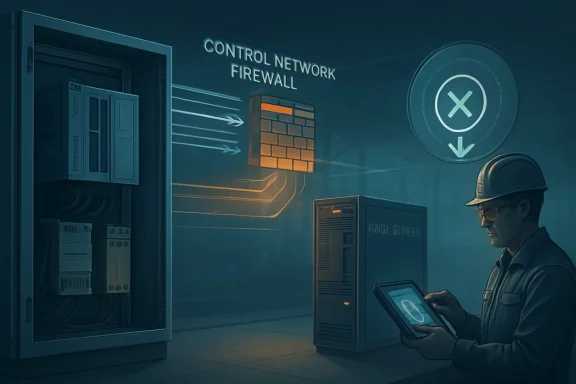
This is where the old security perimeter comes back into focus. ABB says Automation Runtime is designed to operate on Level 1 of the ABB ICS Cyber Security Reference Architecture. Exploitation from outside that level would require bypassing the Control Network Firewall. That is a valuable architectural assumption, but it is also a testable claim for asset owners. If the firewall is misconfigured, bypassed, overloaded with exceptions, or blurred by remote access paths, the design assumption becomes a hope.
CISA’s Republication Turns a Vendor Fix Into a Plant-Floor Deadline
The advisory began as ABB PSIRT SA25P005, issued on January 19, 2026. CISA’s May 5, 2026 republication does not appear to add a new technical bombshell; it increases visibility. That matters because ICS security advisories do not always land where they need to land.
In many organizations, vendor PSIRT advisories are read by security teams, while runtime upgrades are controlled by automation engineers, machine builders, system integrators, or plant maintenance groups. Those worlds overlap more than they used to, but the gap remains real. A CISA ICS advisory acts as a translation layer. It tells security leadership that this is not just a vendor release note, and it tells operations that the vulnerability has entered the broader critical-infrastructure risk register.
The affected sectors listed are also telling. The advisory identifies Critical Manufacturing as the relevant critical infrastructure sector and worldwide deployment as the geographic footprint. That is exactly the kind of environment where patching is least like ordinary IT patching. You do not casually update a runtime on production equipment because a dashboard says “medium.” You plan, test, stage, and hope the machine’s current behavior survives the change.
ABB’s fixed versions are straightforward enough: Automation Runtime 6 is corrected in versions 6.5 and later, and Automation Runtime 4 is corrected in R4.93 and later. The operational path to those versions may be less straightforward. Runtime upgrades can touch validated applications, machine certifications, vendor support matrices, and long-settled assumptions about cycle time and device behavior.
That tension is not a reason to delay indefinitely. It is the reason to start earlier. ICS patch management is slow because it has to be careful, not because it should be optional. The right comparison is not between patching today and patching never; it is between a controlled maintenance window and an unplanned stop caused by someone else choosing the timing.
The Firewall Is a Control, Not a Force Field
ABB’s mitigation advice leans heavily on segmentation and traffic control, as it should. The company recommends limiting maximum data traffic and the maximum number of concurrent connections to the ANSL server at the Control Network Firewall. It also recommends restricting permitted data traffic to no more than 80 percent of the measured peak traffic value after testing maximum load capacity before commissioning.
That is unusually practical guidance because it does not pretend a firewall rule alone solves an application-layer resource problem. It asks operators to measure real load, understand what the application actually does, and then enforce a ceiling with enough headroom to avoid self-inflicted outages. This is less glamorous than threat hunting, but it is closer to how many ICS incidents are prevented.
The catch is that many industrial networks were not built with that kind of precision. They grew over time. A machine gained a remote support connection. A historian needed more data. A vendor laptop needed temporary access that became permanent. A firewall rule was widened during a commissioning crunch and never narrowed. The diagram still shows levels and zones, but the packets tell a more complicated story.
For WindowsForum readers, the analogy is familiar. Every sysadmin has seen a network that looked segmented in Visio and flat in practice. OT networks add the additional complication that the devices behind those lines may not tolerate discovery scans, stress tests, or noisy monitoring the way enterprise servers do. You cannot assume that the normal IT security toolbox can simply be dropped onto Level 1.
The correct response is therefore not “block everything” or “scan everything.” It is to identify where ANSL server exposure exists, determine which devices are running affected Automation Runtime versions, verify whether traffic paths match the intended architecture, and test mitigations with the same respect normally reserved for production changes. The firewall is not magic. It is a control that only works when it reflects the plant’s real traffic and real risk.
Shorter Cycle Times Make Security a Controls Engineering Problem
The most technically interesting line in ABB’s advisory is not the CVE description. It is the mitigation note that shorter cycle times in customer projects increase the likelihood of exploitation. That one sentence drags cybersecurity out of the server room and into controls engineering.
Cycle time is not a decorative setting. It expresses how often control tasks execute and how tightly the system is expected to respond. Shorter cycles can be essential for performance, precision, or process requirements. They also reduce the margin for anything that competes for resources, including network handling in a vulnerable component.
That means the same vulnerability may have different practical risk across deployments. One application may have enough slack that exploitation is unlikely under realistic traffic. Another may run close enough to the edge that carefully timed traffic has a better chance of triggering the race. The CVE is the same, but the plant-specific risk is not.
This is where security teams can get into trouble if they treat industrial advisories like Windows workstation bulletins. A spreadsheet of affected versions is necessary, but insufficient. The runtime version tells you exposure. The application configuration, cycle time, network path, and load profile tell you how frightening that exposure should be.
ABB’s suggested fallback for customers unable to move immediately to a patched version is to consider adjusting application configuration to longer cycle times. That is not a casual knob-twiddle. Lengthening cycle times may affect machine behavior, throughput, quality, or coordination with other systems. It might be a reasonable temporary mitigation in some environments and unacceptable in others.
The point is not that security now gets to rewrite control behavior. The point is that mature OT security requires controls engineers and security engineers to share the same risk conversation. If a vulnerability’s exploitability changes with cycle time, then the people who understand cycle time must be in the room.
The Patch Fixes the Server, but the Advisory Tests the Organization
ABB says the update removes the vulnerability by limiting incoming network traffic handled by the ANSL server component. That is the clean technical answer. Install Automation Runtime 6.5 or later, or Automation Runtime R4.93 or later, and the flawed behavior is corrected.
The organizational answer is messier. First, asset owners must know whether they have affected B&R Automation Runtime deployments. Then they must know which major version line those devices are on. Then they must determine whether upgrading is supported for the specific hardware, application, and vendor package. Then they must test.
That sounds basic, but it remains one of the hardest parts of industrial cybersecurity. Asset inventory in OT is improving, but many environments still rely on tribal knowledge, integrator documentation, old project files, or maintenance records that were never designed for vulnerability response. A vulnerability like this punishes uncertainty. If you cannot quickly answer what runtime versions are deployed, the advisory turns into a discovery project.
There is also the question of ownership. If a machine was delivered as an OEM package, the end user may not feel comfortable updating the runtime without the machine builder. If the line is validated, the quality organization may need to sign off. If the device supports a process with limited downtime, operations may resist any change until the next scheduled outage. None of that is irrational. It is the reality of systems where uptime and safety are the business.
Security teams should resist the urge to frame that reality as stubbornness. The better argument is operational: a controlled update reduces the chance of an uncontrolled stop. A denial-of-service vulnerability against a runtime is not a compliance footnote. It is a maintenance risk with an adversarial trigger.
The Unauthenticated Attacker Still Needs a Path
The phrase “unauthenticated attacker” always raises eyebrows, and rightly so. In this case, it means an attacker does not need valid credentials to exploit the vulnerability once they can reach the affected system node over the network. That is serious. But the network path is not a small detail; it is the central defensive assumption.
ABB’s advisory describes exploitation scenarios that include direct connection to the system network, access through a wrongly configured or penetrated firewall, malicious software on a system node, or otherwise infected network conditions. That is a familiar OT threat model. The attacker does not necessarily begin at the controller. They begin wherever access is easier, then move toward the control network.
This is why remote access remains such a sensitive issue in industrial environments. VPNs, jump hosts, vendor support tools, engineering workstations, and maintenance laptops can all become bridges between ordinary IT compromise and Level 1 assets. The advisory’s network-access requirement is reassuring only if those bridges are controlled, monitored, and kept narrow.
CISA’s recommended practices repeat the standard ICS guidance: minimize exposure, keep control systems off the internet, place them behind firewalls, isolate them from business networks, and use secure remote access when needed. Those recommendations are familiar enough to feel boilerplate. The problem is that boilerplate becomes urgent when a specific network-reachable flaw appears in a runtime layer.
The Windows angle is not incidental. Many engineering workstations, historian servers, remote access hosts, and maintenance laptops in these environments are Windows systems. They are often the practical route into the OT environment, even when the vulnerable runtime itself is not Windows. A Windows estate with weak credential hygiene, unmanaged remote tools, or sluggish patching can become the stepping stone to a controller vulnerability that security teams initially filed under “industrial.”
CVSS 4.0 Makes the Same Bug Look Less Comfortable
The user-facing CISA text highlights the CVSS 3.1 base score of 6.8, a medium severity. Other vulnerability records also show ABB-provided CVSS 4.0 scoring that rates the issue higher, at 8.9. This discrepancy is not a contradiction so much as a lesson in scoring models.
CVSS 3.1 marks the attack complexity as high, which pulls the score down. It also captures high availability impact but no confidentiality or integrity impact. That makes sense for a denial-of-service issue that requires winning a race condition. In many enterprise contexts, a vulnerability with no data exposure and no privilege escalation will struggle to compete for attention.
CVSS 4.0 expresses impact differently, including vulnerable-system and subsequent-system availability concepts. For industrial environments, that framing can feel closer to reality. A stopped device can have consequences beyond the software component itself, even if the attacker never reads a file or changes a value.
This is not an argument to throw out CVSS. It is an argument to stop outsourcing judgment to it. Scoring systems are triage aids, not risk decisions. They cannot know your production schedule, your redundancy design, your recovery process, your network segmentation quality, or your tolerance for a stopped node.
The most defensible reading is simple: treat the vulnerability as operationally significant wherever affected Automation Runtime devices are reachable by systems or users that should not be able to stress the ANSL server. If the device is patched, the issue is largely closed. If it is unpatched but tightly isolated and lightly loaded, the risk may be manageable while an upgrade is planned. If it is unpatched, reachable through messy network paths, and running short cycle times, the “medium” label is a distraction.
CISA’s As-Is Disclaimer Is a Sign of the CSAF Future
The advisory includes a conversion disclaimer explaining that the CISA page is a verbatim republication of ABB’s CSAF advisory. That may sound like bureaucratic housekeeping, but it reflects a larger shift in vulnerability disclosure. Vendors increasingly publish advisories in machine-readable formats, and government portals republish or ingest them to improve visibility.
That is good news for defenders who depend on automation. CSAF can help vulnerability management systems consume advisories more consistently, map products to affected versions, and track remediations. In theory, it reduces the lag between vendor disclosure and enterprise awareness.
But machine-readable disclosure does not solve machine-ambiguous infrastructure. The hard part is still product identification in the field. An advisory can say “Automation Runtime prior to 6.5” with perfect clarity; the plant still needs to know which devices run it, which project files correspond to which machines, and which updates are safe to install.
There is also a subtle accountability shift. CISA’s disclaimer says it is not responsible for the editorial or technical accuracy of republished advisories. That is reasonable. It also means asset owners should treat the vendor advisory as the technical source of truth while using CISA republication as a visibility and prioritization signal. The government page tells you this matters. The vendor’s update path tells you how to fix it.
For defenders, the operational workflow should be increasingly automatic but never fully automatic. Ingest the CSAF. Match affected products. Generate tickets. Notify the OT owner. Then slow down enough to validate the upgrade plan, because the last mile in ICS is not a JSON field. It is a machine.
The Real Test Is Whether Segmentation Survives Contact With Reality
The advisory’s network assumptions should push organizations toward an uncomfortable but productive exercise: prove the control network boundary. Not describe it. Not assert it. Prove it.
That means confirming whether ANSL server traffic is permitted only where required. It means checking whether engineering stations, HMIs, remote access hosts, and vendor support networks can reach affected nodes. It means validating that firewalls enforce connection limits and traffic ceilings rather than merely separating subnets on paper. It means understanding whether temporary commissioning access created permanent exposure.
None of this requires panic. It requires discipline. The vulnerability is fixed in current versions, and ABB provides mitigations for those that cannot update immediately. There are no public exploitation reports in the original advisory. This is the kind of issue that should be handled with urgency, not drama.
The danger is that “medium” becomes an excuse for drift. A medium enterprise vulnerability can wait behind worse bugs. A medium ICS vulnerability that can stop a node may deserve earlier action because the blast radius is physical, procedural, and economic. The right severity is the one your plant would assign if the device stopped during peak production.
That is why this advisory should end up in more than the security queue. It belongs in maintenance planning, network architecture review, remote access governance, and controls engineering discussion. If the only output is a vulnerability ticket that says “patch when possible,” the organization has missed the point.
The Practical Reading for B&R Shops
For teams running ABB B&R Automation Runtime, the next steps are not exotic. The advisory is unusually clear about affected and fixed versions, and it gives concrete compensating controls for sites that cannot upgrade immediately. The trick is to turn those sentences into plant-specific action rather than generic awareness.
- Organizations should identify all B&R Automation Runtime deployments and determine whether they are running Automation Runtime 6 before version 6.5 or Automation Runtime 4 before R4.93.
- Sites that can update should move to Automation Runtime 6.5 or later, or Automation Runtime R4.93 or later, after appropriate testing and change-control review.
- Sites that cannot update immediately should evaluate whether longer cycle times are a safe temporary mitigation for their specific applications.
- Network teams should verify that ANSL server access is constrained at the Control Network Firewall, including limits on traffic volume and concurrent connections.
- Operations and security teams should test maximum application load before commissioning or before relying on traffic ceilings as a mitigation.
- Remote access paths, engineering workstations, and vendor support routes should be reviewed as possible bridges into the Level 1 environment.
The essential point is that this is not just a patch notice. It is a small audit of how honestly the organization understands its automation estate.
The ABB B&R Automation Runtime advisory will not be remembered as the flashiest vulnerability of 2026, and that is exactly why it is useful. It shows the shape of modern industrial risk: a bounded technical flaw, a fixed runtime, a network-access requirement, a dependence on cycle timing, and a set of mitigations that only work if the architecture on paper matches the architecture in the plant. The future of OT security will be won less by treating every advisory as a catastrophe than by treating these quiet availability bugs as opportunities to prove that segmentation, inventory, remote access, and maintenance discipline are real before an attacker, a misconfiguration, or a bad day proves otherwise.