

The Australian Competition & Consumer Commission’s decision to sue Microsoft over how it rolled Copilot into Microsoft 365 is more than a local regulatory tussle — it is a spotlight on how bundled software and platform lock‑in compress genuine consumer choice and why an increasingly credible ecosystem of Linux and Free and Open Source Software (FOSS) alternatives is now a realistic escape route for many users.
Microsoft’s Copilot integration and the ACCC case
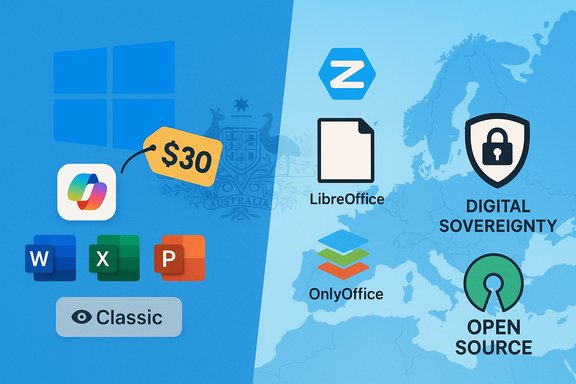
The ACCC alleges Microsoft misled roughly 2.7 million Australian Microsoft 365 subscribers by communicating a binary choice — accept the higher‑priced Copilot‑integrated plans or cancel — while not disclosing a lower‑cost “Classic” plan that retained existing features without Copilot. The regulator says the Classic option only became visible during the cancellation flow, a disclosure tactic the ACCC describes as deliberately concealed. Microsoft’s integration of Copilot into consumer Microsoft 365 plans began in late 2024 and was rolled out globally through 2025, accompanied by substantial price increases for Personal and Family plans in many markets. The ACCC’s complaint focuses not on the price increases themselves, but on how options were described to auto‑renewing subscribers and whether consumers were deprived of the ability to make an informed choice. Why the legal matter matters beyond Australia
This legal action raises three interlinked issues: market power and bundling, consumer transparency, and practical dependence on a single, integrated productivity ecosystem. The ACCC’s concern that Microsoft’s Office apps are “essential” to many consumers is legally and rhetorically useful — but it understates a different story: for many users and institutions the real constraint is not technical inability but policy and habit that make migration look scarier than it really is. The emerging pattern in Europe — governments actively replacing Microsoft services with open‑source stacks for reasons of digital sovereignty — demonstrates that substitution is technically feasible and politically chosen at scale.
However, regulatory action alone is not the only remedy. Public procurement, internal IT policy and the rise of open‑source alternatives are also powerful correctives. Governments choosing to host their own collaboration stacks, adopt LibreOffice/OnlyOffice and migrate endpoints to Linux change the balance of incentives for major vendors. The examples of Schleswig‑Holstein, Austria’s armed forces and Lyon show how policy choices can create real alternatives for citizens and businesses.
The facts are straightforward: consumers were presented with a price‑increased Copilot bundle and purportedly not informed of a cheaper Classic option; regulators have lodged a formal challenge. The response to that regulatory pressure — combined with political decisions by governments to adopt open‑source stacks and the spike in exploratory downloads of distributions such as Zorin OS after Windows 10’s end of support — signals a changing equilibrium. Whether that becomes a mass migration will depend on practical migration work: inventories, pilots, compatibility engineering and the willingness by institutions to make a strategic break from long‑standing vendor lock‑in. For users weighing the choice today, the pragmatic path is clear: test in a low‑risk environment, validate your critical workflows, and treat migration as a project. The technical alternatives are no longer academic: they are real, increasingly polished, and — in the right circumstances — a better fit for those who value choice, sovereignty and transparent pricing.
Source: Pearls and Irritations Why are you still using Microsoft Windows?
 Background / Overview
Microsoft’s Copilot integration and the ACCC caseThe ACCC alleges Microsoft misled roughly 2.7 million Australian Microsoft 365 subscribers by communicating a binary choice — accept the higher‑priced Copilot‑integrated plans or cancel — while not disclosing a lower‑cost “Classic” plan that retained existing features without Copilot. The regulator says the Classic option only became visible during the cancellation flow, a disclosure tactic the ACCC describes as deliberately concealed. Microsoft’s integration of Copilot into consumer Microsoft 365 plans began in late 2024 and was rolled out globally through 2025, accompanied by substantial price increases for Personal and Family plans in many markets. The ACCC’s complaint focuses not on the price increases themselves, but on how options were described to auto‑renewing subscribers and whether consumers were deprived of the ability to make an informed choice. Why the legal matter matters beyond Australia
This legal action raises three interlinked issues: market power and bundling, consumer transparency, and practical dependence on a single, integrated productivity ecosystem. The ACCC’s concern that Microsoft’s Office apps are “essential” to many consumers is legally and rhetorically useful — but it understates a different story: for many users and institutions the real constraint is not technical inability but policy and habit that make migration look scarier than it really is. The emerging pattern in Europe — governments actively replacing Microsoft services with open‑source stacks for reasons of digital sovereignty — demonstrates that substitution is technically feasible and politically chosen at scale.
The factual landscape: what’s verifiable right now
The ACCC’s case — what it claims and seeks
- Allegation: Microsoft misled approximately 2.7 million Australian Microsoft 365 subscribers by omitting the availability of a cheaper “Classic” plan while communicating Copilot‑linked price rises.
- Timeline: Copilot integration for Microsoft 365 Personal/Family in Australia began 31 October 2024; the ACCC’s proceedings were lodged in October 2025.
- Remedies sought: penalties, injunctive relief, consumer redress and legal costs under Australian Consumer Law, where maximum penalties for corporations are significant and can scale with turnover or benefits obtained.
The broader market responses
- Independent reporting and mainstream outlets confirmed the ACCC’s allegations and the numbers cited by the regulator; Microsoft has stated it values consumer trust and is reviewing the complaint. International coverage underscores global regulatory interest in how major platforms bundle AI and paid services.
- In parallel, a surge of interest in desktop Linux — typified by Zorin OS’s high‑profile download figures after Windows 10’s end‑of‑support deadline — underlines how product decisions and vendor timeline changes can catalyze real migration experimentation.
Why the ACCC is only half right about “limited substitutes”
The legal framing: essential vs. habitual
The ACCC’s remark that Office apps are “essential in many people’s lives” is factually accurate in a descriptive sense: Word, Excel and Outlook form the backbone of many workflows and institutional processes. That factual reality means consumers and businesses are sensitive to changes in price, features or compatibility. However, calling substitutes “limited” is a policy assessment, not an immutable technical constraint — and policy can change. The European examples of public administrations moving away from Microsoft illustrate this choice.The real friction points: formats, workflows, and institutional inertia
There are three practical barriers to switching that commonly discourage migration:- Document formats and macros that tie workflows to Microsoft Office.
- Enterprise management tooling, single‑sign‑on, device management, and vendor support commitments.
- Perceived learning curves and short‑term productivity hits during migration.
Europe’s digital sovereignty movement: concrete examples
Schleswig‑Holstein — mail and client migration
The German state of Schleswig‑Holstein completed a migration of its public administration mail system from Microsoft Exchange/Outlook to Open‑Xchange and Thunderbird, moving over 40,000 mailboxes in a six‑month program as part of a broader open‑source strategy. That migration included hundreds of millions of mail items and calendar entries and was framed as a step toward digital sovereignty. This is a large, government‑scale example proving that core productivity infrastructure can be decoupled from Microsoft in practice.Austria’s armed forces — LibreOffice adoption
Austria’s armed forces completed a sizeable conversion — reported at roughly 16,000 workstations — from Microsoft Office to LibreOffice, explicitly motivated by security and sovereignty considerations rather than pure cost saving. The armed forces also invested in upstream contributions to LibreOffice, demonstrating a model where an institutional user both consumes and strengthens open‑source software.Lyon — municipal plans to replace Windows and Office
The city of Lyon announced a progressive strategy to replace Microsoft desktop stacks with Linux, OnlyOffice and a locally governed collaborative platform called “Territoire Numérique Ouvert.” The plan targets thousands of workstations and emphasizes hosting in regional datacentres, interoperability and training. Lyon’s case is notable because it pairs a migration to Linux with an investment in local ecosystem orchestration and operational continuity.Zorin OS and the Windows 10 EOL moment — downloads are a leading indicator
Zorin OS 18 reported a spectacular download milestone shortly after Microsoft ended mainstream Windows 10 support on 14 October 2025. The project celebrated roughly 1 million downloads in a little over a month, with a project‑reported proportion of those downloads originating from Windows systems. That metric is a strong signal of interest, though downloads do not equal completed migrations: many downloads are trials, live‑USB boots, or virtual machine tests. Still, the timing — aligned with Windows 10’s end‑of‑support — shows a clear behavioral reaction: when the cost of staying on Microsoft’s older stack becomes explicit, a measurable fraction of users actively explore alternatives. Important nuance: downloads ≠ installs; converts ≠ retained users- Downloads indicate intent to evaluate and are meaningful as a metric of curiosity and readiness to try alternatives.
- Successful, sustained migration requires attention to driver support, peripheral compatibility, Office format interoperability, and user training.
- The Zorin milestone is therefore a compelling leading indicator that choice is real; it does not yet prove wholesale, permanent migration at mass scale.
Strengths of the Linux/FOSS alternative today
- Rapid improvements in user experience: modern distributions ship polished GUIs, easy installers and preconfigured drivers. Distros like Linux Mint, Ubuntu, Zorin and specialized lightweight releases (Lubuntu) now match mainstream desktop expectations for many users.
- Rich productivity ecosystem: LibreOffice and OnlyOffice are mature alternatives to Microsoft Office for most document, spreadsheet and presentation needs, with increasing compatibility for docx/xlsx/pptx formats.
- Reduced vendor lock‑in: open‑source stacks can be self‑hosted, audited and modified, offering digital sovereignty that appeals to institutions and privacy‑conscious users.
- Cost control and hardware life‑extension: Linux often extends the viable life of older hardware, avoiding forced hardware refresh cycles driven by vendor‑imposed minimum hardware baselines. The Zorin surge after Windows 10 EOL is a practical illustration.
Risks, friction and real limitations to a mass exodus
Compatibility and specialized software
Not every piece of software migrates cleanly: high‑end Windows‑only applications (some scientific packages, specialized accounting or legacy enterprise apps) still require Windows or careful virtualization. For organizations dependent on line‑of‑business Windows applications, the migration path is more complex and costly.Support and service expectations
Large enterprises and public bodies need predictable SLAs, vendor accountability, and procurement frameworks. While the FOSS ecosystem offers commercial support providers, shifting procurement practices and establishing long‑term support contracts takes time, budget and political capital.Training, user experience and inertia
The human cost of change remains significant. Even well‑designed migrations require training programs, pilot phases, and staged rollouts to minimize productivity loss. The short‑term cost can deter some organizations despite long‑term benefits.Vendor retaliation and ecosystem friction
Vendors may continue to design services assuming Microsoft platforms, offering integrations and features that are Windows‑first. The convenience gap can persist for years, particularly in consumer ecosystems dominated by proprietary integrations (e.g., DRM‑protected apps, games, or vendor‑specific cloud services).Practical guidance for readers considering the switch
If you’re evaluating whether to move away from Windows and Microsoft 365 — either as a home user, IT admin or public‑sector decision maker — here’s a pragmatic sequence to reduce risk and increase the chance of a successful migration:- Inventory: catalog critical applications, printers, drivers, macros and dependencies.
- Pilot: create a small pilot group using live USBs or VMs with the candidate Linux distro and productivity replacements.
- Compatibility checks: test complex spreadsheets, macros and any bespoke applications; use document testing tools and conversion checks.
- Training: run short, focused training sessions for pilot users and collect real‑world feedback.
- Support plan: secure a commercial support contract or an internal support escalation path for the first 12 months.
- Staged roll‑out: migrate non‑critical departments first, then iterate and expand after addressing discovered issues.
- Desktop: Linux Mint, Kubuntu, Zorin OS, Lubuntu for low‑spec hardware.
- Office: LibreOffice for broad compatibility; OnlyOffice for improved compatibility with Microsoft’s ribbon interface and collaborative editing.
- Email/browser: Thunderbird, Firefox, or Chromium‑based browsers.
- Compatibility layer: Wine or Bottles for running some Windows apps; consider virtualization for legacy LOB apps.
Why regulators and institutions should care about platform bundling
The ACCC complaint is a reminder that bundling powerful platform features with price changes can have anti‑competitive or consumer‑harm effects when disclosure is opaque. Even if a vendor’s product change is lawful in substance, the process of presenting options can materially influence consumer decisions. Regulators globally are taking note: the intersection of AI feature rollouts, subscription economics, and established dominance in productivity software creates a particularly sensitive regulatory zone.However, regulatory action alone is not the only remedy. Public procurement, internal IT policy and the rise of open‑source alternatives are also powerful correctives. Governments choosing to host their own collaboration stacks, adopt LibreOffice/OnlyOffice and migrate endpoints to Linux change the balance of incentives for major vendors. The examples of Schleswig‑Holstein, Austria’s armed forces and Lyon show how policy choices can create real alternatives for citizens and businesses.
Critical analysis — balancing strengths and caveats
What the ACCC case gets right- It correctly frames the central problem as a transparency and consumer‑rights issue: consumers must be given the information they need to make informed choices about subscriptions and price increases.
- It takes on the practical reality that when services are deeply integrated, disclosure design choices can steer decisions in ways that matter economically for millions.
- Saying substitutes are “limited” risks understating political and technical choices. While Microsoft’s ecosystem is convenient, several robust alternatives exist and are being adopted at institutional scale when organizations decide sovereignty, security or cost justify migration. The political decision to migrate is often the decisive factor, not an absolute technical impossibility.
- The company’s reaction — reviewing the ACCC’s claims and emphasizing consumer trust — is predictable corporate posture. If the behavior alleged by the ACCC is proven, the strategic lesson is that aggressive bundling strategies raise regulatory, reputational and political risk when applied to everyday consumer subscriptions.
- Vendors embedding AI into paid subscriptions will increasingly face scrutiny over disclosure and opt‑in mechanisms.
- Institutions seeking digital sovereignty are now demonstrating that alternatives can scale, but migration remains a planned, resource‑intensive task.
- Consumers can exercise meaningful choice today: trial Linux distros, pilot LibreOffice/OnlyOffice, and test compatibility before committing.
Conclusion
The ACCC’s case against Microsoft is emblematic of a broader shift: the cosy monopoly of convenience that once made Microsoft the default desktop supplier is under pressure from two directions. Regulators are demanding clearer disclosure where bundling and subscription changes matter to consumers’ wallets and choices. At the same time, public bodies and open‑source projects have matured to the point where switching — or at least seriously testing alternatives — is now a sensible, practical option for many users and organizations.The facts are straightforward: consumers were presented with a price‑increased Copilot bundle and purportedly not informed of a cheaper Classic option; regulators have lodged a formal challenge. The response to that regulatory pressure — combined with political decisions by governments to adopt open‑source stacks and the spike in exploratory downloads of distributions such as Zorin OS after Windows 10’s end of support — signals a changing equilibrium. Whether that becomes a mass migration will depend on practical migration work: inventories, pilots, compatibility engineering and the willingness by institutions to make a strategic break from long‑standing vendor lock‑in. For users weighing the choice today, the pragmatic path is clear: test in a low‑risk environment, validate your critical workflows, and treat migration as a project. The technical alternatives are no longer academic: they are real, increasingly polished, and — in the right circumstances — a better fit for those who value choice, sovereignty and transparent pricing.
Source: Pearls and Irritations Why are you still using Microsoft Windows?
