

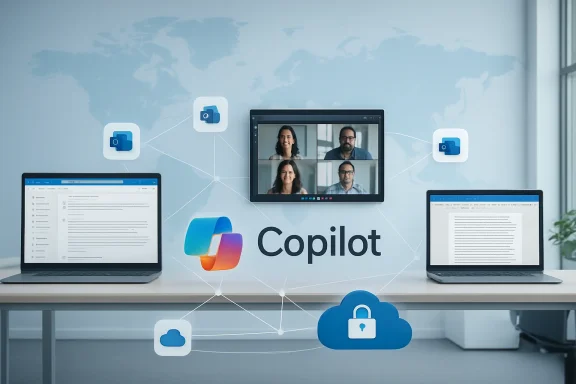
Microsoft’s Copilot push has crossed a symbolic threshold: Accenture is moving Microsoft 365 Copilot from controlled deployment to near-enterprise ubiquity across roughly 743,000 employees. The scale matters because this is not a showcase pilot, a narrow executive trial, or a single-country productivity experiment; it is the largest enterprise Copilot rollout Microsoft has publicly described to date. For WindowsForum readers, the announcement is a practical signal that AI inside Outlook, Teams, Word, SharePoint, OneDrive, and the broader Microsoft 365 stack is becoming part of the default enterprise workstation experience.
Accenture’s move follows nearly three years of escalating enterprise interest in generative AI, beginning with the 2023 rush to test chat-based assistants and maturing into today’s more disciplined focus on workflow integration, data governance, and measurable productivity. Microsoft introduced Microsoft 365 Copilot as the AI layer for its productivity suite, but the early enterprise question was never whether workers could generate text faster. The real question was whether a regulated, global organization could safely embed AI into daily work without creating chaos in permissions, compliance, records management, and employee behavior.
Accenture did not jump from zero to three-quarters of a million seats overnight. The company began testing Copilot in August 2023 with a few hundred senior leaders and selected employees, then expanded to about 20,000 users before reaching much larger internal cohorts. That progression matters because it shows the new enterprise AI playbook: deploy early, measure constantly, tighten governance, and only then expand.
The reported results are striking, though they should be read with the usual caution applied to company-supplied productivity data. Accenture says 97% of employees in a large 2025 data set reported completing routine tasks much faster with Copilot, while 53% reported significant productivity and efficiency improvements. In one roughly 200,000-license tranche, monthly active use reportedly reached 89%, with many users saying they would miss the tool if access disappeared.
Key context for Windows and Microsoft 365 administrators includes:
For Microsoft, the headline is obvious: Copilot now has a flagship deployment that resembles the size and complexity of the customers it most wants to win. Accenture operates across more than 120 countries, supports highly regulated clients, and maintains sprawling internal knowledge repositories. If Copilot can become useful in that environment, Microsoft can argue that the product is ready for the most complex corners of enterprise IT.
For Accenture, the rollout doubles as internal modernization and market signaling. The company advises clients on AI transformation, cloud migration, and Microsoft ecosystem strategy. Running Copilot at this scale gives Accenture a living reference architecture for conversations with banks, manufacturers, public-sector agencies, healthcare organizations, and global retailers.
The language around the rollout also matters. Accenture CIO Tony Leraris has described Copilot as a “personal digital colleague,” a phrase that captures Microsoft’s broader positioning. The company is not selling Copilot as a search box with better grammar; it is selling an assistant that sits in the flow of work and reasons across meetings, emails, files, chats, and enterprise context.
The scale creates several immediate implications:
The early phase gave Accenture room to observe user behavior before locking in assumptions. Employees used Copilot for meeting preparation, summarization, drafting, research, and document review, but different roles discovered different patterns. Leaders needed executive briefings and meeting synthesis; marketing teams needed message consistency; sales teams needed account intelligence and faster preparation.
The expansion to about 20,000 users appears to have functioned as a serious stress test. At that level, organizations start seeing departmental variation, regional compliance questions, and the first signs of whether adoption is novelty-driven or durable. Accenture then moved into larger cohorts, reportedly including 200,000 users, before broadening further.
A sensible enterprise sequence looks like this:
Routine cognitive labor consumes enormous time in large organizations. Workers search for old decks, compare document versions, summarize calls, write follow-up emails, reconcile stakeholder comments, and translate raw notes into presentable output. Copilot’s business case is strongest when it reduces these repetitive loops without forcing users into a separate application.
Accenture’s marketing and communications teams provide one clear example. In a global organization, consistency of message is difficult because teams across regions often create similar materials with slightly different language. Copilot can help writers compare new drafts with existing positioning, identify duplication, and keep content aligned with brand guidelines.
Sales and client-facing teams offer another example. Avanade, the Accenture-Microsoft joint venture, has built AI-powered sales intelligence tooling that uses Copilot-style interaction to bring internal data, customer context, and external business signals into a faster preparation workflow. The strategic value is not only speed; it is giving junior employees more context before they enter high-stakes client conversations.
Common enterprise use cases now include:
Microsoft’s own deployment guidance emphasizes the need to remediate oversharing, set guardrails, and meet regulatory obligations. That is not merely compliance language. In a Copilot environment, data hygiene becomes user experience, because the quality and safety of AI responses depend on the quality and safety of the underlying Microsoft 365 data estate.
Accenture’s reported preparation around data strategy, governance, and access controls is therefore not incidental. It is the foundation that makes a deployment of this size credible. The company reportedly uses enormous volumes of SharePoint and OneDrive data, which means permission boundaries, sensitivity labels, and content lifecycle management are central to whether Copilot is helpful or hazardous.
Important governance priorities include:
The strongest evidence for Copilot’s enterprise value tends to appear in task-level improvements. Independent research on Microsoft 365 Copilot has found measurable time savings in activities such as email handling and document creation, but the gains vary by role, user skill, and task type. Accenture’s data fits that broader pattern: Copilot appears especially useful where employees repeat information-processing tasks every day.
The more difficult metric is sustained organizational performance. A worker who saves 30 minutes may use that time for deeper analysis, more client contact, or better documentation. But the same worker might also face higher meeting volume, faster turnaround expectations, or more work overall. Productivity gains can be absorbed by organizational habits if leaders do not redesign work.
The reported finding that many employees would miss Copilot if it disappeared also matters. That type of sentiment indicates a tool has moved from novelty to dependency. In the Microsoft ecosystem, that is exactly where platform leverage begins.
Still, enterprises should resist shallow measurement. Copilot success should be measured across several dimensions:
For enterprise users, context switching is a hidden tax. If an assistant requires copying text, uploading files, or manually explaining a project, the productivity advantage shrinks. Copilot’s promise is that the assistant already understands the workplace context the user is allowed to access.
This advantage is especially relevant in regulated industries. Companies already have years of investment in Microsoft identity, compliance, retention, legal hold, eDiscovery, and endpoint management. A new AI platform that sits outside those controls may offer impressive model performance but create more governance friction.
Microsoft’s advantage is breadth. It touches productivity, identity, endpoint management, cloud infrastructure, developer tooling, security, collaboration, and business applications. In the Accenture case, that breadth matters because the deployment is not only about chat; it is about embedding AI into the full enterprise operating environment.
Competitive implications include:
For consumers, the impact is indirect but real. Microsoft’s enterprise progress tends to shape the features that eventually appear in consumer Microsoft 365, Windows, Edge, and Copilot experiences. Features proven at work often migrate into personal productivity, though with different privacy, licensing, and data-boundary considerations.
The enterprise stakes are higher because organizational data is more complex than personal data. A consumer may ask Copilot to rewrite a letter or plan a trip. An enterprise worker may ask it to summarize confidential client materials, prepare a board briefing, or compare internal strategy documents. The margin for error is different.
This is especially important for junior staff. AI can help less experienced workers produce more polished emails, better meeting summaries, and stronger first drafts. But it can also mask shallow understanding if employees accept outputs without judgment. The best deployments will teach verification as aggressively as prompting.
Enterprise and consumer differences can be summarized this way:
That makes this rollout a practical case study for Indian IT services, consulting, business process outsourcing, and global capability centers. These organizations operate at large scale, employ many knowledge workers, and often manage complex client documentation. Copilot-like tools could reshape delivery models by reducing time spent on status updates, document preparation, meeting summaries, and internal knowledge retrieval.
The implications for India are not simply about job displacement. They are about task redesign, skill expectations, and competitive differentiation. Professionals who can combine domain expertise with AI-assisted research, communication, and delivery may become more valuable. Those who rely mainly on repetitive documentation or low-context coordination may face pressure to move up the value chain.
Indian enterprises and multinationals with Indian operations will likely study the rollout closely. The key question will not be whether to adopt AI assistants, but how to prepare tens of thousands of employees without overwhelming IT support or creating compliance risk. The winners will treat AI enablement as a workforce transformation program, not a software deployment.
For large delivery organizations, practical priorities include:
Accenture is an unusual customer because it can use the rollout internally while also converting lessons into client advisory work. That creates a broader return profile than many companies will have. A manufacturer, hospital system, or regional bank may need a more direct calculation tied to time saved, reduced external spending, faster cycle times, or higher customer satisfaction.
The strongest ROI cases will likely come from workgroups with heavy information-processing burdens. Legal, consulting, sales, marketing, HR, finance, procurement, and project management teams all spend large amounts of time turning unstructured information into decisions and deliverables. Copilot has a clearer business case when it shortens that path.
Microsoft will benefit if the Accenture story convinces customers that broad deployment creates network effects. If everyone in a project team has Copilot, meetings, documents, and collaboration patterns can change together. If only a few people have it, the impact may remain personal rather than organizational.
Economic questions CIOs should ask include:
Microsoft will also be watched closely for how it evolves Copilot from assistant to agent. Drafting, summarizing, and searching are useful, but the market is moving toward AI systems that can coordinate tasks, update records, trigger workflows, and execute multi-step processes. That is where the productivity upside grows, and where the governance challenge becomes more severe.
For WindowsForum readers, the practical takeaway is to start preparing now even if a broad Copilot rollout is not imminent. The organizations that benefit most will be those with clean identity structures, disciplined file permissions, mature compliance controls, and a workforce trained to use AI critically.
Watch these developments closely:
Accenture’s near-companywide Copilot deployment marks a turning point in the normalization of enterprise AI. It does not prove that every organization should immediately roll out Copilot to every employee, nor does it erase the hard work of governance, training, measurement, and cultural change. But it does show that AI in the Microsoft 365 workspace is no longer a side experiment; it is becoming part of the architecture of modern knowledge work, and the organizations that prepare their data, people, and processes now will have the clearest advantage as the next wave of AI moves from assistance to action.
Source: YourStory.com https://yourstory.com/ai-story/microsoft-copilot-accenture-rollout-ai-workforce/
 Overview
Accenture’s move follows nearly three years of escalating enterprise interest in generative AI, beginning with the 2023 rush to test chat-based assistants and maturing into today’s more disciplined focus on workflow integration, data governance, and measurable productivity. Microsoft introduced Microsoft 365 Copilot as the AI layer for its productivity suite, but the early enterprise question was never whether workers could generate text faster. The real question was whether a regulated, global organization could safely embed AI into daily work without creating chaos in permissions, compliance, records management, and employee behavior.Accenture did not jump from zero to three-quarters of a million seats overnight. The company began testing Copilot in August 2023 with a few hundred senior leaders and selected employees, then expanded to about 20,000 users before reaching much larger internal cohorts. That progression matters because it shows the new enterprise AI playbook: deploy early, measure constantly, tighten governance, and only then expand.
The reported results are striking, though they should be read with the usual caution applied to company-supplied productivity data. Accenture says 97% of employees in a large 2025 data set reported completing routine tasks much faster with Copilot, while 53% reported significant productivity and efficiency improvements. In one roughly 200,000-license tranche, monthly active use reportedly reached 89%, with many users saying they would miss the tool if access disappeared.
Why the timing matters
The rollout lands at a moment when Microsoft needs enterprise proof points for paid AI adoption. Copilot has been positioned as the next major monetization layer on top of Microsoft 365, but many organizations have spent the last two years asking whether the licensing cost, governance overhead, and training burden justify broad deployment. Accenture’s scale gives Microsoft a reference customer large enough to influence boardroom conversations far beyond the professional services industry.Key context for Windows and Microsoft 365 administrators includes:
- Copilot is shifting from optional assistant to embedded workplace layer.
- Governance readiness now determines AI readiness.
- SharePoint and OneDrive hygiene has become a strategic issue, not just an IT housekeeping task.
- Training and change management appear as important as model capability.
- Large deployments will increasingly be judged by adoption telemetry, not launch announcements.
The Scale: Why 743,000 Seats Changes the Conversation
A deployment big enough to reset expectations
A rollout to roughly 743,000 employees is not merely large; it is structurally different from a 5,000-seat or 20,000-seat deployment. At this scale, every weakness in identity management, file permissions, data classification, network policy, and user training becomes visible. A small pilot can survive on hand-holding and executive sponsorship, but a global deployment has to survive ordinary work habits.For Microsoft, the headline is obvious: Copilot now has a flagship deployment that resembles the size and complexity of the customers it most wants to win. Accenture operates across more than 120 countries, supports highly regulated clients, and maintains sprawling internal knowledge repositories. If Copilot can become useful in that environment, Microsoft can argue that the product is ready for the most complex corners of enterprise IT.
For Accenture, the rollout doubles as internal modernization and market signaling. The company advises clients on AI transformation, cloud migration, and Microsoft ecosystem strategy. Running Copilot at this scale gives Accenture a living reference architecture for conversations with banks, manufacturers, public-sector agencies, healthcare organizations, and global retailers.
The language around the rollout also matters. Accenture CIO Tony Leraris has described Copilot as a “personal digital colleague,” a phrase that captures Microsoft’s broader positioning. The company is not selling Copilot as a search box with better grammar; it is selling an assistant that sits in the flow of work and reasons across meetings, emails, files, chats, and enterprise context.
The scale creates several immediate implications:
- Licensing strategy becomes a board-level budget discussion.
- IT operations teams must prepare for sustained AI support demand.
- Knowledge management becomes more valuable when AI can reason over it.
- Poor permissions hygiene becomes more dangerous because AI can surface forgotten content faster.
- Employee expectations will rise as AI assistance becomes normalized.
From Pilot to Platform: The Phased Rollout Blueprint
Why Accenture did not simply “turn it on”
The most important lesson from Accenture’s approach may be that large-scale AI deployment is not a switch-flip exercise. The company started with a limited group, learned how employees used Copilot in Outlook, Teams, and Word, then expanded only after refining governance and training. That sequence is a direct rebuttal to the idea that productivity AI can be deployed like a minor toolbar update.The early phase gave Accenture room to observe user behavior before locking in assumptions. Employees used Copilot for meeting preparation, summarization, drafting, research, and document review, but different roles discovered different patterns. Leaders needed executive briefings and meeting synthesis; marketing teams needed message consistency; sales teams needed account intelligence and faster preparation.
The expansion to about 20,000 users appears to have functioned as a serious stress test. At that level, organizations start seeing departmental variation, regional compliance questions, and the first signs of whether adoption is novelty-driven or durable. Accenture then moved into larger cohorts, reportedly including 200,000 users, before broadening further.
The practical rollout sequence
The phased model is likely to become a template for CIOs and Microsoft 365 administrators. It shows that successful deployment requires a blend of technical readiness, behavioral design, and executive sponsorship. It also suggests that organizations should measure actual usage before declaring victory.A sensible enterprise sequence looks like this:
- Start with role-based pilot groups that represent real business workflows.
- Audit permissions and sensitive content before connecting Copilot to large data estates.
- Measure usage, satisfaction, and task-level outcomes rather than relying on anecdotes.
- Train champions and leaders first so adoption stories spread through trusted peers.
- Expand in controlled waves while keeping the ability to disable risky capabilities by region or role.
How Employees Are Actually Using Copilot
Practical work, not science fiction
The most persuasive part of the Accenture story is that the use cases are ordinary. Employees are not primarily using Copilot to reinvent the company; they are using it to prepare for meetings, summarize Teams conversations, draft Word documents, triage Outlook threads, and extract key points from SharePoint and OneDrive content. That may sound mundane, but mundane work is exactly where enterprise productivity lives.Routine cognitive labor consumes enormous time in large organizations. Workers search for old decks, compare document versions, summarize calls, write follow-up emails, reconcile stakeholder comments, and translate raw notes into presentable output. Copilot’s business case is strongest when it reduces these repetitive loops without forcing users into a separate application.
Accenture’s marketing and communications teams provide one clear example. In a global organization, consistency of message is difficult because teams across regions often create similar materials with slightly different language. Copilot can help writers compare new drafts with existing positioning, identify duplication, and keep content aligned with brand guidelines.
Sales and client-facing teams offer another example. Avanade, the Accenture-Microsoft joint venture, has built AI-powered sales intelligence tooling that uses Copilot-style interaction to bring internal data, customer context, and external business signals into a faster preparation workflow. The strategic value is not only speed; it is giving junior employees more context before they enter high-stakes client conversations.
Common enterprise use cases now include:
- Meeting preparation from emails, chats, documents, and calendar context.
- Meeting recap and action extraction from Teams discussions.
- Document drafting and revision inside Word.
- Email summarization and response drafting in Outlook.
- Knowledge retrieval across SharePoint and OneDrive.
- Brand and message consistency checks across marketing materials.
- Sales research and account preparation for client teams.
Governance Is the Hidden Center of the Story
Copilot makes existing permissions visible
Every large Copilot deployment begins with an uncomfortable truth: AI does not create most data governance problems, but it exposes them faster. If a SharePoint site is overshared, if “Everyone except external users” has access to sensitive files, or if old project documents have weak ownership, Copilot can make that information easier to find. The assistant follows access controls, but the value of those controls depends on whether the organization maintained them properly.Microsoft’s own deployment guidance emphasizes the need to remediate oversharing, set guardrails, and meet regulatory obligations. That is not merely compliance language. In a Copilot environment, data hygiene becomes user experience, because the quality and safety of AI responses depend on the quality and safety of the underlying Microsoft 365 data estate.
Accenture’s reported preparation around data strategy, governance, and access controls is therefore not incidental. It is the foundation that makes a deployment of this size credible. The company reportedly uses enormous volumes of SharePoint and OneDrive data, which means permission boundaries, sensitivity labels, and content lifecycle management are central to whether Copilot is helpful or hazardous.
The admin reality
For WindowsForum’s administrator audience, the key takeaway is that Copilot readiness is deeply tied to Microsoft 365 administration maturity. Entra ID, Purview, SharePoint Advanced Management, sensitivity labeling, Data Loss Prevention, auditing, retention, and user education all become part of the same deployment story. Copilot is not just an AI SKU; it is a pressure test for the tenant.Important governance priorities include:
- Reviewing overshared SharePoint sites before broad rollout.
- Applying sensitivity labels to confidential and regulated content.
- Using Data Loss Prevention policies for prompts, files, and sensitive workflows.
- Auditing Copilot interactions where compliance requirements apply.
- Restricting connectors and agents to trusted systems.
- Testing new features with controlled groups before global release.
- Training users on what Copilot can and cannot access.
Productivity Claims Need Careful Interpretation
Faster does not always mean better
The reported productivity figures are impressive, but they require careful interpretation. When employees say they complete routine tasks faster, they may be measuring saved time, reduced friction, or simply lower effort. Those are valuable outcomes, but they are not identical to higher-quality work, better decisions, or measurable revenue impact.The strongest evidence for Copilot’s enterprise value tends to appear in task-level improvements. Independent research on Microsoft 365 Copilot has found measurable time savings in activities such as email handling and document creation, but the gains vary by role, user skill, and task type. Accenture’s data fits that broader pattern: Copilot appears especially useful where employees repeat information-processing tasks every day.
The more difficult metric is sustained organizational performance. A worker who saves 30 minutes may use that time for deeper analysis, more client contact, or better documentation. But the same worker might also face higher meeting volume, faster turnaround expectations, or more work overall. Productivity gains can be absorbed by organizational habits if leaders do not redesign work.
The adoption signal
The 89% monthly active usage figure from one large Accenture cohort may be more important than the headline productivity claims. Enterprise software often fails not because it lacks features, but because employees ignore it after the launch campaign ends. High active usage suggests Copilot is finding real work to do.The reported finding that many employees would miss Copilot if it disappeared also matters. That type of sentiment indicates a tool has moved from novelty to dependency. In the Microsoft ecosystem, that is exactly where platform leverage begins.
Still, enterprises should resist shallow measurement. Copilot success should be measured across several dimensions:
- Time saved on routine tasks.
- Quality improvement in drafts, summaries, analysis, and client materials.
- Reduced duplication across teams and regions.
- Employee satisfaction and lower cognitive friction.
- Compliance outcomes and avoided data exposure incidents.
- Revenue or delivery impact in sales, consulting, support, and operations.
- Adoption durability after the initial rollout excitement fades.
Microsoft’s Competitive Advantage: The Work Graph
Why integration beats a blank chat window
The Accenture deployment highlights Microsoft’s biggest advantage in enterprise AI: distribution through tools employees already use. Copilot lives inside Microsoft 365, grounding its responses in Outlook, Teams, Word, SharePoint, OneDrive, and the Microsoft Graph. That integration gives Microsoft a powerful answer to rival AI assistants that require workers to move context into a separate chat interface.For enterprise users, context switching is a hidden tax. If an assistant requires copying text, uploading files, or manually explaining a project, the productivity advantage shrinks. Copilot’s promise is that the assistant already understands the workplace context the user is allowed to access.
This advantage is especially relevant in regulated industries. Companies already have years of investment in Microsoft identity, compliance, retention, legal hold, eDiscovery, and endpoint management. A new AI platform that sits outside those controls may offer impressive model performance but create more governance friction.
Rivals will not stand still
Google, OpenAI, Anthropic, Salesforce, ServiceNow, Workday, and a long list of vertical AI providers are all competing for the same enterprise attention. Google can argue for deep integration with Workspace. Salesforce can emphasize customer data and CRM workflows. ServiceNow can focus on IT and business process automation. OpenAI and Anthropic can appeal to organizations that want best-in-class models and more flexible application development.Microsoft’s advantage is breadth. It touches productivity, identity, endpoint management, cloud infrastructure, developer tooling, security, collaboration, and business applications. In the Accenture case, that breadth matters because the deployment is not only about chat; it is about embedding AI into the full enterprise operating environment.
Competitive implications include:
- Microsoft strengthens its position as the default AI layer for Office-centric enterprises.
- Google Workspace customers will face renewed pressure to justify their AI roadmaps.
- Specialized AI vendors must prove deeper domain value than Microsoft’s horizontal assistant.
- Systems integrators will package Copilot readiness as a consulting service.
- Model providers will increasingly compete through enterprise distribution, not just benchmark scores.
Enterprise Impact Versus Consumer Impact
Different audiences, different stakes
For enterprise workers, the Accenture rollout signals that AI assistance is becoming a standard part of the corporate desktop. Employees will increasingly be expected to know how to prompt, verify, refine, and govern AI-generated output. That does not mean every worker becomes a prompt engineer, but it does mean basic AI literacy becomes part of digital literacy.For consumers, the impact is indirect but real. Microsoft’s enterprise progress tends to shape the features that eventually appear in consumer Microsoft 365, Windows, Edge, and Copilot experiences. Features proven at work often migrate into personal productivity, though with different privacy, licensing, and data-boundary considerations.
The enterprise stakes are higher because organizational data is more complex than personal data. A consumer may ask Copilot to rewrite a letter or plan a trip. An enterprise worker may ask it to summarize confidential client materials, prepare a board briefing, or compare internal strategy documents. The margin for error is different.
Skills will matter more than access
The Accenture case also suggests that access alone is not enough. The company invested in tailored adoption, leader training, communications, and peer sharing. That is a reminder that AI tools do not automatically improve work; employees need to learn where the tool is reliable, where it struggles, and how to verify output.This is especially important for junior staff. AI can help less experienced workers produce more polished emails, better meeting summaries, and stronger first drafts. But it can also mask shallow understanding if employees accept outputs without judgment. The best deployments will teach verification as aggressively as prompting.
Enterprise and consumer differences can be summarized this way:
- Enterprise Copilot depends on permissions, compliance, and tenant governance.
- Consumer Copilot depends more on personal productivity and convenience.
- Enterprise mistakes can create legal, financial, or reputational exposure.
- Consumer mistakes are usually narrower but can still affect privacy and trust.
- Enterprise value depends on workflow redesign, not just feature discovery.
India and the Global Workforce Angle
Why the rollout matters beyond Redmond and Dublin
The use of “7.43 lakh” in Indian coverage is not just a numbering convention; it reflects the importance of India in Accenture’s global workforce and the broader enterprise AI labor market. Accenture has a substantial presence in India, and any AI deployment across its global employee base will inevitably affect how large Indian delivery centers, technology teams, operations groups, and client support functions work.That makes this rollout a practical case study for Indian IT services, consulting, business process outsourcing, and global capability centers. These organizations operate at large scale, employ many knowledge workers, and often manage complex client documentation. Copilot-like tools could reshape delivery models by reducing time spent on status updates, document preparation, meeting summaries, and internal knowledge retrieval.
The implications for India are not simply about job displacement. They are about task redesign, skill expectations, and competitive differentiation. Professionals who can combine domain expertise with AI-assisted research, communication, and delivery may become more valuable. Those who rely mainly on repetitive documentation or low-context coordination may face pressure to move up the value chain.
Training becomes the differentiator
The Accenture rollout also points to a training challenge for large employers. If Copilot is widely available but unevenly understood, productivity gains will concentrate among workers who already know how to structure questions, evaluate responses, and connect outputs to business goals. That could widen internal skill gaps.Indian enterprises and multinationals with Indian operations will likely study the rollout closely. The key question will not be whether to adopt AI assistants, but how to prepare tens of thousands of employees without overwhelming IT support or creating compliance risk. The winners will treat AI enablement as a workforce transformation program, not a software deployment.
For large delivery organizations, practical priorities include:
- Role-specific Copilot playbooks for consulting, engineering, finance, HR, sales, and operations.
- Prompting and verification training built into onboarding and professional development.
- Localized governance guidance for regional regulations and client contracts.
- Manager education on measuring outcomes without creating unrealistic productivity pressure.
- Clear rules for client data, confidential work, and AI-generated deliverables.
The Economics of Copilot at Enterprise Scale
The business case must survive the invoice
Copilot’s strategic importance to Microsoft is clear: it offers a way to expand revenue per Microsoft 365 user. For customers, however, the economic case is more complicated. Large deployments require licensing spend, admin time, governance tooling, training, support, and process redesign. The sticker price is only one part of the total cost.Accenture is an unusual customer because it can use the rollout internally while also converting lessons into client advisory work. That creates a broader return profile than many companies will have. A manufacturer, hospital system, or regional bank may need a more direct calculation tied to time saved, reduced external spending, faster cycle times, or higher customer satisfaction.
The strongest ROI cases will likely come from workgroups with heavy information-processing burdens. Legal, consulting, sales, marketing, HR, finance, procurement, and project management teams all spend large amounts of time turning unstructured information into decisions and deliverables. Copilot has a clearer business case when it shortens that path.
Cost discipline will shape adoption
Not every employee may need the same AI license at the same time. Enterprises may segment users by role, task intensity, regulatory exposure, and measurable benefit. The Accenture deployment is notable because of its breadth, but other organizations may choose more selective rollouts.Microsoft will benefit if the Accenture story convinces customers that broad deployment creates network effects. If everyone in a project team has Copilot, meetings, documents, and collaboration patterns can change together. If only a few people have it, the impact may remain personal rather than organizational.
Economic questions CIOs should ask include:
- Which roles generate measurable value from Copilot every week?
- Which workflows produce the highest time savings or quality gains?
- How much training is required before productivity improves?
- What governance investments are prerequisites for safe deployment?
- Can the organization redesign work to capture saved time?
- Will Copilot reduce external tool spending or add another budget line?
Strengths and Opportunities
Accenture’s Copilot rollout gives enterprises a rare large-scale example of AI adoption that combines technical integration, phased deployment, and change management. Its biggest strength is not simply the number of users, but the way the rollout ties AI to the systems where employees already work every day.- Massive proof point for Microsoft 365 Copilot in a complex global enterprise.
- Strong adoption signals from large employee cohorts rather than tiny pilots.
- Practical use cases centered on meetings, documents, email, research, and knowledge retrieval.
- Clear governance emphasis around data strategy, access controls, and phased enablement.
- Potential workforce uplift for junior employees who need faster access to context and structure.
- Consulting leverage for Accenture, which can convert internal lessons into client transformation work.
- Momentum for AI literacy programs across large enterprises and global delivery centers.
Risks and Concerns
The rollout also raises serious questions that every enterprise should consider before imitating the scale. Copilot can accelerate work, but acceleration without governance, verification, and cultural adjustment can create new operational risks.- Overreliance on AI-generated summaries could cause employees to miss nuance or context.
- Poor SharePoint and OneDrive permissions may expose sensitive content to users who technically have access but should not.
- Productivity pressure could rise if managers assume every AI-assisted task should be dramatically faster.
- Uneven training may widen the gap between AI-fluent workers and those who use the tool superficially.
- Hallucinations and errors remain a risk when users fail to verify outputs.
- Licensing costs may be difficult to justify for roles with limited daily Copilot value.
- Agentic features could introduce higher-risk automation if controls do not keep pace.
What to Watch Next
The next test is sustained value
The next milestone is not whether Accenture can technically provide Copilot access to a huge workforce. The harder test is whether the company can convert early enthusiasm into sustained business value over multiple years. That requires better metrics than self-reported speed, including delivery quality, employee experience, client outcomes, and measurable reductions in duplicated work.Microsoft will also be watched closely for how it evolves Copilot from assistant to agent. Drafting, summarizing, and searching are useful, but the market is moving toward AI systems that can coordinate tasks, update records, trigger workflows, and execute multi-step processes. That is where the productivity upside grows, and where the governance challenge becomes more severe.
For WindowsForum readers, the practical takeaway is to start preparing now even if a broad Copilot rollout is not imminent. The organizations that benefit most will be those with clean identity structures, disciplined file permissions, mature compliance controls, and a workforce trained to use AI critically.
Watch these developments closely:
- Whether Accenture reports longer-term ROI beyond adoption and satisfaction metrics.
- How Microsoft prices and packages future Copilot and agent capabilities.
- Whether competitors respond with similarly large enterprise AI deployments.
- How regulators treat AI-generated workplace decisions and records.
- Whether IT teams gain better tools for Copilot auditing, permission cleanup, and risk scoring.
Accenture’s near-companywide Copilot deployment marks a turning point in the normalization of enterprise AI. It does not prove that every organization should immediately roll out Copilot to every employee, nor does it erase the hard work of governance, training, measurement, and cultural change. But it does show that AI in the Microsoft 365 workspace is no longer a side experiment; it is becoming part of the architecture of modern knowledge work, and the organizations that prepare their data, people, and processes now will have the clearest advantage as the next wave of AI moves from assistance to action.
Source: YourStory.com https://yourstory.com/ai-story/microsoft-copilot-accenture-rollout-ai-workforce/
