

Bill Ackman’s Pershing Square has built a multibillion-dollar Microsoft position in 2026 after cutting Alphabet exposure, betting that Microsoft’s recent share-price weakness understates the durability of Azure, Microsoft 365, Copilot, and the company’s expanding AI infrastructure franchise. The tempting answer for ordinary investors is to follow him. The better answer is more irritating: Ackman’s Microsoft trade is understandable, but it is not automatically portable. Microsoft may be cheaper than it was, but it is not cheap in the way most investors mean the word.
The simple version of the Microsoft bull case is that artificial intelligence has turned into a revenue line instead of a slide-deck promise. Microsoft said its AI business has passed a $37 billion annual revenue run rate, growing 123 percent year over year, while Azure and other cloud services grew 40 percent in its fiscal third quarter. Those are not venture-style metrics hiding behind “engagement.” They are enterprise-software metrics flowing through one of the most entrenched sales machines in technology.
That matters because Microsoft’s AI strategy is not a single-product wager. Copilot is the visible consumer of attention, but the economic engine is broader: Azure compute, Microsoft 365 upgrades, GitHub, security, databases, developer tools, identity, and the messy back-office reality of corporate IT. Microsoft does not need every customer to become an AI visionary. It needs a large number of customers to keep paying for the safest, most integrated, least career-threatening way to add AI to work.
Ackman’s trade makes sense in that context. Pershing Square has historically preferred concentrated positions in businesses it believes are high quality, durable, and temporarily mispriced. Microsoft fits the first two conditions easily. The argument now is whether the third condition exists: whether an 11 percent year-to-date decline, a compressed multiple, and anxiety over AI capital spending have created a genuine opening.
The answer is probably yes for Ackman’s time horizon and risk tolerance. It is less obvious for investors who are buying because a famous investor bought. Ackman can size the position, hedge elsewhere, wait through ugly quarters, and change his mind without telling retail investors in real time. A WindowsForum reader buying five shares in a brokerage app does not own Ackman’s process. They own Microsoft.
Revenue for fiscal Q3 2026 reached $82.9 billion, up 18 percent year over year. Microsoft Cloud revenue was $54.5 billion, up 29 percent. Azure and other cloud services grew 40 percent. Commercial remaining performance obligations rose to $627 billion, a figure that functions as a rough map of future contracted demand.
That backlog number deserves more attention than the stock-market chatter gives it. It does not mean Microsoft has $627 billion of guaranteed high-margin cash waiting in a vault. Contracts can vary in timing, usage, margins, and renewal behavior. But it does mean the enterprise market has already made substantial commitments to Microsoft’s platform at a time when many investors are still debating whether AI demand is real.
This is where Microsoft differs from many AI-adjacent equities. The company is not trying to prove it can find customers. It is trying to prove it can serve more demand than its current infrastructure can handle without wrecking its return profile. That is a better problem, but it is still a problem.
The market’s skepticism is not irrational. Microsoft is spending at a scale that would have seemed extravagant even by cloud-era standards a few years ago. Management has signaled enormous calendar-year 2026 capital expenditure requirements, driven partly by AI infrastructure and partly by higher component costs. Investors are being asked to accept a near-term hit to free cash flow in exchange for a larger future platform.
That is the real Microsoft debate. Not whether AI exists. Not whether Azure is relevant. Not whether enterprises will keep buying Microsoft software. The question is whether today’s spending produces tomorrow’s defensible cash flows at a rate that justifies the capital intensity.
AI infrastructure changes the texture of the business. Data centers, GPUs, networking gear, power contracts, cooling systems, and supply constraints make the new cycle more physical. Microsoft still has software economics in many places, but Azure AI capacity looks more like a strategic industrial buildout than a simple SaaS upsell.
This is why the valuation debate has become more complicated. A price-to-earnings multiple in the mid-20s can look reasonable for a company growing revenue nearly 20 percent with high operating margins. It can also look less obviously cheap if free cash flow is being consumed by a capex cycle whose ultimate returns are still being tested.
The bull case says Microsoft is spending from strength. It has the balance sheet, customers, distribution, and technical stack to build capacity while smaller players depend on partners or pray for access to chips. The bear case says even dominant platforms can overbuild when every large customer, cloud provider, and model company extrapolates early AI demand too aggressively.
Both arguments can be true for a while. Microsoft can be a wonderful business and still deliver mediocre stock returns if the market decides the AI buildout is becoming too expensive. Investors learned this lesson in earlier infrastructure cycles: the company selling picks and shovels can be attractive, but the company buying all the picks and shovels must eventually show the mine is profitable.
But Microsoft offers something Alphabet does not: a cleaner enterprise monetization path. Google’s AI story has to thread through search disruption, advertising economics, cloud share gains, regulatory pressure, and the company’s ability to translate technical strength into paid enterprise workflows. Microsoft’s story is more boring and therefore more attractive to a certain kind of investor. It already owns the workplace.
That does not make Alphabet inferior. It makes the two companies different kinds of AI bets. Alphabet is defending and extending an enormous consumer-and-advertising empire while trying to convince enterprises that Google Cloud deserves a larger role. Microsoft is deepening an enterprise-software empire where the buyer, administrator, compliance officer, and end user are already inside its orbit.
For IT departments, this distinction is not theoretical. Microsoft can bundle, integrate, discount, and govern AI tools inside an environment many companies already manage through Entra ID, Microsoft 365, Defender, Purview, Teams, SharePoint, Windows, and Azure. That creates a procurement advantage. It also creates a lock-in concern.
The more Microsoft turns AI into another layer of the enterprise stack, the more customers will ask whether convenience is quietly becoming dependency. CIOs may like Microsoft’s integrated AI story, but they also understand the risks of putting identity, productivity, security, cloud infrastructure, and AI orchestration under one vendor’s commercial umbrella.
But the relationship is also a source of uncertainty. OpenAI is not simply a Microsoft subsidiary, and its strategic needs may not always align neatly with Redmond’s. The more valuable the AI market becomes, the more every partnership around model access, compute supply, revenue sharing, exclusivity, and product overlap becomes a potential fault line.
For investors, that means Microsoft deserves credit for moving early, but not a free pass. The company’s AI momentum is not solely dependent on OpenAI, yet OpenAI clearly helped create the perception that Microsoft was ahead. If that relationship becomes more complicated, Microsoft has enough assets to remain formidable, but the market could still reprice the stock if investors perceive the AI advantage narrowing.
There is also the issue of accounting visibility. “AI revenue run rate” is a useful directional signal, but it is not the same as a fully segmented income statement showing exactly where AI revenue lands, what margins it carries, and how much incremental demand is attached to incremental capital. Microsoft is giving investors a headline number. The market is asking for the unit economics beneath it.
That tension will define the next several quarters. The bulls will point to Azure growth, contracted obligations, Copilot adoption, and the breadth of Microsoft’s platform. The bears will ask how much cash must be reinvested before AI becomes an unmistakable profit accelerator rather than a very expensive growth category.
Microsoft’s incentives are increasingly obvious. The company wants AI attached to the operating system, productivity suite, developer workflow, security stack, and cloud control plane. Windows is no longer just the client operating system at the edge of Microsoft’s empire. It is a delivery surface for subscription services and AI-assisted workflows whose economics live elsewhere.
That is why Copilot’s march through Windows has been so contentious. Enthusiasts often evaluate features by usefulness, performance, privacy, and control. Microsoft increasingly evaluates them by engagement, strategic positioning, and whether they make the broader platform more valuable. Those perspectives sometimes overlap. They often do not.
Enterprise admins will care less about whether Copilot looks clever in a demo and more about governance, data boundaries, licensing clarity, auditability, and support overhead. If AI features create more help-desk tickets than productivity gains, the backlash will be swift. If they reduce repetitive work inside familiar tools without creating compliance nightmares, Microsoft will have a strong case for premium pricing.
The investment case and the product case therefore converge. Microsoft needs AI to be useful enough that customers accept higher spending, deeper integration, and more cloud dependence. If users reject the experience or administrators slow-roll deployment, the revenue curve may still rise, but the enthusiasm embedded in the stock could fade.
The sharper bear case is about return on invested capital. If the company must spend tens of billions more than expected to maintain competitive capacity, if GPU supply remains expensive, if inference margins compress, or if customers resist premium AI pricing, Microsoft can still grow while disappointing shareholders. Growth alone is not enough when the spending required to produce it keeps rising.
There is also competitive pressure from every direction. Amazon remains the cloud infrastructure incumbent. Google has world-class AI talent and a fast-growing cloud business. Meta is pushing open models into the market. Apple may yet redefine consumer AI expectations at the device layer. Startups are attacking specific workflows where Microsoft’s bundled approach may feel heavy.
Microsoft’s advantage is distribution, but distribution does not guarantee delight. Teams proved that bundling can win market share while still leaving users grumbling. Copilot cannot merely be present. It has to become valuable enough that customers renew, expand, and tolerate the added cost.
The danger for Microsoft is not a dramatic collapse. It is a slower compression: Azure growth moderates, AI margins remain opaque, capex stays elevated, and investors decide the stock deserves a lower multiple even as the company continues to post impressive absolute numbers. That is the kind of outcome that can punish late buyers without ever producing a clean “Microsoft failed” headline.
Enterprise technology adoption usually rewards the vendor that reduces organizational friction. A tool may be technically superior, but if it creates procurement headaches, compliance uncertainty, integration work, and user-training overhead, it loses momentum. Microsoft’s genius has always been turning “good enough and already integrated” into a formidable business model.
Azure benefits from that same pattern. Companies that already run Microsoft identity, databases, development tools, endpoint management, and productivity software have reasons to put more workloads into Microsoft’s cloud. AI strengthens that gravity if the models and agents work best when connected to corporate data living in Microsoft-controlled systems.
This is also why the $627 billion commercial remaining performance obligation figure matters psychologically. It reassures investors that customers are not merely experimenting with AI on someone else’s dime. They are signing large commitments across cloud and commercial services. The backlog does not eliminate execution risk, but it makes the demand picture harder to dismiss.
Ackman appears to be betting that the market is over-penalizing Microsoft for spending required to satisfy demand it can already see. If that is right, the current selloff will look in hindsight like a classic chance to buy a dominant platform during an investment phase. The catch is that hindsight is where all difficult trades become obvious.
A concentrated hedge fund can accept volatility that an individual investor may find intolerable. It can rebalance across positions, speak with management, absorb drawdowns, and wait years for a thesis to work. It can also exit faster and more quietly than the investors who read about the trade after the fact.
The more useful question is not “Should I do what Ackman did?” It is “Does Microsoft fit the role I need this stock to play?” For some investors, Microsoft is a core compounder with AI upside, enterprise durability, and lower single-company risk than more speculative tech names. For others, it is already a large index exposure hiding inside every S&P 500 or Nasdaq-heavy fund they own.
That last point matters. Many investors who think they are considering a new Microsoft bet already own a lot of Microsoft indirectly. Buying more may be sensible, but it increases concentration in the same mega-cap complex that dominates retirement accounts, target-date funds, and broad-market ETFs. The decision is not just whether Microsoft is good. It is whether you need more Microsoft than the market already gives you.
Azure growth near 40 percent would strengthen the bull case considerably. A sharp deceleration would not destroy Microsoft, but it would intensify scrutiny of the spending curve. Investors can tolerate heavy investment when growth is accelerating or holding strong. They become less forgiving when spending rises into slowing demand.
Capex commentary may be even more important than headline revenue. Microsoft does not need to stop spending; that would be a bad signal if demand is real. It needs to convince investors that spending is disciplined, capacity is being absorbed, and the returns will accrue to Microsoft rather than being competed away by cloud rivals and model providers.
AI revenue disclosure is the other pressure point. A $37 billion run rate is eye-catching, but investors will increasingly want to know how much is Azure consumption, how much is Copilot, how much is GitHub and developer tooling, how much is security, and what the margin profile looks like. The more Microsoft can separate durable AI revenue from capacity pass-through, the stronger the investment case becomes.
This is where the stock’s rerating could happen. If Microsoft shows another strong Azure quarter, offers credible evidence that AI demand is converting into high-value enterprise revenue, and keeps margins resilient despite capex, the market may decide the selloff went too far. If not, Ackman may still be early — and ordinary investors may discover that “early” feels a lot like “wrong” for longer than expected.
The catch is that the stock is not priced like a distressed asset. A mid-20s earnings multiple for a company of Microsoft’s quality may be attractive, but it still assumes a lot of things go right. Investors buying here are not just buying today’s earnings. They are underwriting management’s claim that AI infrastructure spending will generate large, durable, and profitable revenue streams.
That makes the decision less binary than the headline suggests. Microsoft can be a good company, a reasonable stock, and still not the right buy for every investor at this moment. Ackman’s move is a signal worth studying, not a command worth obeying.
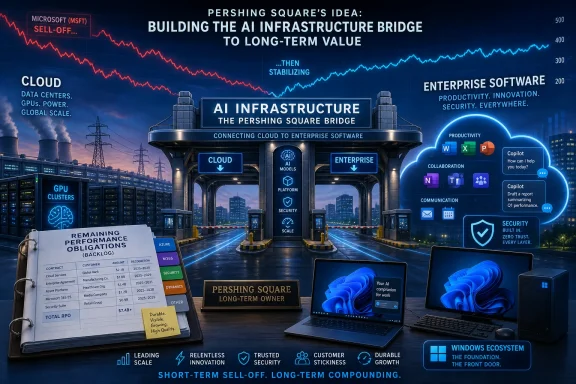 Ackman Is Buying the Tollbooth, Not the Hype Cycle
The simple version of the Microsoft bull case is that artificial intelligence has turned into a revenue line instead of a slide-deck promise. Microsoft said its AI business has passed a $37 billion annual revenue run rate, growing 123 percent year over year, while Azure and other cloud services grew 40 percent in its fiscal third quarter. Those are not venture-style metrics hiding behind “engagement.” They are enterprise-software metrics flowing through one of the most entrenched sales machines in technology.That matters because Microsoft’s AI strategy is not a single-product wager. Copilot is the visible consumer of attention, but the economic engine is broader: Azure compute, Microsoft 365 upgrades, GitHub, security, databases, developer tools, identity, and the messy back-office reality of corporate IT. Microsoft does not need every customer to become an AI visionary. It needs a large number of customers to keep paying for the safest, most integrated, least career-threatening way to add AI to work.
Ackman’s trade makes sense in that context. Pershing Square has historically preferred concentrated positions in businesses it believes are high quality, durable, and temporarily mispriced. Microsoft fits the first two conditions easily. The argument now is whether the third condition exists: whether an 11 percent year-to-date decline, a compressed multiple, and anxiety over AI capital spending have created a genuine opening.
The answer is probably yes for Ackman’s time horizon and risk tolerance. It is less obvious for investors who are buying because a famous investor bought. Ackman can size the position, hedge elsewhere, wait through ugly quarters, and change his mind without telling retail investors in real time. A WindowsForum reader buying five shares in a brokerage app does not own Ackman’s process. They own Microsoft.
Microsoft’s Numbers Are Doing More Work Than Its Story
The impressive thing about Microsoft’s latest quarter is not that it had a good AI narrative. Every mega-cap has one. The impressive thing is that the narrative is now attached to very large operating numbers.Revenue for fiscal Q3 2026 reached $82.9 billion, up 18 percent year over year. Microsoft Cloud revenue was $54.5 billion, up 29 percent. Azure and other cloud services grew 40 percent. Commercial remaining performance obligations rose to $627 billion, a figure that functions as a rough map of future contracted demand.
That backlog number deserves more attention than the stock-market chatter gives it. It does not mean Microsoft has $627 billion of guaranteed high-margin cash waiting in a vault. Contracts can vary in timing, usage, margins, and renewal behavior. But it does mean the enterprise market has already made substantial commitments to Microsoft’s platform at a time when many investors are still debating whether AI demand is real.
This is where Microsoft differs from many AI-adjacent equities. The company is not trying to prove it can find customers. It is trying to prove it can serve more demand than its current infrastructure can handle without wrecking its return profile. That is a better problem, but it is still a problem.
The market’s skepticism is not irrational. Microsoft is spending at a scale that would have seemed extravagant even by cloud-era standards a few years ago. Management has signaled enormous calendar-year 2026 capital expenditure requirements, driven partly by AI infrastructure and partly by higher component costs. Investors are being asked to accept a near-term hit to free cash flow in exchange for a larger future platform.
That is the real Microsoft debate. Not whether AI exists. Not whether Azure is relevant. Not whether enterprises will keep buying Microsoft software. The question is whether today’s spending produces tomorrow’s defensible cash flows at a rate that justifies the capital intensity.
The Stock Has Fallen Because the Market Finally Found the Bill
Microsoft’s selloff is not a mystery. The company is telling investors that the AI opportunity is enormous and that capturing it requires enormous spending. That is not the same pitch shareholders heard during the classic software-margin era, when adding another Office user or Windows license looked almost absurdly profitable.AI infrastructure changes the texture of the business. Data centers, GPUs, networking gear, power contracts, cooling systems, and supply constraints make the new cycle more physical. Microsoft still has software economics in many places, but Azure AI capacity looks more like a strategic industrial buildout than a simple SaaS upsell.
This is why the valuation debate has become more complicated. A price-to-earnings multiple in the mid-20s can look reasonable for a company growing revenue nearly 20 percent with high operating margins. It can also look less obviously cheap if free cash flow is being consumed by a capex cycle whose ultimate returns are still being tested.
The bull case says Microsoft is spending from strength. It has the balance sheet, customers, distribution, and technical stack to build capacity while smaller players depend on partners or pray for access to chips. The bear case says even dominant platforms can overbuild when every large customer, cloud provider, and model company extrapolates early AI demand too aggressively.
Both arguments can be true for a while. Microsoft can be a wonderful business and still deliver mediocre stock returns if the market decides the AI buildout is becoming too expensive. Investors learned this lesson in earlier infrastructure cycles: the company selling picks and shovels can be attractive, but the company buying all the picks and shovels must eventually show the mine is profitable.
Alphabet Was the Easier Stock; Microsoft May Be the Cleaner Bet
Ackman’s rotation from Alphabet into Microsoft is revealing because Alphabet is not obviously broken. Google Cloud is growing quickly, the advertising business remains massive, YouTube is deeply embedded in media consumption, and Alphabet has its own AI research pedigree. If anything, Alphabet has often looked like the cheaper mega-cap AI trade.But Microsoft offers something Alphabet does not: a cleaner enterprise monetization path. Google’s AI story has to thread through search disruption, advertising economics, cloud share gains, regulatory pressure, and the company’s ability to translate technical strength into paid enterprise workflows. Microsoft’s story is more boring and therefore more attractive to a certain kind of investor. It already owns the workplace.
That does not make Alphabet inferior. It makes the two companies different kinds of AI bets. Alphabet is defending and extending an enormous consumer-and-advertising empire while trying to convince enterprises that Google Cloud deserves a larger role. Microsoft is deepening an enterprise-software empire where the buyer, administrator, compliance officer, and end user are already inside its orbit.
For IT departments, this distinction is not theoretical. Microsoft can bundle, integrate, discount, and govern AI tools inside an environment many companies already manage through Entra ID, Microsoft 365, Defender, Purview, Teams, SharePoint, Windows, and Azure. That creates a procurement advantage. It also creates a lock-in concern.
The more Microsoft turns AI into another layer of the enterprise stack, the more customers will ask whether convenience is quietly becoming dependency. CIOs may like Microsoft’s integrated AI story, but they also understand the risks of putting identity, productivity, security, cloud infrastructure, and AI orchestration under one vendor’s commercial umbrella.
OpenAI Is Both Microsoft’s Accelerator and Its Ambiguity
No Microsoft AI story can avoid OpenAI. Microsoft’s early and aggressive partnership gave it the credibility and product momentum that rivals scrambled to match. Azure became the infrastructure home for one of the defining AI companies of the era, and Microsoft gained a privileged position in turning frontier models into enterprise products.But the relationship is also a source of uncertainty. OpenAI is not simply a Microsoft subsidiary, and its strategic needs may not always align neatly with Redmond’s. The more valuable the AI market becomes, the more every partnership around model access, compute supply, revenue sharing, exclusivity, and product overlap becomes a potential fault line.
For investors, that means Microsoft deserves credit for moving early, but not a free pass. The company’s AI momentum is not solely dependent on OpenAI, yet OpenAI clearly helped create the perception that Microsoft was ahead. If that relationship becomes more complicated, Microsoft has enough assets to remain formidable, but the market could still reprice the stock if investors perceive the AI advantage narrowing.
There is also the issue of accounting visibility. “AI revenue run rate” is a useful directional signal, but it is not the same as a fully segmented income statement showing exactly where AI revenue lands, what margins it carries, and how much incremental demand is attached to incremental capital. Microsoft is giving investors a headline number. The market is asking for the unit economics beneath it.
That tension will define the next several quarters. The bulls will point to Azure growth, contracted obligations, Copilot adoption, and the breadth of Microsoft’s platform. The bears will ask how much cash must be reinvested before AI becomes an unmistakable profit accelerator rather than a very expensive growth category.
Windows Users Are Not Just Spectators in This Trade
For WindowsForum readers, the Ackman trade is not merely a stock-market item. Microsoft’s AI capital cycle is going to shape the Windows ecosystem, enterprise administration, licensing, hardware requirements, privacy defaults, and the balance of power between local computing and cloud-connected services.Microsoft’s incentives are increasingly obvious. The company wants AI attached to the operating system, productivity suite, developer workflow, security stack, and cloud control plane. Windows is no longer just the client operating system at the edge of Microsoft’s empire. It is a delivery surface for subscription services and AI-assisted workflows whose economics live elsewhere.
That is why Copilot’s march through Windows has been so contentious. Enthusiasts often evaluate features by usefulness, performance, privacy, and control. Microsoft increasingly evaluates them by engagement, strategic positioning, and whether they make the broader platform more valuable. Those perspectives sometimes overlap. They often do not.
Enterprise admins will care less about whether Copilot looks clever in a demo and more about governance, data boundaries, licensing clarity, auditability, and support overhead. If AI features create more help-desk tickets than productivity gains, the backlash will be swift. If they reduce repetitive work inside familiar tools without creating compliance nightmares, Microsoft will have a strong case for premium pricing.
The investment case and the product case therefore converge. Microsoft needs AI to be useful enough that customers accept higher spending, deeper integration, and more cloud dependence. If users reject the experience or administrators slow-roll deployment, the revenue curve may still rise, but the enthusiasm embedded in the stock could fade.
The Bear Case Is Not That Microsoft Loses; It Is That Winning Costs Too Much
The laziest version of the Microsoft bear case says AI is a bubble and therefore Microsoft is doomed to overbuild. That is too crude. Microsoft is not a speculative model lab with no distribution. It is one of the few companies that can plausibly turn AI demand into products customers already understand how to buy.The sharper bear case is about return on invested capital. If the company must spend tens of billions more than expected to maintain competitive capacity, if GPU supply remains expensive, if inference margins compress, or if customers resist premium AI pricing, Microsoft can still grow while disappointing shareholders. Growth alone is not enough when the spending required to produce it keeps rising.
There is also competitive pressure from every direction. Amazon remains the cloud infrastructure incumbent. Google has world-class AI talent and a fast-growing cloud business. Meta is pushing open models into the market. Apple may yet redefine consumer AI expectations at the device layer. Startups are attacking specific workflows where Microsoft’s bundled approach may feel heavy.
Microsoft’s advantage is distribution, but distribution does not guarantee delight. Teams proved that bundling can win market share while still leaving users grumbling. Copilot cannot merely be present. It has to become valuable enough that customers renew, expand, and tolerate the added cost.
The danger for Microsoft is not a dramatic collapse. It is a slower compression: Azure growth moderates, AI margins remain opaque, capex stays elevated, and investors decide the stock deserves a lower multiple even as the company continues to post impressive absolute numbers. That is the kind of outcome that can punish late buyers without ever producing a clean “Microsoft failed” headline.
The Bull Case Is That Microsoft Has Already Won the Distribution War
The strongest argument for buying Microsoft here is that the company does not need to win every AI category to win financially. It needs to be the default enterprise layer through which a large share of AI work is authenticated, governed, deployed, billed, and monitored. That is a very Microsoft-shaped opportunity.Enterprise technology adoption usually rewards the vendor that reduces organizational friction. A tool may be technically superior, but if it creates procurement headaches, compliance uncertainty, integration work, and user-training overhead, it loses momentum. Microsoft’s genius has always been turning “good enough and already integrated” into a formidable business model.
Azure benefits from that same pattern. Companies that already run Microsoft identity, databases, development tools, endpoint management, and productivity software have reasons to put more workloads into Microsoft’s cloud. AI strengthens that gravity if the models and agents work best when connected to corporate data living in Microsoft-controlled systems.
This is also why the $627 billion commercial remaining performance obligation figure matters psychologically. It reassures investors that customers are not merely experimenting with AI on someone else’s dime. They are signing large commitments across cloud and commercial services. The backlog does not eliminate execution risk, but it makes the demand picture harder to dismiss.
Ackman appears to be betting that the market is over-penalizing Microsoft for spending required to satisfy demand it can already see. If that is right, the current selloff will look in hindsight like a classic chance to buy a dominant platform during an investment phase. The catch is that hindsight is where all difficult trades become obvious.
Copying Ackman Is Not a Strategy
There is a difference between learning from a famous investor and outsourcing your judgment to one. Ackman’s Microsoft position may be rational, but it is rational inside Pershing Square’s portfolio, mandate, liquidity profile, and research process. Retail investors do not inherit those advantages by pressing buy.A concentrated hedge fund can accept volatility that an individual investor may find intolerable. It can rebalance across positions, speak with management, absorb drawdowns, and wait years for a thesis to work. It can also exit faster and more quietly than the investors who read about the trade after the fact.
The more useful question is not “Should I do what Ackman did?” It is “Does Microsoft fit the role I need this stock to play?” For some investors, Microsoft is a core compounder with AI upside, enterprise durability, and lower single-company risk than more speculative tech names. For others, it is already a large index exposure hiding inside every S&P 500 or Nasdaq-heavy fund they own.
That last point matters. Many investors who think they are considering a new Microsoft bet already own a lot of Microsoft indirectly. Buying more may be sensible, but it increases concentration in the same mega-cap complex that dominates retirement accounts, target-date funds, and broad-market ETFs. The decision is not just whether Microsoft is good. It is whether you need more Microsoft than the market already gives you.
The Next Two Quarters Matter More Than the 13F
The market will not grade Ackman’s Microsoft trade on vibes. It will grade it on Azure growth, AI monetization, capex discipline, margins, and management’s ability to explain the investment cycle without sounding as though it is asking for blind faith.Azure growth near 40 percent would strengthen the bull case considerably. A sharp deceleration would not destroy Microsoft, but it would intensify scrutiny of the spending curve. Investors can tolerate heavy investment when growth is accelerating or holding strong. They become less forgiving when spending rises into slowing demand.
Capex commentary may be even more important than headline revenue. Microsoft does not need to stop spending; that would be a bad signal if demand is real. It needs to convince investors that spending is disciplined, capacity is being absorbed, and the returns will accrue to Microsoft rather than being competed away by cloud rivals and model providers.
AI revenue disclosure is the other pressure point. A $37 billion run rate is eye-catching, but investors will increasingly want to know how much is Azure consumption, how much is Copilot, how much is GitHub and developer tooling, how much is security, and what the margin profile looks like. The more Microsoft can separate durable AI revenue from capacity pass-through, the stronger the investment case becomes.
This is where the stock’s rerating could happen. If Microsoft shows another strong Azure quarter, offers credible evidence that AI demand is converting into high-value enterprise revenue, and keeps margins resilient despite capex, the market may decide the selloff went too far. If not, Ackman may still be early — and ordinary investors may discover that “early” feels a lot like “wrong” for longer than expected.
The Ackman Trade Has a Microsoft-Sized Catch
The practical reading of this moment is not that everyone should rush into Microsoft. It is that Microsoft has become interesting again for reasons beyond passive mega-cap exposure. The company is spending aggressively, but it is doing so from a position of rare enterprise strength, with visible demand and a platform that reaches from Windows desktops to cloud data centers.The catch is that the stock is not priced like a distressed asset. A mid-20s earnings multiple for a company of Microsoft’s quality may be attractive, but it still assumes a lot of things go right. Investors buying here are not just buying today’s earnings. They are underwriting management’s claim that AI infrastructure spending will generate large, durable, and profitable revenue streams.
That makes the decision less binary than the headline suggests. Microsoft can be a good company, a reasonable stock, and still not the right buy for every investor at this moment. Ackman’s move is a signal worth studying, not a command worth obeying.
The Numbers to Watch Before Following the Billionaire
Microsoft’s setup is unusually clear because the debate has narrowed to a few measurable variables. The stock will probably not move over the next year based on whether pundits like Copilot or whether AI discourse turns euphoric again. It will move on whether the financial model proves that the AI buildout is accretive rather than merely impressive.- Azure needs to keep growing fast enough to justify the scale of Microsoft’s infrastructure spending.
- Microsoft needs to show that AI revenue is becoming durable, high-quality enterprise revenue rather than a loosely defined run-rate headline.
- Capital expenditure growth must eventually look controlled, even if absolute spending remains enormous.
- Copilot adoption has to translate into renewals, seat expansion, and pricing power inside Microsoft 365.
- The OpenAI relationship must remain strategically useful without making Microsoft look dependent on a partner it cannot fully control.
- Investors should compare any direct Microsoft purchase against the Microsoft exposure they already hold through index funds and retirement accounts.
References
- Primary source: aol.com
Published: 2026-05-25T07:30:08.083037
Bill Ackman Is Going All in on Microsoft. Should You Do the Same? - AOL
After selling off significantly, Microsoft (NASDAQ:MSFT) looks compelling on the numbers, and Bill Ackman appears to agree. Pershing Square has reportedly been loading up on Microsoft while trimming its Alphabet (NASDAQ:GOOGL) position, a rotation worth examining because Microsoft has lagged the...www.aol.com - Official source: microsoft.com
FY26 Q3 - Performance - Investor Relations - Microsoft
FY26 Q3 - Performance - Investor Relations - Microsoftwww.microsoft.com
- Related coverage: 13finsight.com
Pershing Square Q1 2026 13F: Ackman | 13F Insight
Pershing Square's $13.71B 11-stock 13F opened a new Microsoft position (15%) and cut Alphabet 95% in Q1 2026, while adding to Amazon. See full holdings.13finsight.com - Related coverage: bloomberg.com
- Related coverage: boursorama.com
Pershing Square, le fonds d'Ackman, prend une participation dans Microsoft et se retire d'Alphabet, la société mère de Google - 15/05/2026 à 18:55 - Boursorama
((Traduction automatisée par Reuters à l'aide de l'apprentissage automatique et de l'IA générative, veuillez vous référer à l'avertissement suivant: https://bit.ly/rtrsauto)) * Ackman troque Alphabet,... - 15/05/2026 à 18:55 - Boursorama www.boursorama.com
- Related coverage: macrotrends.net

Microsoft PE Ratio 2012-2026 | MSFT | MacroTrends
<p>Current and historical p/e ratio for Microsoft (MSFT) from 2012 to 2026. The price to earnings ratio is calculated by taking the latest closing price and dividing it by the most recent earnings per share (EPS) number. The PE ratio is a simple way to assess whether a stock is over or...
www.macrotrends.net
- Related coverage: quoteddata.com
Pershing Square's Bill Ackman sells top holding in Alphabet to fund $2.1bn investment in Microsoft - QuotedData
Pershing Square (PSH) fund manager Bill Ackman has sold most of his position in Alphabet and switched it into a new $2.1bn holding in rival “Magnificent Seven” stock Microsoft. A US regulatory filing on Friday by his firm Pershing Square Capital Management showed it had bought around 5.65m...quoteddata.com - Related coverage: quiverquant.com
Bill Ackman Adds Microsoft Stake While Slashing Alphabet Position in Latest Pershing Square 13F | Quiver Quantitative
Billionaire investor Bill Ackman disclosed a new stake in Microsoft ($MSFT) in Pershing Square Capital Management’s latest 13F filing while sharply reducing the firm’s position in Alphabet ($GOOG). The filing showed Pershing built a Microsoft position during Q1 2026 that's worth around $2.3...www.quiverquant.com - Related coverage: techradar.com
Microsoft forced to up AI spending by $25 billion to cover hardware price rises — says it 'remains confident in the return on these investments' | TechRadar
Microsoft capex is being hit by rising priceswww.techradar.com - Related coverage: axios.com
Bill Ackman revives his IPO plans
Ackman won't give up his chase for permanent capital, or retail investors.www.axios.com
- Related coverage: omniekonomi.se
Omni Ekonomi – för den nya tidens affärsmänniska.
omniekonomi.se
- Related coverage: windowscentral.com
Everyone has an opinion on Microsoft’s spending, but the real story is what the numbers say about its position | Windows Central
Microsoft beat expectations again, but investors want proof that rising AI spending will deliver real profit down the road.www.windowscentral.com - Related coverage: elpais.com
El inversor Bill Ackman se lanza a por Universal Music en una operación de 55.800 millones | Economía | EL PAÍS
Pershing Square pagaría 9.400 millones en efectivo por la compañía que tiene los derechos de artistas como Lady Gaga y Taylor Swift. Vincent Bolloré, con un 18% del capital, tendrá un papel claveelpais.com
