

Acronis is pitching partner cloud IaaS to service providers in mid-2026 as customers reassess hyperscaler spending, VMware licensing changes, data-sovereignty obligations, and the limits of infrastructure resale. The company’s argument is not subtle: infrastructure is becoming a margin and control conversation again. For MSPs and cloud providers, the interesting part is less the product brochure than the market timing. After years of being told that raw infrastructure was a race to the bottom, providers are being invited to believe there is money again in owning the layer beneath the managed service.
For much of the last decade, the safest advice for service providers was to climb the stack. Do not sell servers; sell outcomes. Do not talk about storage; talk about resilience. Do not compete with hyperscalers; wrap them, broker them, optimize them, and move on.
That advice was not wrong, but it became too neat. Customers still run workloads somewhere, and the location, cost model, jurisdiction, support path, and operational ownership of that somewhere now matter more than they did during the cloud-migration boom. The infrastructure layer did not disappear. It became someone else’s invoice.
Acronis is leaning into that correction with Cyber Frame, a platform meant to let providers deliver cloud infrastructure with cybersecurity, data protection, and management built in from the start. The framing matters because Acronis is not merely selling virtual machines. It is selling the idea that IaaS becomes profitable when it is packaged as a managed, protected, recurring service rather than as commodity compute.
That is a familiar MSP argument, but the backdrop has changed. Broadcom’s VMware overhaul shook confidence in long-settled virtualization assumptions. Hyperscaler bills remain a recurring source of executive anxiety. Regulators and customers continue to press for clearer answers about where data resides and who can touch it. Those forces have turned infrastructure from a procurement detail into a strategic risk surface.
The first wave of public cloud adoption often rewarded speed over discipline. Developers got capacity instantly. Business units bypassed slow procurement cycles. Infrastructure became programmable, global, and elastic. Then the monthly bills arrived, and the same flexibility that made cloud attractive became a management problem.
For service providers, this is the opening. Many customers do not want to abandon hyperscalers; they want a more rational portfolio. Stable line-of-business applications, predictable virtualized workloads, backup repositories, compliance-sensitive systems, and regional customer platforms may not need the full sprawl of a hyperscale environment. They may need competent hosting, clear pricing, strong support, and dependable recovery.
That is where partner cloud IaaS can make sense. The provider does not have to claim it can out-engineer Azure. It has to identify the workloads where simpler economics, closer support, and more direct accountability beat the convenience of buying everything from a global platform.
Acronis’s pitch lands in that middle ground. It is not promising that every MSP should become a miniature hyperscaler. It is arguing that providers can own a slice of infrastructure again if they attach enough operational value to avoid selling undifferentiated capacity.
That is why the disruption has been so consequential. When pricing models change, perpetual licensing gives way to subscription packaging, partner access narrows, and renewal conversations become more difficult, customers start asking uncomfortable questions. They ask whether the stack they have trusted for a decade still fits their economics. They ask whether their service provider has a migration plan. They ask whether infrastructure strategy is suddenly something they should care about again.
The irony is that VMware’s dominance created exactly the market Acronis now wants to address. Service providers built hosting, backup, disaster recovery, and managed infrastructure services around a familiar virtualization layer. When that layer becomes more expensive or less predictable, providers can either absorb the change, pass it through, or offer a new path.
Passing it through is the weakest long-term answer. Customers already irritated by licensing complexity do not become more loyal when their provider simply forwards the pain. Absorbing the cost may protect accounts temporarily, but it attacks the provider’s margin. Offering a credible alternative is harder, but it changes the conversation from “your bill went up” to “we have a plan.”
That is why partner cloud IaaS is timely. Not because VMware is finished, which it is not. Not because every workload should move immediately, which it should not. It is timely because the status quo has become negotiable.
That is not fatal if resale is part of a broader managed-service strategy. It is dangerous if resale becomes the strategy. The provider ends up responsible for support and customer satisfaction without controlling enough of the service design to shape margin or differentiation.
Partner cloud changes that balance only if the provider uses it to create a service, not merely a catalog. A virtual machine with a different logo is still a virtual machine. A managed workload platform with backup, disaster recovery, patching support, security monitoring, migration assistance, compliance reporting, and local accountability is a different proposition.
This distinction is central to the Acronis pitch. Cyber Frame is presented as a way to avoid stitching together infrastructure, cyber protection, and management tools after the fact. In MSP terms, that means fewer moving parts at launch and a clearer path to packaging. In customer terms, it means the provider can sell confidence rather than capacity.
But there is a trap here. Providers should not hear “own the infrastructure” and assume they must immediately buy racks, sign data center contracts, and build an operations team overnight. The smarter reading is that control is a spectrum. A provider can start with hosted capacity, learn the demand curve, standardize offers, and only then decide whether local or self-hosted infrastructure makes business sense.
A small MSP with loyal SMB customers may need a quick way to offer predictable infrastructure without hiring a cloud architecture team. A regional provider may already have facilities, hardware relationships, and operational staff, but need a more integrated platform for protection and management. A larger service provider may want to reposition away from low-margin resale into a branded cloud service with defined tiers and add-ons.
The platform has to serve all three without forcing them into the same capital model on day one. That is the practical appeal of “start hosted, move local later.” It lets providers test demand before committing to full ownership.
This is also where the product strategy reflects a broader change in the MSP market. Providers want recurring revenue, but they are more cautious about speculative infrastructure spend than they were during earlier hosting cycles. They have seen what happens when hardware bets, licensing shifts, and customer churn collide. A phased model lowers the emotional and financial barrier.
Still, optionality does not eliminate execution risk. Providers must decide which workloads they want, which customers they can support, which compliance promises they are willing to make, and which SLAs they can actually meet. A platform can simplify the starting point. It cannot make a weak service model profitable.
Raw IaaS is brutally comparable. Customers can ask how much CPU, RAM, storage, bandwidth, backup, and support they get for a given price. If the provider’s answer is just a line item, the customer will shop it. If the answer is an operating model, the discussion changes.
That operating model might include migration planning, continuous backup, disaster recovery testing, ransomware recovery workflows, monitoring, patch coordination, identity integration, cost reviews, and compliance documentation. None of those are decorative extras. They are the reasons a customer pays a service provider instead of buying infrastructure directly.
This is especially true for smaller and midmarket customers. Many do not have the staff to run a clean cloud environment, let alone to optimize it continuously. They need someone to tell them which workloads belong where, how to protect them, and how to recover when something goes wrong. Partner cloud IaaS gives the provider a platform for that conversation.
The business case becomes strongest when IaaS is the anchor for adjacent services. A migration project creates the opening. Managed operations creates recurring revenue. Backup and disaster recovery create resilience value. Security services create urgency. Optimization reviews create retention. The virtual machine is the substrate; the service relationship is the product.
But migration revenue is episodic. It is useful, sometimes lucrative, and often necessary, but it does not create a durable business by itself. The real prize is what happens after the cutover.
That is where providers must be careful not to underprice the operational burden. Running infrastructure for customers means owning the 2 a.m. incident, the restore test, the capacity warning, the certificate expiration, the misconfigured firewall rule, and the customer who assumes “managed” means “you handle it.” If those responsibilities are not built into pricing, the margin story collapses.
This is why packaging matters. Providers should not launch with a sprawling menu of custom infrastructure choices. They should define a few repeatable offers, identify supported workloads, set boundaries around customer responsibilities, and make protection part of the default rather than an upsell that can be declined.
The less glamorous work is what determines profitability. Standard images, migration runbooks, backup policies, monitoring templates, support tiers, and onboarding checklists are not marketing copy. They are the difference between a scalable IaaS service and a bespoke hosting mess.
Partner cloud providers have an advantage here if they are honest about it. A regional provider may be able to offer clearer locality, more direct operational accountability, and a support relationship that does not disappear into a global ticket queue. That does not automatically make it more secure or compliant than a hyperscaler, but it can make governance simpler for certain customers.
The key is precision. Providers should not imply that “local cloud” magically solves sovereignty. They need to document data location, subcontractors, administrative access, encryption practices, backup replication, logging, retention, and legal process handling. Sovereignty is not a vibe. It is a set of controls and commitments.
Acronis’s broader cyber-protection identity gives its IaaS pitch a useful angle here. If infrastructure, backup, recovery, and security controls are designed together, providers can tell a more coherent story about resilience and governance. That story will resonate with customers who are not only trying to save money but also trying to reduce ambiguity.
For WindowsForum readers, this is where the debate becomes practical. Many Windows-heavy shops run a mix of Active Directory, SQL Server, file services, legacy applications, Remote Desktop environments, and line-of-business systems that are not easily refactored. These workloads often need reliability and protection more than cloud-native sophistication. A well-run partner cloud can be a sensible landing zone if the provider has the discipline to define and defend the service.
That matters because many of these workloads fit the partner cloud argument better than the hyperscale dream. They are predictable. They are operationally familiar. They often require close support. They may have backup and recovery requirements that customers understand better than they understand autoscaling groups or Kubernetes clusters.
For service providers, Windows-heavy environments offer a practical starting point. A small set of standardized IaaS packages can support domain controllers, application servers, SQL workloads, remote access systems, and test environments. Add managed backup, disaster recovery, patch coordination, and security monitoring, and the provider has something more defensible than a commodity VM.
The danger is overreach. Providers should not promise seamless migration for every legacy Windows application or pretend licensing complexity disappears in a partner cloud. Microsoft licensing, application vendor support policies, identity dependencies, and latency requirements all need careful review. The customers most tempted by a simpler infrastructure story are often the ones with the messiest environments.
That is why the first 90 days of an IaaS launch should be narrow. Pick workloads that are easy to assess, easy to protect, and easy to support. Build proof with early customers. Turn those projects into templates. Expand only after operations catches up with sales.
That does not make the argument wrong. It means providers should separate the market thesis from the vendor solution. The thesis is that customer pressure around cloud cost, VMware uncertainty, sovereignty, and managed outcomes creates an opening for partner cloud IaaS. The solution is Acronis Cyber Frame. Those are related, but not identical.
A disciplined provider should test the thesis first. Which customers are complaining about hyperscaler bills? Which VMware renewals are becoming painful? Which workloads are candidates for migration? Which buyers care about data location? Which accounts already trust the provider enough to move infrastructure under its control?
Only after that should the provider evaluate whether Cyber Frame is the right operating platform. The answer may be yes, especially for providers that already use Acronis or want integrated protection from the start. But the business case must survive outside the vendor deck.
This is the healthy skepticism service providers need. Acronis can lower friction, but it cannot create demand where none exists. It can bundle capabilities, but it cannot fix poor packaging. It can support a phased model, but it cannot make infrastructure ownership painless. The provider still has to choose a market position.
Resale is fast but thin. Hosting offers more control but requires operational maturity. Managed IaaS creates deeper relationships but increases responsibility. Outcome-driven services can be stickier and more profitable, but only if the provider can consistently deliver the outcome.
The temptation is to move up the ladder in marketing before doing so operationally. Every provider wants to say it delivers outcomes. Fewer are prepared to define the outcome, measure it, price it, and accept consequences when it fails.
For IaaS, that means being explicit. Is the provider selling infrastructure availability, workload recovery, security posture, cost predictability, migration execution, compliance support, or all of the above? The more the provider bundles, the more valuable the service becomes. The more it bundles without process, the more fragile the business becomes.
This is why Acronis’s “do not overcomplicate the starting point” advice is more than launch guidance. It is risk management. Start with one or two simple packages. Target workloads that can be migrated and supported repeatably. Attach services that the provider already knows how to deliver. Grow from evidence, not ambition.
That middle looks more durable now. Customers are not becoming less hybrid; they are becoming more deliberate about hybrid. They want the right venue for each workload, and they want help making the decision. That is an opportunity for service providers that can translate infrastructure choices into business consequences.
Partner cloud IaaS fits this moment because it does not require a theological argument about cloud purity. It can sit beside Microsoft 365, Azure, AWS, SaaS platforms, on-premises systems, and endpoint management. Its value is not that it replaces everything. Its value is that it gives providers another controlled venue for workloads that do not neatly fit elsewhere.
The winners will not be the providers that simply announce a cloud. They will be the ones that productize the boring parts: intake, assessment, migration, backup, recovery, monitoring, patching, reporting, and support. Customers do not need another ambiguous infrastructure option. They need a clearer operating model.
Acronis is effectively betting that many service providers want that model but do not want to assemble it from scratch. That is a reasonable bet. The question is whether providers can resist the urge to sell too broadly before they have learned where the service truly works.
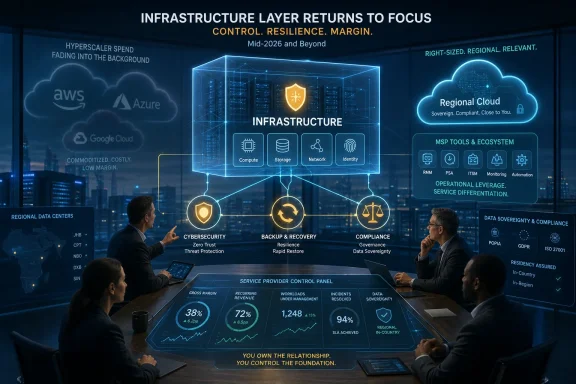 Infrastructure Is Back on the Boardroom Agenda
For much of the last decade, the safest advice for service providers was to climb the stack. Do not sell servers; sell outcomes. Do not talk about storage; talk about resilience. Do not compete with hyperscalers; wrap them, broker them, optimize them, and move on.That advice was not wrong, but it became too neat. Customers still run workloads somewhere, and the location, cost model, jurisdiction, support path, and operational ownership of that somewhere now matter more than they did during the cloud-migration boom. The infrastructure layer did not disappear. It became someone else’s invoice.
Acronis is leaning into that correction with Cyber Frame, a platform meant to let providers deliver cloud infrastructure with cybersecurity, data protection, and management built in from the start. The framing matters because Acronis is not merely selling virtual machines. It is selling the idea that IaaS becomes profitable when it is packaged as a managed, protected, recurring service rather than as commodity compute.
That is a familiar MSP argument, but the backdrop has changed. Broadcom’s VMware overhaul shook confidence in long-settled virtualization assumptions. Hyperscaler bills remain a recurring source of executive anxiety. Regulators and customers continue to press for clearer answers about where data resides and who can touch it. Those forces have turned infrastructure from a procurement detail into a strategic risk surface.
The Hyperscaler Hangover Created an Opening, Not a Rebellion
It would be too easy to frame partner cloud as a revolt against AWS, Microsoft Azure, and Google Cloud. That is not what is happening. The hyperscalers are still enormous, deeply capable, and, for many workloads, the right answer. The shift is more pragmatic: customers are becoming more selective about which workloads deserve hyperscale economics.The first wave of public cloud adoption often rewarded speed over discipline. Developers got capacity instantly. Business units bypassed slow procurement cycles. Infrastructure became programmable, global, and elastic. Then the monthly bills arrived, and the same flexibility that made cloud attractive became a management problem.
For service providers, this is the opening. Many customers do not want to abandon hyperscalers; they want a more rational portfolio. Stable line-of-business applications, predictable virtualized workloads, backup repositories, compliance-sensitive systems, and regional customer platforms may not need the full sprawl of a hyperscale environment. They may need competent hosting, clear pricing, strong support, and dependable recovery.
That is where partner cloud IaaS can make sense. The provider does not have to claim it can out-engineer Azure. It has to identify the workloads where simpler economics, closer support, and more direct accountability beat the convenience of buying everything from a global platform.
Acronis’s pitch lands in that middle ground. It is not promising that every MSP should become a miniature hyperscaler. It is arguing that providers can own a slice of infrastructure again if they attach enough operational value to avoid selling undifferentiated capacity.
VMware’s Upheaval Made “Do Nothing” Look Riskier
The VMware story is the accelerant. Broadcom’s acquisition of VMware and subsequent licensing, packaging, and partner-program changes have forced customers and providers to revisit assumptions that had been stable for years. For many organizations, VMware was not merely a hypervisor vendor. It was the substrate of the data center.That is why the disruption has been so consequential. When pricing models change, perpetual licensing gives way to subscription packaging, partner access narrows, and renewal conversations become more difficult, customers start asking uncomfortable questions. They ask whether the stack they have trusted for a decade still fits their economics. They ask whether their service provider has a migration plan. They ask whether infrastructure strategy is suddenly something they should care about again.
The irony is that VMware’s dominance created exactly the market Acronis now wants to address. Service providers built hosting, backup, disaster recovery, and managed infrastructure services around a familiar virtualization layer. When that layer becomes more expensive or less predictable, providers can either absorb the change, pass it through, or offer a new path.
Passing it through is the weakest long-term answer. Customers already irritated by licensing complexity do not become more loyal when their provider simply forwards the pain. Absorbing the cost may protect accounts temporarily, but it attacks the provider’s margin. Offering a credible alternative is harder, but it changes the conversation from “your bill went up” to “we have a plan.”
That is why partner cloud IaaS is timely. Not because VMware is finished, which it is not. Not because every workload should move immediately, which it should not. It is timely because the status quo has become negotiable.
Resale Was Always the Low-Control End of the Cloud Business
Acronis’s critique of the resale model is the sharpest part of the argument. Reselling someone else’s infrastructure can be a useful on-ramp, but it rarely gives providers control over the economics that matter most. The vendor sets the platform. The vendor influences the price. The customer relationship can drift toward the underlying brand rather than the local provider.That is not fatal if resale is part of a broader managed-service strategy. It is dangerous if resale becomes the strategy. The provider ends up responsible for support and customer satisfaction without controlling enough of the service design to shape margin or differentiation.
Partner cloud changes that balance only if the provider uses it to create a service, not merely a catalog. A virtual machine with a different logo is still a virtual machine. A managed workload platform with backup, disaster recovery, patching support, security monitoring, migration assistance, compliance reporting, and local accountability is a different proposition.
This distinction is central to the Acronis pitch. Cyber Frame is presented as a way to avoid stitching together infrastructure, cyber protection, and management tools after the fact. In MSP terms, that means fewer moving parts at launch and a clearer path to packaging. In customer terms, it means the provider can sell confidence rather than capacity.
But there is a trap here. Providers should not hear “own the infrastructure” and assume they must immediately buy racks, sign data center contracts, and build an operations team overnight. The smarter reading is that control is a spectrum. A provider can start with hosted capacity, learn the demand curve, standardize offers, and only then decide whether local or self-hosted infrastructure makes business sense.
Cyber Frame’s Real Product Is Optionality
Acronis describes Cyber Frame as flexible across deployment models: providers can start with Acronis-hosted infrastructure, move toward a self-hosted hyperconverged model, and wrap the result into a managed service. That flexibility is more important than any single feature claim because the IaaS opportunity is not uniform across service providers.A small MSP with loyal SMB customers may need a quick way to offer predictable infrastructure without hiring a cloud architecture team. A regional provider may already have facilities, hardware relationships, and operational staff, but need a more integrated platform for protection and management. A larger service provider may want to reposition away from low-margin resale into a branded cloud service with defined tiers and add-ons.
The platform has to serve all three without forcing them into the same capital model on day one. That is the practical appeal of “start hosted, move local later.” It lets providers test demand before committing to full ownership.
This is also where the product strategy reflects a broader change in the MSP market. Providers want recurring revenue, but they are more cautious about speculative infrastructure spend than they were during earlier hosting cycles. They have seen what happens when hardware bets, licensing shifts, and customer churn collide. A phased model lowers the emotional and financial barrier.
Still, optionality does not eliminate execution risk. Providers must decide which workloads they want, which customers they can support, which compliance promises they are willing to make, and which SLAs they can actually meet. A platform can simplify the starting point. It cannot make a weak service model profitable.
The Margin Is in the Wrapper, Not the Virtual Machine
The most important sentence in Acronis’s argument is the idea that margin is not driven by infrastructure itself, but by how the service is designed and delivered. That is the difference between a credible business plan and a nostalgic return to hosting.Raw IaaS is brutally comparable. Customers can ask how much CPU, RAM, storage, bandwidth, backup, and support they get for a given price. If the provider’s answer is just a line item, the customer will shop it. If the answer is an operating model, the discussion changes.
That operating model might include migration planning, continuous backup, disaster recovery testing, ransomware recovery workflows, monitoring, patch coordination, identity integration, cost reviews, and compliance documentation. None of those are decorative extras. They are the reasons a customer pays a service provider instead of buying infrastructure directly.
This is especially true for smaller and midmarket customers. Many do not have the staff to run a clean cloud environment, let alone to optimize it continuously. They need someone to tell them which workloads belong where, how to protect them, and how to recover when something goes wrong. Partner cloud IaaS gives the provider a platform for that conversation.
The business case becomes strongest when IaaS is the anchor for adjacent services. A migration project creates the opening. Managed operations creates recurring revenue. Backup and disaster recovery create resilience value. Security services create urgency. Optimization reviews create retention. The virtual machine is the substrate; the service relationship is the product.
Migration Is the Door, But Operations Is the House
Acronis is right to emphasize migration as an entry point. Customers facing VMware uncertainty, hyperscaler cost pressure, or data-residency concerns may be willing to consider a move in a way they were not two years ago. A provider that can assess, package, migrate, and support workloads has a timely reason to re-engage accounts.But migration revenue is episodic. It is useful, sometimes lucrative, and often necessary, but it does not create a durable business by itself. The real prize is what happens after the cutover.
That is where providers must be careful not to underprice the operational burden. Running infrastructure for customers means owning the 2 a.m. incident, the restore test, the capacity warning, the certificate expiration, the misconfigured firewall rule, and the customer who assumes “managed” means “you handle it.” If those responsibilities are not built into pricing, the margin story collapses.
This is why packaging matters. Providers should not launch with a sprawling menu of custom infrastructure choices. They should define a few repeatable offers, identify supported workloads, set boundaries around customer responsibilities, and make protection part of the default rather than an upsell that can be declined.
The less glamorous work is what determines profitability. Standard images, migration runbooks, backup policies, monitoring templates, support tiers, and onboarding checklists are not marketing copy. They are the difference between a scalable IaaS service and a bespoke hosting mess.
Data Sovereignty Turns Locality Into a Feature Again
Data sovereignty has become one of those phrases that vendors can stretch until it means almost anything. At minimum, customers want to know where their data is stored, which legal jurisdictions apply, who operates the platform, and how access is controlled. For some sectors, those questions are compliance requirements. For others, they are procurement comfort.Partner cloud providers have an advantage here if they are honest about it. A regional provider may be able to offer clearer locality, more direct operational accountability, and a support relationship that does not disappear into a global ticket queue. That does not automatically make it more secure or compliant than a hyperscaler, but it can make governance simpler for certain customers.
The key is precision. Providers should not imply that “local cloud” magically solves sovereignty. They need to document data location, subcontractors, administrative access, encryption practices, backup replication, logging, retention, and legal process handling. Sovereignty is not a vibe. It is a set of controls and commitments.
Acronis’s broader cyber-protection identity gives its IaaS pitch a useful angle here. If infrastructure, backup, recovery, and security controls are designed together, providers can tell a more coherent story about resilience and governance. That story will resonate with customers who are not only trying to save money but also trying to reduce ambiguity.
For WindowsForum readers, this is where the debate becomes practical. Many Windows-heavy shops run a mix of Active Directory, SQL Server, file services, legacy applications, Remote Desktop environments, and line-of-business systems that are not easily refactored. These workloads often need reliability and protection more than cloud-native sophistication. A well-run partner cloud can be a sensible landing zone if the provider has the discipline to define and defend the service.
The Windows Workload Angle Is Bigger Than the Marketing Copy
Windows infrastructure remains stubbornly present in the real world. Not every business application became a SaaS product. Not every database moved to a managed cloud service. Not every file share was replaced by collaboration software. The result is a large base of workloads that still look like traditional infrastructure, even when they are hosted somewhere else.That matters because many of these workloads fit the partner cloud argument better than the hyperscale dream. They are predictable. They are operationally familiar. They often require close support. They may have backup and recovery requirements that customers understand better than they understand autoscaling groups or Kubernetes clusters.
For service providers, Windows-heavy environments offer a practical starting point. A small set of standardized IaaS packages can support domain controllers, application servers, SQL workloads, remote access systems, and test environments. Add managed backup, disaster recovery, patch coordination, and security monitoring, and the provider has something more defensible than a commodity VM.
The danger is overreach. Providers should not promise seamless migration for every legacy Windows application or pretend licensing complexity disappears in a partner cloud. Microsoft licensing, application vendor support policies, identity dependencies, and latency requirements all need careful review. The customers most tempted by a simpler infrastructure story are often the ones with the messiest environments.
That is why the first 90 days of an IaaS launch should be narrow. Pick workloads that are easy to assess, easy to protect, and easy to support. Build proof with early customers. Turn those projects into templates. Expand only after operations catches up with sales.
Acronis Is Selling a Business Model as Much as a Platform
Vendor blogs are not neutral market analysis, and this one is no exception. Acronis has every reason to argue that service providers should rethink IaaS around cyber-protected infrastructure. The company benefits if MSPs conclude that they need a packaged platform rather than a do-it-yourself stack.That does not make the argument wrong. It means providers should separate the market thesis from the vendor solution. The thesis is that customer pressure around cloud cost, VMware uncertainty, sovereignty, and managed outcomes creates an opening for partner cloud IaaS. The solution is Acronis Cyber Frame. Those are related, but not identical.
A disciplined provider should test the thesis first. Which customers are complaining about hyperscaler bills? Which VMware renewals are becoming painful? Which workloads are candidates for migration? Which buyers care about data location? Which accounts already trust the provider enough to move infrastructure under its control?
Only after that should the provider evaluate whether Cyber Frame is the right operating platform. The answer may be yes, especially for providers that already use Acronis or want integrated protection from the start. But the business case must survive outside the vendor deck.
This is the healthy skepticism service providers need. Acronis can lower friction, but it cannot create demand where none exists. It can bundle capabilities, but it cannot fix poor packaging. It can support a phased model, but it cannot make infrastructure ownership painless. The provider still has to choose a market position.
The Provider’s Choice Is Really About Control
The article’s most useful strategic question is what role the provider wants to play in the value chain. That framing cuts through the usual cloud jargon. A provider can resell, broker, host, manage, optimize, secure, or fully operate. Each role has different margins, risks, and customer expectations.Resale is fast but thin. Hosting offers more control but requires operational maturity. Managed IaaS creates deeper relationships but increases responsibility. Outcome-driven services can be stickier and more profitable, but only if the provider can consistently deliver the outcome.
The temptation is to move up the ladder in marketing before doing so operationally. Every provider wants to say it delivers outcomes. Fewer are prepared to define the outcome, measure it, price it, and accept consequences when it fails.
For IaaS, that means being explicit. Is the provider selling infrastructure availability, workload recovery, security posture, cost predictability, migration execution, compliance support, or all of the above? The more the provider bundles, the more valuable the service becomes. The more it bundles without process, the more fragile the business becomes.
This is why Acronis’s “do not overcomplicate the starting point” advice is more than launch guidance. It is risk management. Start with one or two simple packages. Target workloads that can be migrated and supported repeatably. Attach services that the provider already knows how to deliver. Grow from evidence, not ambition.
The Cloud Middle Class Gets Its Moment
The broader market story is the return of the cloud middle class. For years, the industry conversation was dominated by two poles: hyperscale public cloud at one end and traditional on-premises infrastructure at the other. Between them sat regional providers, MSP-hosted platforms, private clouds, co-location environments, and hybrid models that were often treated as transitional.That middle looks more durable now. Customers are not becoming less hybrid; they are becoming more deliberate about hybrid. They want the right venue for each workload, and they want help making the decision. That is an opportunity for service providers that can translate infrastructure choices into business consequences.
Partner cloud IaaS fits this moment because it does not require a theological argument about cloud purity. It can sit beside Microsoft 365, Azure, AWS, SaaS platforms, on-premises systems, and endpoint management. Its value is not that it replaces everything. Its value is that it gives providers another controlled venue for workloads that do not neatly fit elsewhere.
The winners will not be the providers that simply announce a cloud. They will be the ones that productize the boring parts: intake, assessment, migration, backup, recovery, monitoring, patching, reporting, and support. Customers do not need another ambiguous infrastructure option. They need a clearer operating model.
Acronis is effectively betting that many service providers want that model but do not want to assemble it from scratch. That is a reasonable bet. The question is whether providers can resist the urge to sell too broadly before they have learned where the service truly works.
The Acronis Pitch Leaves Providers With a Harder, Better Question
The concrete message for service providers is not “launch IaaS because cloud is expensive.” That is too simplistic. The better message is that infrastructure is again a place where providers can create customer value, but only if they bring control, protection, and operational clarity to the offer.- Service providers should treat partner cloud IaaS as a managed-service opportunity, not as a commodity hosting revival.
- VMware disruption gives providers a timely reason to revisit customer infrastructure plans, but it does not remove the need for careful migration assessment.
- Hyperscaler cost frustration creates openings for predictable workloads, especially where elasticity is less important than support, resilience, and price clarity.
- Data-sovereignty concerns can strengthen a regional or partner cloud story, but only when backed by specific controls and documented commitments.
- A phased launch with a few repeatable packages is safer than a broad catalog that creates custom operational debt from day one.
- The strongest margin is likely to come from attached services such as backup, disaster recovery, managed operations, security, and optimization.
References
- Primary source: Acronis
Published: 2026-06-30T18:12:14.448142
Rethinking IaaS: Why partner cloud is a timely growth opportunity for service providers
If you’re a service provider, you’ve probably felt the shift already. Clients are asking tougher questions about cost. Some are frustrated with hyperscaler bills. Others are rethinking VMware. And more are paying attention to where their data lives and who controls it. Put all of that together... www.acronis.com
- Related coverage: atonementlicensing.com
What Broadcom Changed at VMware: 2024 to 2026 Timeline
Every Broadcom change to VMware: product cuts, perpetual license end, VCF bundling, partner eliminations, price hikes. Plan your renewal defense now.atonementlicensing.com
- Related coverage: techradar.com
'A bulldozer named Broadcom' hits cloud service providers after another major blow against VMware partners | TechRadar
European VCSPs are being 'bulldozed' by Broadcomwww.techradar.com - Related coverage: itpro.com
TCS expands sovereign cloud into the EU | IT Pro
The EU-specific TCS Enterprise Cloud Framework is designed specifically for governments, public sector enterprises, and regulated industrieswww.itpro.com - Related coverage: cloudthesis.com
- Related coverage: arstechnica.com
More VMware cloud partners axed as Broadcom launches new invite-only program - Ars Technica
Smaller businesses most likely to be affected as white-label cloud program is also ending.arstechnica.com
- Related coverage: news.broadcom.com
Continuing to Simplify and Optimize through Cloud Service Providers
A Simplified Route and a Simplified Solution Earlier this week, Broadcom’s President and CEO Hock Tan and Vice President of Global Partner and Commercial Sales Cindy Loyd each shared their perspectives on the progress we’re making with VMware’s modernized product offerings and our different... news.broadcom.com
- Official source: techcommunity.microsoft.com
- Related coverage: licensefortress.com
A Complete Guide to All the VMware… | LicenseFortress
Software licensing solutions for Oracle, Microsoft, IBM, VMware, and SAP. Optimize spend, negotiate contracts, and stay compliant.licensefortress.com
- Related coverage: ondeck.console.cloud.ibm.com
IBM Cloud Docs
Find documentation, API & SDK references, tutorials, FAQs, and more resources for IBM Cloud products and services. ondeck.console.cloud.ibm.com
- Related coverage: vmware.com
vmware cloud foundation license portability list of certified cloud providers
PDF documentwww.vmware.com
