

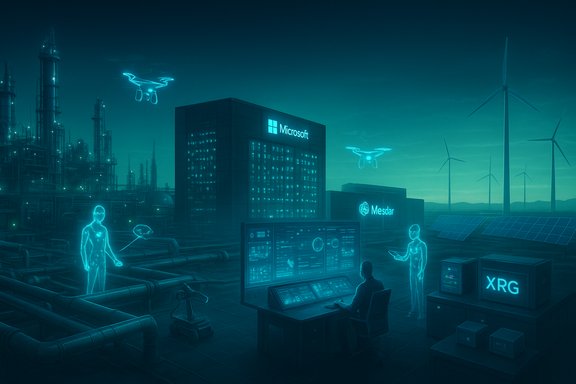
ADNOC’s announced expansion of its AI partnership with Microsoft marks a significant escalation in the energy sector’s race to embed advanced artificial intelligence across operations, infrastructure and the energy systems that will power global AI growth.
Background
ADNOC and Microsoft have worked together for several years, evolving from enterprise productivity tools to large-scale AI deployments. The latest agreement, unveiled at a high-profile energy and AI gathering in Abu Dhabi, brings two additional UAE entities — Masdar and XRG — into the collaboration and frames the relationship around two linked objectives: embedding AI agents throughout ADNOC’s value chain to boost efficiency and operational autonomy, and delivering energy and infrastructure solutions to support Microsoft’s global AI and data‑center expansion.ADNOC reports that its initial generative AI rollout using Microsoft Copilot began in November 2023 and has since become a central part of internal workflows. ADNOC also cites large-scale employee upskilling, high utilization rates and substantial productivity gains as justification for scaling the partnership into co‑development of agentic AI systems. Independent media coverage and industry briefings corroborate the broad contours of the announcement and the inclusion of Masdar and XRG to focus on sustainable energy for compute-intensive AI infrastructure.
What the expanded partnership covers
- Joint development and deployment of AI agents across ADNOC’s operations, aimed at enabling more autonomous decision-making and process automation.
- Collaboration with Masdar and XRG to plan and build energy projects and infrastructure that supply Microsoft’s expanding global AI and data-center footprint.
- Delivery of advanced AI tooling, joint innovation programs and skills development from Microsoft to ADNOC personnel.
- Exploration of a broader innovation ecosystem to create new AI-driven solutions for the energy sector.
Why this matters now
The energy demands of advanced AI services — particularly large models and data centers — are rising rapidly. For a technology company such as Microsoft, ensuring resilient, low-carbon power for new data centers is a strategic priority. For a national oil company like ADNOC, deepening AI capabilities can deliver direct operational benefits: lower operating costs, improved safety, emissions reductions and extended asset life.Adding Masdar, a major renewable-energy developer, and XRG, an investor and developer focused on energy and infrastructure, reframes the relationship: it’s not only about AI inside ADNOC, but about building the energy systems that will power AI globally. The partnership therefore links energy supply, AI compute demand and industrial AI capability in a single strategic thread.
The concrete claims and what’s been independently verified
ADNOC’s announcement includes several concrete claims that merit scrutiny:- ADNOC states it rolled out generative AI enterprise-wide in November 2023 using Microsoft Copilot, with widespread adoption inside the company.
- ADNOC reports that more than 40,000 employees have completed AI training, with utilization rates above 90% and a claimed productivity gain equivalent to tens of thousands of hours per month.
- Earlier reporting tied ADNOC’s early AI efforts to measurable financial and environmental benefits — one widely reported figure is roughly half a billion dollars of “extra value” in a past year and significant CO₂ reductions attributable to AI-driven efficiencies.
What “AI agents” likely means — and what remains ambiguous
The term AI agents in public statements can cover a wide range of capabilities, and the distinction matters for risk, safety and technical governance.- At its simplest, an AI agent could be a task‑specific automation using models and rules to handle workflows, notifications and decision support in offices and supply chains.
- More advanced definitions imply agentic AI: systems with the ability to sense an environment, plan multi‑step actions, and execute decisions — potentially integrating with industrial control systems, robotics and operational technology (OT).
- In industrial settings, “AI agents” can also mean digital twins or multi‑agent systems that coordinate optimization across fields, pipelines, logistics and maintenance.
Technical and operational implications
Digital transformation at scale
Embedding AI agents across an oil major’s value chain implies a sweeping integration across:- Upstream operations: reservoir modeling, drilling optimization, production forecasting.
- Midstream logistics: pipeline monitoring, leak detection, scheduling and routing.
- Downstream operations: refining optimization, maintenance scheduling, supply chain and trading.
- Corporate functions: procurement, HR, finance and legal automation.
Cloud + edge hybridization
Operational AI in energy often requires near-real‑time responses and high availability in remote environments. Expect architectures that combine:- On‑site edge compute for latency‑sensitive control loops.
- Cloud compute for heavy model training, centralized orchestration and long‑horizon planning.
- Secure, optimized data links between edge and cloud, with careful failover strategies to keep safety-critical control autonomous of network outages.
Model lifecycle and MLOps
Deploying agents at scale forces industrial-grade MLOps:- Versioned model registries and reproducible training pipelines.
- Explainability tooling for AI decisions tied to operational logs.
- Rigorous online testing and staged rollouts, with rollback mechanisms.
- Continuous monitoring for drift, distributional shifts and failure modes.
Benefits ADNOC and Microsoft will likely pursue
- Operational efficiency: predictive maintenance, optimized production scheduling and reduced downtime.
- Cost reduction: automation of routine decisions and better reservoir management.
- Emissions reductions: optimized processes can lower fuel use and flaring, contributing to decarbonization targets.
- Workforce upskilling: large-scale AI training increases digital skills among thousands of employees.
- Energy-for-AI symbiosis: building renewables and efficient power systems that support data centers while offering new revenue streams for energy companies.
Critical risks and governance challenges
The scale and ambition of this partnership also surface meaningful risks that need explicit mitigation.Safety and operational risk
Agentic systems interacting with OT and control environments introduce new safety vectors. Even well‑intentioned agents can produce hazardous outcomes if training data is biased, models are poorly validated, or human oversight is insufficient. Any system that influences pumps, compressors, valves or drilling equipment must be designed with safety first principles: formal verification where possible, multi‑layered failsafes, and conservative operational envelopes.Cybersecurity and supply chain risk
A deeper integration between cloud providers and critical infrastructure amplifies the attack surface. Threats include data exfiltration, model manipulation, and ransomware across cloud and on‑premise stacks. Robust segmentation, zero‑trust architectures, hardware-rooted security, and careful third‑party software vetting are essential.Data sovereignty and regulatory exposure
Cross-border data flows for cloud training and telemetry — especially when tied to international cloud providers — raise questions of jurisdiction, access by foreign governments, and compliance with local laws. For national oil companies, this is both an operational and a sovereign concern.Vendor lock‑in and strategic dependency
Deeper technical coupling with a single hyperscaler increases strategic dependence. Migrating agent architectures, model datasets, and integrated DevOps pipelines away from a given cloud provider becomes exponentially harder over time. Contract structures, open standards and modular architectures can mitigate lock‑in.Environmental trade-offs
Although the partnership foregrounds renewables, AI model training and inference are energy intensive. The net environmental benefit depends on the carbon intensity of power used for compute, the lifecycle emissions of new infrastructure, and whether optimization gains outrun energy costs for AI workloads.Governance, ethics and transparency
Deploying agentic AI in energy calls for robust governance frameworks that include:- Explicit safety‑of‑life requirements for any agent touching OT.
- Transparent model documentation and decision logs for auditability.
- Clear incident reporting lines and independent oversight for safety incidents.
- Workforce transition plans to reskill staff and avoid deskilling or overreliance on opaque systems.
- Environmental impact assessments that transparently weigh AI compute emissions against operational emissions reductions.
Economic and geopolitical dimensions
This partnership is not just technological — it is geopolitical and economic.- Abu Dhabi’s positioning as a hub for both energy and AI investment strengthens national strategic depth and attracts global capital.
- For Microsoft, securing low‑carbon, resilient energy supplies for data centers supports global expansion plans for AI infrastructure and helps control operational costs and ESG exposure.
- The deal model — coupling energy incumbents with hyperscalers — may be replicated globally, creating new alliances where national energy champions become strategic energy suppliers for tech giants.
What to watch next: short‑ and medium‑term milestones
- Technical briefings on the architecture of the proposed AI agents: edge vs cloud balance, safety controls, and human-in-the-loop requirements.
- Commercial deals or power purchase agreements (PPAs) between Masdar/XRG and Microsoft for specific data‑center locations.
- Pilots that demonstrate agentic control in low-risk environments (e.g., analytics, scheduling) before any integration with safety‑critical control systems.
- Governance frameworks and third‑party audits for AI model behaviour and safety testing.
- Evidence of measurable operational outcomes published in independently verifiable form — e.g., audited emission reductions or third‑party validation of claimed productivity gains.
Practical takeaways for IT and cloud professionals
- Expect increased demand for hybrid cloud architects who can blend Azure services with secure edge compute in industrial environments.
- Skills in MLOps, model governance, and orchestration for distributed inference will be in high demand.
- Security teams must upskill in OT and ICS threat models and implement integrated cloud-to-edge security postures.
- Organizations should plan for multi‑vendor strategies and data portability standards to reduce lock‑in risk while engaging with hyperscalers.
Strengths of the partnership
- Scale and resources: combining a national oil company’s operational footprint with a hyperscaler’s cloud and AI expertise creates a potent platform for rapid impact.
- Integrated energy-compute strategy: pairing renewables developers with data‑center needs addresses a core constraint for AI scale — reliable, low‑carbon power.
- Workforce development: large-scale training initiatives can accelerate the digital skills base in the region.
- Potential measurable benefits: prior ADNOC initiatives have demonstrated tangible efficiency and emissions gains, indicating the partnership could yield real returns if executed rigorously.
Unresolved questions and cautionary notes
- The announcement lacks public technical detail about agent autonomy levels, safety interlocks, and human oversight. That’s a material gap for evaluating operational risk.
- Figures for productivity gains, utilization rates and economic value appear promising but are company‑reported; the methods for calculation are not disclosed and should be treated with cautious optimism until independently validated.
- The environmental calculus is complex: AI increases demand for electricity even as operators claim efficiency gains. Net impact depends on power sourcing, efficiency yields and the lifecycle carbon footprint of new infrastructure.
Final assessment
The expanded ADNOC–Microsoft partnership is a pivotal example of how national energy players and hyperscalers are co‑designing the future of energy and AI together. It aligns incentives: ADNOC seeks operational excellence and value creation; Microsoft needs resilient, low‑carbon power and edge capability to scale AI services; Masdar and XRG bring the renewable and infrastructure expertise to close the loop.If executed transparently and with rigorous governance, the collaboration could accelerate safer, more efficient energy operations and create a template for energy‑sourced compute ecosystems worldwide. Conversely, if key technical, safety and transparency questions remain unanswered, the program risks amplifying cybersecurity, operational and environmental liabilities while locking partners into asymmetric dependencies.
For technologists and industry watchers, the near term will be revealing: detailed technical disclosures, pilot results, and transparent governance frameworks will be the clearest indicators of whether this is an exemplary model of industrial AI deployment — or a high-profile strategic partnership that still needs to prove its operational and ethical foundations.
Source: Oil & Gas Middle East https://www.oilandgasmiddleeast.com/news/adnoc-microsoft-expand-ai-partnership/
