

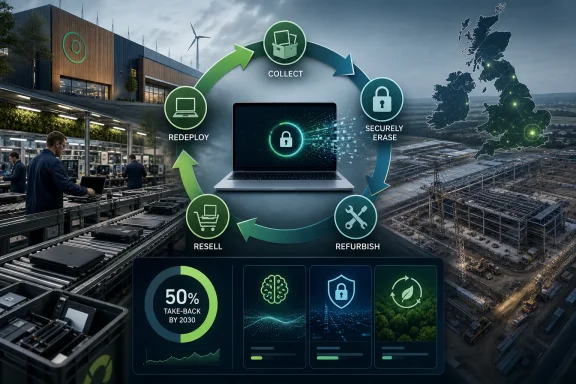
Advania chief executive Hege Støre says the Northern European IT services group wants to take back 50 percent of the devices it sells and resell them as reused devices by 2030, with a UK refurbishment operation planned from early 2028. That target, detailed in a CRN interview, is more than a sustainability flourish. It is a statement about where the reseller channel thinks margin, relevance, and customer control will come from next. In a market obsessed with AI pilots and security anxiety, Advania is betting that the humble laptop refresh cycle may become one of the most strategic battlegrounds in enterprise IT.
The traditional value-added reseller model was built around procurement gravity. Customers needed hardware, licensing, deployment support, and perhaps a little integration work; the reseller converted vendor complexity into a workable buying motion. That business still exists, but Støre’s comments underline how inadequate the old vocabulary has become for companies trying to own a larger slice of the technology lifecycle.
CRN’s interview frames Advania’s next phase around three strategic priorities: AI, cyber resilience, and total lifecycle management. The first two are familiar boardroom magnets. The third sounds less glamorous, but it may be the most operationally consequential because it touches budgets, carbon reporting, asset governance, data erasure, procurement policy, and the secondary device market all at once.
Advania already has a proof point in Sweden. The company’s Dreamhouse facility in Enköping, near Stockholm, is a 10,000-square-metre refurbishment and logistics hub that Advania says can process one million IT devices annually. Advania’s own materials describe the site as a circular IT centre where used equipment can be collected, erased, repaired, refurbished, redeployed, resold, or responsibly recycled.
The UK plan matters because it shows circular IT moving from Nordic showcase to repeatable channel infrastructure. Støre told CRN she had expected the UK market to be less mature, but research with McKinsey persuaded Advania that demand was stronger than assumed. That is the detail that should make competitors pay attention: this is not being pitched as corporate virtue signalling, but as a market opportunity large enough to justify local capacity.
The economic logic is straightforward. A reseller that only sells a fleet of laptops competes on availability, price, vendor incentives, and procurement relationships. A provider that manages the device estate from planning through financing, deployment, support, return, refurbishment, resale, and replacement is embedded in the customer’s operating model.
This is why lifecycle management is strategically useful. It extends the reseller’s role across the entire asset journey, creating more moments to advise, standardise, secure, and monetise. It also turns what used to be disposal into inventory, and what used to be end-of-life administration into a measurable service line.
For mid-market customers, the appeal is equally pragmatic. Many organisations are too large to manage technology informally but too constrained to maintain specialist internal teams for every layer of procurement, endpoint management, security compliance, sustainability reporting, and AI governance. A partner that can consolidate those functions has a stronger claim than a supplier that simply wins the next hardware quote.
Advania says it serves around 30,000 customers, and CRN quotes Støre saying those customers increasingly want advice on AI, data security, and governance. That is the real connective tissue between the company’s three strategic priorities. Customers are not buying “AI” in isolation, or “cyber” in isolation, or “sustainability” in isolation; they are trying to keep control of increasingly complicated technology estates.
That is a very different proposition from telling customers to recycle more responsibly. Recycling is often the last stop after value has already leaked away. Refurbishment and reuse try to preserve value before the asset becomes waste.
In enterprise terms, this changes the conversation from “What do we do with old kit?” to “How do we design the refresh cycle so that old kit is never orphaned?” That shift is where circular IT becomes commercially serious. A device that is specified, tracked, protected, maintained, and recovered properly has a second-life value; one that disappears into drawers, informal hand-me-downs, or poorly documented disposal streams does not.
Advania’s Dreamhouse pitch leans heavily on this idea. The company says the facility can give technology a “second chance” at scale, and its sustainability pages claim refurbished laptops can deliver sharply lower carbon impact than newly manufactured devices. Those claims sit within a broader industry reality: embodied emissions from manufacturing are a major part of endpoint hardware’s lifecycle impact, so extending usable life is one of the more direct ways to reduce the footprint of workplace computing.
But there is also a security story here. Device take-back is not just about carbon; it is about custody. If a provider can control collection, data erasure, refurbishment, and redeployment, it can reduce the messy risk that retired hardware becomes a compliance problem. For IT administrators, that may be the more immediate selling point.
Støre’s comment to CRN about McKinsey research is revealing because it suggests a market correction inside Advania itself. The company apparently discovered that the UK was more ready for circular IT than leadership had expected. In channel terms, that means sustainability demand may be moving from policy language to procurement behaviour.
The UK is also a useful test market because it has a dense base of mid-market organisations, public sector procurement pressure, managed services maturity, and a large installed base of Windows endpoints. If Advania can prove that take-back, refurbishment, and resale work commercially there, the model becomes easier to replicate elsewhere.
There is a timing issue as well. Windows 10 reached end of support in October 2025, and the Windows 11 hardware floor pushed many organisations to reassess older PC estates. Even with extended security options and staged refresh plans, the Windows endpoint market has been working through one of its more consequential hardware transitions in years. That creates both a disposal problem and a second-life opportunity, depending on device age, specification, and customer policy.
For WindowsForum readers, this is where the story becomes practical. Circular IT will not make every unsupported machine viable, and it does not erase the security baseline problem created by ageing hardware. But a mature refurbishment chain can separate devices that should be securely retired from those that can be redeployed, resold, or used in lower-risk contexts with appropriate support.
Advania is not ignoring that market. Støre says the company is investing in AI platform infrastructure and developing tools to help customers use data securely, implement governance, and deploy AI responsibly. She also says Advania is using tools such as Microsoft Copilot and Claude internally, with weekly 30-minute knowledge-sharing sessions where employees swap practical use cases.
That internal-use detail matters more than the brand names. In 2026, it is no longer enough for an IT provider to say it can sell AI. Customers need partners that can explain where AI helps, where it creates risk, how to govern it, and how to integrate it into real workflows without turning every department into an unsupervised experiment.
Still, lifecycle management may produce stickier customer relationships than AI advisory on its own. AI projects can be episodic, especially when customers are still discovering use cases. Device lifecycle services, managed endpoint operations, security controls, and refresh planning create recurring engagement. They generate data about the customer’s environment that can, in turn, inform AI and security work.
This is Advania’s strategic braid. AI gives the company relevance in boardroom conversations. Cyber resilience gives it urgency. Lifecycle management gives it operational permanence.
That matters because refurbished enterprise devices are not the same thing as second-hand consumer gadgets. Business buyers need confidence that equipment has been wiped, tested, repaired, documented, and supported to an auditable standard. The stronger the refurbishment process, the easier it becomes for IT teams to treat reused devices as a legitimate part of the estate rather than an exception.
Cyber resilience also changes how customers think about “old” equipment. The question is not simply whether a laptop boots quickly enough for office work. It is whether the device can meet operating system requirements, receive firmware updates, support modern identity and encryption controls, and fit into endpoint detection and management frameworks.
This creates a natural advantage for providers that already sit across procurement, managed services, and security. A pure recycler may be able to process hardware. A pure reseller may be able to supply replacements. A managed IT provider with refurbishment capacity can connect the two, turning lifecycle policy into enforceable operational practice.
That is why Advania’s cyber resilience priority is not separate from its circular IT push. If anything, cyber is the trust layer that makes circular IT acceptable to risk-conscious customers.
The phrase “single partner” can sound like procurement convenience. In practice, it reflects a deeper frustration. Mid-market IT teams are being asked to handle enterprise-grade complexity without enterprise-scale staff. They face cloud cost pressure, identity sprawl, ransomware risk, endpoint churn, compliance obligations, data governance demands, and now AI adoption pressure.
A partner that can cover products, licensing, managed services, consulting, AI enablement, cyber resilience, and lifecycle management offers a seductive promise: fewer handoffs and more accountability. The risk, of course, is lock-in. The same model that reduces fragmentation can also make customers dependent on one provider’s commercial incentives and operational maturity.
That is where Advania’s positioning will be tested. Vendor neutrality is easy to claim and harder to maintain when providers have preferred alliances, commercial targets, and service platforms to scale. Customers will need to see whether lifecycle recommendations are driven by asset value and operational fit, or by the provider’s need to feed refurbishment and resale pipelines.
The best version of this model is genuinely advisory. It tells customers when to buy new, when to redeploy, when to refurbish, when to extend support, and when to retire hardware securely. The weaker version becomes a circular gloss on the same old sales machine.
That means contracts will matter. Customers may need device return clauses, employee offboarding processes, asset tagging discipline, financing models that encourage recovery, and clear rules for data erasure. Procurement teams may need to compare total lifecycle cost rather than upfront unit price. Sustainability teams may need credible reporting that connects device reuse to emissions accounting without overclaiming.
This is difficult work, but it is exactly the kind of difficulty that creates defensible services revenue. A provider that helps customers redesign procurement and asset management around circular outcomes is not just selling greener hardware. It is changing the customer’s operating rhythm.
The 2030 date also gives the target a useful tension. It is far enough away to allow infrastructure build-out, customer education, and market development. It is close enough that Advania cannot treat it as a vague aspiration. A UK facility starting in early 2028 would leave roughly two years before the target year to prove its contribution at scale.
For competitors, the question is whether they follow with their own refurbishment hubs, partner with specialist refurbishers, or dismiss the model as too operationally heavy. The danger in dismissing it is that lifecycle management is becoming attached to higher-value conversations about security, AI readiness, and cost control.
There is margin potential in remarketing, repair, managed refresh planning, secure disposal, and lifecycle consulting. There is also strategic data value in understanding the customer’s installed base: device age, performance, failure rates, refresh cycles, operating system readiness, and security posture. That information can inform future sales, but it can also support better advice.
For Windows estates, this could become particularly important. Microsoft’s platform direction increasingly assumes modern hardware security capabilities, cloud management, identity integration, and AI-assisted workflows. Organisations that do not understand their endpoint inventory will struggle to plan rationally. Those that do can make more deliberate decisions about when “new” is necessary and when “good enough, securely managed” is the smarter choice.
Advania’s bet is therefore not nostalgia for hardware. It is a bid to make hardware lifecycle intelligence part of the managed services fabric. If the company succeeds, the endpoint becomes less of a commodity SKU and more of a recurring relationship anchor.
The irony is that the greenest part of the strategy may also be the most commercially hard-nosed. A recovered laptop is an environmental claim, but it is also an asset with residual value. Circular IT works when both truths are allowed to coexist.
For customers and competitors, the most concrete implications are already visible:
Advania’s wager is that the next version of the reseller is not really a reseller at all, but a lifecycle operator sitting between vendors, customers, security demands, AI ambitions, and the growing pressure to make technology last longer. If that model works, the company’s most important product may not be a new device or an AI platform, but the ability to keep value moving through the system after the first sale is done.
 Advania Wants the Device Sale to Stop Being the End of the Story
The traditional value-added reseller model was built around procurement gravity. Customers needed hardware, licensing, deployment support, and perhaps a little integration work; the reseller converted vendor complexity into a workable buying motion. That business still exists, but Støre’s comments underline how inadequate the old vocabulary has become for companies trying to own a larger slice of the technology lifecycle.CRN’s interview frames Advania’s next phase around three strategic priorities: AI, cyber resilience, and total lifecycle management. The first two are familiar boardroom magnets. The third sounds less glamorous, but it may be the most operationally consequential because it touches budgets, carbon reporting, asset governance, data erasure, procurement policy, and the secondary device market all at once.
Advania already has a proof point in Sweden. The company’s Dreamhouse facility in Enköping, near Stockholm, is a 10,000-square-metre refurbishment and logistics hub that Advania says can process one million IT devices annually. Advania’s own materials describe the site as a circular IT centre where used equipment can be collected, erased, repaired, refurbished, redeployed, resold, or responsibly recycled.
The UK plan matters because it shows circular IT moving from Nordic showcase to repeatable channel infrastructure. Støre told CRN she had expected the UK market to be less mature, but research with McKinsey persuaded Advania that demand was stronger than assumed. That is the detail that should make competitors pay attention: this is not being pitched as corporate virtue signalling, but as a market opportunity large enough to justify local capacity.
The VAR Model Is Being Rewritten by What Happens After Procurement
Støre pushes back on the label “VAR” because, in her telling, Advania rarely just sells products. The company now talks in terms of products and licensing, managed services, and consulting. That shift is not semantic decoration; it reflects a channel-wide migration from transaction brokerage to recurring operational dependency.The economic logic is straightforward. A reseller that only sells a fleet of laptops competes on availability, price, vendor incentives, and procurement relationships. A provider that manages the device estate from planning through financing, deployment, support, return, refurbishment, resale, and replacement is embedded in the customer’s operating model.
This is why lifecycle management is strategically useful. It extends the reseller’s role across the entire asset journey, creating more moments to advise, standardise, secure, and monetise. It also turns what used to be disposal into inventory, and what used to be end-of-life administration into a measurable service line.
For mid-market customers, the appeal is equally pragmatic. Many organisations are too large to manage technology informally but too constrained to maintain specialist internal teams for every layer of procurement, endpoint management, security compliance, sustainability reporting, and AI governance. A partner that can consolidate those functions has a stronger claim than a supplier that simply wins the next hardware quote.
Advania says it serves around 30,000 customers, and CRN quotes Støre saying those customers increasingly want advice on AI, data security, and governance. That is the real connective tissue between the company’s three strategic priorities. Customers are not buying “AI” in isolation, or “cyber” in isolation, or “sustainability” in isolation; they are trying to keep control of increasingly complicated technology estates.
Circular IT Has Become a Control Plane, Not a Recycling Programme
The most interesting thing about Advania’s circular IT goal is its specificity. “Take back 50 percent of the devices we sell” is a measurable operating target. It forces the company to think about logistics, device grading, repair capability, data destruction, resale channels, warranty structures, customer incentives, and procurement policy.That is a very different proposition from telling customers to recycle more responsibly. Recycling is often the last stop after value has already leaked away. Refurbishment and reuse try to preserve value before the asset becomes waste.
In enterprise terms, this changes the conversation from “What do we do with old kit?” to “How do we design the refresh cycle so that old kit is never orphaned?” That shift is where circular IT becomes commercially serious. A device that is specified, tracked, protected, maintained, and recovered properly has a second-life value; one that disappears into drawers, informal hand-me-downs, or poorly documented disposal streams does not.
Advania’s Dreamhouse pitch leans heavily on this idea. The company says the facility can give technology a “second chance” at scale, and its sustainability pages claim refurbished laptops can deliver sharply lower carbon impact than newly manufactured devices. Those claims sit within a broader industry reality: embodied emissions from manufacturing are a major part of endpoint hardware’s lifecycle impact, so extending usable life is one of the more direct ways to reduce the footprint of workplace computing.
But there is also a security story here. Device take-back is not just about carbon; it is about custody. If a provider can control collection, data erasure, refurbishment, and redeployment, it can reduce the messy risk that retired hardware becomes a compliance problem. For IT administrators, that may be the more immediate selling point.
The UK Refurbishment Bet Shows Sustainability Following the Money
The planned UK refurbishment centre, expected from the beginning of 2028, is the clearest sign that Advania sees circular IT as a local infrastructure business. You can centralise some functions across borders, but device logistics, customer trust, compliance expectations, and resale markets all have local texture. A UK customer may like the idea of a Swedish circular IT hub; it is more likely to operationalise the model if there is a domestic facility and a local commercial framework.Støre’s comment to CRN about McKinsey research is revealing because it suggests a market correction inside Advania itself. The company apparently discovered that the UK was more ready for circular IT than leadership had expected. In channel terms, that means sustainability demand may be moving from policy language to procurement behaviour.
The UK is also a useful test market because it has a dense base of mid-market organisations, public sector procurement pressure, managed services maturity, and a large installed base of Windows endpoints. If Advania can prove that take-back, refurbishment, and resale work commercially there, the model becomes easier to replicate elsewhere.
There is a timing issue as well. Windows 10 reached end of support in October 2025, and the Windows 11 hardware floor pushed many organisations to reassess older PC estates. Even with extended security options and staged refresh plans, the Windows endpoint market has been working through one of its more consequential hardware transitions in years. That creates both a disposal problem and a second-life opportunity, depending on device age, specification, and customer policy.
For WindowsForum readers, this is where the story becomes practical. Circular IT will not make every unsupported machine viable, and it does not erase the security baseline problem created by ageing hardware. But a mature refurbishment chain can separate devices that should be securely retired from those that can be redeployed, resold, or used in lower-risk contexts with appropriate support.
AI Is the Loudest Story, but Lifecycle May Be the Stickiest One
Støre told CRN that customers are all discussing AI, data security, and governance. That tracks with the wider enterprise market, where AI has moved from experimentation to policy wrestling. The problem is that many AI programmes still sit in a fog of uncertain return on investment, fragmented tooling, and unresolved data access questions.Advania is not ignoring that market. Støre says the company is investing in AI platform infrastructure and developing tools to help customers use data securely, implement governance, and deploy AI responsibly. She also says Advania is using tools such as Microsoft Copilot and Claude internally, with weekly 30-minute knowledge-sharing sessions where employees swap practical use cases.
That internal-use detail matters more than the brand names. In 2026, it is no longer enough for an IT provider to say it can sell AI. Customers need partners that can explain where AI helps, where it creates risk, how to govern it, and how to integrate it into real workflows without turning every department into an unsupervised experiment.
Still, lifecycle management may produce stickier customer relationships than AI advisory on its own. AI projects can be episodic, especially when customers are still discovering use cases. Device lifecycle services, managed endpoint operations, security controls, and refresh planning create recurring engagement. They generate data about the customer’s environment that can, in turn, inform AI and security work.
This is Advania’s strategic braid. AI gives the company relevance in boardroom conversations. Cyber resilience gives it urgency. Lifecycle management gives it operational permanence.
Cyber Resilience Turns Refurbishment Into a Trust Question
The channel often talks about sustainability and security as separate buying centres. Advania’s strategy implies they are increasingly the same conversation. A customer cannot responsibly extend device life if it cannot trust asset identity, patch posture, firmware state, data erasure, and supportability.That matters because refurbished enterprise devices are not the same thing as second-hand consumer gadgets. Business buyers need confidence that equipment has been wiped, tested, repaired, documented, and supported to an auditable standard. The stronger the refurbishment process, the easier it becomes for IT teams to treat reused devices as a legitimate part of the estate rather than an exception.
Cyber resilience also changes how customers think about “old” equipment. The question is not simply whether a laptop boots quickly enough for office work. It is whether the device can meet operating system requirements, receive firmware updates, support modern identity and encryption controls, and fit into endpoint detection and management frameworks.
This creates a natural advantage for providers that already sit across procurement, managed services, and security. A pure recycler may be able to process hardware. A pure reseller may be able to supply replacements. A managed IT provider with refurbishment capacity can connect the two, turning lifecycle policy into enforceable operational practice.
That is why Advania’s cyber resilience priority is not separate from its circular IT push. If anything, cyber is the trust layer that makes circular IT acceptable to risk-conscious customers.
The Mid-Market Wants One Throat to Choke, but Also One Brain to Trust
Støre told CRN that about 89 percent of mid-market customers prefer buying from one partner. Whether that exact figure varies by survey or region, the underlying trend is familiar to anyone working in IT services: customers want simplification, but not at the cost of competence.The phrase “single partner” can sound like procurement convenience. In practice, it reflects a deeper frustration. Mid-market IT teams are being asked to handle enterprise-grade complexity without enterprise-scale staff. They face cloud cost pressure, identity sprawl, ransomware risk, endpoint churn, compliance obligations, data governance demands, and now AI adoption pressure.
A partner that can cover products, licensing, managed services, consulting, AI enablement, cyber resilience, and lifecycle management offers a seductive promise: fewer handoffs and more accountability. The risk, of course, is lock-in. The same model that reduces fragmentation can also make customers dependent on one provider’s commercial incentives and operational maturity.
That is where Advania’s positioning will be tested. Vendor neutrality is easy to claim and harder to maintain when providers have preferred alliances, commercial targets, and service platforms to scale. Customers will need to see whether lifecycle recommendations are driven by asset value and operational fit, or by the provider’s need to feed refurbishment and resale pipelines.
The best version of this model is genuinely advisory. It tells customers when to buy new, when to redeploy, when to refurbish, when to extend support, and when to retire hardware securely. The weaker version becomes a circular gloss on the same old sales machine.
The Green Goal Will Live or Die in Procurement Policy
A 50 percent take-back target by 2030 sounds ambitious, but it depends on customers changing behaviour as much as Advania building capacity. Devices cannot be refurbished if they are not returned. They cannot be resold at good value if they are damaged, unmanaged, locked, missing chargers, or undocumented. Circular IT starts at procurement, not disposal.That means contracts will matter. Customers may need device return clauses, employee offboarding processes, asset tagging discipline, financing models that encourage recovery, and clear rules for data erasure. Procurement teams may need to compare total lifecycle cost rather than upfront unit price. Sustainability teams may need credible reporting that connects device reuse to emissions accounting without overclaiming.
This is difficult work, but it is exactly the kind of difficulty that creates defensible services revenue. A provider that helps customers redesign procurement and asset management around circular outcomes is not just selling greener hardware. It is changing the customer’s operating rhythm.
The 2030 date also gives the target a useful tension. It is far enough away to allow infrastructure build-out, customer education, and market development. It is close enough that Advania cannot treat it as a vague aspiration. A UK facility starting in early 2028 would leave roughly two years before the target year to prove its contribution at scale.
For competitors, the question is whether they follow with their own refurbishment hubs, partner with specialist refurbishers, or dismiss the model as too operationally heavy. The danger in dismissing it is that lifecycle management is becoming attached to higher-value conversations about security, AI readiness, and cost control.
The Channel’s Next Margin Pool May Be Hidden in Old Hardware
The reseller market has spent years adapting to cloud subscriptions and vendor-direct pressure. Hardware never disappeared, but the easy assumption that endpoint sales alone could sustain a channel business has been weakened by commoditisation. Circular IT offers a way to put services, logistics, and trust back around the device.There is margin potential in remarketing, repair, managed refresh planning, secure disposal, and lifecycle consulting. There is also strategic data value in understanding the customer’s installed base: device age, performance, failure rates, refresh cycles, operating system readiness, and security posture. That information can inform future sales, but it can also support better advice.
For Windows estates, this could become particularly important. Microsoft’s platform direction increasingly assumes modern hardware security capabilities, cloud management, identity integration, and AI-assisted workflows. Organisations that do not understand their endpoint inventory will struggle to plan rationally. Those that do can make more deliberate decisions about when “new” is necessary and when “good enough, securely managed” is the smarter choice.
Advania’s bet is therefore not nostalgia for hardware. It is a bid to make hardware lifecycle intelligence part of the managed services fabric. If the company succeeds, the endpoint becomes less of a commodity SKU and more of a recurring relationship anchor.
The irony is that the greenest part of the strategy may also be the most commercially hard-nosed. A recovered laptop is an environmental claim, but it is also an asset with residual value. Circular IT works when both truths are allowed to coexist.
The 2030 Promise Gives IT Buyers Something Concrete to Measure
Advania’s plan is still a promise, not a completed transformation. The Swedish Dreamhouse is operating, the UK facility is planned, and the 50 percent take-back goal has a 2030 horizon. The execution risk is real, but the strategy is unusually legible.For customers and competitors, the most concrete implications are already visible:
- Advania is trying to turn device take-back into a normal part of the sales relationship rather than a disposal afterthought.
- The planned UK refurbishment centre suggests circular IT demand is strong enough to justify local infrastructure, not just centralised Nordic capacity.
- AI, cyber resilience, and lifecycle management are being positioned as connected services rather than separate product campaigns.
- Mid-market customers are likely to benefit from simpler accountability, but they will need to watch for lock-in and insist on transparent lifecycle economics.
- The 2030 target gives buyers a measurable benchmark against which to judge Advania’s sustainability claims and operational progress.
Advania’s wager is that the next version of the reseller is not really a reseller at all, but a lifecycle operator sitting between vendors, customers, security demands, AI ambitions, and the growing pressure to make technology last longer. If that model works, the company’s most important product may not be a new device or an AI platform, but the ability to keep value moving through the system after the first sale is done.
References
- Primary source: CRN UK
Published: 2026-07-06T11:02:09.472053
‘We want to take back 50 per cent of the devices we sell’: Hege Støre on Advania’s green goals and tech ambitions
The VAR’s CEO talks circular IT, VAR model and AI adoptionwww.channelweb.co.uk - Related coverage: advania.com
- Related coverage: new.advania.com
- Related coverage: annual-report.advania.com
Advania Annual report executive summary
www.annual-report.advania.com
- Related coverage: advania.se
Welcome to our Dreamhouse | Advania
Take a virtual tour of the Dream House, Advania’s center for circular IT management. Step inside and see how we make a real difference. www.advania.se
- Related coverage: advania.co.uk
- Related coverage: advania.no
Advanias års- og bærekraftsrapport: 22% vekst og solid resultat
Advania Group rapporterer 22% vekst i 2025, med fokus på bærekraft og strategiske vekstområder som AI og cybersikkerhet. Selskapet styrker sin rolle i IT-bransjen. www.advania.no
- Related coverage: advania.is
Advania Primary Logo White_RGB
Mid adult businesswoman talking to group of seminar attendees in conference hall.www.advania.is
- Related coverage: advania.dk
Advania Primary Logo White_RGB
Mid adult businesswoman talking to group of seminar attendees in conference hall.www.advania.dk