

The Edge Is No Longer Content With Being Small
For years, “edge computing” carried a certain polite ambiguity. It could mean a rugged gateway, a fanless industrial PC, a camera controller, a small inference node, or simply a server that happened not to live in a data center. Advantech’s EPYC Embedded 4005 rollout sharpens the definition: the edge is becoming a place where serious compute is expected to run continuously, close to machines, sensors, production lines, medical devices, and video streams.
That shift is not happening because factories suddenly want miniature data centers for their own sake. It is happening because latency-sensitive workloads are piling up faster than centralized infrastructure can absorb them. Machine vision, robotics control, defect inspection, real-time analytics, and on-prem AI inference all punish round trips to the cloud.
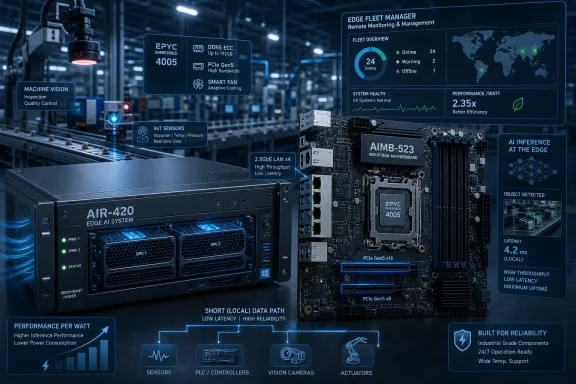
The AIR-420 and AIMB-523 therefore sit in a useful middle ground. They are not hyperscale servers. They are also not the old embedded boxes whose main achievement was surviving dust, vibration, and neglect. They are compact industrial platforms built around a CPU family that borrows heavily from the server world while trying to stay inside the power and lifecycle expectations of embedded deployments.
That is the real benchmark Advantech is pointing to. The quoted 1.44x performance-per-watt advantage over competitive CPUs is the headline number, but the strategic claim is broader: industrial customers can now ask for higher local compute without immediately blowing up their power budgets, cooling designs, or maintenance cycles.
AMD’s Embedded Play Is Really a Server Play in Workwear
AMD’s EPYC Embedded 4005 Series is built around the company’s Zen 5 architecture and tops out at 16 cores, 32 threads, and as much as 128MB of L3 cache, with configurable TDPs spanning 65W to 170W. Those numbers are not exotic in a rack server, but they are notable in industrial platforms where long availability, deterministic behavior, and deployment stability often matter more than raw benchmark theater.
The distinction between “server” and “embedded” has always been partly cultural. Server buyers expect high throughput, ECC memory, modern I/O, remote management, and a roadmap that does not disappear after one procurement cycle. Embedded buyers expect long product lifetimes, stable BOMs, harsh-environment tolerance, and enough predictability to certify systems that may live inside machines for years.
EPYC Embedded 4005 is designed to collapse those expectations into one platform class. That is why the combination of DDR5 ECC memory, PCIe Gen5, high cache capacity, and long-term availability matters. The silicon is not merely faster; it is being packaged into a procurement story that industrial customers can actually use.
For AMD, this is also a way to push EPYC into terrain Intel has historically defended with Xeon E, Core, and embedded-class parts. The edge is attractive because it is fragmented, numerous, and upgrade-hungry. A factory may not buy thousands of rack servers, but it might refresh dozens or hundreds of inspection stations, robot controllers, analytics nodes, and inference gateways over time.
Advantech Turns the Spec Sheet Into Two Different Arguments
The AIR-420 and AIMB-523 represent two separate readings of the same market. The AIR-420 is the box: a compact 28.6-liter edge AI HPC system with support for two large graphics cards, redundant power options, multiple fans, and a smart fan algorithm meant to balance thermal headroom against noise. It is aimed at buyers who want a deployable system rather than a motherboard integration project.
The AIMB-523 is the platform foundation: a Micro-ATX industrial motherboard for OEMs, integrators, and equipment builders who need to design the compute node into a larger machine. Its appeal is in expansion and I/O density — PCIe Gen5, M.2 NVMe, up to six 2.5GbE ports, USB 3.2 connectivity, COM ports, and PSE support on select Ethernet ports. That is the language of cameras, sensors, actuators, inspection equipment, and industrial peripherals.
This two-pronged launch matters because edge computing is not one buying motion. Some organizations want finished systems that can be mounted, configured, imaged, and monitored. Others want a motherboard they can wrap in their own chassis, thermal design, carrier boards, and certification process.
Advantech is therefore not just announcing support for a new CPU. It is creating a path for the same processor family to appear in both standardized edge servers and bespoke industrial equipment. That is exactly how a platform becomes sticky.
Performance Per Watt Is the Polite Way to Talk About Power Anxiety
The 1.44x performance-per-watt claim is doing a lot of work here. In cloud and enterprise settings, performance per watt is often framed as sustainability, density, or operating expense. At the industrial edge, it is more immediate: can the system fit in the enclosure, stay within the power envelope, avoid excessive noise, survive ambient conditions, and keep running without a technician constantly visiting the line?
A 170W embedded CPU may not sound “low power” to anyone coming from fanless gateways or ARM-based controllers. But Advantech is not positioning EPYC Embedded 4005 against the smallest edge devices. It is positioning it against x86 systems that need server-class work done near the data source.
That distinction matters. There is a world of difference between collecting telemetry from a PLC and running multi-camera inspection with GPU acceleration, model inference, local preprocessing, and real-time decision loops. The latter workload does not merely need “a computer.” It needs bandwidth, cache, I/O, memory integrity, and predictable performance under load.
Power anxiety is also a facilities problem. Many factories, hospitals, and field deployments do not have the luxury of adding cooling capacity every time a new AI model arrives. A better performance-per-watt curve buys time, and in industrial computing, time is often the difference between a feasible upgrade and a capital project.
The AIR-420 Is a Small Server Wearing an Industrial Badge
The AIR-420’s most interesting trait is not that it supports EPYC Embedded 4005. It is that Advantech pairs that CPU with dual-GPU expansion in a relatively compact chassis aimed at edge AI workloads. That makes the system less like a traditional industrial PC and more like a small inference server designed to live outside the data center.
The company describes the system as suitable for light-to-mid AI inference, machine vision, and real-time analytics. That phrasing is careful, and appropriately so. This is not a replacement for a rack of high-end accelerators training frontier-scale models. It is a platform for localized inference, inspection, classification, analytics, and production intelligence.
The redundant power option is a useful tell. Advantech is not merely chasing enthusiasts who want a powerful box on a bench. It is aiming at operations where downtime has measurable cost, and where a failed power supply should not stop a line, delay imaging, or interrupt a robotic workflow.
Noise also appears in the product pitch, which is easy to overlook. Edge AI systems may be installed near people, machines, medical equipment, or constrained enclosures rather than in isolated server rooms. A smart fan algorithm is not glamour engineering, but it is the kind of feature that determines whether a system is tolerable in real deployments.
The AIMB-523 Is Where Integrators Will Do the Hard Work
The AIMB-523 is less visually dramatic than a dual-GPU edge system, but it may be the more consequential product for long-lived industrial deployments. A Micro-ATX board with EPYC Embedded 4005 support gives machine builders a way to standardize on a high-performance x86 platform without surrendering the expansion flexibility they need.
The board’s I/O mix reads like an industrial wish list. Multiple 2.5GbE ports can feed camera networks, inspection devices, segmented machine networks, or local uplinks. USB 3.2 ports cover high-speed peripherals. COM ports acknowledge the stubborn reality that industrial environments do not modernize on consumer refresh cycles.
PCIe Gen5 is the forward-looking piece. Even when a workload does not need full Gen5 bandwidth on day one, the slot capability gives integrators headroom for capture cards, accelerators, storage, networking, or specialized controllers. Edge systems age badly when they run out of I/O before they run out of CPU.
That is why the AIMB-523 is not just a motherboard announcement. It is an invitation to build a new class of industrial equipment around a platform that can scale from today’s machine vision pipeline to tomorrow’s AI-assisted inspection station without a complete redesign.
Windows at the Edge Is Still a Practical Choice, Not a Nostalgia Act
Advantech says the EPYC Embedded 4005 product line is validated for Windows Server IoT and Ubuntu LTSC. That dual validation reflects a reality that often gets lost in edge-computing marketing: Linux may dominate many AI and cloud-native workflows, but Windows remains deeply entrenched in industrial software, medical systems, operator interfaces, device management, and legacy application stacks.
For Windows administrators, Windows Server IoT support is the part that turns this from an embedded hardware story into an operations story. It means these platforms can potentially fit into familiar management, security, imaging, and application deployment practices, depending on the customer’s environment and licensing model. The edge does not eliminate Windows administration; it distributes it into more places.
That distribution brings complications. More capable edge nodes mean more patching responsibility, more identity and access management, more endpoint monitoring, and more pressure to segment networks properly. A machine vision box with server-class compute is also a server-class asset from a security perspective, even if it sits next to a conveyor belt.
The industry has sometimes treated edge devices as appliances that can be installed and forgotten. That model is increasingly untenable. Once a box runs AI workloads, stores local data, talks to cameras and controllers, and exposes remote management, it needs to be governed like infrastructure.
Advantech’s Software Stack Is the Lock-In Layer and the Safety Net
The hardware announcement arrives with Advantech’s surrounding software suite: DeviceOn, SUSI API, Edge AI SDK, GenAI Studio, and design-in services. These tools are pitched as accelerators for deployment, monitoring, I/O control, maintenance, inference evaluation, and LLM-related workflows. In plain terms, Advantech wants to sell not only the compute platform but the operational envelope around it.
That is sensible because edge deployments fail less often from a lack of theoretical compute than from integration drag. The hard parts include driver validation, thermal tuning, remote health monitoring, OS imaging, field updates, I/O handling, model deployment, and diagnosing intermittent problems when the system is physically far from the person responsible for it.
DeviceOn and SUSI API are particularly important in this context. Remote monitoring and device control are not optional luxuries when edge nodes multiply across factories or medical environments. If administrators cannot see health status, manage I/O, push updates, or detect failures, the edge becomes a fleet of expensive mysteries.
GenAI Studio is the flashier name, especially with its no-code positioning for LLM applications. But buyers should be careful with the implication that LLM deployment becomes simple just because a GUI exists. The workflow may become more approachable, yet questions around data governance, model selection, inference cost, latency, and hallucination risk do not disappear at the edge.
The AI Pitch Is Real, but It Needs a Smaller Vocabulary
Every industrial computing vendor now has an AI story, and not all of those stories deserve equal patience. Advantech’s case is stronger than many because machine vision, inspection, robotics, and medical imaging are already plausible edge AI workloads. These are not speculative “AI everywhere” fantasies; they are domains where local inference can reduce latency, bandwidth use, and dependency on remote services.
Still, the vocabulary matters. The AIR-420 is described as suitable for light-to-mid AI inference, which is a refreshingly grounded phrase. It suggests object detection, defect classification, image preprocessing, local analytics, or smaller language-model applications rather than massive model training.
That realism should be welcomed. Edge AI succeeds when the workload is bounded, measurable, and tied to an operational outcome. A camera system that rejects defective parts in milliseconds is a better business case than a vague promise to make the factory “intelligent.”
The danger is that the term AI can obscure the engineering fundamentals. Memory bandwidth, PCIe lanes, thermal design, redundant power, OS validation, and remote management will decide whether these systems deliver value. The model is only one component of the pipeline.
The Benchmark Claim Is Useful, but Buyers Should Demand Context
Performance-per-watt comparisons are valuable, but they are also highly dependent on workload, compiler choices, memory configuration, accelerator use, power limits, and system design. Advantech’s 1.44x figure gives buyers a reason to look closer, not a reason to skip evaluation.
That is especially true in mixed CPU-GPU edge systems. If the workload is dominated by GPU inference, CPU performance per watt may matter most for preprocessing, orchestration, data movement, and system responsiveness. If the workload is CPU-bound — packet processing, control logic, compression, database operations, or certain imaging tasks — then core count, cache, and sustained clocks become more central.
Industrial buyers should also test under realistic thermal conditions. A benchmark run on an open bench or in a favorable lab environment does not always predict performance inside an enclosure near hot equipment. Sustained behavior matters more than peak throughput.
The good news is that EPYC Embedded 4005’s range of TDP options gives integrators some design flexibility. A 65W part may suit restrained deployments where power and heat dominate. A 170W part may make sense when throughput and latency justify a more capable thermal solution.
The Hidden Story Is Lifecycle Discipline
Industrial customers do not upgrade the way consumer PC buyers upgrade. A board or system may need to remain available, supportable, and certifiable across years of production. This is why long-term availability is not a throwaway line in Advantech’s announcement; it is part of the value proposition.
When an industrial platform disappears too quickly, the cost is not merely buying a replacement. It can mean redesigning enclosures, revalidating software images, recertifying equipment, updating documentation, retraining support teams, and carrying multiple spare-part strategies. That friction is exactly what embedded product lines are supposed to reduce.
AMD’s embedded roadmap gives Advantech a stronger story for customers who want modern performance without consumer-style churn. The question is not whether a faster CPU will exist next year. It is whether the platform being designed into a machine today can be purchased, serviced, and trusted years from now.
This is also where Windows Server IoT and Ubuntu LTSC validation fits the broader picture. Long-term operating system support and stable hardware availability belong together. If either side fails, the deployment becomes fragile.
Edge Security Gets Harder When the Edge Gets Smarter
A more powerful edge node is a more useful edge node, but also a more attractive target. Systems like the AIR-420 and AIMB-523 may sit at the intersection of IT and OT networks, handling sensitive production data, imaging streams, model artifacts, credentials, and remote-management channels. That is a rich attack surface.
The security model has to treat these systems as servers, not peripherals. Secure boot, TPM support, OS hardening, least-privilege access, network segmentation, patch management, logging, and remote attestation become practical requirements. The fact that a system is mounted in an industrial enclosure does not make it less exposed.
There is also the question of AI model integrity. If a machine-vision model is part of a quality-control process, then unauthorized model changes are operational risks, not just cybersecurity events. A compromised or poorly governed inference pipeline can produce defective goods, false rejects, or unsafe automation decisions.
Advantech’s management tooling may help, but tools are not policy. IT and OT teams will need shared ownership models for these nodes, because the old division — IT owns servers, operations owns machinery — breaks down when the machinery contains server-class compute.
Intel Should Not Ignore the Embedded Flank
This launch is another reminder that AMD’s EPYC strategy is no longer confined to mainstream data center contests. The company has been pushing EPYC down into entry servers and sideways into embedded markets, where the competitive terrain is different but the strategic prize is meaningful. Edge systems can become a beachhead for broader platform adoption.
Intel still has deep advantages in industrial ecosystems, software relationships, validation history, and installed base. Many OEMs and integrators are conservative for good reasons, and industrial buyers are not always eager to switch CPU vendors unless the payoff is clear. But AMD does not need to win every socket to alter the market.
The pressure point is performance density. If AMD and partners like Advantech can show that EPYC Embedded 4005 delivers more local compute per watt, per dollar, or per enclosure than incumbent options, the conversation changes. The upgrade path becomes less about brand familiarity and more about whether older platforms can keep pace with AI-assisted industrial workloads.
This is how embedded markets move: not in one dramatic replacement wave, but through design wins, validated platforms, and accumulated confidence. The AIR-420 and AIMB-523 are two more pieces in that campaign.
The Real Upgrade Is From Appliance Thinking to Fleet Thinking
The most important operational consequence of Advantech’s announcement is that edge nodes are becoming fleets. One AIR-420 in a lab is a system. Dozens across production lines, hospitals, warehouses, and inspection stations are infrastructure.
Fleet thinking changes the requirements. Administrators need repeatable imaging, remote telemetry, controlled updates, hardware inventory, failure prediction, security baselines, and lifecycle planning. Developers need deployment targets that behave consistently. Operations teams need uptime and deterministic behavior.
This is where many edge projects stumble. The pilot succeeds because a small team babysits the hardware. The rollout struggles because every site has slightly different power, networking, thermal, OS, driver, and access conditions. A high-performance platform helps only if it can be standardized.
Advantech’s combination of hardware, management tools, and design-in services is clearly meant to address that scaling problem. The company is selling a stack because the edge punishes customers who buy components and hope integration will sort itself out later.
The Specs Point to a Different Kind of Industrial PC
The concrete product details are worth holding onto because they show how far the category has moved from the old embedded-PC template. The AIR-420 offers a compact chassis, support for two large GPUs, redundant power options, multi-fan reliability features, and built-in GenAI Studio. The AIMB-523 offers Micro-ATX flexibility, DDR5 ECC memory support, PCIe Gen5 expansion, multiple high-speed Ethernet ports, USB 3.2, COM connectivity, and NVMe support.
That is not the profile of a minimalist controller. It is the profile of a localized compute node designed to ingest data, process it near the source, and participate in a managed software environment. The industrial PC is becoming less of a peripheral and more of a distributed server.
For Windows environments, this evolution will feel familiar and uncomfortable at the same time. Familiar, because the administrative concepts resemble server management. Uncomfortable, because the physical and operational contexts are messier than a server room.
The winners in this category will be vendors that make the mess manageable. Compute alone is not enough. The platform must survive real deployment conditions and remain governable after the excitement of the proof of concept wears off.
The Practical Read for WindowsForum Readers
Advantech’s announcement is best understood as a platform availability signal, not a magic performance event. The company is giving industrial buyers two routes into EPYC Embedded 4005: a deployable edge AI system and a motherboard for custom integration. That makes the news relevant to administrators, OEMs, and developers planning the next refresh cycle of edge compute.
- Advantech’s AIR-420 and AIMB-523 are now available to order with AMD EPYC Embedded 4005 processors.
- The EPYC Embedded 4005 platform brings up to 16 Zen 5 cores, up to 128MB of L3 cache, DDR5 ECC support, PCIe Gen5, and configurable 65W to 170W TDPs into industrial edge designs.
- The AIR-420 is aimed at compact edge AI deployments that need dual-GPU expansion, redundant power options, and local inference capability.
- The AIMB-523 is aimed at integrators who need a Micro-ATX foundation with dense industrial I/O, high-speed networking, and expansion headroom.
- Validation for Windows Server IoT and Ubuntu LTSC makes the platform more relevant to mixed IT and OT environments than a hardware-only announcement would.
- The 1.44x performance-per-watt claim is promising, but serious buyers should validate it against their own thermal conditions, models, peripherals, and uptime requirements.
The edge is becoming powerful enough that it can no longer be treated as a collection of smart appliances bolted onto the side of real infrastructure. Advantech’s EPYC Embedded 4005 systems show the direction of travel: server-class compute moving into industrial spaces, wrapped in embedded lifecycles, AI tooling, and remote-management expectations. The next competitive fight will not be over whether edge devices can run heavier workloads; it will be over which platforms can make those workloads reliable, secure, and administrable at scale.
References
- A new low-power benchmark in high-performance edge computing Electropages · 2026-06-15T11:40:12.353792