

Aembit announced on June 16, 2026, at Identiverse in Las Vegas that its identity and access management platform for agentic AI now supports Microsoft Copilot Studio, extending policy-based access controls, credential brokering, and audit visibility to agents built on Microsoft’s low-code enterprise AI platform. The announcement is not just another integration badge for the Microsoft ecosystem. It is a signal that the next IAM fight is moving from human users and cloud workloads to AI agents that can invoke tools, touch data, and act across business systems. For Windows-heavy organizations, Copilot Studio is becoming a convenient front door for automation — and that convenience is exactly why security teams are now looking for a second lock.
The first wave of generative AI in the workplace was mostly about prompts, documents, summaries, and chat windows. The risks were real, but they were familiar enough to fit into existing governance buckets: data leakage, hallucinated answers, overbroad access to enterprise search, and users pasting sensitive information into tools they should not use.
Agentic AI changes the shape of the problem. An agent is not merely answering a question; it may decide which tool to call, which workflow to trigger, which system to query, and which piece of data to retrieve next. That makes the agent less like a chatbot and more like a junior automation service with a language model for a brain and enterprise connectors for limbs.
Copilot Studio sits directly in that transition. Microsoft has spent the last several years pushing Copilot from branded assistant to extensible platform, and Copilot Studio gives business teams a comparatively easy way to build agents that connect to Microsoft 365, Dataverse, Power Platform connectors, APIs, and Model Context Protocol servers. That is powerful because it lets the people closest to a business process automate it. It is risky for the same reason.
Aembit’s pitch is that the identity layer must catch up with this reality. If an AI agent can call a payroll API, query a customer database, open a ticket, or pull data from a third-party SaaS system, then “the user clicked approve once” is not enough of a security story. The access decision needs to account for the agent, the human on whose behalf it is acting, the system it is trying to reach, the runtime context, and the policy that governs that exact combination.
But low-code development has always carried a governance tax. The easier it becomes to create applications, flows, connectors, and agents, the more IT has to worry about sprawl. Shadow IT did not disappear when enterprises adopted Microsoft 365; it merely learned to use sanctioned tooling.
Microsoft is not blind to this. Copilot Studio includes governance concepts around environments, data loss prevention policies, connector controls, auditing, lifecycle management, and Entra-linked agent identities. Microsoft’s own documentation increasingly treats agents as governable assets rather than disposable prompt wrappers. The platform can expose what connector permissions an agent is configured to use, and admins can apply policy through the Power Platform and Entra ecosystems.
The catch is that enterprises rarely live entirely inside one vendor’s neat control plane. A Copilot Studio agent may touch Microsoft services, but it may also reach out to external APIs, custom MCP servers, partner systems, cloud workloads, and legacy services that were never designed for autonomous AI mediation. That is where Aembit is trying to insert itself: not as a replacement for Microsoft’s governance stack, but as a control point for the broader mess around it.
That distinction matters. Traditional secrets management answers the question, “How does this workload prove it is allowed to connect?” Workload IAM asks a sharper question: “What is this workload, what is it trying to do, what policy governs it, and should credentials even be issued for this request?”
Agentic AI raises the stakes because the workload is no longer a predictable daemon calling the same API endpoint on a schedule. Agents can be dynamic. They can chain tools. They can act under delegated user context. They can traverse MCP servers that expose multiple tools and resources through a standardized interface. They can produce activity patterns that look less like a static integration and more like a human analyst moving through systems — except faster, and sometimes with less predictable judgment.
Aembit’s answer is to treat the agent as a non-human identity that needs policy-based access rather than hard-coded secrets. Its agentic AI capabilities center on ideas such as blended identity, in which the agent’s identity is considered alongside the human user it represents, and an MCP identity gateway that can broker access to tools and resources behind MCP servers. In plain English, the company wants to know both who asked and what is acting before it lets the agent reach sensitive systems.
For security teams, MCP is a new choke point and a new blind spot at the same time. If an MCP server exposes a set of tools, a capable agent can discover and call them. That is elegant when the tools are safe and well-scoped. It is unsettling when the server becomes a gateway to sensitive databases, ticketing systems, identity operations, or production infrastructure.
Microsoft’s embrace of MCP in Copilot Studio makes the issue more urgent for WindowsForum’s core audience. Copilot Studio can connect agents to existing MCP servers, and Microsoft’s own guidance positions MCP as a scalable way to expose tools and data sources to agents. Once that pattern becomes normal, the question shifts from “Can we connect this agent?” to “Who decides what this agent is allowed to do through that connection?”
Aembit’s integration is aimed squarely at that question. By placing identity and policy enforcement around MCP access, it gives security teams a way to mediate the agent’s path to downstream systems. The company’s claim is not that Microsoft lacks controls; it is that the access layer for agentic AI must follow the agent beyond Microsoft-native boundaries.
That does not make business users reckless. It means the platform abstracts away complexity that security teams still have to govern. A sales operations manager building an agent to enrich account records should not need to understand OAuth flows, token exchange, workload attestation, or MCP transport details. But someone in the organization must understand what that agent can access, where it can send data, and how to shut it down if it behaves badly.
This is the old Power Platform governance problem with a more autonomous actor in the middle. A badly designed workflow can leak data or trigger the wrong business process. A badly governed agent can decide to call the wrong tool, over-collect context, or combine actions in ways its maker did not fully anticipate. The difference is subtle but important: the system is not merely executing a fixed sequence; it may be selecting from available capabilities.
That is why Aembit’s move matters even if the company remains a specialist vendor rather than a household name. The enterprise agent market will not be secured only by model alignment or prompt filters. It will be secured, if it is secured at all, by mundane controls: identity, policy, least privilege, audit trails, conditional access, environment boundaries, and credential hygiene.
AI agents may change that. Once executives ask business units to deploy agents into revenue, support, finance, HR, and operations workflows, non-human identities become visible business actors. An agent that can retrieve a contract, summarize a customer history, open a refund request, or update a record is not just an application component. It is a participant in business process execution.
That creates a naming problem as much as a technical one. Organizations are used to asking which employee accessed a file or which service account called an API. They are less prepared to ask which agent, created by which team, operating on behalf of which user, invoked which tool, through which connector, under which policy, and with what downstream effects.
Aembit’s “blended identity” framing is a useful attempt to make that question legible. If an agent is acting on behalf of a human, the human context matters. If the agent itself has its own permissions, the agent context matters. If the access path involves an MCP server, connector, or external API, the resource context matters. Audit trails that flatten all of this into a generic service account are not going to satisfy serious security or compliance teams.
The risk is especially acute in hybrid Microsoft environments. Many enterprises still straddle Windows Server, Active Directory, Entra ID, Azure, Microsoft 365, third-party SaaS, on-prem databases, and custom internal applications. An agent built in a modern Microsoft tool can still end up needing access to systems with older assumptions about identity. That is where policy mediation becomes more than a convenience.
Those controls are meaningful. In a Microsoft-only deployment, they may cover much of what an organization needs. The problem is that “Microsoft-only deployment” is not how most large organizations actually operate.
A Copilot Studio agent may need to reach Salesforce, ServiceNow, Workday, Snowflake, a custom ERP endpoint, a partner API, a self-hosted MCP server, or a legacy application wrapped in a modern connector. Each hop adds another identity assumption. Each external system has its own authorization model. Each integration risks becoming a place where credentials are copied, over-permissioned, or forgotten.
Aembit’s value proposition is strongest in that messy middle. It offers a way to enforce policy and issue short-lived access without forcing every downstream system to become agent-aware overnight. That does not eliminate the need for Microsoft’s controls, but it gives organizations an additional enforcement layer when agents leave the comfortable boundaries of Microsoft 365 and Power Platform.
The practical question for IT is not whether to trust Microsoft or Aembit. It is whether the organization has a coherent access story from the Copilot Studio canvas to the system of record. If the answer is “the agent uses a stored credential in a connector someone approved last quarter,” the governance story may not survive contact with production.
A good audit record for an agent interaction should not merely say that a connector was invoked. It should reveal the agent identity, the user context, the policy decision, the resource requested, the credential issued or denied, and the runtime conditions that shaped the decision. That is the difference between a compliance artifact and an operational instrument.
This matters because agent behavior can be difficult to reason about after the fact. A human may ask a broad question, the agent may choose a tool, the MCP server may expose several resources, and the downstream API may return data that influences the next action. Without a durable identity trail, incident responders are left piecing together fragments from application logs, connector logs, identity provider events, and whatever telemetry the agent platform exposes.
Aembit is leaning into that gap by emphasizing complete records of access decisions. Whether customers find the implementation elegant will depend on the details, but the direction is right. In the agent era, auditability is not a checkbox at the end of deployment. It is part of the access architecture.
This is not an argument against low-code AI. It is an argument against pretending that ease of creation reduces the need for governance. In fact, it increases it. The more people can create agents, the more the platform must assume that not every maker understands the security implications of every connector, tool, and data source.
The historical parallel is macro malware, then SharePoint sprawl, then OAuth consent abuse, then Power Platform governance. In each case, Microsoft enabled useful extensibility, users adopted it enthusiastically, and security teams later had to impose structure around permissions, sharing, lifecycle, and monitoring. Agentic AI compresses that cycle because the objects being created can act rather than merely store or display information.
Aembit’s announcement lands at the point where enterprises are trying to avoid repeating that history. The company is betting that organizations will want IAM controls before agent sprawl becomes unmanageable. That is a sensible bet, because retrofitting least privilege onto a large estate of semi-autonomous agents will be painful.
The old admin questions still apply. Who can create agents? Which environments can they publish to? Which connectors are allowed? Which data classifications are off-limits? Which logs are retained? Which approvals are required before an agent reaches production?
The new questions are more subtle. Should an agent be allowed to call a tool only when acting for a specific user group? Should it receive different access when invoked from Teams than when invoked through another channel? Should it be blocked from calling an MCP tool outside a corporate network? Should it be denied access if the user is high-risk, the agent is newly published, or the requested operation falls outside its normal pattern?
Those are IAM questions, not prompt-engineering questions. They belong in the same family as conditional access, workload identity, just-in-time privilege, and zero trust. Agentic AI may be new, but the security model it needs is an extension of disciplines enterprise IT already understands.
Aembit’s challenge will be proving that its controls fit naturally into existing Microsoft-centric operations. Security teams do not want yet another dashboard that becomes an island. They want policy that maps to real workflows, logs that land where investigators already work, and deployment patterns that do not require every maker to become an identity engineer.
Still, specialist vendors often identify the pain before platform vendors fully absorb it. Workload identity was once treated as an implementation detail; now it is a major category because leaked secrets and overpowered service accounts became too dangerous to ignore. Non-human identity management followed a similar arc. Agentic AI is likely to accelerate the next turn because it combines non-human identity with delegated human intent and dynamic tool use.
Aembit’s move into Copilot Studio is therefore less about one vendor integration and more about category formation. The market is beginning to separate “AI safety” in the model-behavior sense from “AI access governance” in the enterprise-control sense. Both matter, but they are not interchangeable.
A model that refuses harmful instructions does not automatically enforce least privilege against an ERP system. A prompt shield does not rotate credentials. A content filter does not tell an auditor why an agent accessed a customer record. The access layer needs its own architecture.
This does not mean every experimental agent needs a months-long approval process. It means organizations need zones. Sandboxes should allow experimentation with constrained data and limited tools. Production environments should require stronger controls, narrower access, and clear accountability. The path from one to the other should be visible rather than improvised.
Copilot Studio can support parts of that model through environments, governance policies, connector controls, and application lifecycle management. Aembit wants to strengthen the access layer once agents begin touching external resources and MCP-exposed tools. The two approaches are not mutually exclusive; in a mature deployment, they should be complementary.
The danger is letting the agent builder experience define the security architecture. A low-code interface can make an integration look harmless because the complexity is hidden. But hidden complexity still exists. It has simply moved into identity providers, connectors, token exchanges, MCP servers, and downstream APIs.
Aembit’s Copilot Studio support arrives at the moment enterprise AI is leaving the demo stage and entering the administrative one. The winners in this phase will not be the organizations with the most agents, but the ones that can explain what those agents are, what they can touch, who they represent, and why each access decision was allowed. Microsoft has made the agent factory attractive; now the Windows ecosystem has to make the factory governable before the machines start working faster than anyone can audit them.
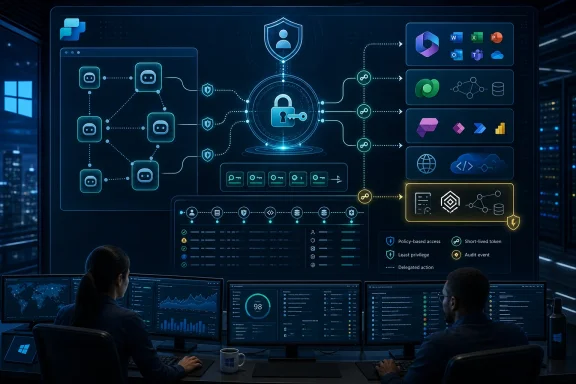 Agentic AI Has Reached the Boring, Dangerous Part of Enterprise Adoption
The first wave of generative AI in the workplace was mostly about prompts, documents, summaries, and chat windows. The risks were real, but they were familiar enough to fit into existing governance buckets: data leakage, hallucinated answers, overbroad access to enterprise search, and users pasting sensitive information into tools they should not use.Agentic AI changes the shape of the problem. An agent is not merely answering a question; it may decide which tool to call, which workflow to trigger, which system to query, and which piece of data to retrieve next. That makes the agent less like a chatbot and more like a junior automation service with a language model for a brain and enterprise connectors for limbs.
Copilot Studio sits directly in that transition. Microsoft has spent the last several years pushing Copilot from branded assistant to extensible platform, and Copilot Studio gives business teams a comparatively easy way to build agents that connect to Microsoft 365, Dataverse, Power Platform connectors, APIs, and Model Context Protocol servers. That is powerful because it lets the people closest to a business process automate it. It is risky for the same reason.
Aembit’s pitch is that the identity layer must catch up with this reality. If an AI agent can call a payroll API, query a customer database, open a ticket, or pull data from a third-party SaaS system, then “the user clicked approve once” is not enough of a security story. The access decision needs to account for the agent, the human on whose behalf it is acting, the system it is trying to reach, the runtime context, and the policy that governs that exact combination.
Microsoft Made Agents Easy; Now Security Teams Have to Make Them Legible
Copilot Studio’s appeal is that it lowers the cost of building agents. A department can assemble an assistant that answers HR questions, triages support cases, retrieves CRM records, or orchestrates Power Automate flows without asking a central engineering team to build a bespoke application from scratch. That is precisely the kind of democratization Microsoft has long sold through the Power Platform.But low-code development has always carried a governance tax. The easier it becomes to create applications, flows, connectors, and agents, the more IT has to worry about sprawl. Shadow IT did not disappear when enterprises adopted Microsoft 365; it merely learned to use sanctioned tooling.
Microsoft is not blind to this. Copilot Studio includes governance concepts around environments, data loss prevention policies, connector controls, auditing, lifecycle management, and Entra-linked agent identities. Microsoft’s own documentation increasingly treats agents as governable assets rather than disposable prompt wrappers. The platform can expose what connector permissions an agent is configured to use, and admins can apply policy through the Power Platform and Entra ecosystems.
The catch is that enterprises rarely live entirely inside one vendor’s neat control plane. A Copilot Studio agent may touch Microsoft services, but it may also reach out to external APIs, custom MCP servers, partner systems, cloud workloads, and legacy services that were never designed for autonomous AI mediation. That is where Aembit is trying to insert itself: not as a replacement for Microsoft’s governance stack, but as a control point for the broader mess around it.
The Real Issue Is Not Whether an Agent Can Authenticate
Enterprise security teams already know how to issue credentials. They know how to create service principals, manage secrets, rotate tokens, and wire applications into identity providers. The hard part is not making an agent authenticate. The hard part is deciding whether it should receive access right now, for this action, under these conditions, with a record that will still make sense during an audit six months later.That distinction matters. Traditional secrets management answers the question, “How does this workload prove it is allowed to connect?” Workload IAM asks a sharper question: “What is this workload, what is it trying to do, what policy governs it, and should credentials even be issued for this request?”
Agentic AI raises the stakes because the workload is no longer a predictable daemon calling the same API endpoint on a schedule. Agents can be dynamic. They can chain tools. They can act under delegated user context. They can traverse MCP servers that expose multiple tools and resources through a standardized interface. They can produce activity patterns that look less like a static integration and more like a human analyst moving through systems — except faster, and sometimes with less predictable judgment.
Aembit’s answer is to treat the agent as a non-human identity that needs policy-based access rather than hard-coded secrets. Its agentic AI capabilities center on ideas such as blended identity, in which the agent’s identity is considered alongside the human user it represents, and an MCP identity gateway that can broker access to tools and resources behind MCP servers. In plain English, the company wants to know both who asked and what is acting before it lets the agent reach sensitive systems.
MCP Is Becoming the New Integration Surface Nobody Can Ignore
The Model Context Protocol is one of those technologies that sounds dry until it becomes operationally unavoidable. Its purpose is to give AI systems a standardized way to discover and use tools, resources, and prompts exposed by servers. For developers, that promises less one-off integration work. For platform teams, it promises a more reusable way to expose enterprise capabilities to multiple agents.For security teams, MCP is a new choke point and a new blind spot at the same time. If an MCP server exposes a set of tools, a capable agent can discover and call them. That is elegant when the tools are safe and well-scoped. It is unsettling when the server becomes a gateway to sensitive databases, ticketing systems, identity operations, or production infrastructure.
Microsoft’s embrace of MCP in Copilot Studio makes the issue more urgent for WindowsForum’s core audience. Copilot Studio can connect agents to existing MCP servers, and Microsoft’s own guidance positions MCP as a scalable way to expose tools and data sources to agents. Once that pattern becomes normal, the question shifts from “Can we connect this agent?” to “Who decides what this agent is allowed to do through that connection?”
Aembit’s integration is aimed squarely at that question. By placing identity and policy enforcement around MCP access, it gives security teams a way to mediate the agent’s path to downstream systems. The company’s claim is not that Microsoft lacks controls; it is that the access layer for agentic AI must follow the agent beyond Microsoft-native boundaries.
Copilot Studio Is the Right Battlefield Because It Is Built for Business Users
If agentic AI were only a developer tool, this would be a narrower story. Developers are used to IAM reviews, application registrations, environment separation, and security gates, even if they occasionally grumble about them. Copilot Studio changes the social architecture of agent creation by giving business units a more direct path to automation.That does not make business users reckless. It means the platform abstracts away complexity that security teams still have to govern. A sales operations manager building an agent to enrich account records should not need to understand OAuth flows, token exchange, workload attestation, or MCP transport details. But someone in the organization must understand what that agent can access, where it can send data, and how to shut it down if it behaves badly.
This is the old Power Platform governance problem with a more autonomous actor in the middle. A badly designed workflow can leak data or trigger the wrong business process. A badly governed agent can decide to call the wrong tool, over-collect context, or combine actions in ways its maker did not fully anticipate. The difference is subtle but important: the system is not merely executing a fixed sequence; it may be selecting from available capabilities.
That is why Aembit’s move matters even if the company remains a specialist vendor rather than a household name. The enterprise agent market will not be secured only by model alignment or prompt filters. It will be secured, if it is secured at all, by mundane controls: identity, policy, least privilege, audit trails, conditional access, environment boundaries, and credential hygiene.
Non-Human Identity Is No Longer a Back-Office Problem
For years, non-human identity was a concern for cloud security architects, DevOps teams, and platform engineers. Service accounts, API keys, workload identities, CI/CD tokens, and machine credentials were the plumbing behind modern applications. They were important, but they rarely occupied the boardroom unless something went wrong.AI agents may change that. Once executives ask business units to deploy agents into revenue, support, finance, HR, and operations workflows, non-human identities become visible business actors. An agent that can retrieve a contract, summarize a customer history, open a refund request, or update a record is not just an application component. It is a participant in business process execution.
That creates a naming problem as much as a technical one. Organizations are used to asking which employee accessed a file or which service account called an API. They are less prepared to ask which agent, created by which team, operating on behalf of which user, invoked which tool, through which connector, under which policy, and with what downstream effects.
Aembit’s “blended identity” framing is a useful attempt to make that question legible. If an agent is acting on behalf of a human, the human context matters. If the agent itself has its own permissions, the agent context matters. If the access path involves an MCP server, connector, or external API, the resource context matters. Audit trails that flatten all of this into a generic service account are not going to satisfy serious security or compliance teams.
The risk is especially acute in hybrid Microsoft environments. Many enterprises still straddle Windows Server, Active Directory, Entra ID, Azure, Microsoft 365, third-party SaaS, on-prem databases, and custom internal applications. An agent built in a modern Microsoft tool can still end up needing access to systems with older assumptions about identity. That is where policy mediation becomes more than a convenience.
Microsoft’s Native Controls Are Necessary but Not Sufficient for Hybrid Reality
Microsoft’s security model for Copilot Studio has become more sophisticated. Agent identities can be represented in Entra. Connectors can be governed through Power Platform policies. Data loss prevention rules can restrict which connectors coexist in an environment. Admins can separate development and production environments, enforce approval workflows, and monitor usage.Those controls are meaningful. In a Microsoft-only deployment, they may cover much of what an organization needs. The problem is that “Microsoft-only deployment” is not how most large organizations actually operate.
A Copilot Studio agent may need to reach Salesforce, ServiceNow, Workday, Snowflake, a custom ERP endpoint, a partner API, a self-hosted MCP server, or a legacy application wrapped in a modern connector. Each hop adds another identity assumption. Each external system has its own authorization model. Each integration risks becoming a place where credentials are copied, over-permissioned, or forgotten.
Aembit’s value proposition is strongest in that messy middle. It offers a way to enforce policy and issue short-lived access without forcing every downstream system to become agent-aware overnight. That does not eliminate the need for Microsoft’s controls, but it gives organizations an additional enforcement layer when agents leave the comfortable boundaries of Microsoft 365 and Power Platform.
The practical question for IT is not whether to trust Microsoft or Aembit. It is whether the organization has a coherent access story from the Copilot Studio canvas to the system of record. If the answer is “the agent uses a stored credential in a connector someone approved last quarter,” the governance story may not survive contact with production.
The Audit Trail Is the Product
Security vendors often talk about prevention first, but in agentic AI the audit trail may become equally valuable. Agents will make mistakes. Makers will over-scope tools. Business units will experiment before central IT has perfected governance. The organizations that survive this phase will be the ones that can reconstruct what happened quickly and precisely.A good audit record for an agent interaction should not merely say that a connector was invoked. It should reveal the agent identity, the user context, the policy decision, the resource requested, the credential issued or denied, and the runtime conditions that shaped the decision. That is the difference between a compliance artifact and an operational instrument.
This matters because agent behavior can be difficult to reason about after the fact. A human may ask a broad question, the agent may choose a tool, the MCP server may expose several resources, and the downstream API may return data that influences the next action. Without a durable identity trail, incident responders are left piecing together fragments from application logs, connector logs, identity provider events, and whatever telemetry the agent platform exposes.
Aembit is leaning into that gap by emphasizing complete records of access decisions. Whether customers find the implementation elegant will depend on the details, but the direction is right. In the agent era, auditability is not a checkbox at the end of deployment. It is part of the access architecture.
The Weakest Agent Will Define the Enterprise Risk
The uncomfortable truth about Copilot Studio is that its security posture will not be defined by the most carefully built agent. It will be defined by the agent someone builds quickly because a department has a deadline and the platform makes the build feel easy.This is not an argument against low-code AI. It is an argument against pretending that ease of creation reduces the need for governance. In fact, it increases it. The more people can create agents, the more the platform must assume that not every maker understands the security implications of every connector, tool, and data source.
The historical parallel is macro malware, then SharePoint sprawl, then OAuth consent abuse, then Power Platform governance. In each case, Microsoft enabled useful extensibility, users adopted it enthusiastically, and security teams later had to impose structure around permissions, sharing, lifecycle, and monitoring. Agentic AI compresses that cycle because the objects being created can act rather than merely store or display information.
Aembit’s announcement lands at the point where enterprises are trying to avoid repeating that history. The company is betting that organizations will want IAM controls before agent sprawl becomes unmanageable. That is a sensible bet, because retrofitting least privilege onto a large estate of semi-autonomous agents will be painful.
The Copilot Studio Security Conversation Just Moved Up a Layer
For Windows administrators, the immediate temptation is to see this as a niche AI security integration. That understates the shift. Copilot Studio is part of Microsoft’s broader attempt to make agents a standard enterprise development surface, and any standard development surface eventually becomes an administrative surface.The old admin questions still apply. Who can create agents? Which environments can they publish to? Which connectors are allowed? Which data classifications are off-limits? Which logs are retained? Which approvals are required before an agent reaches production?
The new questions are more subtle. Should an agent be allowed to call a tool only when acting for a specific user group? Should it receive different access when invoked from Teams than when invoked through another channel? Should it be blocked from calling an MCP tool outside a corporate network? Should it be denied access if the user is high-risk, the agent is newly published, or the requested operation falls outside its normal pattern?
Those are IAM questions, not prompt-engineering questions. They belong in the same family as conditional access, workload identity, just-in-time privilege, and zero trust. Agentic AI may be new, but the security model it needs is an extension of disciplines enterprise IT already understands.
Aembit’s challenge will be proving that its controls fit naturally into existing Microsoft-centric operations. Security teams do not want yet another dashboard that becomes an island. They want policy that maps to real workflows, logs that land where investigators already work, and deployment patterns that do not require every maker to become an identity engineer.
Vendor Positioning Meets an Unsettled Market
It is worth keeping the marketing claims in proportion. Aembit is announcing support, not solving agentic AI security by decree. Copilot Studio already has native governance features, and Microsoft will continue expanding its own identity and agent-management capabilities. The competitive boundary between Microsoft-native controls, third-party IAM, cloud security posture management, SaaS security platforms, and AI governance vendors will remain fluid.Still, specialist vendors often identify the pain before platform vendors fully absorb it. Workload identity was once treated as an implementation detail; now it is a major category because leaked secrets and overpowered service accounts became too dangerous to ignore. Non-human identity management followed a similar arc. Agentic AI is likely to accelerate the next turn because it combines non-human identity with delegated human intent and dynamic tool use.
Aembit’s move into Copilot Studio is therefore less about one vendor integration and more about category formation. The market is beginning to separate “AI safety” in the model-behavior sense from “AI access governance” in the enterprise-control sense. Both matter, but they are not interchangeable.
A model that refuses harmful instructions does not automatically enforce least privilege against an ERP system. A prompt shield does not rotate credentials. A content filter does not tell an auditor why an agent accessed a customer record. The access layer needs its own architecture.
Windows Shops Should Treat Agents Like Production Workloads
The most useful mental model for IT pros is simple: treat every production agent like a production workload. It needs an owner, an identity, a deployment path, an access policy, a logging strategy, a rollback plan, and a review cycle. If that sounds heavy, it is because production access is heavy.This does not mean every experimental agent needs a months-long approval process. It means organizations need zones. Sandboxes should allow experimentation with constrained data and limited tools. Production environments should require stronger controls, narrower access, and clear accountability. The path from one to the other should be visible rather than improvised.
Copilot Studio can support parts of that model through environments, governance policies, connector controls, and application lifecycle management. Aembit wants to strengthen the access layer once agents begin touching external resources and MCP-exposed tools. The two approaches are not mutually exclusive; in a mature deployment, they should be complementary.
The danger is letting the agent builder experience define the security architecture. A low-code interface can make an integration look harmless because the complexity is hidden. But hidden complexity still exists. It has simply moved into identity providers, connectors, token exchanges, MCP servers, and downstream APIs.
The Access Checklist Microsoft Shops Cannot Postpone
Aembit’s announcement should push administrators to inventory agent access before the estate becomes too large to reason about. The practical work is not glamorous, but it is the difference between controlled adoption and another unmanaged automation layer.- Organizations should identify which Copilot Studio agents can reach production data, external APIs, or MCP servers before expanding deployment.
- Every production agent should have a named business owner, a technical owner, and a documented access boundary.
- Agent access should be governed by short-lived credentials and policy decisions wherever possible, rather than long-lived shared secrets.
- Audit logs should preserve both the human user context and the non-human agent identity so investigations can reconstruct delegated actions.
- MCP servers should be treated as privileged integration surfaces, not merely developer conveniences.
- Microsoft-native controls and third-party workload IAM should be evaluated together, because most enterprises will need governance across both Microsoft and non-Microsoft systems.
Aembit’s Copilot Studio support arrives at the moment enterprise AI is leaving the demo stage and entering the administrative one. The winners in this phase will not be the organizations with the most agents, but the ones that can explain what those agents are, what they can touch, who they represent, and why each access decision was allowed. Microsoft has made the agent factory attractive; now the Windows ecosystem has to make the factory governable before the machines start working faster than anyone can audit them.
References
- Primary source: The Norfolk Daily News
Published: 2026-06-17T08:50:24.651062
Aembit Extends IAM for Agentic AI to Microsoft Copilot Studio
LAS VEGAS, June 17, 2026 (GLOBE NEWSWIRE) -- Aembit on Tuesday announced support for Copilot Studio, extending itsnorfolkdailynews.com - Related coverage: aembit.io
Aembit Extends Workload IAM to Microsoft Ecosystem, Securing Hybrid Access for Non-Human Identities - Aembit
New capabilities unify identity and access management controls for agentic AI and software workloads across Windows Server, Active Directory, and Azure environments.aembit.io - Related coverage: analyticsinsight.net
Aembit Extends IAM for Agentic AI to Microsoft Copilot Studio
Aembit extends IAM to Microsoft Copilot Studio, giving security teams centralized control over AI agent access, verified identities, and zero standing credentials.www.analyticsinsight.net - Related coverage: news.backbox.org
- Official source: news.microsoft.com
- Related coverage: docs.aembit.io
Securing AI agent access to your resources | DOCS
How Aembit secures AI agent access to enterprise resources through the Model Context Protocol (MCP)docs.aembit.io


- Related coverage: globenewswire.com
Atos Group and Microsoft Expand Strategic Collaboration to
Atos Group and Microsoft Expand Strategic Collaboration to Scale Secure Agentic AI Across Atos Group Workforce and Clients...www.globenewswire.com
