

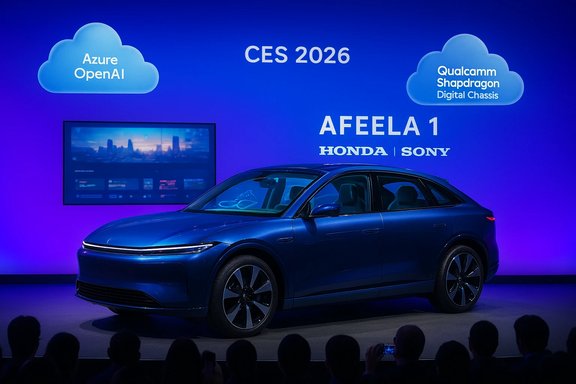
Sony Honda Mobility used CES 2026 to move AFEELA from long‑running concept into a concrete product and roadmap: AFEELA 1 is slated for U.S. deliveries in 2026 (initially in California), priced from roughly $89,900, built under contract at Honda’s Ohio facility, and positioned as an entertainment‑first, cloud‑native software‑defined vehicle that pairs Qualcomm hardware with Microsoft Azure/OpenAI services and Sony’s imaging and media strengths.
Background / Overview
Sony Honda Mobility (SHM), the 2022 joint venture between Sony Group and Honda Motor, has spent the past three years refining AFEELA as a platform that blends automotive engineering, content ecosystems and cloud AI. The brand’s narrative shifted over multiple CES showings from “vision car” demonstrations to a near‑production reality at CES 2026, where SHM presented the production‑intended AFEELA 1 and a second vehicle, the AFEELA Prototype 2026 SUV, which SHM says could underpin a 2028 U.S. model. That strategic posture is straightforward: Honda brings manufacturing and safety‑critical know‑how; Sony supplies imaging, entertainment IP and UX design; third‑party platforms (Qualcomm for vehicle compute and Microsoft Azure/OpenAI for cloud and conversational AI) provide the backbone for processing and services. The result is a product pitched at tech‑forward buyers who value an evolving cabin platform as much as traditional automotive attributes.What SHM Announced at CES 2026
AFEELA 1: timing, trims and pricing
- Deliveries: SHM confirmed AFEELA 1 deliveries will begin in California within 2026, with expansion to Arizona in 2027 and Japan to follow in the first half of 2027.
- Trims & pricing: Two trims were restated — Origin (starting near $89,900) and Signature (about $102,900) — including a bundled complimentary subscription period for certain services. Multiple outlets reporting from CES align on the $89,900 entry figure.
- Reservations & access: Reservations opened previously (California‑first), and SHM has run AFEELA Studios and demo programs that it cites as proof of demand (100,000+ showroom visitors; ~24,000 in‑vehicle demos). These experiential channels will feed a phased, dealer‑free delivery model.
New prototype and longer‑term product roadmap
At CES SHM also revealed the AFEELA Prototype 2026 — a sloped‑silhouette, higher‑clearance SUV concept intended to broaden the brand’s appeal. SHM says a production model based on this prototype could reach the U.S. around 2028, though technical specifics for that model remain high‑level at this stage.Technology stack: compute, sensors and AI
Qualcomm Snapdragon Digital Chassis and compute strategy
SHM declared the intention to adopt solutions from Qualcomm’s Snapdragon Digital Chassis in its next‑generation E/E architecture. That direction ties AFEELA to an ecosystem designed to handle telematics, ADAS/ADAS‑adjacent compute, connectivity and IVI tasks without in‑house silicon design. Qualcomm’s platform is a sensible vendor choice for a software‑heavy new OEM and was explicitly named in SHM’s CES materials. Why this matters: choosing a standardized, automotive‑grade compute stack reduces integration risk and shortens time‑to‑market for cloud‑connected features such as over‑the‑air (OTA) updates, local/edge model inference and seamless cellular fallback for cloud agents.Sensors, cameras and imaging (Sony’s domain)
Sony is leading on cameras and imaging sensors for driver assistance and the cabin’s audiovisual experience. Sony’s sensor pedigree (image quality, low‑light performance and depth/perception capabilities) is a core differentiator in a design that leans heavily on vision systems for ADAS and immersive AR features. SHM’s public briefings repeatedly emphasize Sony’s role in cameras and display/entertainment systems.AFEELA Intelligent Drive — L2+ now, L4 aspiration
SHM positions AFEELA Intelligent Drive as an evolving ADAS strategy that will ship as Level 2+ today — providing hands‑on semi‑autonomy and end‑to‑end route support — and aims for Level 4‑equivalent capability as a future goal. The company frames L4 as aspirational and contingent on validation, regulatory approvals and likely incremental hardware and software changes. This staged approach is explicit in SHM’s messaging and mirrored in coverage from major outlets. Treat the L4 target as a roadmap milestone, not an imminent deliverable.Inside the cabin: software, services and PlayStation integration
AFEELA Personal Agent — Azure + OpenAI
The headline interior story is the vehicle’s software experience. SHM is developing a conversational, personalized in‑vehicle assistant — the AFEELA Personal Agent — built on Microsoft Azure OpenAI Service and hybrid edge/cloud orchestration. SHM describes a model where deterministic, latency‑sensitive functions run at the car edge while conversational context and personalization are orchestrated in Azure. Microsoft’s cloud is central to SHM’s plan for updates, recall, and large‑model orchestration. Technical nuance: SHM’s Azure/OpenAI approach reduces the need to embed full‑scale LLMs in the vehicle at launch, but it increases cloud dependency and raises privacy, latency and data‑governance questions that must be carefully managed (see Risk section).Entertainment and PlayStation streaming
Sony’s content assets are visible in the product pitch: the cabin is treated as a “Creative Entertainment Space” with support for high‑bandwidth streaming, AR overlays driven by Unreal Engine and PlayStation‑adjacent gaming experiences (e.g., Remote Play-style features). The AFEELA narrative openly positions the vehicle as a place to consume and create content as well as to drive. This is a deliberate identity play that shifts the purchase calculus away from traditional automotive performance metrics to long‑term platform value.Co‑Creation Program and developer ecosystem
SHM announced an AFEELA Co‑Creation Program with APIs, SDKs and documentation to attract third‑party developers and creators. The idea is to bootstrap an in‑car app economy (AR navigation themes, entertainment apps, in‑vehicle mini‑games, creator skins and more) and to expose Android IVI development flows and cloud APIs for distribution. That makes AFEELA less a static product and more a platform for ongoing content and services.Production, logistics and the supply chain
Manufacturing partner and Ohio trial production
SHM confirmed trial production runs of AFEELA 1 at Honda’s East Liberty (Ohio) plant in fall 2025 as part of production validation. SHM intends to use existing Honda capacity under contract manufacturing arrangements to reduce capital intensity and accelerate ramp. Multiple corporate releases and reporters at CES repeated the Ohio plan. Practical implications: using an established Honda plant reduces tooling risk and leverages existing supplier networks, but it also means SHM must coexist with Honda’s broader manufacturing and supplier timelines. Any supply‑chain disruption that affects mainstream Honda programs could cascade into AFEELA production slots.Studio‑first, dealer‑light delivery model
SHM is using physical AFEELA Studios (showrooms and delivery hubs) and experiential demos to control the brand entrance and customer onboarding. That model reduces reliance on a traditional dealer network but introduces questions around service logistics, repair networks and certified maintenance coverage that buyers should clarify before purchase.Business model: subscriptions, token experiments and recurring revenue
SHM is explicit: the car is a software platform. Key commercial elements:- A three‑year complimentary subscription for select services (e.g., AFEELA Intelligent Drive and the Personal Agent) is included with early trims; after the trial period, features will likely be tiered behind subscription plans.
- The AFEELA Co‑Creation Program creates potential for an app economy and publisher revenue share.
- SHM floated an on‑chain mobility platform with a token‑based “X‑to‑Earn” incentive to reward creators and participants in ideation, development and evaluation cycles. That plan is exploratory and framed as future experimentation rather than immediate functionality.
What’s compelling — strengths and strategic fits
- Complementary partner set: Sony’s entertainment and UX strength paired with Honda’s manufacturing and safety credentials makes for a credible combination that reduces the typical new‑brand execution risk.
- Platform‑first architecture: Adopting Qualcomm’s Snapdragon Digital Chassis and Microsoft Azure/OpenAI gives SHM mature building blocks for compute, connectivity and conversational AI that shorten time to market for complex features.
- Experience‑led distribution: Studio and demo programs allow SHM to control the first‑user journey for a software‑centric product, an asset when the value differential relies on software and content.
- Developer outreach: The Co‑Creation Program is a pragmatic move to accelerate third‑party content and app creation, which can amplify cabin differentiation faster than in‑house development alone.
Risks, unknowns and verification status
This is a strategy with visible merits, but several non‑trivial risks remain. Wherever possible, claims are cross‑checked against SHM’s press materials and independent reporting; items that lack third‑party verification are flagged.1) Autonomy vs. aspiration
Claim: SHM aims to progress from Level 2+ to Level 4‑equivalent autonomy. This aspiration is clearly stated in SHM materials, but Level 4 deployment requires enormous validation datasets, regulatory approvals and potentially different hardware than what ships in 2026. Treat L4 as a future target, not a near‑term guarantee.2) Privacy, cloud dependency and telemetry
Claim: the AFEELA Personal Agent will run on Azure OpenAI Service with hybrid edge/cloud orchestration. That reduces local model footprint but means voice transcripts, personalization data and telemetry will be routed through cloud systems. Buyers and regulators will demand transparent consent flows, clear retention/erasure policies and robust data governance. SHM’s statements are explicit about Azure usage; independent coverage corroborates Microsoft’s role. However, exact data‑handling practices and retention windows were not fully disclosed at CES and should be requested by early buyers.3) Cybersecurity and attack surface
A cloud‑connected entertainment hub greatly expands attack surface. SHM must ensure strict partitioning between safety‑critical ECUs and infotainment/third‑party apps, hardened OTA systems, signed updates, and an incident‑response program with accountability. The announcement mentions platform vendors and security layers but does not publish the full SOTA of compartmentalization and update cadence — ask for these details before purchase.4) Token economics and regulatory friction
SHM’s proposed on‑chain mobility platform and tokenized “X‑to‑Earn” concepts are exploratory. These mechanisms invite securities law scrutiny, tax reporting complexity, anti‑money‑laundering (AML) obligations and KYC requirements that differ across jurisdictions. The announcements are high‑level and should be treated as speculative until accompanied by legal frameworks and compliance roadmaps.5) Price positioning and market timing
At a starting price around $89,900, AFEELA 1 sits in premium territory and faces intense competition from established luxury EVs that combine brand cachet with mature dealer/service networks. SHM must demonstrate tangible, ongoing software value to justify the premium and ensure conversion from showroom curiosity to long‑term ownership. Independent reporting confirms the price band; consumers should weigh software/service continuity and maintenance practicality against comparable alternatives.For WindowsForum readers and developers: practical implications
The AFEELA story is interesting beyond cars. For developers and system integrators — particularly those experienced with Azure, LLM orchestration and Windows‑centric toolchains — AFEELA represents a new class of distributed endpoint for cloud services.- The AFEELA Co‑Creation Program and Android IVI environment will likely expose RESTful cloud APIs, event streams and SDKs that map well to existing cloud skillsets.
- Hybrid edge/cloud patterns used by SHM (edge speech capture + cloud conversational context) are an increasingly common template for low‑latency, privacy‑mindful assistants. Experience deploying LLMs on Azure will be directly relevant to in‑vehicle scenarios.
- Security practice matters: Windows developers and enterprise integrators should watch for how SHM enforces partitioning between safety stacks and entertainment apps — lessons here generalize to any software‑defined vehicle (SDV) project.
Practical buyer checklist (for reservation holders and prospective buyers)
- Confirm exact delivery timing and your queue position. CES demos and reserved demos do not guarantee immediate allocation.
- Get written clarity on which features are included for the complimentary subscription period and which will require paid tiers afterward.
- Ask how personal data is stored, processed and deleted — specifically voice logs, personalization profiles and telemetry, and whether local model inference is available as an opt‑out.
- Verify safety stacks enabled at delivery (what AFEELA Intelligent Drive capabilities are active) and how future L4 features — if ever shipped — will be validated and certified.
- Clarify warranty, maintenance and repair logistics for a dealer‑light model: where and how will authorized repairs happen, and what is the OTA update cadence and rollback procedure?
Final assessment — what to watch next
Sony Honda Mobility’s CES 2026 presentation turned a multi‑year vision into a product‑centric narrative with concrete commercial milestones. The combination of credible partners (Qualcomm, Microsoft, Honda) materially lowers execution risk compared with many new EV entrants, and the platform‑first orientation is correctly aligned to the SDV era.However, the most consequential claims remain the hardest to deliver: autonomous Level 4 capability, a secure and privacy‑respecting cloud/agent stack, and a tokenized creator economy that survives regulatory scrutiny. These are non‑trivial technical, legal and operational problems that will define whether AFEELA becomes a durable player in the premium EV market or a niche, entertainment‑forward curiosity.
Short term, independent validation will come from: first customer deliveries (California 2026); early owner reports on reliability and real‑world ADAS behavior; retail reviews that stress battery and software reliability; and developer traction for the Co‑Creation Program. For buyers and developers, the prudent posture is informed optimism — celebrate the integration of cloud AI and immersive entertainment into a mainstream OEM program, but demand clarity on safety, privacy and long‑term service commitments before treating the product as just another luxury EV purchase.
Sony Honda Mobility’s AFEELA program is now a near‑term market reality rather than a distant exercise in concept cars. How well the company executes on safety, security, developer openness and subscription economics will determine whether the cabin’s promise as a “Creative Entertainment Space” becomes a sustainable differentiator — and whether buyers at the $90k price point will stick for the long run.
Source: тарантас ньюс Sony Honda Afeela EV debuts at CES: U.S. launch in 2026
