

Microsoft’s latest AI diffusion snapshot reframes a familiar narrative: Africa is not a single market but a collection of fast-moving, unevenly resourced digital economies—and a small number of countries are already pulling ahead on AI adoption, skills and governance while the rest face structural barriers that risk locking in a new digital divide.
Microsoft’s AI Diffusion analysis (H1/H2 2025) places South Africa at the top of the continent with a 21.1% AI user share in the second half of 2025, while countries such as Egypt, Tunisia and Senegal post double‑digit diffusion and a wider group (Nigeria, Kenya, Ghana) register single‑digit to low‑double‑digit adoption growth. The dataset explicitly links three vectors—Frontier (model development), Infrastructure (compute & data centers), and Diffusion (workplace use)—to show where AI is actually changing how people work, not just where model research happens. That headline picture sits beside two sobering infrastructure facts that keep reappearing across independent analyses: Africa hosts only a tiny fraction of global data center capacity (commonly reported as less than 1% of global capacity), and data‑centre and power constraints remain the single largest bottleneck for running GPU‑intensive AI workloads at scale. Those constraints amplify language, skills and regulatory gaps that together shape who benefits from AI’s economic gains. This feature unpacks the Microsoft findings, verifies the major claims where possible, evaluates practical implications for IT leaders and investors, and flags risks that deserve urgent attention.
The next 24 months are decisive. Investors that move on well‑structured, power‑aware data centre builds, and startups that solve local language and last‑mile problems with lean models, will find outsized opportunities. Equally important, governments and large enterprises must demand operational clarity from cloud vendors about residency, telemetry and portability—not marketing claims alone.
For IT leaders managing Windows and Microsoft 365 ecosystems, the practical imperative is straightforward: combine diffusion signals with contractual rigor, start with pilot projects that stress governance and portability, and design hybrid architectures that match business risk tolerance with realistic infrastructure availability. The upside is large; the path forward depends on building compute and people capacity in parallel and ensuring that adoption is inclusive, accountable and sustainable.
FAQs (brief)
Source: Tech In Africa Microsoft AI Report: Top 10 African Countries for AI Readiness - Tech In Africa
 Background / Overview
Microsoft’s AI Diffusion analysis (H1/H2 2025) places South Africa at the top of the continent with a 21.1% AI user share in the second half of 2025, while countries such as Egypt, Tunisia and Senegal post double‑digit diffusion and a wider group (Nigeria, Kenya, Ghana) register single‑digit to low‑double‑digit adoption growth. The dataset explicitly links three vectors—Frontier (model development), Infrastructure (compute & data centers), and Diffusion (workplace use)—to show where AI is actually changing how people work, not just where model research happens. That headline picture sits beside two sobering infrastructure facts that keep reappearing across independent analyses: Africa hosts only a tiny fraction of global data center capacity (commonly reported as less than 1% of global capacity), and data‑centre and power constraints remain the single largest bottleneck for running GPU‑intensive AI workloads at scale. Those constraints amplify language, skills and regulatory gaps that together shape who benefits from AI’s economic gains. This feature unpacks the Microsoft findings, verifies the major claims where possible, evaluates practical implications for IT leaders and investors, and flags risks that deserve urgent attention.How Microsoft measures AI readiness
What the AI Diffusion metric actually captures
Microsoft’s AI Diffusion (or AI User Share) is a usage‑anchored measure that estimates the percentage of working‑age adults actively using a basket of AI tools—productivity copilots, chat models, generative design and domain agents—based on anonymized telemetry combined with statistical correction. This is a pragmatic, adoption‑centric metric designed for procurement and policy decisions, but it is not a census: methodology choices (telemetry sources, which tools are counted, and how “working age” is defined) materially affect country rankings. Practitioners should treat the numbers as directional signals rather than absolute counts.Strengths and limits
- Strength: behavioral anchor — measures real workplace usage rather than installs or downloads.
- Limit: uneven Windows/telemetry penetration and exclusion of mobile‑first populations can bias results, particularly in markets where Windows desktops are not the primary productivity device.
The Top 10—what the numbers mean in practice
The next sections summarize the Microsoft profile for each top‑10 African market, verify the key load‑bearing claims with independent sources, and highlight implications for enterprise and public‑sector IT.1. South Africa — continental anchor for AI adoption
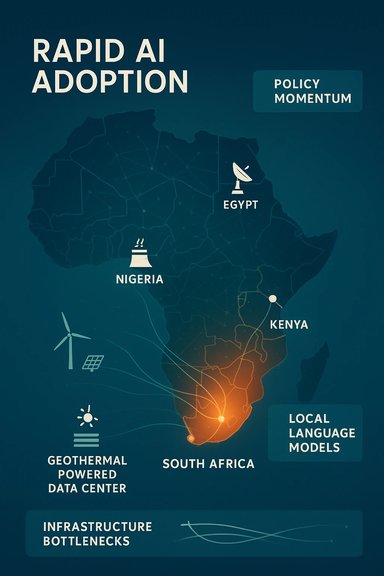
South Africa leads Africa in diffusion (21.1% H2 2025) and is rated “High” across infrastructure, talent, governance and adoption on Microsoft’s readiness map. That position is driven by established cloud presence, multiple hyperscale deployments, a strong technical workforce and active government strategy work. Microsoft telemetry and country case examples (tax pre‑fill, chatbots, banks migrating to Azure) underpin the adoption claims. Key points:- Azure availability zones and hyperscale data presence support enterprise AI pilots and regulated workloads.
- Large public‑sector pilots (e.g., automated tax pre‑fill and national chatbots) are concrete signals of operational deployment rather than proof‑of‑concepts.
2. Nigeria — scale ambitions, structural frictions
Nigeria’s AI diffusion (≈9.3% H2 2025) places it among the high‑potential markets by population size and startup density. The government has signalled ambitious targets (including large productivity gain aspirations) and launched national skills initiatives to generate technical talent at scale. Microsoft and local partners have backed large skilling rounds and cloud footprint expansion. Key corroboration: Nigeria hosts multiple commercial data centers and is one of Africa’s bigger startup hubs, but electricity access and last‑mile connectivity remain constraints for broad‑based enterprise AI deployments. Independent reporting and industry databases confirm Nigeria’s status as a regional infrastructure hub while highlighting power constraints that raise operating costs and latency.3. Kenya — East Africa’s infrastructure bet
Microsoft and G42’s joint announcement of a $1 billion digital ecosystem for Kenya (including a geothermal‑powered data centre in Olkaria and a new East Africa Azure cloud region) is a significant, verifiable development that materially raises Kenya’s infrastructure profile. The initiative couples sustainable power with local cloud capacity and an AI skills push. Reuters and Microsoft’s own press briefings confirm the deal and the Olkaria renewable data‑centre plan. Implication: geothermal or other green data centre designs reduce energy risk and are a model for resilient deployment in energy‑constrained markets.4. Egypt — language, compute hubs and national strategy
Egypt posts a H2 2025 diffusion near 13.4% and is widely reported as one of Africa’s data‑centre hubs. Microsoft’s regional analysis and local industry reports show concentrated computing infrastructure in Cairo and ongoing investments (including partnerships with regional players) that broaden GPU access and datasets for Arabic language models. These developments align with Egypt’s stated national AI strategy.5. Morocco — connectivity and STEM base
Morocco’s readiness is rooted in high internet penetration, a rising STEM graduate pool and targeted programs, though R&D investment remains low by comparator standards. Independent indexes and national digital strategy reporting corroborate Morocco’s improving rankings and connectivity metrics.6. Rwanda — policy first, infrastructure to follow
Rwanda’s National AI Policy and cloud‑first public strategy position it as an incubator for policy‑driven adoption. The government’s push for digitization and a hybrid multi‑cloud architecture is intended to attract regional workloads; implementation depends on digitization of public datasets and improved throughput. Rwanda’s model is frequently cited as a governance‑led path to AI readiness.7. Ghana — decade‑long strategy and language inclusion
Ghana’s National AI Strategy (2023–2033) and the AI Ready Ghana program place language inclusion and local NLP at centre stage. The country has explicit targets for data centres and skills hubs, but diffusion remains below global averages and will depend on outreach beyond Accra and regional tech clusters.8. Tunisia — developer density and talent concentration
Tunisia’s claim of a high developer density (≈4,120 developers per million) and strong ICT skills penetration is supported by regional talent indexes and higher education enrolment statistics; these strengths drive above‑average diffusion despite limited data‑centre capacity. Tunisia emerges as a talent‑led AI market where human capital compensates for compute shortfalls.9. Senegal — connectivity investments and satellite internet
Senegal’s strategy emphasizes foundational connectivity steps—satellite internet deployment and 5G rollouts—paired with national digital plans. The country’s diffusion gains illustrate that targeted, low‑cost connectivity interventions can raise AI accessibility and public service impact quickly.10. Ethiopia — pragmatic, open‑source path
Ethiopia’s AI diffusion (≈6.8%) reflects steady, pragmatic progress: open‑source stacks and partnerships (including engagements with Chinese vendors) enable low‑cost adoption, but persistent power shortages and language fragmentation slow broader rollout. The emphasis is on practical applications that run in constrained environments.Verifying the big claims
“Less than 1% of global data centers are in Africa”
Multiple independent market trackers and regional analyses report that Africa accounts for a very small share of global data‑centre capacity—commonly cited as below 1% (with some industry commentary placing Africa under 2% while noting rapid growth). Market databases that enumerate operational and planned facilities across the continent support the small share conclusion and show heavy concentration in South Africa, Egypt, Kenya and Nigeria. These figures are directional and change as new hyperscale investments are built, but the broad point—Africa is dramatically under‑provided for modern AI compute—is robust across sources. Caveat: precise percentage estimates vary by market‑research methodology (how capacity is measured—MW vs. facility count vs. rack space). Treat “<1%” as a conservative headline that underscores a major infrastructure gap verified by multiple independent datasets.“230 million digital jobs by 2030”
This projection appears repeatedly in recent industry and policy reports from a range of organisations—Microsoft programmatic commentary, SAP’s Africa Skills Readiness reporting, Mastercard whitepapers and continent‑level analyses. Those documents converge on a large‑scale, jobs‑creation figure in the low‑hundreds of millions (commonly cited as ~230 million), contingent on aggressive upskilling, infrastructure buildout and expanded local content. The figure functions as a plausible upper bound—an aspirational scenario conditioned on capturing a significant share of global AI market growth and on coordinated public‑private skilling investments. Caveat: this is a projection, not an observed outcome. The number depends on assumptions about automation complementarity, sectoral absorption rates and policy success; it should be treated as scenario guidance rather than a near‑term forecast.Microsoft / G42 Kenya $1 billion data centre initiative
The $1 billion package for Kenya (including a geothermal data‑centre campus and new East Africa Azure Cloud Region) was announced by Microsoft and G42 and corroborated by mainstream press coverage. The plan is concrete and includes renewable energy sourcing for the Olkaria site and commitments to regional connectivity and local‑language AI development. Implementation timelines, commercial terms and sovereign data‑governance arrangements are still subject to definitive agreements and local regulatory approvals.Critical analysis: strengths, risks and what the numbers miss
Strengths worth celebrating
- Policy momentum: Several countries are moving beyond generic digital strategies to explicit AI plans, with regulatory sandboxes and public‑sector pilots. That signals political will and provides procurement pull for private investment.
- Targeted public‑private initiatives: Large deals (e.g., Microsoft/G42‑Kenya) and hyperscaler regional expansions provide anchored compute capacity and partner ecosystems that can reduce cost and latency for local buyers.
- Talent hotbeds: Tunisia, South Africa, and pockets of Kenya and Nigeria possess concentrated developer talent, making them fertile ground for startups and for the kinds of local language models that increase relevance.
Material risks and downsides
- Infrastructure bottlenecks remain decisive. Without reliable power, fiber, and local data centers, GPU‑heavy inference will either run offshore (raising latency and sovereignty concerns) or incur high costs. Independent data shows Africa’s data centre share is tiny, and planned capacity must be built quickly to match AI demand.
- Methodological blind spots in diffusion numbers. Telemetry‑based measures undercount mobile‑first and informal economies. Countries with high mobile adoption could have greater real AI use than Windows‑anchored telemetry suggests. Procurement teams must request contract language, security attestations and day‑one feature inventories rather than rely solely on diffusion headlines.
- Language and dataset gaps. Most large models are trained on high‑resource languages; without investment in localized datasets and benchmarks (efforts are underway, but funding is uneven), many African use‑cases will experience poorer accuracy and higher hallucination risk.
- Energy and sustainability. Localizing inference implies big GPU loads and predictable high energy demand. Projects that do not factor in resilient, low‑carbon power will face practical constraints and reputational risk. Kenya’s geothermal model is a strong counterexample but is still exceptional.
What this means for IT leaders, startups and investors
For enterprise IT and Windows administrators
- Treat global AI diffusion figures as signals, not guarantees: verify feature parity, evidence of in‑country inference, telemetry flows and support SKUs before deploying Copilot‑class features in regulated environments. Demand explicit contractual attestations.
- Prioritise hybrid deployment patterns: where local latency or sovereignty is critical, build architectures that can fail over between local edge compute and regional hyperscaler capacity.
- Invest in governance: implement drift detection, human‑in‑the‑loop controls, model‑validation processes and clear incident playbooks before scaling generative AI into customer‑facing or regulated workflows.
For startups and product teams
- Focus on local problems (language, last‑mile logistics, agritech, compliance automation) where small, efficient models and clever UX will outperform larger, generic models.
- Consider hybrid host models: keep sensitive inference on private or sovereign compute and non‑sensitive workloads on public clouds to balance cost and compliance.
- Use open‑source and small‑model approaches where data or compute is constrained; open initiatives and benchmarks (regional LLM benchmarks) are emerging and can accelerate adoption.
For investors and infrastructure builders
- Build with power resilience and sustainability in mind. Renewable‑powered campuses (e.g., geothermal in Kenya) materially change the operating economics of AI compute.
- Data centre investments will pay off, but the timeline and execution risk are real: regulatory clarity, procurement anchors (government or telco partnerships) and power availability are non‑negotiable success factors.
- Look for opportunities in horizontal stack layers: localized NLP datasets, token‑efficient inference stacks, model‑ops tooling for constrained environments.
A practical, near‑term roadmap for closing the gap
- Increase local computing capacity with mixed ownership models: public‑private hyperscaler regions, telco cloud nodes, and grant‑supported colocation for research and civic AI.
- Scale inclusive skilling programs and standardize credentials so that employers can rapidly certify AI competence (a recurring Microsoft and partner priority across the continent).
- Build national and cross‑border data commons with clear governance—open, safe datasets for healthcare, agriculture and public service use that accelerate local model building.
- Push for transparent procurement terms and portability clauses to reduce lock‑in risks when sovereign clouds or hybrid offers are announced.
Where to be cautious: claims that need close verification
- Absolute counts derived from telemetry (e.g., precise user‑share percentages by tiny decimal points) should be interpreted as estimates; buyers in regulated sectors must insist on auditable logs, SOC/ISO attestations and explicit contractual mappings that define what “in‑country processing” covers in practice. Microsoft itself flags methodological caveats and advises purchasers to demand day‑one inventories.
- Projections of hundreds of millions of jobs are scenario‑dependent. They highlight potential scale but depend on policy success and massive skilling investments––not a foregone conclusion. Use them as planning targets, not promises.
Conclusion — the long and short of it
The Microsoft AI Diffusion findings crystallize a pragmatic truth: Africa’s AI story is accelerating but fragmentary. A handful of countries—led by South Africa, aided by Kenya’s recent infrastructure commitments, and supported by talent hubs in Tunisia and Rwanda’s policy experiments—are showing how public procurement, hyperscaler partnerships and targeted skilling can combine into real adoption. At the same time, the continent’s tiny share of global data centre capacity and persistent power/connectivity gaps are structural constraints that require coordinated capital, policy and sustainability planning.The next 24 months are decisive. Investors that move on well‑structured, power‑aware data centre builds, and startups that solve local language and last‑mile problems with lean models, will find outsized opportunities. Equally important, governments and large enterprises must demand operational clarity from cloud vendors about residency, telemetry and portability—not marketing claims alone.
For IT leaders managing Windows and Microsoft 365 ecosystems, the practical imperative is straightforward: combine diffusion signals with contractual rigor, start with pilot projects that stress governance and portability, and design hybrid architectures that match business risk tolerance with realistic infrastructure availability. The upside is large; the path forward depends on building compute and people capacity in parallel and ensuring that adoption is inclusive, accountable and sustainable.
FAQs (brief)
- Why trust the diffusion numbers? They are useful because they measure behavioral use, but procurement decisions should always be backed by contractual and audit evidence.
- Is Africa really under‑served by data centres? Yes—multiple industry trackers put Africa’s share of global data‑centre capacity at a fraction of 1%, highlighting an urgent infrastructure opportunity.
- Are the “230 million jobs” real? They are a widely cited scenario tied to aggressive skilling and adoption; treat it as aspirational planning guidance conditioned on policy and investment success.
Source: Tech In Africa Microsoft AI Report: Top 10 African Countries for AI Readiness - Tech In Africa
